

Charging is where product decisions meet the shipping carton, and it is the part of a smart glasses programme most likely to produce an unpleasant surprise at delivery. The interface is published for our range, the charge time is published, and almost nothing else is — which is why a charging checklist earns a place in a procurement file.
Two structural facts from our catalogue shape everything else. First, magnetic charging is the majority arrangement, with Type-C on a specific set including the V03 Pro, the L2 Utral, the D11, the D12, the D17, the ZH12 and the bone conduction model, and four camera models — the CY03 and the L1 Pro, and the CY05 and the MT6 — that publish no charging interface at all. Second, several models are published with a charging case rather than a cable as the primary charging path — the L1 Pro and the CY03, and the CY05 — each at 1400 mAh, the MT6 at a foldable 1200 mAh, and the L2 Utral at 900 or 1400 mAh depending on configuration.
The single most important thing to understand before working through this checklist is that every entry in the catalogue publishes a charge time — two hours or less on twenty-six of them, and about one hour on the D17 and the ZH12. Nothing is missing in the way a reader might assume. What is missing is the context around the number: no starting state of charge, no completion criterion, no input current, and no case recharge time. Those are the rows this checklist is really about.
Smart glasses charging: the interface rows across the twenty-eight entries
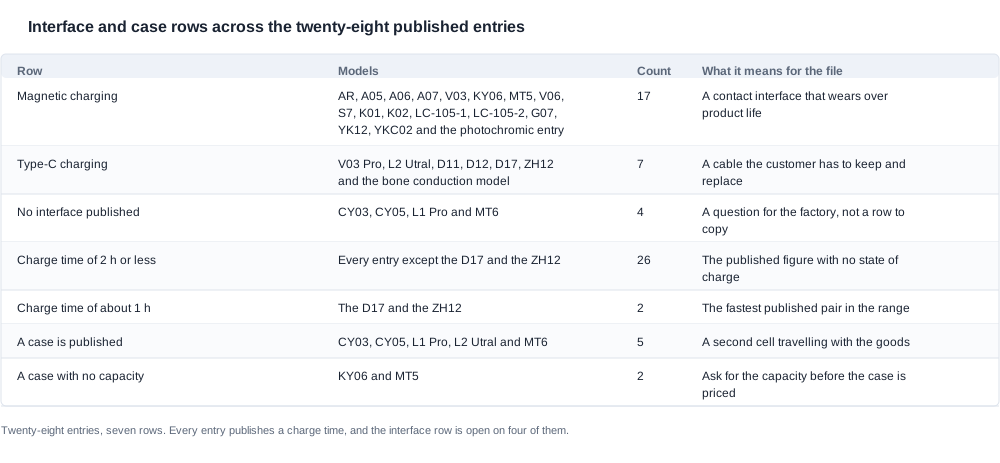
Seventeen of the twenty-eight catalogue entries charge magnetically. The seven that charge over Type-C are the V03 Pro, the L2 Utral, the D11, the D12, the D17, the ZH12 and the bone conduction model. The remaining four, the L1 Pro and the CY05, and the CY03 and the MT6, publish a case capacity and no charging interface, so for those four the interface is a question to put to the factory rather than a row to read off.
The interface row is the one charging decision that is fixed before any commercial conversation, because it is a property of the device. Everything else in this checklist sits downstream of it: what goes in the box, what the customer has to keep, what the returns path has to accept, and how long a device is out of service between charges.
Seven models charge over Type-C and seventeen use magnetic contacts
The seven Type-C models span the range in a way that is worth noticing, because they cut across the product families. The V03 Pro is a camera platform with photochromic lenses and a flexible temple. The L2 Utral is a camera platform with a published 13 MP sensor and two case configurations. The D11 and the D12 are audio platforms on 100 mAh cells. The D17 and the ZH12 are sport platforms, and they are the two models that publish the fastest charge time in the catalogue at about one hour. The bone conduction model is a 200 mAh platform with a stated amplification gain.
The seventeen magnetic entries are the AR glasses, the two children's models on 40 mAh cells, the 70 mAh children's audio model, the five magnetic camera platforms — the S7 and the MT5, the V06 and the V03, and the KY06 — the two-cell audio platforms at 55 mAh and 90 mAh, the YKC02 sport model and the photochromic model.
For the procurement file this means one practical thing: the interface is not a family attribute and cannot be assumed from the family name. A buyer building a charging kit for a range needs the interface row for every model in it, because the same product family contains both arrangements. The rows are in the table above and they can be read straight off it.
What the interface row decides downstream
The interface is a hardware fact, but it sets the terms of four commercial decisions that follow it, and a buyer who treats it as a technical detail ends up making all four decisions by accident.
It sets what goes in the box. A Type-C platform needs a cable in the carton, and the cable then becomes a specifiable item with a gauge, a length and a connector. A magnetic platform needs no cable, which is cheaper and simpler, and it puts a consumable into the customer's hands instead of into the buyer's cost.
It sets what the customer has to keep. A Type-C platform depends on a cable the customer may not have, may have lost, or may be carrying a poor version of. That is a support question and, in some markets, it is a recurring cost that the customer did not sign up for.
It sets what the returns route accepts. A device returned with a failed magnetic contact and a device returned with a failed port are two different diagnostic paths, and the after-sales process needs to know which one it is handling. The interface row belongs in the after-sales instruction, not only in the product specification.
It sets what happens across regions. A magnetic interface is universal; a Type-C device shipped into a market where the local mains supply differs does not change, but a device sold without a supply has to work with whatever the customer already owns. Where a brand sells the same platform into several markets with different accessory ecosystems, that difference is worth more attention than the interface itself.
The case rows and what a case obliges you to
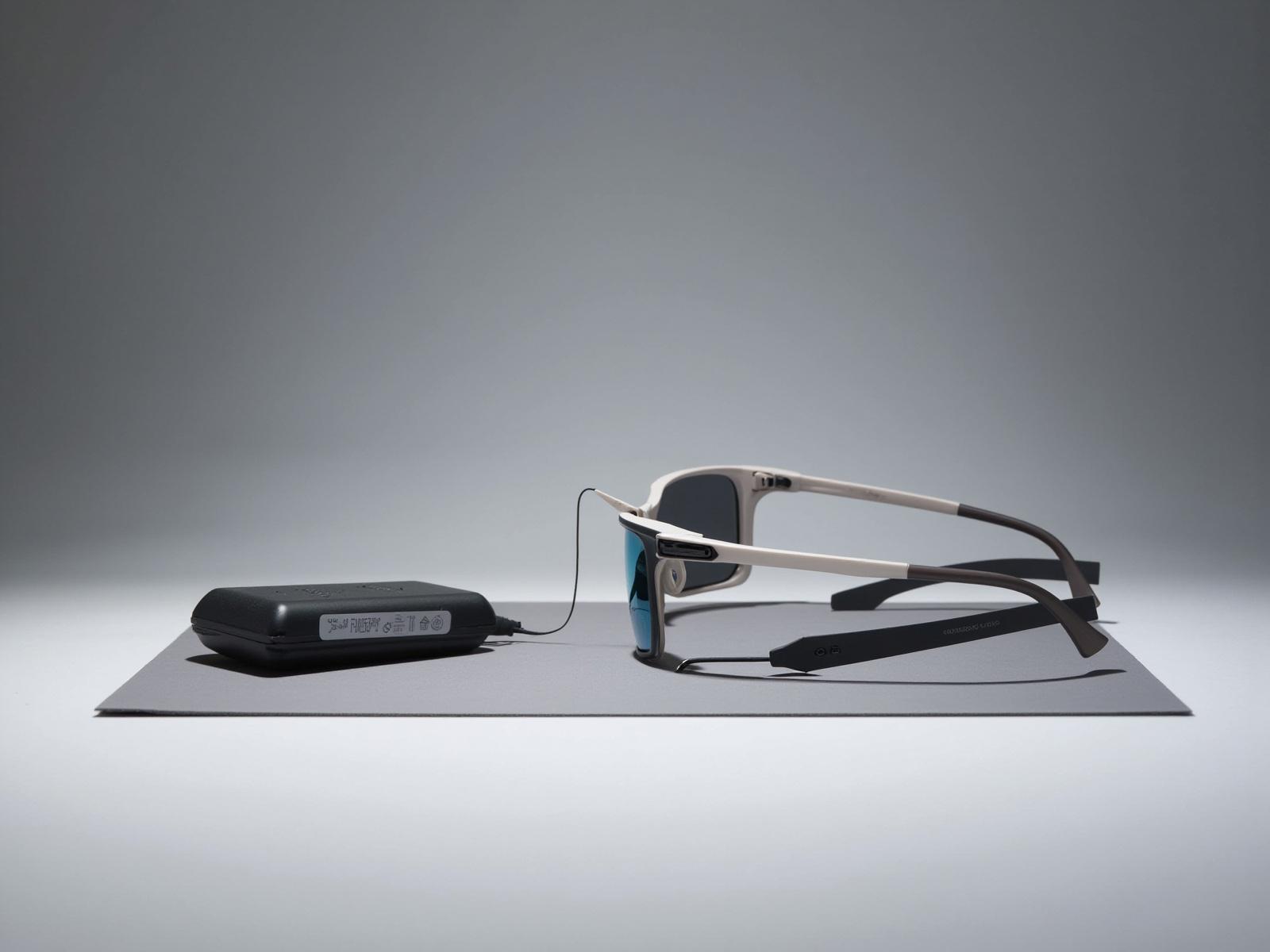
A case is not an accessory in the sense that a pouch is an accessory. Where a case is supplied, it contains a cell of its own, and the presence of that cell changes four things at once: the transport documentation for the consignment, the packing list, the warranty position and the returns route.
The two cases with no published capacity
Seven camera platforms in our range ship a case. Five publish its capacity, and two do not.
The published ones are the L1 Pro and the CY05, and the CY03 — each at 1400 mAh, the L2 Utral at 900 or 1400 mAh depending on which configuration is ordered, and the MT6 at a foldable 1200 mAh. The two that do not are the KY06 and the MT5, both of which are described with a charging case and a magnetic interface but publish no capacity for it.
Those two are the first item on the charging request list, for three reasons that compound. A case with no published capacity cannot be priced accurately, because the bill of materials depends on what is inside it. It cannot be declared for transport, because a declaration needs a figure. And it cannot be described on a packing list or on a product page, because the buyer would be publishing a number the catalogue does not carry.
The L2 Utral needs one extra line of its own, because it has two published configurations rather than one. A buyer ordering that platform has to decide which case configuration is being ordered and record it, because the two will sit differently in the carton, will carry different labels and will be difficult to tell apart at goods-in.
The case and the packing decision
A case changes the carton, and the carton is where a charging decision becomes a cost.
A device with a case ships in a box that has to hold two objects rather than one, and the case is usually the larger of them, which means the device sits in a void and the protective material doubles. It also means the case can arrive damaged independently of the device, and a damaged case in an undamaged carton is a return the customer has to initiate rather than a transit claim the buyer can make, because the buyer has to decide which of the two items is at fault before either is returned.
Three packing decisions follow, and they are worth making explicitly. Does the case travel in the same carton as the device, or in its own? One carton is cheaper and protects both; two cartons make the transit claim separable but double the freight handling. Is the case held in place, or does it move in transit? A case that moves is a case that arrives with a contact interface that has been knocked against something. Is the case labelled separately? If a customer returns a device and the case is in the same carton, the case comes back too; if it is labelled separately and the customer returns only the device, the buyer has no case and no way to test the charging path that failed.
None of this is visible in the case capacity row, which is why the case belongs in the packing decision as well as in the bill of materials.
The timing rows, and what is missing from every one of them
The timing rows are the most complete part of the published charging data and the most misused part of it. Twenty-six entries publish two hours or less. The D17 and the ZH12 publish about one hour. Those two are the only entries in the catalogue with a charge time below two hours, and they are Type-C models on 115 mAh and 100 mAh cells respectively.
What none of the twenty-eight publishes is the starting state of charge, and what none of them publishes is the point at which a charge is judged complete. That combination has three consequences a buyer has to plan around.
The figures cannot be compared with each other. Two hours or less from one starting point and two hours or less from another are not the same measurement, and neither is two hours or less measured from a full battery as opposed to a flat one.
The figures cannot be turned into an interruption time. A buyer planning a shift rotation needs to know how long a device is out of service while it charges, and that number is the published charge time only if the start state is known and if the "finished" point is agreed. Neither is.
The figures say nothing about the case. Where the case is the primary charging path, the device's charge time is not the number that governs the rotation, and the case's own recharge time is not published for any model in the range.
There is one further timing row that is published and that gets used in the wrong place: the cell capacity. Capacity in milliamp-hours describes charge, not stored energy, because energy also depends on the cell's nominal voltage, and voltage is not published for any model in our range. Two entries rated at the same 100 mAh can hold materially different energy, and the difference shows up as a runtime difference that gets attributed to the software. Five entries in the catalogue are at 100 mAh — the AR glasses, the D11, the D12, the ZH12 and the photochromic model — and they do not all publish the same runtime, which is a useful illustration that the two rows are not interchangeable.

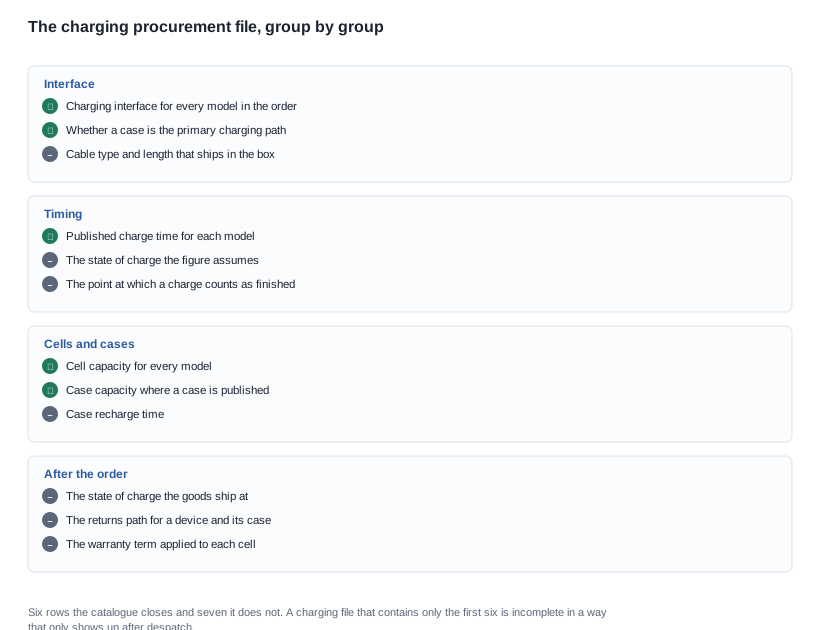
What to add to the procurement file

The flow above is the sequence, and it is deliberately short. The catalogue supplies the first two steps for every model, and the work a buyer has to do is in the last four.
The four roles a charging row plays in a contract
Once the file is organised, the rows are used in four different places, and it is worth knowing which is which because they accept different levels of evidence.
The product specification accepts only published, unconditional rows. The interface and the cell capacity belong here, and the charge time belongs here only if the condition travels with it.
The acceptance criteria accepts a method rather than a figure. The starting state, the source, the cable and the completion point form the method, and a supplier that has agreed to a method has agreed to be measured.
The listing copy accepts a figure with a condition attached and nothing else. A charge time quoted without a condition is a promise the buyer cannot keep, and it is the row most likely to be copied into a page by somebody who did not read the condition.
The after-sales instruction accepts a behaviour rather than a number. What to do with a returned device, whether to charge it on arrival, and how long it may wait are all process decisions rather than specifications, and none of them belongs on a product page.
A row that is used in all four places at once — the charge time is the usual one — needs to be the strongest row in the file, because it carries the most exposure. That is the argument for requesting its condition first.
How to file an answer so that it can be used later
A charging file that is a folder of documents becomes unusable within a year. The same file organised as one table per supplier stays usable indefinitely, and the difference is three columns.
The value. Obvious, and still the column most often left blank when an answer is "to be confirmed".
The condition. The starting state of charge, the source, the cable, the completion point, the temperature. An answer without its condition cannot be compared, and therefore cannot be used in an acceptance criterion or quoted on a product page.
The date and the source. Who said it, when, and against which document. Without this, a later question — a warranty claim, a second order, a market-access audit — turns into a fresh investigation.
The fourth column is worth adding even though it is not information: the consequence. What a buyer is allowed to do with the row, which is one of three things — publish it as a specification, use it internally for planning, or not use it at all. Writing the consequence down next to the value is what stops an unverified figure from being copied into a listing a year later, and it is a single word in a cell.
Which row answers which job in the programme
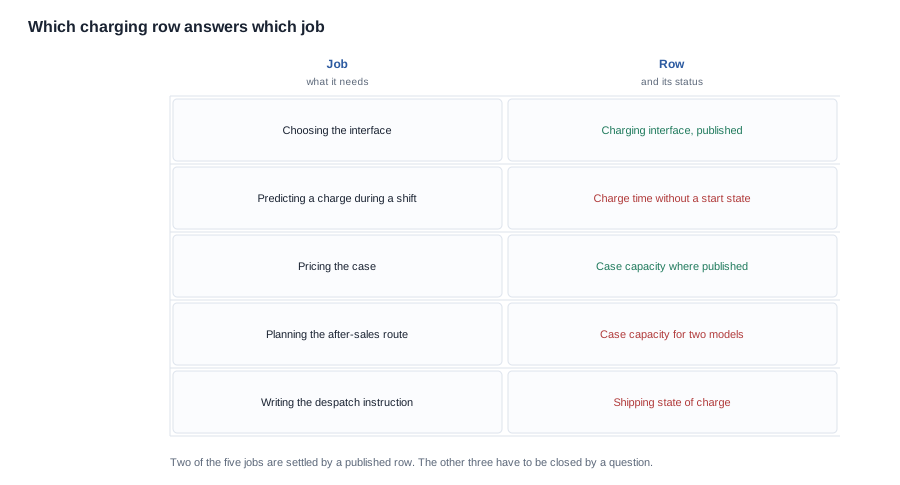
The matrix is a practical way to decide where to spend the effort. Only two of the five jobs are settled by a published row, and both of them are settled before any supplier conversation is needed.
Choosing the interface is answered by the published interface row, and it is answered completely. Pricing the case is answered by the published case capacity for the five platforms that carry one, and partially for the two that do not.
Predicting a charge during a shift is not answered by anything in the catalogue, because the published figure has no start state. Planning the after-sales route is not answered for the two camera platforms whose case capacity is unpublished. And writing the despatch instruction is not answered at all, because no shipping state of charge is published for any model.
That last one is the easiest to fix and the most commonly missed. A buyer who decides the shipping state of charge in the despatch instruction, rather than leaving it to the factory's default, has settled it for one shipment at a time. A buyer who puts it in the order has settled it for the programme.
The questions to request in writing
The request itself should be short enough to be answered and specific enough to be usable. Nine questions cover the charging file for any platform, and the wording matters more than the number.
- What is the charging interface for each model in the order? The starting point of the file, and the row the catalogue closes for twenty-four of the twenty-eight entries.
- What is the published charge time for each model, and from what starting state of charge? Both halves. The first without the second cannot be used.
- At what point is a charge judged complete, and how is that determined? A percentage, a current threshold or a time.
- What input current does the device accept, and what source was the published figure measured from? Without it, two charge times cannot be compared.
- For a platform that ships a case, what is the case capacity and what is the case's own recharge time? Measured the same way as the device.
- What cable ships in the box — gauge, length, connector? All three, in writing, so the packing list can state them.
- What contact cycle life is rated for a magnetic interface, and how is it verified? A number and a method.
- What state of charge are the goods despatched at? A shipping instruction that belongs in the order.
- What does the returns route do with a device and a case returned separately? Because that is what happens, and a case returned alone cannot be diagnosed.
Ask all nine in one message, with a date, and identify the model on each line.
The answers come back into the file in the order the questions were asked, and the two that most often do not come back are the third and the fifth — the completion criterion and the case recharge time. Both are worth chasing on their own, because each one is the reason a charging figure in this catalogue cannot be used to plan a shift. A buyer who closes those two has turned a catalogue number into a number it can defend, and that is the whole value of the exercise. Nine questions in one message produce one answer per model in a comparable form; nine messages produce nine answers in nine forms and several weeks of elapsed time.
Here, we will publish the interface, the charge time and the case capacity exactly as the manufacturer states them, and we will not publish a cycle life, an input current or a charging efficiency figure we do not have. If you need those, ask for them in writing during evaluation rather than discovering the gap after your first shipment.
Tell us the models you are considering and the channel, and we will tell you which charging arrangements are in play and what each of them implies for your packaging and your returns path.
Related reading
- charging solutions and interfaces
- smart glasses battery life and power
- after-sales packaging for returns
Tell us the models and the channel and we will say which charging arrangements apply and what they mean for packaging.


