

A smart glasses factory audit done before a first order is mostly a sequence, not a checklist.
Checklists are useful afterwards, when a buyer knows what a failure resembles and wants a record of it. Before a first order the buyer does not yet know which items in the building are the ones that matter, and a long list of things to examine produces a long visit that produces no decision. The useful first audit answers four questions in one day, and the order of those four questions matters considerably more than the length of any list.
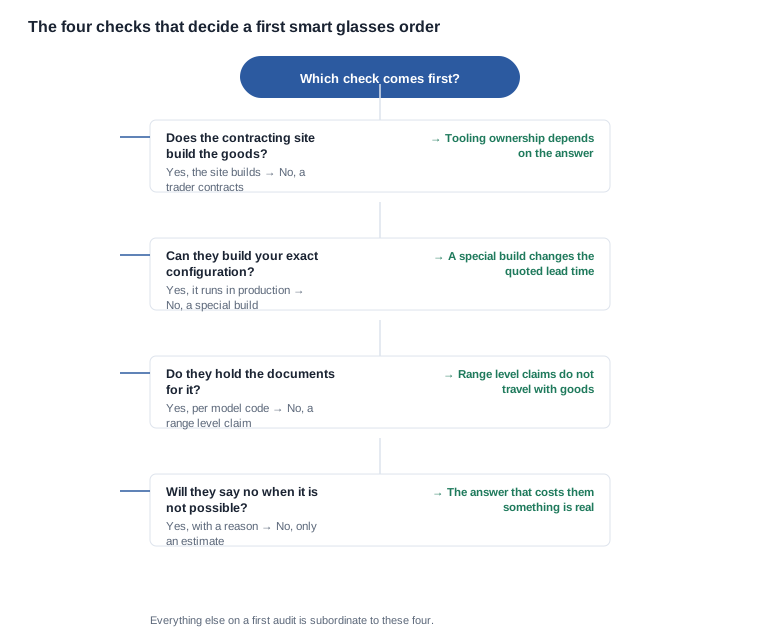
Those four questions are: is this the party that will actually build the goods, can they build the configuration you want, do they understand the documentation you need, and will they tell you when something is not possible. Everything else on a first visit is subordinate to those four, and a visit that spends its time on anything else has missed the point of being a first visit.
Smart glasses factory audit: a sequence, not a checklist
The two kinds of first audit
There are two first audits, and they have opposite objectives. A first audit before a first order is a selection test: the output is a decision to proceed or not to proceed, and the input is evidence about capability, structure and counterparty. A first audit after a first order, where the problem is that something went wrong, is a diagnostic test: the output is a cause, and the input is a symptom and a production history.
Mixing the two is the most common structural mistake. Diagnostic material dilutes a selection visit — a factory that is entirely capable can still have one failing component lot, and a buyer who arrives with a symptom gets a conversation about the symptom instead of a decision about the supplier. Selection material dilutes a diagnostic visit, because a well-documented factory is not thereby a factory without a problem.
The rest of this guide is about the first kind, the one that happens before the first order, because that is the audit that most often gets run and least often gets planned.
Why the four questions come in this order
The sequence is not arbitrary, and each question depends on the answer to the one before it.
The identity question comes first because it determines who owns the tooling and who carries the compliance obligation, and both of those are needed to write the purchase order. If the contracting entity turns out not to be the producing entity, the shape of the contract changes, and it is cheaper to learn that before signing than after the tooling has been paid for.
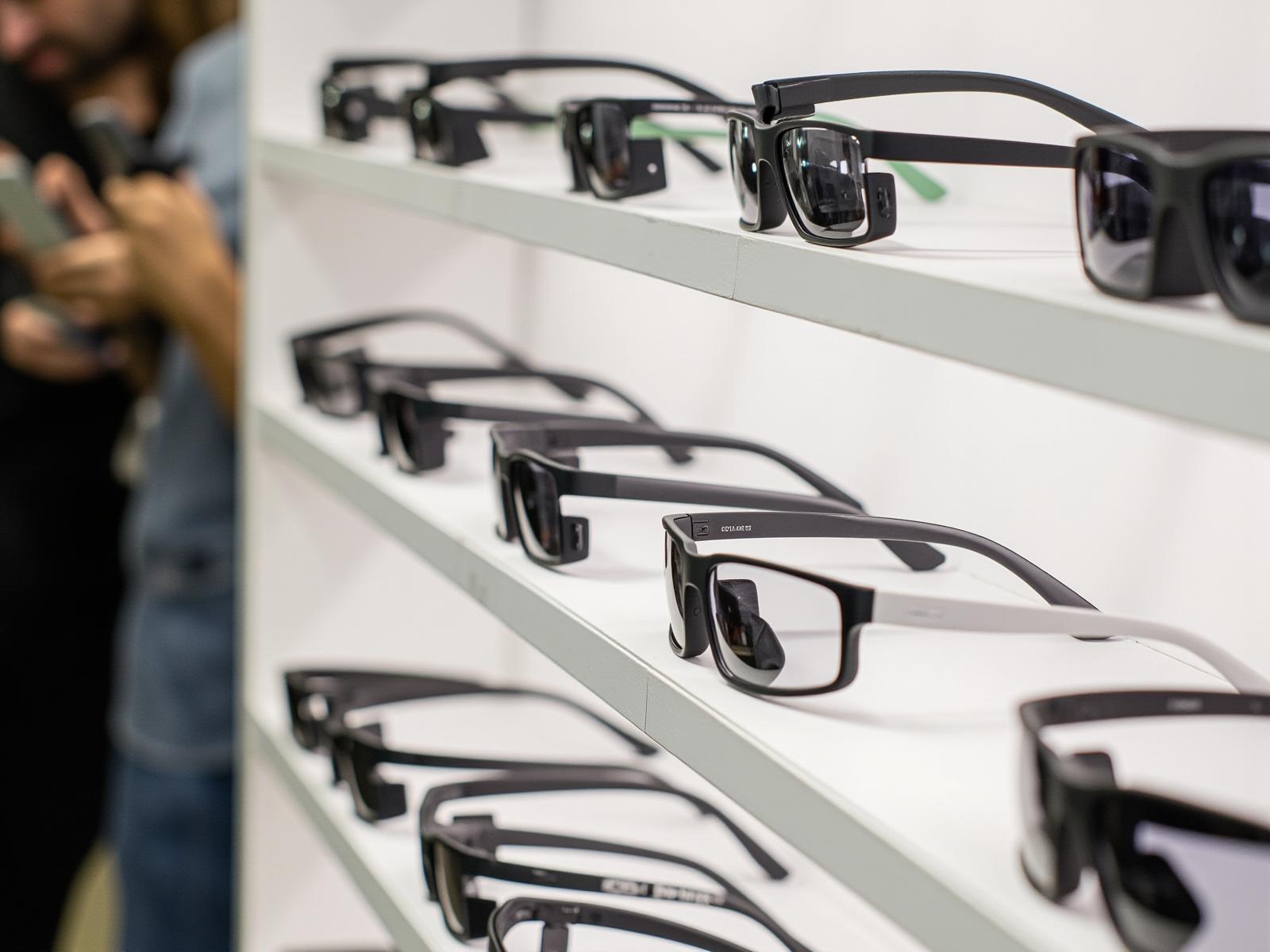
The configuration question comes second because it determines whether the programme you are planning is a programme they run or a programme they would have to develop. The published range is a good test here, because the configurations are specific rather than generic: the L2 Utral is published with either a 900 mAh or a 1400 mAh charging case; L1 Pro and the CY03, and CY05 are published with a 1400 mAh case; the MT6 is published with a 1200 mAh folding case; the V03 Pro has no charging case in the published rows at all; and the KY06 and MT5 are published with a case whose capacity is not stated.
The documentation question comes third because it is the one that decides whether goods can move at the destination, and because it is the question with the clearest pass-and-fail structure. A factory that answers it concretely is a factory that will handle your compliance file. A factory that answers it in general terms has told you what you need to know.
The honesty question comes fourth for a reason that has nothing to do with trust. It cannot be faked, because it costs the factory something to answer it accurately. A supplier asked for a frame weight for a model where no weight is published, or for a camera field of view where no field of view is published, has to choose between inventing a number and saying that it cannot confirm one. The second answer is the expensive one, and that is exactly why it is the diagnostic one.
The four checks that decide a first smart glasses factory audit
First: is the production site the contracting site
Examine who signs the contract, who is named on the business licence, and who owns the tooling. A supplier that contracts through a trading entity while production sits at another site is a normal arrangement in this industry and a serious one to discover late.
The question is not whether a trading company is involved. It is whether you know. The distinctions that matter between the two are set out in the factory and trading company comparison, and the practical consequences are contractual: the tooling clause, the compliance responsibility, the entity named on the technical file, and the entity that receives a claim.
Second: can they build your configuration
The published range is the test, and the reason it works is that the configurations are specific. The published rows distinguish between models with a charging case and models without one, between case capacities of 900 mAh, 1200 mAh and 1400 mAh, between magnetic charging, Type C charging and four models whose charging method is not published at all — MT6 and CY03, and L1 Pro and CY05.
A factory that handles those combinations as standard production is a different proposition from one that treats them as a special request, and the difference shows up in how the question is answered, not in the answer itself. A factory working to standard configurations will have a route for them. A factory that treats each as special will quote it as special, and the price and the lead time will carry the cost of that.
Third: do they understand the documentation
Ask for a certificate that covers a named model code and see what happens. The published position in our own documentation is that certificate numbers, issuing bodies and validity dates are not available to us, because certification is held at company level, and that the IP54 marking appears on two models only, the V06 and the S7, as a catalogue marking without a published third-party report number.
So a good answer is specific: which documents exist, for which configurations, issued by whom, valid until when, and where the file is held. A weak answer is a range-level assurance. Both of those are answers, and the difference between them is the entire point of asking.
Fourth: will they say no when it is not possible
This is the check that cannot be faked, because an honest answer costs the supplier something. Ask for something genuinely uncertain — a frame weight for a model where none is published, a camera field of view, a certificate number — and watch whether the reply is a number or a sentence about what they can and cannot confirm.
A supplier that answers this well is telling you something about every future conversation you will have with them. It is also the check most likely to be skipped, because it is awkward, and because buyers tend to ask the questions they already know the answer to.
The question behind all four
There is a fifth question that the four checks are really asking, and stating it makes the whole sequence easier to run. The question is: is the person in front of me going to tell me when something goes wrong?
Everything else — who builds the goods, whether they can build the configuration, whether they hold the documents — is verifiable against something outside the factory. Identity is verified against a licence, configuration against a catalogue, documentation against a file. The fifth question cannot be verified against anything, and it is the only one that predicts how the next eighteen months will go.
That is why it sits last. If it is asked first, it is a strange question with no context. If it is asked fourth, after three answers that establish competence and honesty so far, it is a natural extension of the conversation, and the answer carries much more weight.
The rest of the day: what to examine on a first smart glasses factory audit
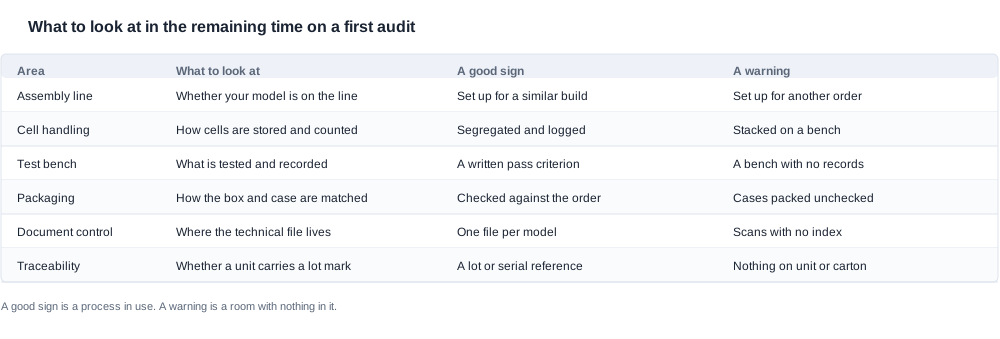
Once the four questions have been answered, the remaining time is best spent on stations rather than on areas. The table below is a way to spend about three hours, and each row names what to examine, what a good sign resembles, and what a warning resembles.
Two of those rows carry more weight than the others, and it is worth saying why.
The test bench row is the one most often skipped, because a test bench is not visually interesting. It is also the only station on the list that answers the question a buyer actually cares about at the end of the day, which is whether the published numbers can be produced by the people in the building. A written test with a pass criterion tells you that a procedure exists. A test demonstrated on a unit tells you that the procedure runs.
The traceability row is the one with the longest tail. Whether a unit can be traced to a component batch does not matter on the day of the audit. It matters the first time something goes wrong in production, which may be nine months later, and at that point it is the difference between a diagnosable pattern and a series of unrelated complaints that cannot be attributed to anything.
The four things not worth the time
There is a short list of audit activities that consume time and produce nothing, and it is worth naming because all of them are requested by someone at some point:
- Photographing the floor. Tidy is achievable for a visit and says nothing about process.
- Asking for headcount or floor area. Neither is published in this category, and neither tells you whether the stage that limits output can scale.
- Asking for a defect rate or a yield figure. It depends on counting rules that nobody shares, and it is the number most likely to be presented without a basis.
- Asking for the photographs on the supplier website. They show the product, not the process.
The common feature of all four is that they produce a number or an impression that cannot be traced to anything the buyer can check later.
There is also one activity that is worth doing and is often skipped, because it feels redundant when the specification sheet is already in hand. Compare the specification sheet against the published catalogue, line by line, with the model codes in front of you. The reason is that the two documents are produced by different people at different times, and where they disagree you have found something. Most often the disagreement is a designation, a case option or a charging method that was added to one document and not the other — which is precisely the class of discrepancy that turns into a mis-shipped order rather than a delay.
What to write down during a first smart glasses factory audit
A buyer who leaves a factory with a page of observations makes a better decision than one with a folder of photographs, and the difference costs nothing.
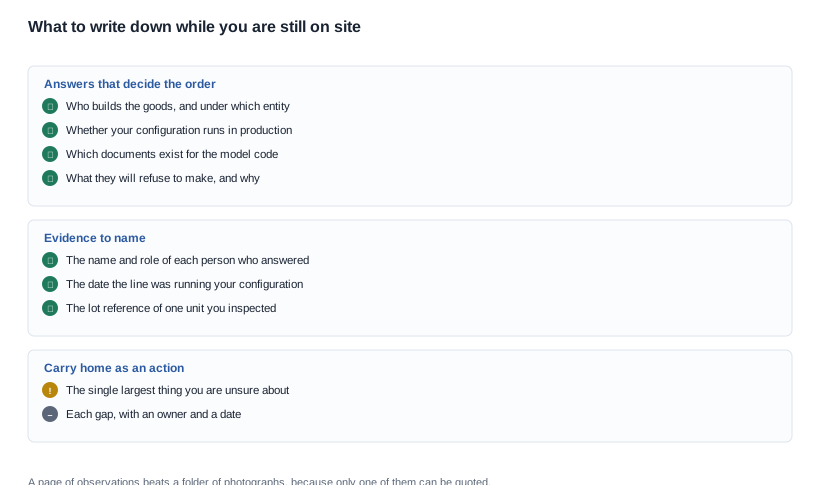
The three categories in that list are the minimum, and each one does a different job. The answers that decide the order are what you will quote when someone asks why you proceeded. The evidence to name is what allows a colleague to repeat the check without you. The carry-home actions are what stop the visit from being an event rather than a change.
Write them in the order you will need them later. The answers that decide the order come first because they are the ones that get repeated in a purchase order and in a review meeting. The evidence to name comes second because it is what turns a recollection into a checkable fact. The actions come last because they are what you will be chasing in six weeks, and writing them while the names and dates are still in front of you is the difference between a specific item and a vague one.
It also helps to record what the line was doing at the moment you were there, with the date. A factory's visible state changes, and the dated record is what lets you compare what you were told in the sales conversation with what you were shown on the day. This matters more than it sounds, because the most common finding in a first audit is not a failure but a difference between the two.
Turning what you wrote into contract language
Each open item is worth converting into a line before the purchase order, and the conversion is mechanical. An open item that is about the build becomes a configuration string with a revision. An open item that is about the documents becomes a line in the document handover list. An open item that is about the process becomes an acceptance criterion with a method. An open item that is about timing becomes a milestone with a condition attached.
The reason to do this while the visit is still fresh is that an open item without an owner and a date tends to disappear, and a disappeared open item tends to reappear as a returns problem.
The five conversations to have in the first hour
The four checks happen in the first hour or they do not happen at all, because everything after them depends on the answers. The order below is the one that produces them most reliably:
- Start with the business licence and the payment account. Two documents, one minute, and it establishes the entity before anyone has had time to prepare a story.
- Ask what is on the line right now. A concrete, present-tense question that any factory can answer and that nobody can bluff.
- Ask which model codes they build that are not in your quotation. The list reveals the real production mix, which tells you whether your configuration is routine or a guest.
- Ask which documents exist for your model code, specifically. The question that separates a file from a brochure, and it is much harder to give a general answer to when it is asked early.
- Ask for something they cannot confirm. Frame weight, field of view, a certificate number — anything genuinely unpublished. This is the fourth check, and it works best when the factory has not yet had time to construct an answer.
Everything else — the floor, the bench, the paperwork, the despatch area — is supporting evidence for the answers to those five. If the morning has gone well, the rest of the day is confirmation. If it has gone badly, the rest of the day is probably better spent on the telephone than in the building.

The questions that a first smart glasses factory audit cannot answer
Three limits worth stating before you book the trip
The first is product performance. A well-run factory can still ship goods with poor endurance, because endurance depends on test conditions the audit did not witness, and the published endurance figures in this category carry no test condition. Our camera models are published at roughly five to eight hours or around seven hours depending on the model, and in every case that is a rated use figure rather than a measured result under a stated load.
The second is market acceptance of the documentation. A factory can hold a complete technical file and still have a gap that the destination authority treats differently. The audit confirms that a file exists and that a person owns it; it cannot confirm the determination made at the border.
The third is the journey. Packing, freight and handling are outside the factory entirely, and they are where a surprising proportion of damage claims originate.
What to do with the questions the audit leaves open
The remaining questions should be routed to the instrument that can actually settle them. A question about how the product behaves belongs to a sample and a written method. A question about what documents exist belongs to the document set, and can be answered by email. A question about whether the goods will travel belongs to the packaging specification and the carrier's requirements.
The factory audit checklist carries the full item list for the visit, and the sample verification guide is where the configuration questions get answered in practice, which is usually where they should have been answered from the start.
What we will show you during a first smart glasses factory audit
Here, a first audit should be judged on the four questions rather than on the length of any checklist, and the most informative moment of the visit is the one where the factory is asked for something it cannot immediately supply.
We publish our own gaps openly. The unit weight is not published for any model except the MT6 glasses body at 158 g, which includes its 265 mAh cell and its camera and excludes its 1200 mAh folding charging case, whose own weight is not published. Camera specifications beyond the resolution tier are not published for any of the eleven camera models. Acoustic measurements are not published across the range. Ingress test report numbers behind the IP54 marking on the V06 and the S7 are not published. Certificate numbers, issuing bodies and validity dates are not published, because certification is held at company level.
We will also say that a factory audit is a snapshot and a supplier verification is a relationship, and that neither replaces the sample. A first audit that ends with a clear answer on the fourth question has done its job, and a first order placed after that answer is a better decision than a first order placed after a tour.
If you would rather not travel for a first order, say so and we will tell you which of the four questions can be answered from documents alone, and which genuinely requires somebody to stand on the floor. That is a more useful answer than an invitation to visit, and it costs nothing to ask.


