A smart glasses factory audit is a documentary exercise before it is a physical one, and the document set is where most of what a buyer needs to know actually lives. The right way to use it is not to collect files. It is to know which document settles which question, what that document has to name for it to settle anything, and when it goes stale.
The working rule is short: a document becomes evidence when it names something. A business licence that names the wrong entity settles the wrong question. A report number that resolves to a different model settles nothing. A traceability record that stops at the carton proves the carton is traceable.
That single test — does it name something, and does it name the thing you are buying — is what separates a supplier who has done the work from one who has described it. Everything below is an application of it.
Smart glasses factory audit: the buyer behind the request, and their fear
Three people send this request in a normal month. A brand-side procurement manager who has two quotations that look identical and needs to know which one is a quotation and which one is an estimate. A channel buyer who has received a returns cluster and cannot find a cause in anything the supplier told them. And an importer whose customer has asked for evidence of the product they are about to list, and who has discovered the request is larger than the question sounded.
Underneath the three requests is one fear, and it is never the price. It is that a shipment will arrive different from the approved sample, or that a document route will stop the goods at a border, or that the first consignment becomes a returns problem nobody priced. Each of those three is a document problem before it is a production problem, which is why the request below is worth sending before the sample rather than after it.
There is a second reason to send it early, and it is commercial rather than technical. The cost of a document gap discovered after a programme has launched is an order of magnitude higher than the cost of the question that would have found it, because at that stage the fix is a reprint, a re-list or a deduction from a payment, all of which land in the same quarter as the revenue. Before the order, the fix is an email.
The request, in the order that makes it work
Send it as a list rather than as a question, and send it to every supplier on the same day. The order matters, because the first three items cost nothing and rule out the largest share of the risk.
- The business licence of the entity that will sign the contract, with its registered name and scope.
- The document set behind the approvals for the exact model on the quotation.
- The configuration string the quotation prices, written out in full.
- The minimum order quantity, the lead time and the production capacity, each stated per model.
- The model list on every approval held, with the issuing body and the validity dates.
- A dated incoming inspection record for a batch you already hold, if one exists.
- The firmware version naming scheme, and who holds the version log.
- The tooling position for your build: who owns it, and over what volume it is amortised.
That is the whole request. It fits in two emails, and it is the same list for every supplier, which is what makes the answers comparable.

What the catalogue settles, and what only a document can settle
The single most useful thing about buying in this category is how much of the specification is already public. It changes what the document request should be about, because a buyer who asks for a battery capacity that is already published signals that they have not read the catalogue, and a supplier who answers that question signals that they will answer anything.
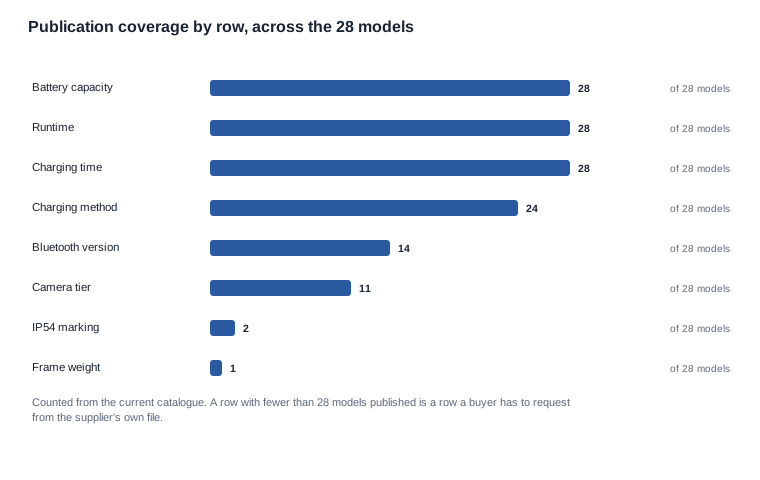
Read the chart as a request prioritisation tool. Four rows are published for all twenty-eight models: battery capacity, runtime, charging time, and — for twenty-four of them — the charging method. Those are not questions for the supplier. The charging method is missing for MT6 and L1 Pro, and CY05 and CY03, and for those four it becomes a specific, answerable question: how is this unit charged?
Bluetooth version is published for fourteen models, and the camera models are not among them, so for a camera order the radio version is a document question. The camera tier is published for the eleven camera models — eight at eight megapixels, three at thirteen — but the field of view, frame rate, video format and storage path are not published for any of them. The IP54 marking appears on the V06 and the S7 only, and it is an annotation rather than a report number. The unit weight is published for exactly one model in the whole range, the MT6 at 158 g for the glasses unit excluding its foldable charging case.
So the document request in this category has a short list of high-value items and a long list of things nobody publishes. The commercially decisive layer — prices, minimum order quantities, lead times, capacity — is entirely unpublished, and that is exactly where the document request earns its place.
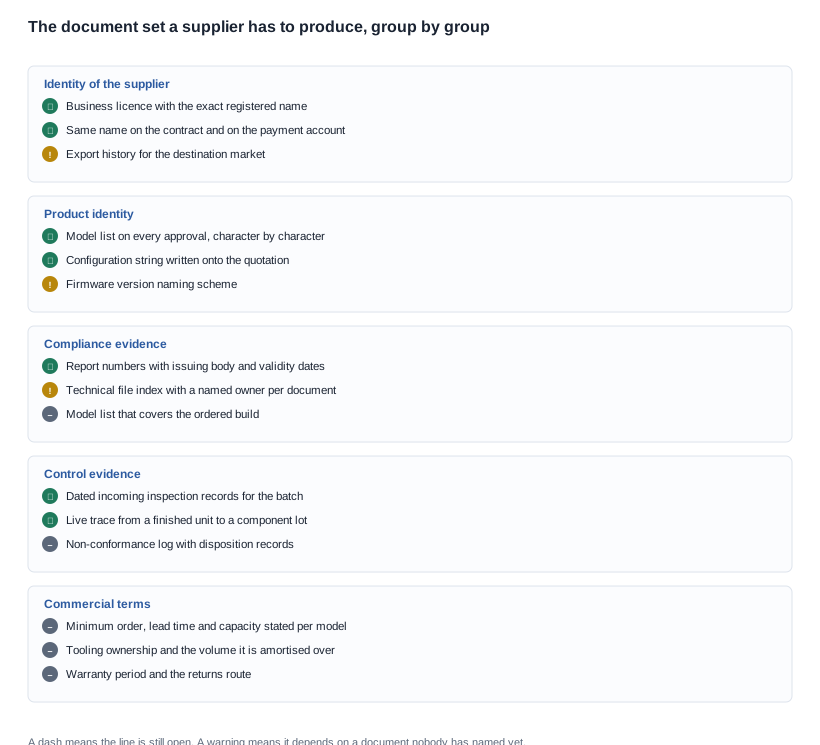
The five groups and what each one has to name
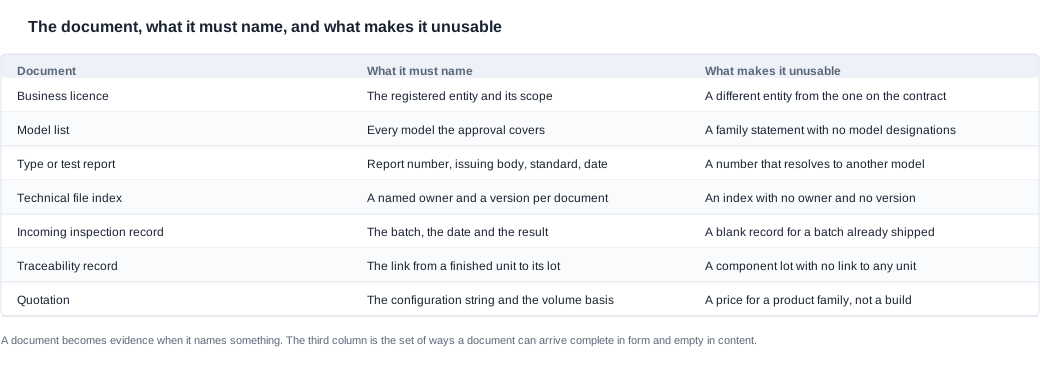
The table above is the usable version of the request. Each row has three parts: the document, the thing it has to name for it to settle anything, and the specific way it arrives complete in form and empty in content.
The five groups, and why each one is separate:
Identity. The business licence, the export history, and the entity on the payment account. A trading company presenting a manufacturer's licence is the most common finding in this category, and it is not automatically disqualifying. What it changes is the contract: who owns the tooling, who carries the warranty, and who is the party your customer can sue.
Product identity. The configuration string, the model list on each approval, and the firmware version naming scheme. These three together answer the question "is this the unit I approved". They are the documents that stop a substitution, and they are cheap to check and expensive to discover late.
Compliance evidence. Report numbers with the issuing body and the validity dates, the technical file index with a named owner, and a model list that covers the build you have ordered rather than a neighbouring one. Note the European framing if you buy into that market: the radio directive is (EU) 2014/53/EU, and the electromagnetic compatibility directive is 2014/32/EU. They are different instruments and a supplier who blends them has not read either.
Control evidence. The dated incoming inspection records, a live trace from a finished unit back to a component lot, and the non-conformance log with its dispositions. This is the group that turns a photograph of a production line into a statement about repeatability.
Commercial terms. Minimum order, lead time, capacity, tooling ownership and warranty route. These are the terms that decide the programme, and they are the group most often left to a verbal assurance that later cannot be evidenced.
How a document becomes evidence you can file
The failure in most document sets is not that a file is missing. It is that a file arrives, looks complete, and names nothing that can be checked. The seven steps below are what turn a pile of documents into a filed position you can defend later.

Step one: ask by name, with the model and the market on the request. "Send us your certificates" produces a folder. "Send us the report number, issuing body, standard and validity date for the approval covering model X for the European market" produces one usable line. The model and the market on the request is what removes the family-level answer that names a product range instead of your product.
Step two: read the model designation before anything else. This sounds trivial and is the single highest-yield minute in the whole review. Compare the designation on the document with the designation on your purchase order, character by character. A06 and A07 differ by one character. L1 Pro and L2 Utral differ by one word. MT5 and MT6 differ by one digit. In a range with these naming patterns, a family-level document is very likely to be close enough to pass a glance and wrong enough to fail a shipment.
Step three: establish the condition the document was issued under. A rating or an approval attaches to a configuration, not to a product name. What ports, contacts, interfaces and variants were present when the sample was tested? The answer tells you whether the document covers the unit in your packaging or something next to it.
Step four: file it against the order. Not against an email thread, not in a shared drive with no naming rule. A document that is filed against an order can be found at the moment you need it, which is usually the moment a customs broker asks.
Step five: set the date it goes stale. Every document has one. A report has a validity date. A licence has an issue date and a registered scope. A technical file has a version. A calibration record has a check date. A document with no date is not a document; it is a claim.
Step six: decide what triggers a re-issue. A change of seal, port, contact, interface, sub-supplier or firmware branch can invalidate a document without anybody noticing, because the change is usually made to solve a production problem rather than to preserve paperwork. The trigger has to be written down before the change, not after it.
Step seven: write the acceptance term into the purchase order while it is still cheap to change. A criterion in an email is not binding. A criterion in the purchase order is an acceptance standard, and a lot that fails it is a lot you can refuse.
Who owns each document in the chain
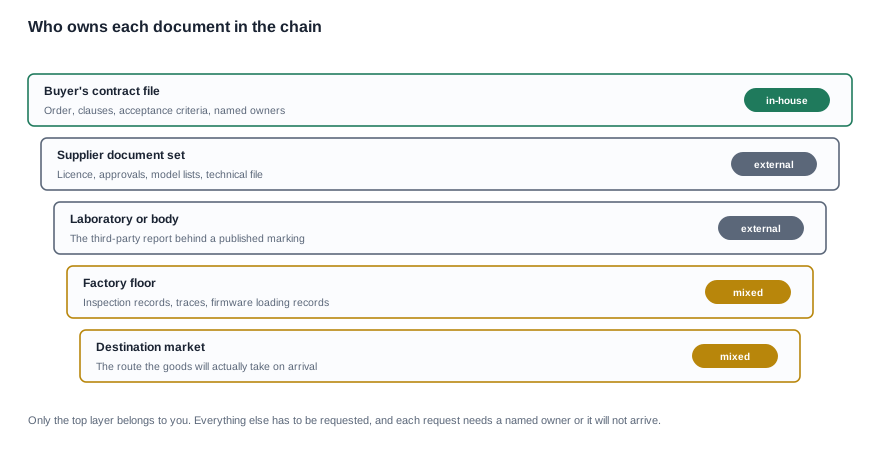
The chain in that diagram is worth reading for the top row. Only your contract file is genuinely yours. The supplier's document set, the third-party report and the factory floor records all have to be requested, and the practical failure mode is not refusal — it is that nobody asked, and the request has no owner, so it is never chased.
For each of the five groups in the checklist, name one person in your own organisation who will chase it and one date by which it has to arrive. That single line of administration does more for a programme than a larger document set with no owners.

The failure modes a document set hides
Four ways a supplier can produce a complete-looking file set that supports nothing.
The family document presented as coverage. The document names a product family or a configuration range rather than the model you ordered. The symptom is a customs query, a marketplace rejection or a warranty claim that cannot be settled. The root cause is that the request did not name the model. The prevention is in step one of the request list, and it costs one clause.
The manual link in the traceability chain. Component lots are recorded and finished units are recorded, and the link between the two is a person with a memory. The symptom is a quality claim you cannot answer, because nobody can say which lot went into which unit. The root cause is that the trace was demonstrated by description rather than performed live.
The report number that resolves to another model. This one is subtle because the number itself is real, the issuing body is real and the standard is right. The model designation on the document is the variant. The prevention is the character-by-character comparison, which takes two minutes and catches this every time.
The calibration record for the instruments that matter. Most instruments in a small assembly operation have a calibration status. The ones on the critical measurement path are a subset. A supplier showing you all of them has shown you nothing; a supplier naming the two that decide whether your unit passes has shown you the control.
There is a fifth that is not a document failure but a commercial one, and it is worth naming because it is expensive: the document set arrives, it is complete, and it covers a configuration you are not ordering. The prevention is to fix the configuration string in the purchase order before the document request goes out, not after the documents arrive.

Sequencing the request against the order, so nothing arrives too late
A document set can be complete and still arrive at the wrong moment. The failure this prevents is not a missing document; it is a document that arrives after the decision it should have informed has already been made and paid for. Four deadlines matter, and they are not the same deadline.
Before the deposit: identity and the commercial frame. The business licence, the entity on the payment account, the minimum order, the lead time and the capacity figure. These four are the ones that can still stop the programme cheaply, because a deposit is the point at which the money becomes unrecoverable. If a supplier will not state capacity per model, or will not say whether the minimum order applies per model, per colour or per order, that is a fact about the relationship and it is better to learn it here.
Before the sample order: the configuration string and the model list. The sample is the instrument that closes the product gaps, and it is worthless if it is built to a configuration you did not write down. This is the cheapest place in the whole sequence to catch a configuration mismatch, because a sample is a few hundred units and a production run is not.
Before artwork approval: every approval that constrains what can be printed. This is the deadline most programmes miss. The IP54 marking on the V06 and the S7 is an annotation without a published report number behind it, which means a printed claim about it is a claim you cannot currently evidence. If your artwork says something the document set does not support, the correction is a reprint of every piece, and a reprint lands in the same quarter as the launch.
Before shipment: the control evidence. Dated incoming inspection records for the batch, the live trace from a finished unit to its component lot, and the non-conformance log. These are the documents that settle a warranty claim later, and asking for them before the goods leave is what gives you standing to ask.
The order of those four deadlines is not a formality. Move any of them later and the cost of the same discovery rises sharply: a configuration mismatch found after artwork approval becomes a reprint; a capacity figure found to be an aspiration after the deposit becomes a negotiation with no leverage; a traceability gap found after shipment becomes a claim you have to argue rather than a lot you can refuse.
Two practical rules follow. First, put the whole request out at once, in a single list, rather than drip-feeding it across the four deadlines — a supplier who receives eight items in one message treats it as a process, and a supplier who receives them one at a time treats each as a negotiation. Second, decide before you send which of the eight items you would walk away over. A request with no stated stopping point produces a long conversation with no decision.
Turning the request into terms, and where we draw our line
This is a hypothetical sequence rather than a client project, and it is here to show the request working, not to report an outcome.
Assume an importer opening a first programme with two suppliers, ordering a camera model, into a European market. The importer sends the eight-item request to both on the same day.
The first reply arrives in two days with the licence, the model list and a report number. The importer reads the model designation on the report before anything else, and it does not match the model on the quotation: it names the variant with the foldable charging case rather than the unit without one. The four models where the charging method is not published — L1 Pro and MT6, and CY05 and CY03 — are precisely the models where a variant difference is easy to miss, because the case capacity is the thing that varies.
The second reply arrives after a week with a catalogue and a promise to follow up, and does not follow up. That difference is itself evidence: it is a statement about document control, obtained without a visit.
The first supplier's follow-up arrives on day four with the variant question answered: the approval covers the build without the case, and the case is a separate line with its own documentation. The importer now has a configuration string, and the document set matches it.
The commercial request in the same thread produces a different answer from each supplier. One states minimum order, lead time and capacity per model, with the capacity tied to a measured record. The other repeats the same figures for every model in the range, which is a strong hint that the figures describe the facility rather than the model. The importer does not need to prove anything at this stage; the comparison is enough to know which quotation is a quotation.
The clause follows. The purchase order now requires the report number and the exact model designation attached to the order, a notice obligation before any change of variant, port or interface, a live trace per lot, and the acceptance criteria from the sample. Each of those is a line, and each of them is cheaper to write now than to argue later.
The decisive moment was the model designation, and it took two minutes. Everything else in this sequence was administrative.
What we publish, and what we will not fill in
It is worth being precise: the published rows in our catalogue are the specification we can stand behind, and everything else is a question for the supplier's own file. We publish what our documentation states, we mark the rows that are open, and we will not fill an open row with a typical figure from a general data sheet. A buyer who builds a claim on an estimated number finds the error in the field rather than in the quotation, and the correction costs more than the question did.
What our published data does settle for this range is worth stating plainly. The cell population spans 40 mAh to 290 mAh in the devices and 900 mAh to 1400 mAh in the charging cases. Runtime is published for every model, and the charging tiers are published for twenty-four of the twenty-eight. Camera models divide into eight at eight megapixels and three at thirteen.
What we will not do is quote a document from a photograph, name a report number we have not been given, or present a marking as though it were a report. The catalogue's export certification line is a company-level capability, and it is not a per-model certification list, so we do not present it as one. The certification verification page is where the document-based route is set out, and the AI camera glasses range is where the camera configurations are listed.
What we will do is take a configuration, a quantity and a market and tell you which parts are settled, which are open, and which have to come from the supplier's own file. The sample evaluation route is where the physical gaps are closed, and the contract terms page is where the clauses above sit.
The three requests to make this week
Send the eight-item request as a list, to every supplier, on the same day. Same questions, same day, so the answers are comparable. A comparison only works between responses to the same request.
Read the model designation first, on every document that arrives. Two minutes per document, and it is the check that catches a substitution before the goods ship rather than after.
Give the request an owner and a date in your own file. The documents that arrive are the ones somebody was chasing. The factory audit pillar holds the wider framework, and this request is the first step inside it.
Related reading
Send the configuration, the quantity and the market, and we will say which parts of the document set are settled and which are yours.