
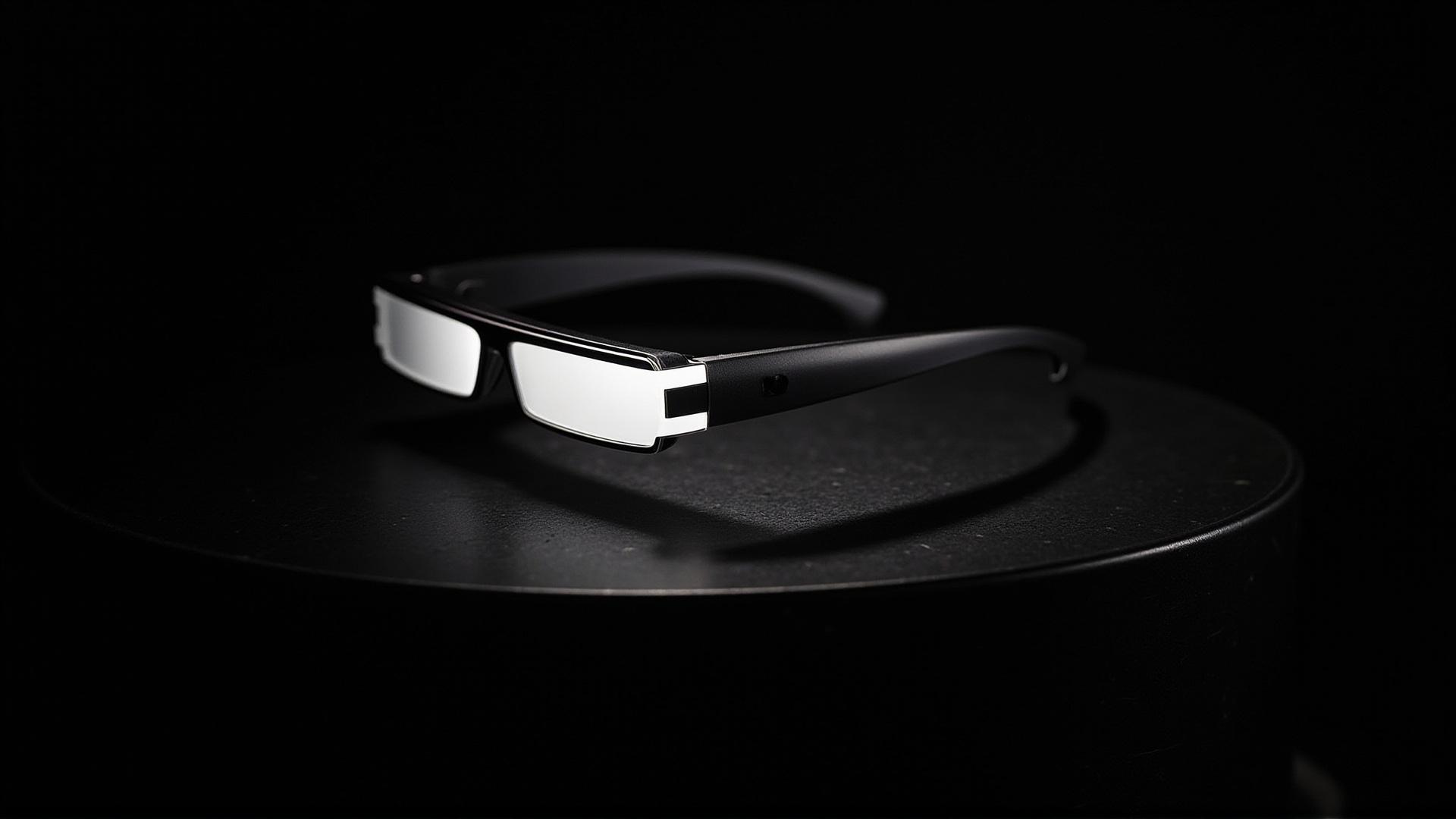
Certification support is the one area where a consumer electronics brand's existing compliance muscle is most likely to mislead it. A team that has spent years shipping earbuds, speakers and charging accessories knows how to manage supplier documentation, because for those products the supplier's file is usually the whole file. A pair of glasses is a different regulatory object. It has a radio, a lithium cell, a camera or a microphone, an optical element that touches skin, and in many cases a category of use — children's, sport, shooting, driving — that carries its own standards regime on top of the electronics ones. The frameworks that apply are not the ones a general consumer electronics practice was built around, and the difference shows up in the documentation the supplier hands over.
There is a second trap in this category, and it is a commercial one rather than a technical one. A brand that arrives at a supplier asking for "certification support" has not yet decided what it wants supported, and a supplier willing to answer that vague question will produce a vague answer: a folder of generic documents, a claim that everything is compliant, and a quotation with no scope attached. The useful version of the request is specific — these models, these configurations, these destination markets — and the useful version of the support is a handover that arrives with the goods rather than a promise to send something later.
This article sets out how to frame that request, what a manufacturer can genuinely carry on the brand's behalf, what stays with the brand no matter how cooperative the supplier is, and the two lists of questions that make the difference at quotation stage and internally.
One thing is worth saying at the top because it changes how the whole conversation should be run: certification support is not a cost line to be negotiated down, it is a scope line to be negotiated precisely. The trade-off in this category is not between paying more and paying less. It is between a programme where the documentation position is written down and one where it is assumed, and the second version always costs more, because it moves the cost from a quotation to a delay and from a delay to a re-order.
Smart glasses documentation: what actually arrives with the goods
Start with a blunt statement about our own published position, because it shapes everything else in this article. Our published catalogue carries no per-model certification row. There is no table anywhere on our product pages that maps a model to a radio authorisation number, a safety report or a chemical declaration, and there is no certification mark printed on a product page for any model in the range. Our export-certification page is a picture page: it shows ten patent certificate images, eight design patents and two utility models, and that is the complete published certification surface of the company.
That is a deliberate choice, and it has a defensible commercial logic behind it. A certification number is only meaningful when it is bound to a specific model, under a specific legal entity, at a specific date. Printed on a catalogue page, that number tends to outlive the fact it describes — the model gets revised, the entity changes, the certificate expires, and the page keeps asserting something no longer true. So we hold the documents and we hand them over, but we do not advertise numbers we cannot quote you directly.
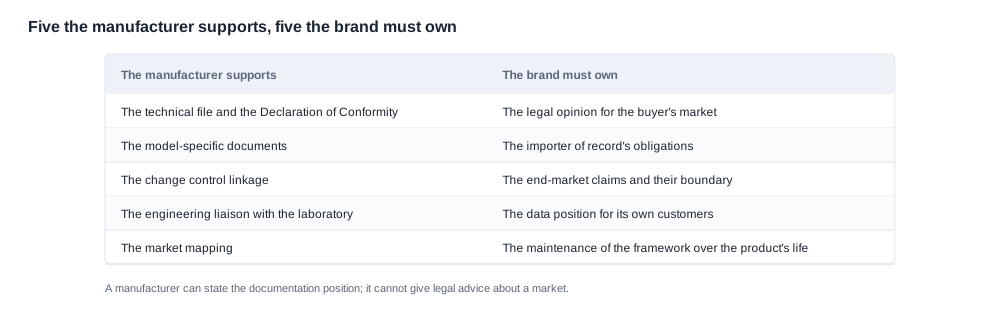
The practical consequence for a buyer is that the certification conversation starts as a document request rather than as a marketing claim, and that the documents a competent supplier should hand over are specific and identifiable. At minimum, for each model and configuration in the programme, a handover should contain:
- The regulatory documents for that exact model, not for the family and not for the predecessor. Model numbers on the documents have to be read rather than assumed.
- The conformity declaration for the ordered configuration, naming the configuration as built.
- The radio authorisation position, including which entity holds it and whether the marking appears on the device itself.
- The battery transport summary for the specific cell fitted to that model.
- The material and substance declarations covering the frame, coatings, adhesives, electronics and packaging.
- The test reports, with the configuration and the date on them, and with the standard named so you can compare them against what your customer has written into a contract.
- The Bluetooth qualification position, with the identifier and the entity, and with the question of who holds it answered rather than assumed.
Seven items per model. The reason to insist on per-model answers is structural: a document that names a family does not name your SKU, and a document that names a predecessor does not name your configuration. In our published range this is not a theoretical concern. Bluetooth version is published for 14 of 28 models; the 11 camera models, the A05 and A06 kids models and the bone conduction entry do not publish one. An IP rating is published on exactly two models, V06 and S7, both at IP54, and no test report number is published for either. Charging method is published for most models but not for CY05 and L1 Pro, and MT6 and CY03. A buyer who accepts a family-level answer will end up with a file that cannot answer for the specific model it needs.

Smart glasses work a manufacturer can carry
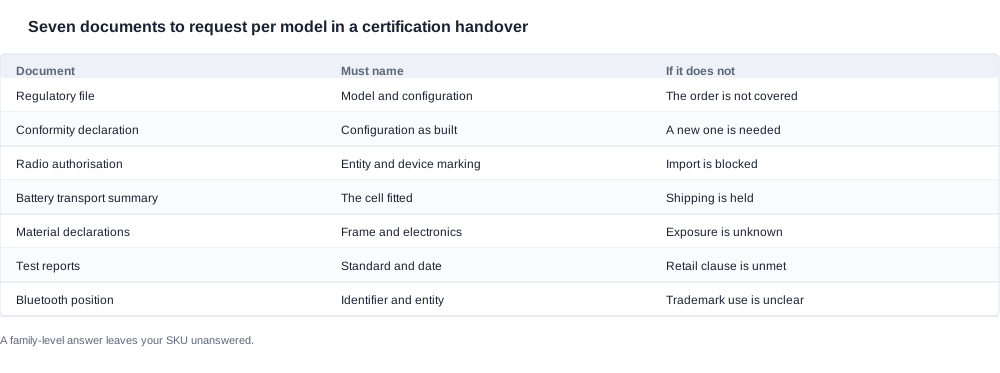
There is a body of work that genuinely reduces a brand's schedule and risk, and it belongs to the manufacturer because the manufacturer is the party that owns the product under test.
Interpreting the product to the test body. A laboratory asks detailed questions about a device it has never seen: what the antenna is, where the battery sits relative to it, how the enclosure is assembled, what firmware versions were flashed during the test. The manufacturer already has all of this in its engineering file. A brand that has to answer those questions through a supplier's account manager spends weeks relaying. A brand whose supplier's engineer answers them directly spends days.
Holding the change-control linkage. A configuration is only as compliant as the last change to it. A component substitution, a lens material change, a different charging method, a firmware branch, a supplier change on a hinge — each of these can move the file. A manufacturer that maintains a written procedure linking changes to a conformity review, and that tells the brand when a review was triggered, is doing something the brand cannot do for itself and cannot easily audit from outside.
Maintaining the model list. Documents cover models. When a brand adds a SKU, the question is whether that SKU is on the document or needs its own. Reading a model list accurately is unglamorous work and it is where a lot of programmes go wrong, because a supplier may reasonably assume that a closely related model inherits everything.
Running the sample and pre-test cycles. Testing happens on a sample, and the sample has to be the product. A manufacturer that produces units from the same line as production units, and that handles the test-house logistics, removes an entire category of argument about what was actually tested.
Mapping frameworks to destinations. The applicable route differs by market, and the divergences are real: the European Union runs on the radio equipment framework with harmonised standards, the United Kingdom operates a separate conformity framework that has to be tracked as it diverges, the United States splits between federal radio authorisation, state chemical law and contract-based retailer standards, and children's products sit in their own regime in both the European Union and the United States. Mapping that is factory work, because it depends on knowing which markets the factory has actually built documents for.
None of this is glamorous, and none of it is expensive relative to the alternative. It is, however, the part of certification support that a brand genuinely cannot substitute.
There is a specific argument for brands with genuine consumer electronics capability here, because they often assume the factory handles it and then discover the boundary. A brand that already manages supplier certification for a speaker knows how to read a declaration and how to ask a factory for a model list. What it does not know, until it asks, is that smart glasses add layers that speaker documentation does not contain: an optical element touching skin, a battery whose cells may differ between SKUs of the same housing, a firmware branch that interacts with the radio, and a category claim — sport, shooting, children — that pulls the product into a standards regime of its own. The capability transfers; the checklist does not. Treat the category-specific layers as new work rather than as covered by the existing practice.
Smart glasses work that stays with the brand
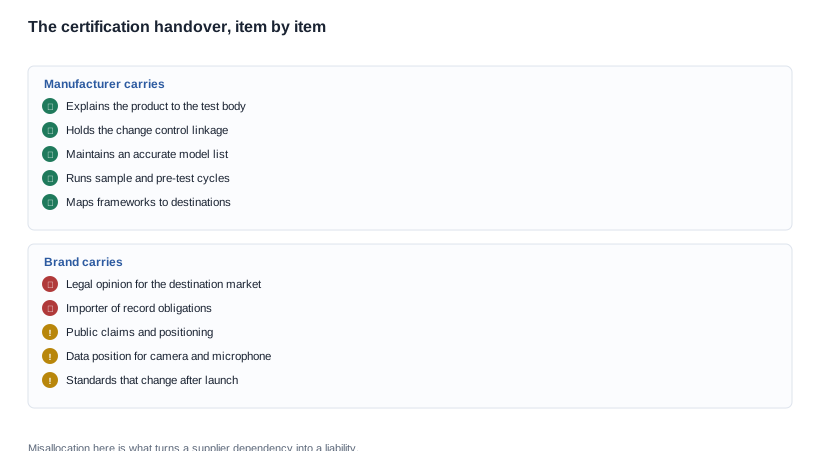
The mirror image matters more, because a brand that misallocates these five items ends up carrying liability it believed it had delegated.
The legal opinion. Whether a product may lawfully be sold in a market, and how it may be described there, is a question for the buyer's own legal function. A manufacturer can state its documentation position precisely; it cannot give legal advice about your market, and a supplier who offers to is overstepping. Ask instead for the factual basis: which entity holds which authorisation, which markets each document covers, and what the declared product is. Facts are what a legal function needs; opinions from a counterparty are not.
The importer of record. Customs clearance, market registration where it applies, and the duty that follows a product into the market all sit with the importer — which is the brand or its distributor, not the factory. This has a knock-on consequence worth understanding early: the obligations that attach to the importer are often the reason a brand needs its own qualification rather than inheriting the factory's, and the negotiation point with a supplier is not about avoiding that obligation but about understanding which documents support it.
The claims. Listing copy, the water-resistance claim, the health or medical positioning, the battery-runtime language. Claims are where the regulatory exposure concentrates, because a claim is made in public, in a jurisdiction you may not have legal cover in, and it is difficult to retract once it has been indexed. Our published range makes the point neatly: exactly two models carry an IP marking, V06 and S7 at IP54, so "waterproof" is a defensible statement for those two and nothing else in the range. Likewise the published runtime figures for camera models — batteries in the 220–290 mAh band with a rated runtime of roughly five to eight hours — carry no published test condition, which means the number cannot be turned into a comparative claim without further information.
There is a second discipline here that experienced consumer electronics brands already know and that smart glasses make harder to apply: a claim made in one market travels. A listing written for a regional marketplace is indexed, syndicated and referenced by reviewers within weeks, and a later correction in one market does not retract the earlier statement elsewhere. The cheapest control is upstream — agreeing the claim set before the copy is written, and having the claims checked against the published configuration rather than against the marketing ambition.
The data position. Where a camera and a microphone produce personal data, the privacy and data-protection position is a question about your customers and their jurisdictions. A manufacturer can tell you what the hardware collects and how it is configured; it cannot decide what your legal basis is. In this category the practical exposure comes from the combination of a camera and a microphone with a radio in a device that is worn continuously in public, which is a materially different proposition from a camera in a fixed installation. If your programme includes recording, indicator design and storage behaviour become questions worth asking at quotation stage rather than at launch.
The lifetime obligation. Standards move on an edition cycle. Children's product standards in the European Union, and the United States equivalents for children's products, can require retesting when a new edition appears. A brand that keeps a product on sale carries that obligation for as long as it sells. This is the item most often forgotten, because it falls in year three, after the launch team has moved on.

Smart glasses questions to put into the quotation round
These are the questions that belong in the first quotation round, before artwork is commissioned and before anyone signs. Their purpose is to convert a vague promise into a scoped, priced, dated commitment — and to give a supplier something concrete to respond to.
- Which documents exist for the exact model and configuration we are pricing, and can we see copies before we commit?
- Which of those documents name our model and configuration, rather than the family or a predecessor?
- What has to be produced rather than handed over, what does each item cost, and what is the lead time on each? A laboratory queue is a lead time, and it is usually the longest item in the list.
- What is the position if we change a component, a lens, a charging method or the firmware after the golden sample is signed? Who carries the cost and the schedule?
- What is the position on standards that change after launch, and who is responsible for tracking the change?
Question three is the one that decides whether the programme is realistic, and it is the one most often answered vaguely. A useful answer names the work, the owner and the duration. Question four is the one that decides whether the programme is stable, because the answer determines whether your first customisation is a configuration change or a new compliance event.
A shortlist of candidate suppliers should be scored against these five answers rather than against unit price, because the answers are what determine whether the first order lands on schedule. A supplier whose answer to question three is a number for every item is telling you the programme is plannable. A supplier whose answer to question four is a process with a cost basis is telling you the programme will survive its own success. A supplier who answers both with "it depends" has not refused to answer; they have told you that your configuration is not yet defined enough to answer, and that is a legitimate and useful response — it means you should send the configuration, not that you should disqualify them.
There is a sixth question worth adding when the programme includes more than one destination market: which of the documents produced for one market are reusable in another, and which are market-specific. In this category the answer is rarely uniform, and knowing it in advance changes how you sequence the launches.

There is a commercial way to ask these questions that works better than an audit tone. Frame them as the scope of the quotation. A supplier that answers "the certification is included" has given you a price and a promise with no boundary; a supplier that answers "this quotation includes the existing model documentation for these three models, and an extension to your configuration costs X and takes Y weeks" has given you a plan. The difference is not the supplier's competence — it is whether anyone asked.

Smart glasses questions for the brand's own legal and customs function
The parallel list goes inside the brand, and it is the list that is skipped when the team assumes the supplier's documentation covers it.
- What is the claim for the product in one sentence, per market? The claim determines the route, and it determines which of the five brand-side obligations you are actually exposed to.
- Who is the importer of record in each destination, and what does that oblige them to do?
- What is the data position for the camera and the microphone in each jurisdiction we sell into?
- What is the recall procedure, and who runs it — including the field communication plan, not only the logistics?
- What is our position on the product remaining on sale if a standard changes or an authorisation lapses?
This list is deliberately short, because the purpose of a pre-launch legal review is to surface the two or three decisions that will be expensive to reverse. In practice the answers cluster: the claim and the data position are almost always where the risk sits, and the importer-of-record answer determines whether you need your own qualification. Ask those two first, and treat the rest as the framework around them.
A useful way to run this review is to bring the brand's legal function the same facts you asked the supplier for, rather than a summary. The legal function is far more useful when it can see which entity holds which authorisation and which configuration was actually tested, and it is a waste of a scarce internal resource to ask it to reason about a programme described only as "certified".
Note the discipline this creates on the supplier side. Once the brand knows which decisions are its own, it can ask the supplier for exactly the facts those decisions need — the entity behind each authorisation, the declared configuration, the collection behaviour of the hardware — without asking for legal conclusions. That is the version of a certification conversation that gets a useful answer in one round.
Smart glasses certification support: the handover that makes it usable
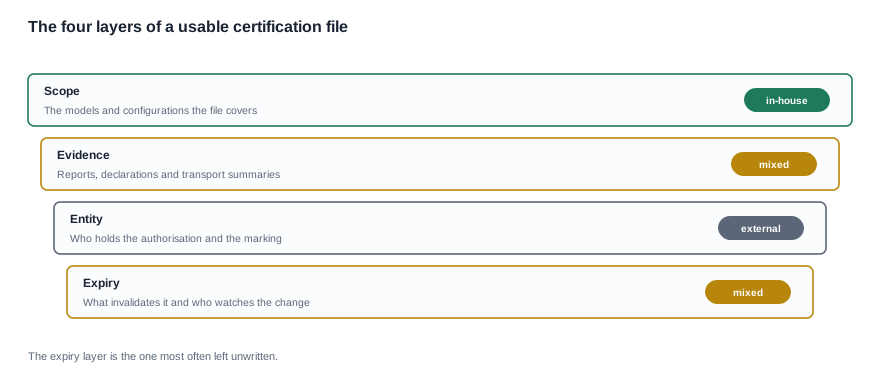
The distinction that decides whether certification support is worth anything is not the size of the document set. It is whether the set is scoped to a specific model and configuration, handed over as part of the programme, and accompanied by a written statement of what would invalidate it.
Three commitments describe a usable handover. First, per-model specificity: the documents name the models and configurations in your programme, and where a document does not cover one, that gap is stated rather than left for you to find. Second, delivery as part of the programme, alongside the samples and the production schedule, so that a document arriving late is a visible schedule item rather than a gap. Third, a stated change position: a list of the modifications that would require a review, and a process and cost basis for that review, agreed before you commit.
Our own published position will remain narrow in the same way it always is. We publish models, configurations and figures we can stand behind. We do not publish radio authorisation numbers, test report numbers, prices, minimum order quantities, lead times or sample fees, because those are facts we should quote you directly rather than facts you should inherit from a webpage. Where a document is not published — and for certification that is most of them — we will tell you plainly whether we hold it for a given model, and what has to be produced.
There is a habit worth keeping at the end of a programme, and it costs nothing. Record, per model, which documents were handed over, in which revision, and what invalidates them. When the next order arrives — a second colour, a second market, a firmware update — that record turns a four-week reconstruction exercise into a five-minute check. Brands that keep it tell us it is the single most useful artefact in the handover.
If you send the models, the configurations and the destination markets, we will tell you which documents apply, which of them we can hand over now, and which ones your own legal function will still have to do. The certification checklist and model coverage notes are on the certification verification checklist page, the documentation side is covered in smart glasses oem documentation needed, and the schedule question is addressed in does certification add to lead time.
Related reading
- Smart Glasses for consumer electronics brands
- Certification checklist and model coverage
- OEM documentation needed
- Does certification add to lead time
Send the models, configurations and destination markets and we will tell you which documents apply.


