

Documentation is the part of an OEM programme that is cheapest to do properly at the start and most expensive to do properly late, and the reason it goes wrong is structural rather than human. The manufacturer holds the technical data. The buyer holds the commercial need. The conformity file is the one artefact that both need and neither owns, and it is produced by the party with the least day-to-day interest in it. By the time anybody discovers that the file is incomplete, the goods are in the market and the question is no longer a document question.
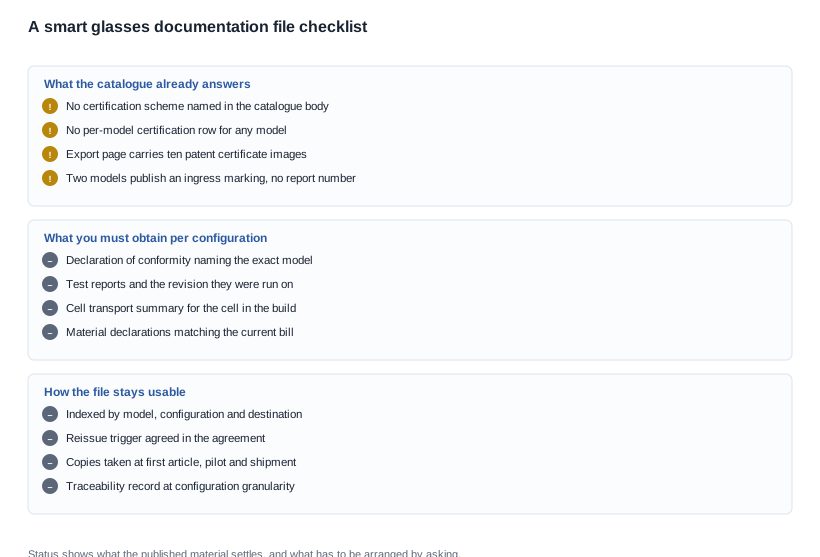
The published position in our own catalogue makes the gap concrete, and it is worth stating without softening. The catalogue body names no certification scheme at all — CE, FCC, RoHS, RED and EN 18031 do not appear in it. There is no per-model certification row for any of the twenty-eight models. The export-certification page is a picture page carrying ten patent certificate images, eight design patents and two utility models, and nothing else. Two models publish an ingress marking, the V06 and the S7, and no test report number is published behind either. The children's models — the A05, the A06 and the A07 — carry no published certification position at all, and they are also among the models for which no Bluetooth version is published.
So smart glasses oem documentation needed is a list of what has to exist for a specific model in a specific configuration for a specific destination, who produces each one, who ends up holding it, and how a buyer establishes that it is in a usable form rather than merely in existence.
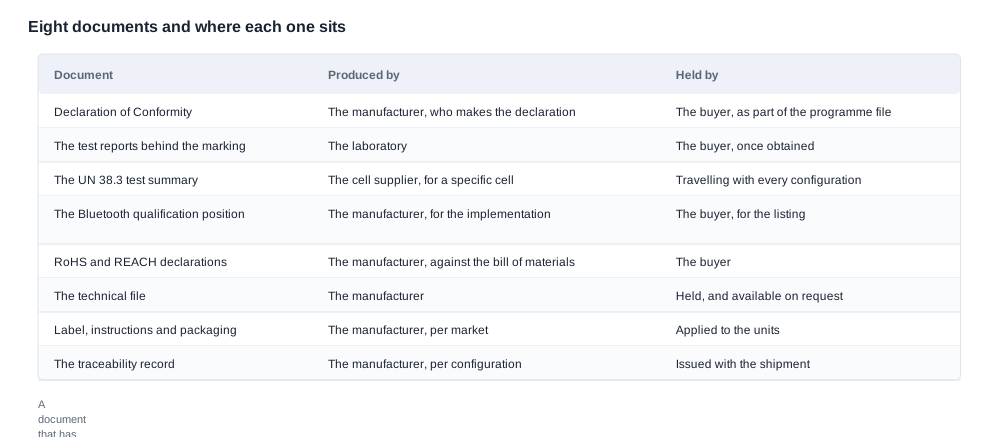
Smart glasses documentation is an evidence chain, not a folder
The most useful way to think about the document set is as a chain. Each link connects a physical unit in a customer's hand back to a decision that was made about it, and the chain is only as good as its weakest link. It runs, in order: the component as purchased, the material declaration for that component, the cell and its transport summary, the product built from those parts, the test reports for the product, the declaration that ties them together, the label and instructions that travelled with the unit, the traceability record that links the unit to a production run, and finally your file, which contains copies of all of it.
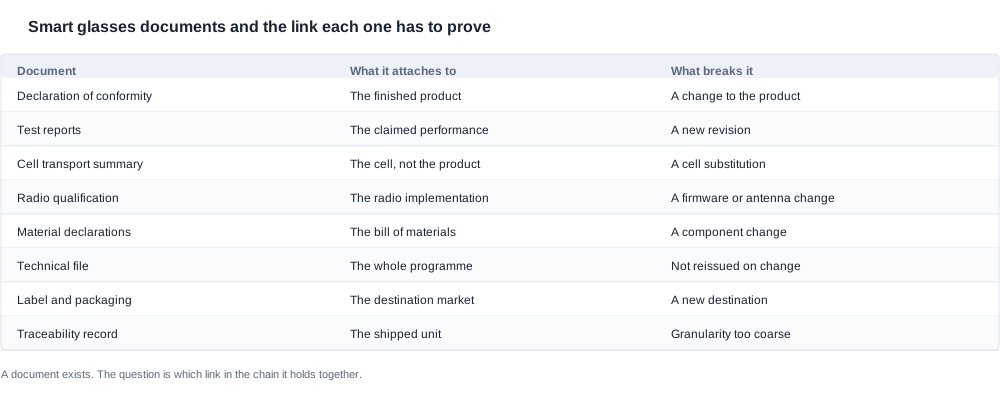
Most documentation disputes in this category are chain failures rather than document failures. The document exists; the link between it and your unit does not. A traceability record that identifies a production week but not the cell in that week leaves a chain that cannot support a claim about the cell. A declaration that names a product family leaves a chain that cannot support a claim about your colourway. A test report for a pre-production revision leaves a chain that cannot support a claim about the units you shipped. The document was never the problem; the chain was.
The structural problem follows from the same logic. A document is produced by the party with the least interest in it — the factory produces a conformity file because the market requires it, and the buyer holds the commercial need, and the factory's own interest in the file ends when it leaves the building. Every element of a working document set has to be assigned an owner with a reason to care, and the two failures that recur are an unowned document and a document whose owner changes. The first is fixed by naming it in the agreement. The second is fixed by taking possession of the copy before the person moves on, which is a scheduling problem rather than a legal one and is therefore much easier to solve.
This is also why the answer to "can you provide the documentation" is rarely a simple yes. The honest answer has four parts, and a supplier that only answers the first is not being helpful, they are being incomplete. The parts are: what exists, what it names, whether it is current, and whether you have it. Our own position is a useful illustration, because we can state the first part for several document classes and not the others — the technical files exist, the test reports exist, the transport summaries exist, the qualification positions exist, and none of them is published on this site or transferred automatically. They are obtained and handed over for a specific configuration, because a document that has to be chased is a document that will be missing when it matters.

The four states of a smart glasses document
It is worth being precise about the difference between a document that exists and a document that can be relied on, because the gap between them is where the money is lost. There are four states, and a document moves through them.
State one: it exists. The supplier holds a document of a recognised type for something in this programme. This is the weakest state and it is the answer most often given, because it is the only one that can be produced without checking anything. "We can provide a test report" says nothing about which product, which revision or which date.
State two: it names the exact model and configuration. A family-level document does not cover a specific model, and a model-level document does not necessarily cover a specific configuration. Our own catalogue contains a model listed as "L2 Utral", and the naming is exactly the sort of ambiguity that turns a document question into a dispute: a declaration that names one string of characters does not obviously cover a variant listed under a different one, and a buyer who assumes it does is relying on a coincidence. The same applies to configuration: a document for a magnetic-charging unit does not cover a Type-C one, and a document for the standard cell does not cover a substituted cell. Note the scale of the problem in our own range: charging interface is published for twenty-four of the twenty-eight models, with magnetic on seventeen and Type-C on seven, and the four exceptions — the L1 Pro and the CY05, and the MT6 and the CY03 — are precisely the models where a document naming the configuration has to be checked rather than assumed.
State three: it is current with the bill of materials. A component change, a firmware change, a lens change, a material change or a cell change can each invalidate a declaration without changing the product's appearance. This is where the chain breaks most often, and it breaks quietly, because the product still looks and works the same. The four states of a document are also a lifecycle, and a programme that treats them as a single yes or no will lose track of the transitions.
State four: it is in your hands. A document that has to be requested each time it is needed is not part of your file, it is a recurring email. The scope of work discussion covers where that boundary should sit, and the honest answer for most buyers is that the file is handed over at defined moments — at the first-article approval, at the pilot, and at the first shipment — rather than at the end of the programme, when the people who know the file have moved on.
The four questions that get a buyer to the right state are simple and are worth asking in this order: does the document exist for this exact model and configuration, can I have a copy now, what has to be produced that does not yet exist, and what is the lead time on each of those. A laboratory queue is a lead time, and it is a lead time that belongs in the programme schedule rather than in a footnote.
A concrete chain break shows how the four states fail in practice. A programme ships a camera model with a magnetic-charging configuration, and the declaration on file names the model but was issued against the earlier Type-C variant of the same housing. The document exists, and it names the model exactly, and it is eighteen months old. Everything about it is right except the configuration, which is why the fourth state matters: because the copy was handed over at the pilot and held in the buyer's file, the discrepancy is caught by an index and a date rather than by a customs query. Had the file been assembled retrospectively from a supplier's archive, the same discrepancy would have been found by a customer, in public, two years later.
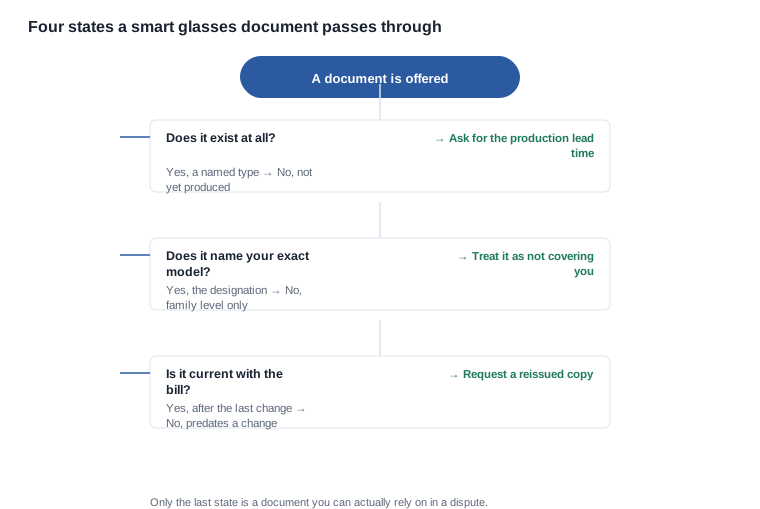

The smart glasses documents that travel with the product
Eight document classes do most of the work, and the useful thing about listing them by what they attach to rather than by what they are called is that it makes the per-cell and per-market boundaries obvious.
The Declaration of Conformity. Produced by the manufacturer, because the manufacturer is the party making the declaration. It names the product and it has no expiry date; what invalidates it is a change to the product. A buyer without a copy cannot answer a market access question, and a distributor who has never seen one will discover its absence at the worst possible moment, usually during a customs query rather than during a purchase.
The test reports behind the product's claims. The V06 and the S7 publish an IP54 marking and no test report number is published behind either, and the report is what makes the marking a claim rather than a catalogue entry. Ask for the report, not for the marking. Ask also which revision of the product it was performed on, because a report on a pre-production revision and a report on the production revision are not interchangeable.
The cell transport summary. This one is cell-specific rather than product-specific, and it is invalidated by a cell substitution regardless of whether the finished product is unchanged. It therefore has to travel with every configuration that contains a cell, and the clause to look for in the agreement is the one that ties a substitution to a re-issue of the affected documents.
The radio qualification position. The listing status, the membership terms, and the fact that the qualification attaches to a specific implementation rather than to a brand. Fourteen of the twenty-eight models in our range publish a Bluetooth version; the eleven camera models, the A05, the A06 and the bone-conduction products do not. That is a published gap rather than a defect, and it means the radio documentation question has to be asked per model rather than answered from a family position.
A related point applies to the children's models. The A05, the A06 and the A07 sit in a category where the regulatory treatment differs from the adult range in most destination markets, and the catalogue publishes no certification position for them at all. A buyer with a genuine education or family channel should treat that as a research item with a lead time rather than a documentation request, because the route may not be the same route.
The material declarations. These have to correspond to the actual bill of materials. A declaration not updated after a component change is not evidence of anything, and in a category with constant component substitution it is the document most likely to have drifted.
The technical file. The design information, the test reports and the certificates behind the declaration, held together so that somebody who was not in the programme can answer a question about it. This is the document that most needs to exist before the people who built it have left, and it is the one that is most often assembled too late to be complete.
The label, the instructions and the packaging. The language, the warnings, the model designation, the importer's details and the market-specific requirements, all of which are per destination rather than per product.
The traceability record. The batch or serial reference that links a shipped unit to a production run. This is the document that makes a claim work two years later, and it is the one most often missing, because it is generated by the factory's production system and nobody asked for it.

Per-market smart glasses paperwork and the destinations that change it
Four classes of document follow the destination rather than the product, and mixing them up is a common and expensive error because they look identical in a folder.
Labelling, instructions and packaging. The language, the warnings, the importer's name and address, the model designation as it must appear, and the market's own requirements. This is per destination, and it is a per-destination artwork and print cost rather than a paperwork cost, which is why it belongs in the quotation rather than in the afterthought stage.
Battery, transport and waste documentation. Wherever the product carries a cell, the transport and the waste obligations apply per destination, and the transport document in particular is cell-specific, as described above. A programme that ships to two destinations has at least two versions of this, and the cell specification has to be identical across them for the cell summary to cover both.
The radio authorisation position. The destination market's equipment authorisation route, which in the European Union runs through the radio equipment framework and the harmonised standards cited into it including the EN 18031 series, in the United Kingdom through the UKCA route with a framework that has diverged, and in the United States through FCC equipment authorisation. The route determines the technical file's contents and the timeline, and it is a question about the destination rather than about the hardware.
Product registration where the market requires one. This is typically a distributor obligation, and it is per market. If you are appointing a distributor, this is one of the things you need to ask them about, and the answer tells you how much of the market work is already done.
The practical consequence for a buyer is that the destination set has to be fixed early, because these four classes of document affect artwork, packaging, the technical file and the timeline. Adding a destination after the packaging artwork is approved is a reprint rather than a cost line.
This connects directly to the commercial terms, and a buyer who separates the two is negotiating better. The document set determines whether the goods can lawfully enter a market, and the commercial terms determine what it costs to get them there. A quotation that is DDP hides the freight, the duty and the clearance work inside one number, which makes the document position invisible; a quotation that is FOB exposes them, which makes the destination's requirements visible. Neither is better in principle, but the second is easier to reason about when the document set is per destination, because each destination's cost line then has a matching document obligation behind it.
The same applies to the landed cost more generally. A programme that ships to several markets with a cell in every unit carries the transport documentation obligation into every market, and the weight and capacity of the cell affects the freight, the packaging and the cost. None of those numbers is published for any model in our range — the catalogue gives cell capacities for the camera models in the 220 to 290 mAh band and leaves the transport, freight and duty questions to a quotation — so the correct response is to ask for the landed cost broken down by destination against the document set that destination requires. A supplier who can do that in one line is telling you something useful about how the programme will run.
There is a second-order effect worth planning for, and it is the one that catches a distributor rather than a brand. A per-market document set creates a configuration matrix: the same model in the same configuration can carry different labels, different instructions and different accompanying paperwork depending on where it is going. The moment a programme has more than one destination and more than one configuration, the number of combinations multiplies, and the risk is that a unit built for one destination reaches another. The control is the same traceability mechanism used elsewhere — a code on the unit that resolves to a destination and a document set — and it is far cheaper to design into the labelling than to audit retrospectively. In a range where a single model already carries up to four published colour options, the matrix is wide before the destinations are even counted.

Building a smart glasses documentation file you can still use in two years
A file that works is a file with an index, a re-issue trigger and a copy in the buyer's hands. Three things separate a file that survives from a folder that accumulates.
Index it by model, configuration and destination. Not by document type, which is how manufacturers file and how nobody can search. For each row: the document, the model designation as printed, the configuration it covers, the destination, the date, the holder, and the re-issue trigger. When a component changes, you can see the blast radius in one view, which is the question that matters when a change is announced.
Define the re-issue trigger in advance. Something has changed and every affected document has to be reissued. The trigger is usually a change to the bill of materials, a change to the cell, a change to a lens or material, a change to the firmware build, a change to the label, or a change to the destination. Put the list in the agreement, with a lead time per document type, and with the trigger sitting alongside the change-control process so that no change is made without the document consequence being assessed in the same conversation. The link to the wider lifecycle support commitments matters here, because the document obligation outlives the order and the support commitment usually does not.
Take possession at defined moments. At the first-article approval, at the pilot, and before the first shipment. At the first shipment in particular, three physical checks are worth the time: the model designation on the unit matches the model designation on the documents; the labelling on the unit matches the destination market; and the traceability record was issued with the consignment at configuration granularity rather than at batch granularity. Those three checks catch the chain breaks that no amount of document review will, because they test the link rather than the piece.
Two questions are worth raising at the quotation stage, before anything has been bought. The first is which documents exist for the exact model and configuration and can be seen now, rather than after an order. The second is what the position is on a component substitution and what happens to the affected documents when one occurs. The second question is the more valuable of the two, because the answer reveals whether the document set is maintained as a living thing or whether it was assembled once for an audit.
A third question belongs slightly later and earns its place: which of these documents will the factory continue to support after the programme ends, and for how long. A cell transport summary that the factory will no longer reissue after the last production run has an expiry date that nobody has written down, and it is the document a distributor is most likely to be asked for in a market-access query two years after the programme closed. The after-sales support side of the agreement is where that horizon belongs, and it should be asked about at the same time as the document list rather than assumed to be the same thing.
The certification side of the same work is set out in the certification checklist and model coverage, and the programme structure that the documentation attaches to is under smart glasses OEM.
Related reading
- Smart Glasses OEM service scope
- What is included in the scope of work
- Certification checklist and model coverage
- Lifecycle support commitments
Send the model, the configuration and the destination markets and we will tell you which documents apply.


