

The first order is the easy one. Everything about it is new and therefore legible: the samples are fresh, the specification is short, the questions have obvious answers, and nobody has yet had to ask what happens in month seven. The second order is the one that reveals how a supplier actually operates, and it is the one that decides whether a smart glasses programme is a supply relationship or a series of awkward negotiations.
What makes the second order different is that it is not a repeat of the first. It carries everything the first one taught, plus whatever has changed since — a firmware update, a supplier substitution on a component, a colour that now needs to match a new retail fixture, a market that has asked for a document the first order did not need. A supplier's operating model is easiest to see here, because the first order only tests whether they can say yes and the second order tests whether they can say "that is not ours to answer" as clearly as they said yes.
So this article is a description of our working model rather than a sales page. It is what we do in a smart glasses programme for a consumer electronics brand, what we will not do, and — more usefully — why the second column matters more than the first. It is also the shortest honest description available of the boundary around our published range, which has more fields left blank than you might expect from a manufacturer.
There is a practical way to read any supplier's operating model without a factory visit, and it is worth naming because it is what a brand should be doing while it reads this. Ask each candidate what happens to a specific figure when the product changes underneath it. Ask what happens to a specific document when a component is substituted. Ask which side of a disagreement a particular question will land on. The answers will be consistent in quality and consistent in character, and they will tell you more than any capability presentation will, because they reveal whether the supplier has a process or a personality.
Smart glasses for consumer electronics brands: what we do and do not do
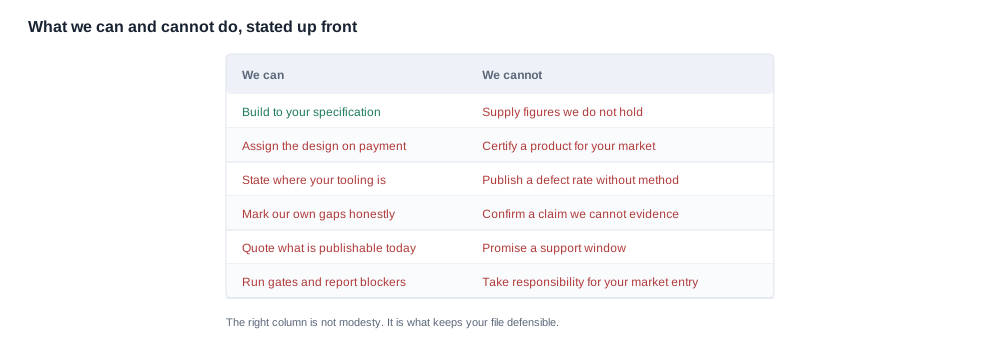
The first column is the one everybody writes, and it is not the one that matters.
We build to your specification. Our published customisation list names seven routes: logo, colour, packaging, temple shape, system and interface customisation, Bluetooth device naming and firmware customisation. Beyond the routes themselves, the catalogue publishes colour options for two models only — three for the V03 Pro, four for the V06 — photochromic lenses on the V03 Pro, and an electrochromic entry with no model string. Everything else in the colour and lens space is written as not published and has to be asked for. Depth within a route is a decision we take with you, not a number we advertise.
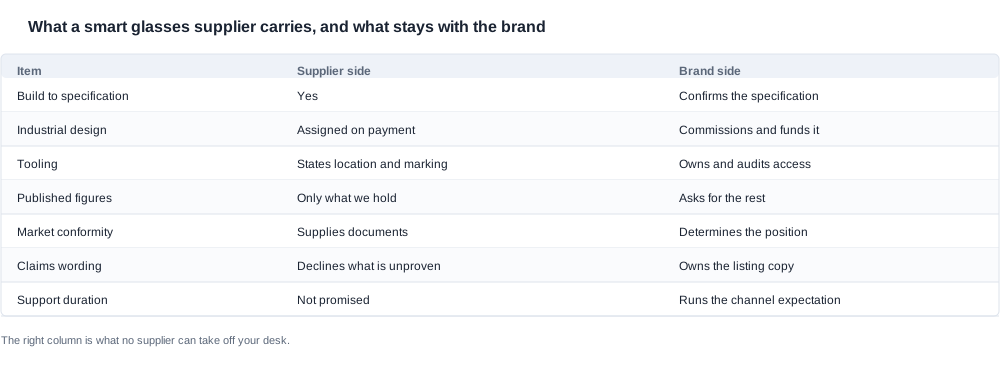
We hand over the industrial design you commission and pay for. That position goes in the contract rather than being left to a default legal position, because the alternative is a dispute at the end of a programme rather than at the start of one.
We state where your tooling is. Once it is paid for, we tell you where it is stored and whether it is marked, so that the question of access is a fact rather than a request.
We mark our own gaps on the specification. Where a figure is not published, it stays blank on the sheet we give you. We do not fill it with an industry-typical value.
We report blockers as named decisions. If a stage cannot complete because a decision is outstanding on your side, you get the decision and its owner, not a date that slips.
The second column is the one worth reading twice.
We do not supply figures we do not hold. That currently covers frame and temple material composition, weights apart from the one model that publishes one, microphone specifications, camera specifications beyond the published megapixel count, ingress test reports, certificate numbers and issuing bodies, cycle lives, and the test conditions behind our stated charge times and runtimes.
We do not certify a product for your market. The burden of demonstrating compliance sits with the party placing the product on that market. We supply documentation that exists. We do not substitute a summary of it for a determination.
We do not publish a defect rate without a method, a production capacity figure, or a minimum order quantity without the scenario attached to it. Each of those would be a number we would eventually have to retract, and a retraction in a category where a buyer has already built a launch plan around it is expensive for both of us.
We do not confirm a claim we cannot evidence. If a listing needs to say a device prevents something, treats something or meets a medical standard, we will decline the wording rather than support it. This is not caution for its own sake. It is the only thing that keeps a brand out of trouble when a regulator reads the listing rather than the datasheet.
We do not promise a support window. Production capacity figures and stage lead times are not published, and a support duration stated now would be a commitment we could not keep across a component supply change.

Smart glasses build ownership: design, tooling and who holds what
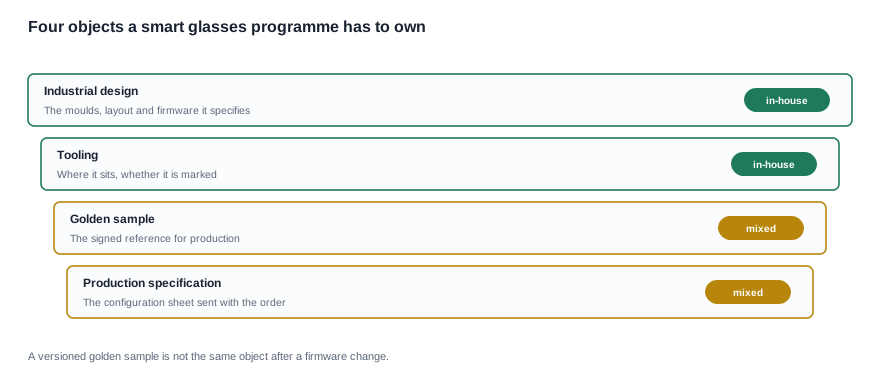
Ownership is the part of a manufacturer relationship that gets argued about late and settled badly. Three objects need a named owner, a location and a rule for what happens when the relationship ends.
The industrial design. If you commission it and pay for it, it is yours. In a smart glasses programme this is more consequential than it sounds, because the design is not a drawing — it is the specification of the moulded parts, the electronic layout, the firmware behaviour and the assembly sequence all at once. The value of owning it is that the second order, the new colour and the future product revision all derive from it, and a brand that does not own it cannot make those decisions.
The tooling. A mould is a physical asset that sits in the factory's building and is used by the factory's people. A brand that has paid for it is entitled to know where it is, whether it is marked, and what the plan is if the relationship ends. We state that as a matter of course rather than treating it as a point of leverage, because the alternative is a dispute at a moment when neither side can act quickly. The related commercial question — whether a second order from the same tool carries an amortised cost — is a negotiation, and it belongs in the quotation rather than in the second invoice.
The golden sample. The accepted reference unit against which production is judged. This is an object, and it should be physically held, signed and controlled, because it is the only thing that lets a dispute in month seven be settled by comparison rather than by argument. It should also be versioned: a golden sample approved before a firmware change is not the same reference as a golden sample approved after it, and treating them as one artefact is how visual and functional approvals drift apart.
There is a fourth object that is easy to forget and expensive to lose: the production specification itself. The configuration sheet that says which cell, which charging method, which case, which firmware build, which colour reference and which tolerances apply to the order. It is a document, not an object, and it is the one that most often gets lost between a brand's engineering file and a factory's build instructions. A programme that keeps one current version of it and sends it with each order is measurably calmer than one that assumes the last email contained the answer.
The second-order test applies to all four. Ask a supplier what happens to the tooling if a component in the product is superseded, whether the golden sample is replaced when a build changes, and which version of the configuration sheet governs a repeat order. A supplier who answers all three crisply has an operating model. A supplier who answers one of them vaguely has not yet had to.

Smart glasses specification gaps: the fields we leave open deliberately
Our published range has more blanks than a product page normally shows, and the blanks are deliberate. It is worth being explicit about which are deliberate and what the reasoning is, because a buyer who understands the pattern can plan around it, while a buyer who only notices the holes tends to assume the hole is a defect.
The pattern is this: we publish the rows we can stand behind, and we leave the rest empty. That produces a published range with an unusually precise configuration grid in some areas and complete silence in others.
In the published grid you will find charging method across twenty-four of the twenty-five named models — magnetic on seventeen, Type-C on seven — with L1 Pro and CY05, and the CY03 and MT6 not published. You will find charging case capacity for exactly five models: CY05 and L1 Pro, and CY03 — each at 1400 mAh, L2 Utral at 900 or 1400 mAh, and the MT6 as a 1200 mAh foldable, with a case present but no published capacity for the KY06 and MT5, and no case row at all for the V03 and S7, and V06, with the V03 Pro explicitly published as having no case. You will find charge time published as "2 hours or less" for twenty-six models, with only the D17 and the ZH12 publishing approximately one hour. You will find camera resolution at 8 MP across eight models and 13 MP across three — the S7 and the L1 Pro, and the L2 Utral — and camera batteries in the 220–290 mAh band with a rated runtime of roughly five to eight hours.
And then the range stops publishing.
Weight appears for one model only: the MT6, at 158 g for the glasses alone, explicitly excluding its foldable case. An ingress rating appears for two models only: the V06 and the S7, both at IP54. Bluetooth version is published for fourteen of the twenty-eight catalogue entries and not published for the eleven camera models, the A05, the A06 and the bone conduction entry. Surround audio is published for the D11, with the D17 publishing "Surround Sound" and the ZH12 publishing 立体环绕音. And there is no capacitive-touch row and no translation row for any model in the range, which means no model in it may be described as having capacitive touch, and multi-language packaging is a programme rather than a stock feature.
Three reasons sit behind that pattern.
The first is that a published figure becomes a commitment. A number on a product page is quoted back, printed on a carton, compared against a competitor and relied upon for two years. A figure the factory can stand behind can be quoted and defended; an estimate can only be revised, and revision is expensive once the figure has spread.
The second is that specifications move. A cell substitution changes a runtime; a firmware build changes a behaviour; a supplier change moves a component without changing the product name. A published figure without a stated condition and a review mechanism becomes wrong quietly rather than loudly, and nobody notices until a customer complains.
The third is that the honest gap is more useful than a comfortable number. If the catalogue does not publish an ingress rating for a model, a brand that needed one can ask for it, negotiate for it, and put it in the contract as a deliverable. If the catalogue published a generic "IP54-class" figure for a model that had never been tested, the brand would have nothing to ask for and nothing to hold.
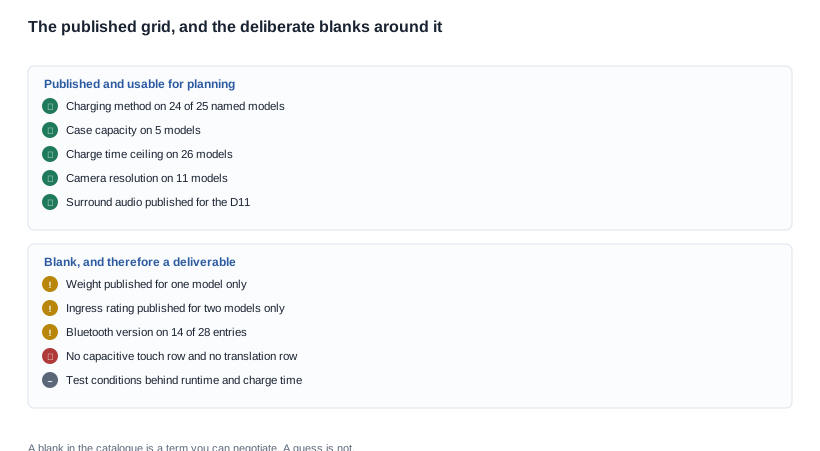
The practical consequence for a buyer: read the published rows as the constraints they are, and treat each blank as an open deliverable. In a smart glasses programme the blanks are concentrated in exactly the places a consumer electronics brand cares about most — ingress, weight, radio version, runtime conditions and the availability of touch control — which is why they need to be closed deliberately in the contract rather than assumed.
The mechanism for closing a blank is straightforward and it is worth doing at quotation stage rather than at sample stage: convert each blank into a named deliverable with an owner and a date. "Ingress rating for the S7 at IP54, with the test method stated" is a deliverable. "Water resistant" is a claim with no method behind it. "Weight excluding the case, with what else is excluded" is a deliverable. "Lightweight" is a claim. The first version of each pair can be negotiated, scheduled and checked; the second version can only be argued about later, usually by a customer who has already returned the product.
The discipline is worth extending to the rows that are published too. A published figure is a starting position, not the end of the file. The charge-time ceiling of "2 hours or less", the runtime band of roughly five to eight hours, the megapixel count — these are the rows that a buyer's own datasheet, carton and listing will inherit, so they are worth checking against the conditions you intend to state alongside them, and worth re-checking when the configuration moves.

Smart glasses gates: naming a blocker instead of reporting a delay
Every production programme has gates, and the difference between a smooth one and a difficult one is usually not technical. It is whether a blocked stage arrives as a named, owned decision or as a quiet slip in the schedule.
A gate in a smart glasses programme is usually one of five things: artwork approved, tooling released, the golden sample signed, the software build frozen, or the configuration sheet issued. Each of them blocks work downstream, and each of them can be stuck for a reason that has nothing to do with the factory.
The rule we work to is simple and it is worth holding a supplier to it: a blocked gate is reported with the decision that unblocks it, the owner of that decision, and the date it is needed. Not the number of days lost, not "we are waiting on something" — the decision itself. It sounds like a small thing and it is not, because a gate reported as a decision can be escalated to the person who can make it, while a gate reported as a delay can only be waited on.
This works in the brand's favour more often than it appears. If the factory names the outstanding artwork approval on your side, the artwork approval gets prioritised, because it is now visibly the thing holding the programme. If it is reported as a two-week schedule slip, it simply joins the list of delays, and delay lists lose their most important entries first.
The same principle applies in the other direction, and it is where a brand's own diligence pays off. The gates a factory controls and the gates a brand controls interlock: artwork cannot be approved before the model is fixed, the model cannot be fixed before the market is chosen, the market cannot be chosen before the claims are settled, and the claims cannot be settled before the configuration is known. A programme that maps those dependencies at the start spends far less time in the queue, because it stops discovering that a decision three steps back was never made.
There is a version of this that goes wrong, and it is worth naming. A brand that treats its own gates as the factory's problem — sending artwork late, leaving the model undecided, asking for a configuration change after the build started — will experience the factory's reporting discipline as obstruction. It is not obstruction. It is the same rule applied in both directions: a gate blocked by a decision is reported as a decision, whoever owns it. A supplier that names your outstanding artwork approval is doing you a favour, because a named decision can be escalated while a delay can only be absorbed.

Smart glasses commercials: what a quotation covers and what it does not
A quotation is a snapshot of a configuration, and configurations in this category are not stable objects. So the useful question is not "what does this quotation say" but "what does this quotation actually cover, and what would have to change for the number to move".
We publish no unit price, no production lead time, no minimum order quantity, no sample fee, no warranty term, no tooling cost, no non-recurring engineering cost, no payment terms, no shipping cost and no tier prices. That is not coyness; it is that each of those numbers is a function of a configuration that only exists once the request has been classified and specified. A lead time in particular is not a property of a model. It is a property of a model's customisation depth, and it moves with the request list. Publishing one figure would invite it to be planned against and would be wrong most of the time.
What we do instead is quote against your configuration and state the assumptions. The useful commercial content of a quotation from us is the specification it assumes, the quantities it assumes, the inclusions and exclusions, the stage structure, the sample and golden sample position, and the tooling position. Where a commercial term is not yet determined because the configuration is not yet determined, we will say that in the quotation rather than omitting it.
The negotiation therefore happens on a different object than usual. Instead of arguing about a unit price, the conversation is about which assumptions are right, which changes would reopen which stage, and what a given change costs in time rather than in money. In many cases the second question is the more valuable one, because in this category a change that is cheap in tooling can be expensive in schedule and vice versa.
There is one commercial term that deserves to be settled in the first order rather than the second, and it is the one everybody defers: the ownership, location and amortisation of tooling, and the status of the industrial design. Settling it early is not adversarial. It is the difference between a relationship that has to renegotiate from a position of dependency and one that does not.
Two further terms belong in the first order because they are structural rather than commercial. The first is the sample position — what a pre-production sample proves, what a golden sample commits to, and how many of each are included — because the sample is the point at which the configuration stops being a description and starts being an object. The second is the change-control position: what modifications trigger a re-review, who authorises them, and what the schedule consequence is. Both of these are cheap to agree at the start and expensive to introduce later, because both of them are attached to a document that a supplier writes once.
For a buyer deciding which supplier to shortlist, the practical test is whether the supplier's quotation and specification arrive with the same shape: configuration, assumptions, inclusions, exclusions, stages. A supplier that returns a number without those is not quoting a configuration, and the difference will surface at the second order rather than the first.
Related reading
- Turning a request into a quotation: customization depth by tier.
- The manufacturing side of the same relationship: quality assurance layers.
Tell us the product, the market and the deadline, and we will tell you which of these we can deliver and which we cannot.


