

Quality assurance for smart glasses is not one inspection. It is a stack of layers, and the failure mode for a brand is almost always the same: the stack was agreed for the sample and never contracted for production. Six layers, what each catches, and who owns it — that is the whole content of a quality agreement that actually works.
The reason this matters more in this category than in most is that a smart glasses unit is an assembly of a wearable frame, an electronics product and an optical element, and each of those three fails in its own way and on its own timescale. A frame defect shows up as a comfort complaint months later. A charging contact defect shows up as a returns problem in the first week. A lens seating defect may not show up at all until the customer puts it on in daylight. A single end-of-line inspection catches almost none of them, which is why the stack has to be designed rather than assumed.
The practical output of reading this article should be a quality agreement with six named layers, a frequency and an owner against each, and a written test coverage list. That document is worth more than any percentage, because a percentage without its denominator and its sampling method is a marketing figure rather than an engineering one.
There is a commercial reason to write the agreement before production rather than after the first dispute, and it is not only about avoiding the dispute. The layers that get agreed early are the ones that can be priced into the order, and the layers that get negotiated during a quality dispute are the ones that get paid for out of margin. A brand that contracts a run audit with a frequency and a name has a costed line and a scheduled activity. A brand that discovers drift after a week of production has an expedited shipment, a withheld payment and a rushed replacement order, and none of those were in the quotation.
The same reasoning applies to the coverage list. It is a short document, it takes an afternoon to write, and it converts an argument about what "passed" means into a comparison against a written list. That is a due diligence step in the cheapest sense of the word — reading what you are about to rely on — and it is the one most often skipped because the consequence of skipping it is invisible until it is expensive.
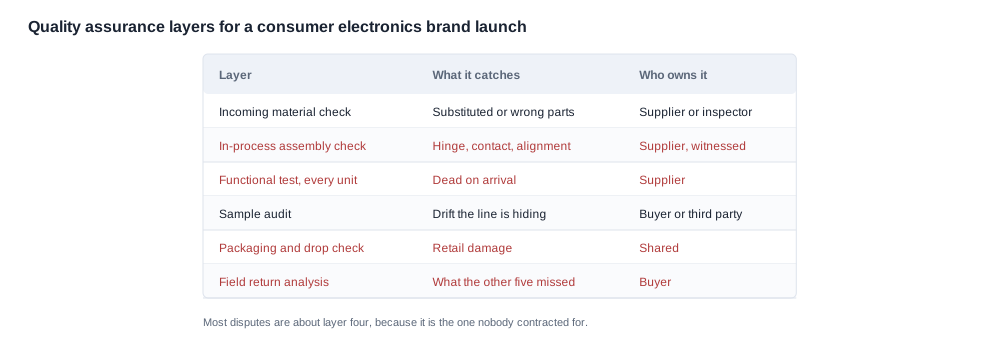
Smart glasses quality assurance: the layers that matter
The six layers, and who owns each:
- Incoming material. Owned by the supplier, and the layer a buyer can most easily witness.
- In-process assembly. Owned by the supplier, and the layer a buyer should attend on a first run.
- Functional test on every unit. Owned by the supplier by definition, because it is per unit.
- Sample audit during the run. Owned by the buyer or a third party, and the layer most often skipped.
- Packaging and transit. Shared, which is exactly why it is contested.
- Field return analysis. Owned by the buyer, because the supplier does not see your channel.
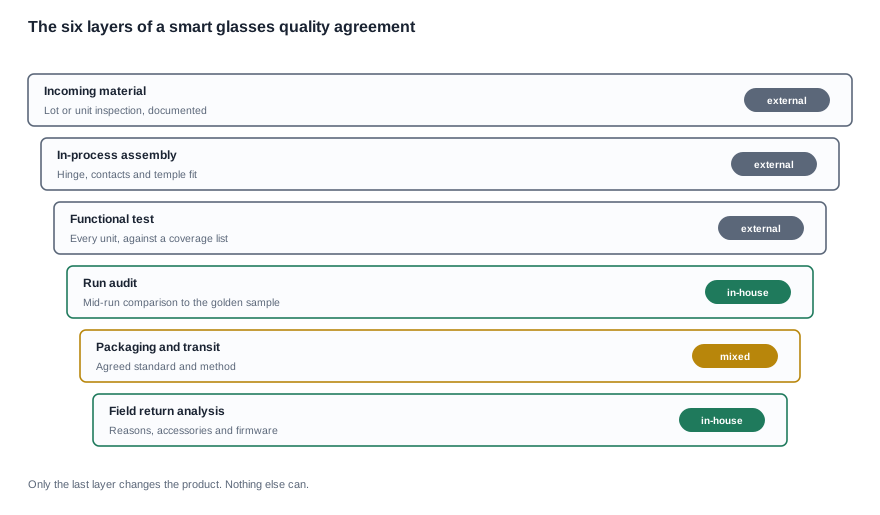
Two properties of this stack are worth stating before the detail, because they determine how the agreement should be drafted.
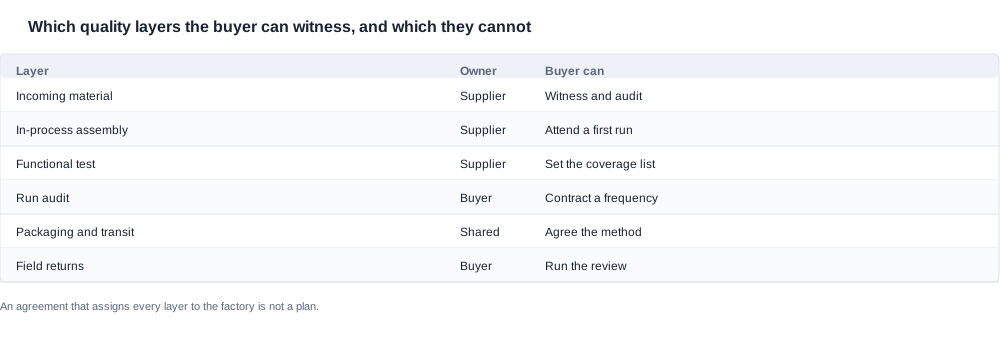
The first is that the layers have different owners, and that is not a flaw in the design — it is the design. A supplier cannot own the layer that requires someone from your side on site, and a buyer cannot own the layer that happens inside the factory. An agreement that assigns every layer to the factory is not a quality plan; it is a statement that nobody is going to do the part that needs the buyer.
The second is that each layer produces a different kind of evidence, and each piece of evidence supports a different kind of decision. Layers one to three produce pass and fail results that stop defective goods from shipping. Layer four produces a comparison against a reference that shows whether the run is drifting. Layer five produces damage statistics that determine packaging changes. Layer six produces a reason. Only the last one changes the product, and it is the only one that no inspection can substitute for.
A third property is worth adding, because it explains why the layers are usually drafted in the wrong order. The stack is not a funnel of increasingly expensive checks; it is a set of checks that answer different questions, and the cheapest question is the most important one. Layer one answers "is this the product we specified", which is the question that determines whether the other five are measuring anything meaningful at all. A brand that invests in layers three to six while leaving layer one loose has bought a precise measurement of the wrong product.
That is the reason the incoming layer deserves the first line in any quality agreement, and the reason the cell and configuration figures in the published catalogue matter more to a quality conversation than they first appear. The specification is the reference, and a reference that has drifted is not a reference.

Smart glasses incoming and assembly: the two layers the factory owns
Layer one — incoming material. This catches substituted or incorrect parts, a wrong colour compound, and cells that do not match the specified capacity.
Who owns it: the supplier, and you can witness it. The two questions worth asking are whether incoming inspection is by lot or by unit, and whether it is documented. A supplier that inspects incoming by lot is making a statistical assumption on your behalf, which may be entirely reasonable, but it should be an assumption the brand knows about rather than one it discovers later.
This layer matters more in smart glasses than the cell figure alone suggests. A cell that drifts within the published band does not change the specification — the camera tier publishes batteries across the 220–290 mAh band with a rated runtime of roughly five to eight hours — but it does change the behaviour a customer experiences, and the published runtime carries no test condition, so there is nothing in the specification that would catch the drift either. The same logic applies to the charging method, which is published as magnetic on seventeen models and Type-C on seven, with the CY03 and L1 Pro, and CY05 and MT6 not published at all: an incoming substitution on those four changes a published row into a different one without any assembly error being made.
Layer two — in-process assembly. This catches hinge assembly, charging contact alignment, button fit and lens seating.
Who owns it: the supplier. You can be present, and for a first production run it is worth being.
The three that matter most in this category are the hinge, the charging contacts and the temple fit. All three are visible only after assembly, and all three produce returns rather than rejects if they are not caught on the line — a hinge that binds under a pocket, a charging contact that does not seat properly in a case, and a temple that does not hold its position after a few hours. The last of these is specific to this form factor, and it is the one a factory inspection checklist written for a different product category will not contain.
There is a related point about the golden sample, which is the reference object for both of these layers. A golden sample signed before production describes an intent; a golden sample that is signed per configuration, held physically and versioned against firmware and colour changes describes a product. In a category where the electronics and the frame are assembled together, the sample is the only thing that can be compared at the line, and its value is in being versioned rather than in being signed once.
A third point on the golden sample is about which model it belongs to. The reference object is per configuration, not per product family, and this category makes that distinction concrete. Two models that share a frame but differ in the cell, the case or the charging method do not share a golden sample, because the parts that differ are exactly the parts the sample exists to judge. Our published range shows how often that happens: the camera tier publishes three cell capacities across the 220–290 mAh band, five published case capacities across five models, and a charging method split across magnetic, Type-C and four models where the method is not published at all. A brand that signs one sample for a camera range has signed a reference for a configuration that does not exist.
Smart glasses functional test: the coverage list that makes it enforceable
Layer three — functional test on every unit. This catches dead on arrival, pairing failures, units that do not charge, a dead channel in a twin-cell audio model, and a camera that does not capture.
Who owns it: the supplier, by definition, because it is per unit.
The specification that makes this layer enforceable is a test coverage list. State which functions are exercised on every unit and which only on a sample, and be explicit that a function not on the list is not verified. Without that list, a supplier can truthfully report a pass rate while testing nothing beyond power-on, and both sides will believe the number is meaningful.
The list is worth writing in a particular way. For each function, name the observable result rather than the action — not "charge test" but "unit reaches the charge state indicated for its charging method and holds it for the stated interval"; not "camera test" but "unit captures and stores a frame". A coverage list written as actions cannot be audited, because the observation is left to whoever is running the line.
There is one function this category makes impossible to leave implicit, and it is the one with the widest consequences. The runtime figure published for the camera models is a rated runtime with no published test condition, and the charge time published across the range is a ceiling of two hours or less for 26 models and approximately one hour for the D17 and the ZH12. Those are the figures a listing will inherit. Whether the units leaving the line actually behave that way is a question the coverage list has to answer — at minimum with a sampled charge-time check against the published ceiling, and with the test condition written down so that the figure means the same thing in your listing as it does in the factory's record.
A second function worth naming on the list for the camera tier is capture, and it is worth separating from the resolution class. Resolution is published in two classes across eleven models, but the sensor model, the field of view and the video specification are not published for any of them, which means a unit can pass every documented criterion and still not produce an image the customer considers acceptable. The coverage list protects against a dead camera. It does not protect against a disappointing one, and only a sample evaluation does that.
The same argument applies to audio, where the published range contains no acoustic measurement for any of the eight audio models. A coverage list can verify that both channels produce sound, and that is what it should say. It cannot verify that the sound is good, and a brand whose proposition depends on sound quality needs that verified separately, on samples, under conditions it can describe.
There is a version of the coverage list that is much easier to enforce than the one most brands negotiate, and it is worth knowing which one you have been handed. A list that names a function and an observable result can be audited by anyone. A list that names a function and a procedure can only be audited by the people who wrote it. The difference matters when a dispute arrives, because in the second version the only evidence available is the supplier's own record — which is a weak position to negotiate from, and a reason to ask for the third-party test house or the third-party inspector instead.
Smart glasses run audit and packaging: the two layers that get skipped
Layer four — sample audit during the run. This catches drift the line is producing after the golden sample was approved.
Who owns it: the buyer, or a third party. This is the layer most often skipped because it requires someone on your side to be present, and it is where most quality disputes actually originate. A golden sample signed at the start describes the intent; only a mid-run audit tells you whether the run still matches it.
Contract this layer explicitly, with a frequency and a person. The trade-off is straightforward: a brand that audits once per run gets continuity but not drift detection, and a brand that audits at a fixed frequency gets detection but needs a named person with the authority to stop a shipment. The second option is more useful and more expensive, and the cost of it is a person in a factory rather than a percentage in a report. Where that person is not available, the honest alternative is to contract for the factory to hold and photograph samples at intervals against the golden sample, which is weaker evidence and still much better than nothing.
Layer five — packaging and transit. This catches retail damage, which is a large share of consumer electronics returns and is almost never a manufacturing defect.
Who owns it: shared, which is exactly why it is contested. Agree the standard and the method, and agree who pays when the damage rate exceeds it. We do not publish a drop standard, a damage rate or a packaging test method, and neither should a supplier present one without its method, because a damage rate without a method is not a number you can negotiate against.
This layer has a specific complication in this category, and it is the charging case. A case-equipped tier ships a moulded accessory with its own dimensions, its own weight and its own packaging requirement, and a product returned without its case is a different commercial event from a product returned with it. Three models in the published range also carry a detachable component — an inner frame on the V06, an inner frame on the S7 and a temple on the G07 — and a detached part is an accessory return rather than a warranty claim. All of that has to be designed into the packaging and the return route before the first shipment, not after the first complaint about a missing case.
There is a further reason to treat layer five as its own agreement rather than as a footnote to the others. Transit damage is usually shared, and shared costs are usually disputed, and the dispute is about attribution rather than about facts. The way to remove it is to decide the attribution rule in advance: who absorbs damage below the agreed standard, who absorbs it above it, what evidence settles a contested shipment, and how long that settlement takes. A brand that agrees the method but not the attribution will still be arguing at the end of a year, because the argument will be about whose judgement was right.

Smart glasses field returns: the only layer that learns
Layer six — field return analysis. This catches everything the other five missed, and it is the only layer that learns.
Who owns it: the buyer. There is no version of this that a supplier can do for you, because the supplier does not see your channel.
Set it up before the first shipment: what you collect, how it comes back to you, and how often you review it. Without it, the same defect recurs across three production runs, and the cost of that recurrence is the whole reason a launch has a quality agreement at all.
There are three pieces of field data that are worth more than the rest in this category, because they are the ones that map onto the layers above.
Returns by reason, separated into fit, function and transit. The split tells you which layer is failing. Fit complaints point at the temple and the frame; function complaints point at the charging contacts, the pairing or the cell; transit complaints point at the packaging. A single undifferentiated return rate tells you nothing about which of those to fix, and it is the reason many brands cannot improve their return rate even after spending heavily on inspection.
The accessory return rate, which in this category is a packaging and merchandising problem rather than a product problem. A high rate of returns missing a case is a design problem with the packaging and the unboxing, and it is fixable without touching the factory at all.
The firmware and app complaint rate, because a behaviour that is wrong for one market is not a hardware defect and will never be caught by any of the first five layers. It is caught here, and only here, and only if the data is collected in a way that distinguishes it from a hardware failure.
The review itself is the mechanism, and it needs a cadence and a decision. A monthly review that produces no change is a report, not a control. What makes it work is a standing rule about which findings reach the factory — a defect rate above an agreed threshold, a new failure mode, or a repeat of a known issue — and who is required to respond. Deciding in advance which findings travel and which are handled internally is what stops a return analysis from turning into a list of complaints nobody owns.
One piece of this review is often underestimated, and it is the one a factory can help with even though the factory does not own the layer. A structured return reason is far more useful than a free-text comment, and the reason codes a brand should ask for are specific to this category: charging fault, pairing failure, audio fault on one side, camera fault, hinge or fit complaint, lens or optical complaint, accessory missing, and transit damage. Those codes separate the layers cleanly — the first five point inward, the accessory code points at packaging, and the last points at packaging and logistics. A free-text return note tends to collapse all of them into "not working", which sends the analysis nowhere.

Smart glasses quality agreement: what to put in the document
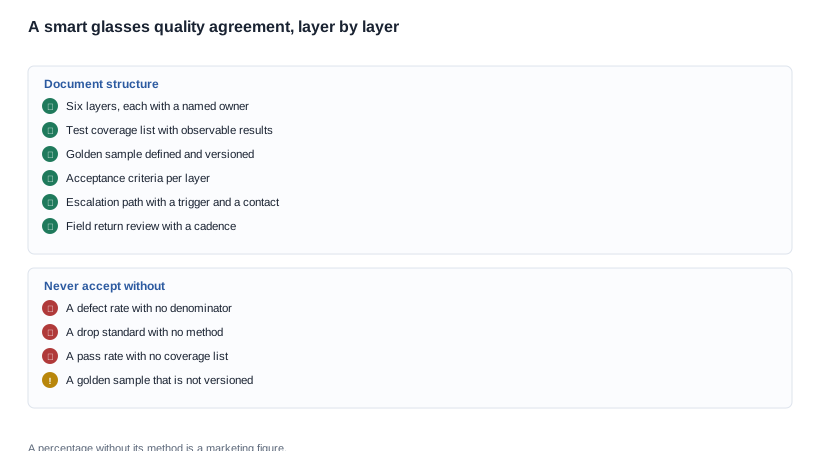
A quality agreement that works is short, and it is written before production rather than after the first dispute. Six things belong in it, and each of them is a line rather than a paragraph:
- The six layers, each with a named owner — the supplier, the buyer, or shared — and a frequency.
- The test coverage list, naming the observable result for each function tested on every unit, and stating explicitly which functions are sampled rather than tested.
- The golden sample definition, with the configuration it belongs to, what it fixes, what is allowed to vary, and where it is held.
- The acceptance criteria for each layer, including the standard and method where one applies. These are the criteria a shipment is judged against, so they need to be specific enough that two people would reach the same conclusion.
- The escalation path, with a defined trigger, a named contact and a timeframe — the same discipline that applies to a blocked production gate.
- The field return review, with the data collected, the review cadence and the threshold at which a finding travels to the factory.
Our own published position is narrow and deliberate. We do not publish incoming inspection pass rates, defect rates, sampling methods or production capacity figures, and we would rather say that than hand over a percentage without its denominator and its method. We will agree which of the six layers we operate, on which parts of the production run, and put it in the quality agreement.
The broader commercial terms — what the layer costs, what a re-run costs, and how the warranty position attaches to the layers — are covered in smart glasses oem quality expectations, what happens when a run fails a layer is in after sales support channels, and the models the agreement would be written against are on the OEM-ready smart glasses page.
Send us your target volume, your markets and the layers you already operate, and we will tell you which layers we can operate, which need your presence on site, and which are worth adding before the first shipment rather than after the first complaint.
Related reading
- What happens when a run fails a layer: after sales support channels.
- Where the products themselves sit: OEM-ready smart glasses.
Send us your target volume and markets and we will tell you which layers we can operate and which need your presence on site.


