

A request list arrives at a smart glasses factory in one of two forms. Either it is a list of things that can be printed, painted, packaged and shipped, or it is a list that includes a firmware behaviour, a cell capacity, a temple profile and a new functional claim. The second form is not a problem in itself — most brands need some of it. The problem is that both forms arrive in the same email, in the same document, under the same heading of "our customisation requirements", and the supplier is then obliged to treat every line as if it were the same kind of thing. What comes back is either a quotation that quietly prices only a fraction of the list, or a price that looks like a ransom because it has bundled a three-week engineering study into a box of frames.
The fix is not a bigger list and a better spreadsheet. It is a classification, applied before the list leaves your building, because the five categories of request in this category differ in kind rather than in degree. One is an input to an existing production process. One is a decision you have to make once. One is a specification that engineering can start from. One is a change that reopens approvals you have already signed. And one is not an engineering matter at all — it is a claim, and claims live or die on evidence rather than on effort.
This article sets out those categories, what each one needs from you, and how to send a request list that produces a usable answer rather than a second round of clarification.
There is a second reason to classify before sending, and it is about negotiating rather than about pricing. In this category the most useful negotiation is not over a unit price — unit prices in smart glasses are decided by configuration, and the configuration is decided by what you ask for. The useful negotiation is over scope: what is included in the base model, what is an option, what triggers a new approval, and what you are told plainly is not available. A request list that mixes all five categories gives a supplier no basis for separating those, and the resulting quotation tells you nothing you can use in a decision.
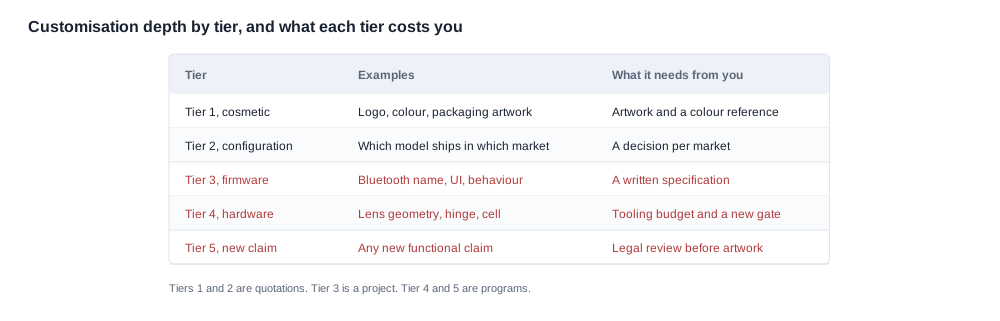
Smart glasses customization depth: what separates a quotation from a project
The practical difference between the categories is not effort. It is whether a number exists yet.
An input has a number already, somewhere in the factory's costing system, because the factory has done that operation before. A colour-matched injection part, an etched brand mark, a printed insert card, a branded package — these are costing inputs. They consume materials and labour, and a competent factory quotes them routinely without an engineering study.
A configuration has a number, but it depends on a decision you have not yet made. Which model ships in which market, which firmware build is loaded, which colourway pairs with which package, which language the artwork carries. There is nothing to invent here, but there is something to decide, and the decision has to be made once and recorded, because it propagates into packaging, manuals, listings and the certification position.
A firmware change has no number until someone specifies the behaviour. "Set the Bluetooth device name to our brand" is close to a configuration item with an input attached. "Change the pairing behaviour so the glasses reconnect automatically after the phone sleeps" is an engineering item, and it carries a verification requirement with it, because a behaviour change needs a test that proves the behaviour rather than a note that says it was done.
A hardware change has no number until engineering opens the gates. Lens geometry, temple styling, hinge behaviour, cell selection, module selection, charging method. These are the changes that reopen the fit approval, the runtime figure in your listing, the transport documentation for the cell, and the regulatory position of the device.
A claim has no number because it is not a manufacturing item. A new functional statement about what the product does is a statement about evidence, and the evidence for it is the published configuration of the model.
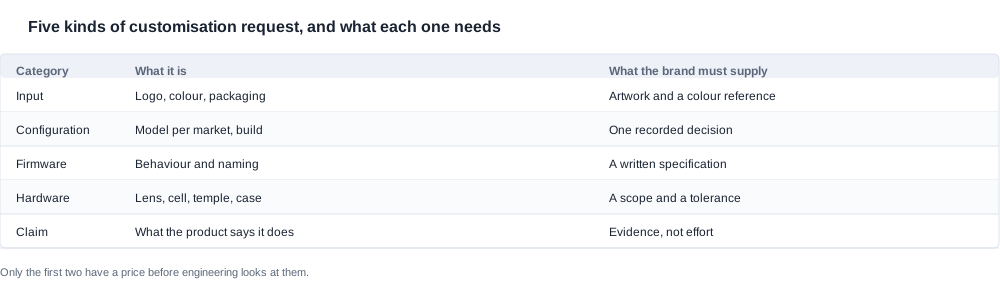
The value of this classification is that it changes what you are asking for. In the first two categories you are asking for a price. In the third and fourth you are asking for a scope and a schedule, and you should expect a quotation for the study as well as for the work. In the fifth you are asking for evidence, and the honest answer may be that the claim is not supportable for that model.
That distinction also decides who at your side owns the conversation. Inputs and configurations belong to purchasing. Firmware and hardware belong to engineering. Claims belong to your legal function, with the supplier's role being to state the evidence rather than to write the copy.

Smart glasses inputs and configurations: lines a factory can price today
The first category is the one most brands are comfortable with, and it is worth getting it exactly right anyway, because rework in this category is disproportionately expensive relative to the money involved.
Logo and brand mark. Engraved, printed, embossed or laser-etched, the technique depending on the surface and the material. The requirement from you is artwork in a form the factory can use without interpretation: vector where possible, and a statement of the minimum stroke width and the clear space, because a mark that is too fine disappears in the mould texture and then you own a second tool.
Colour. Here is the single most common source of rework in the whole category, and it is not the factory's fault. A colour name is not a colour. "Matte black" describes a family of blacks that differ in gloss and in the pigment load, and two factories will produce visibly different results from the same phrase. What the factory needs is a physical or photographic reference, or a Pantone or RAL reference with the surface finish stated, and ideally an approved sample. In our published range the second question is well illustrated: V06 publishes four colour options, and V03 Pro publishes three colour options alongside its photochromic lenses. A programme with four colourways across a range is four approvals, not one.
Packaging and printed materials. The package artwork, the insert card, the user manual, the outer carton. These are inputs, but they carry a dependency that makes them awkward: the packaging cannot be finalised before the model, the colour and the market set are final, because the manual and the box carry the compliance text and the market-specific content.
Configuration. Model-to-market assignment, firmware build per market, colourway-to-package pairing, language on the packaging. Nothing here requires invention, but everything here requires a decision, and the cost of this category is almost entirely the cost of not deciding early. A late configuration decision does not just cost a reprint; it can strand packaging that has already been tooled, and it changes which document set applies to which shipment.
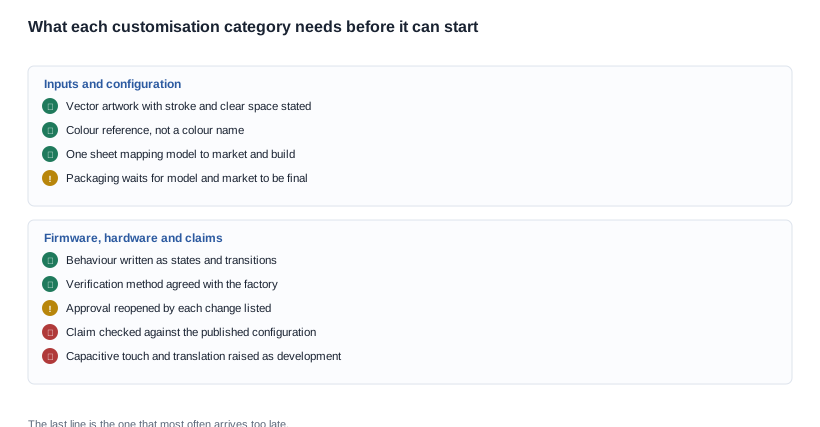
A useful discipline here is to record the configuration decision once, in a single controlled sheet, and to treat it as an input to every other workstream — packaging, manuals, listings, the certification file and the factory's build instructions. In a brand with genuine consumer electronics capability this sheet probably already exists in some form for other categories, and reusing it is cheaper than building a new one. The smart glasses specific addition is the firmware build per market and the pairing between the model and the market, because in this category the model you choose for a market determines which document set that market needs.
Smart glasses firmware work: the specification it needs to start
Firmware is where a brand's specification habit shows. A written specification produces a quotation; a description produces a study, and a study costs money whether or not the work proceeds.
The distinction in practice looks like this. "The device should show our brand name in the Bluetooth menu" is an input to an existing firmware build process. "The device should connect to two phones in sequence and switch between them without a manual re-pair" is a behaviour with states, transitions and a verification method, and it needs an engineering answer before anyone can quote it.
The parts of the firmware surface that a brand is most likely to want are the ones that touch the customer experience directly: the device name, the pairing flow, the power and connection behaviour, the prompt and voice behaviour where it exists, the on-screen interface, and the firmware build identifiers per market. Our published customisation list for the camera and audio models includes system and interface work, the Bluetooth device name and firmware, which means these three sit inside the supported surface for those categories.
There is one point where a brand can lose time without knowing it: a firmware change that touches pairing or radio behaviour may interact with the radio position of the device. We publish Bluetooth version for 14 of the 28 models in our range; for the 11 camera models, the A05 and A06 kids models and the bone conduction entry, no version is published. That is not a prohibition on customisation, but it does mean the answer to "which Bluetooth build does this model use, and can we change it" is a question that has to be asked per model rather than a line on a capability sheet.
The negotiation point worth making at quotation stage is the verification method. Agree what proves the firmware change is done — a build number, a test protocol, a sample unit that exhibits the behaviour — and agree who signs it off. A change shipped without an agreed proof is a change that will be re-opened at the first customer complaint, and at that point the argument is expensive because the brand has already accepted the delivery.
A second negotiation point is the one that determines whether a firmware change stays cheap. Agree now what the change is allowed to touch. A Bluetooth device name is a narrow, contained edit. A change to the pairing flow touches the radio behaviour and the user experience together, and it should be priced and reviewed as a bigger object than it looks. The brands that get good value here are the ones that decide, at the specification stage, which of their requests are genuinely worth the engineering cost, and which are a cosmetic preference they can live without.

Smart glasses hardware changes: the ones that reopen the gates
Hardware is where the risk concentrates, and the reason is structural rather than technical. A hardware change is not only a different product; it is a different product in the eyes of every approval that already exists.
A lens change reopens the fit and the optical performance, and in our range it is also a change to what the model publishes. Photochromic lenses are published for exactly one camera model, V03 Pro, which is also the only camera model publishing three colour options. A brand that wants a photochromic proposition across its camera range is not asking for a customisation of eleven models; it is asking for a product that does not exist in the published range for ten of them, and that is a product-development conversation with a much larger budget than a customisation request.
A charging method change is subtler and it is easy to miss. Our published range separates into magnetic charging on 17 models, Type-C on 7, and four camera models — CY05 and CY03, and L1 Pro and MT6 — for which the charging method is not published at all. A brand that assumes a charging-method change is a wiring detail is assuming something the published configuration does not support for those four models.
A cell or battery change reopens the runtime, the transport documentation, the charging time and the case. Our camera models publish batteries in the 220–290 mAh band with a rated runtime of roughly five to eight hours, and no test condition is published for that figure, so a cell change does not just alter the number on the datasheet — it removes the basis on which the number was stated. On charge time, 26 models publish "2 hours or less" and only D17 and ZH12 publish about one hour, which tells you that charge-time variation is a real dimension in this category and one the factory already manages.
A charging case change is the change with the clearest consumer consequence, because the case is what a customer sees at the unboxing and what a retail shelf has to accommodate. Our range publishes a case capacity for exactly five models — L1 Pro and CY03, and CY05 — each at 1400 mAh, L2 Utral at 900 or 1400 mAh, and MT6 as a 1200 mAh foldable — with a case present but no published capacity for KY06 and MT5, and no case row at all for S7 and V03, and V06, with V03 Pro explicitly published as having no case. Those five published figures are also the best available evidence of how a case is treated in this category: it is a variant dimension, not a standard accessory.
A temple, hinge or frame profile change reopens tooling and the fit approval. It is the most conventional item on the list and the one where tooling cost and stage duration matter most; we do not publish tooling costs or stage durations, because they depend on the specific request and because indicative numbers get planned against.
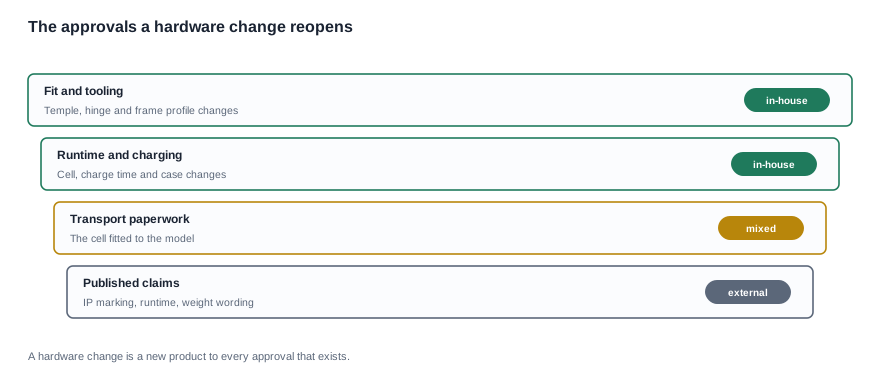
The planning discipline that follows from all of this: write down, before the quotation, which of your requested hardware changes reopen which approval, and put that list in front of the supplier. If they say a lens change does not reopen the fit, you want to know why. If they say it does, you want it in the schedule.
The same discipline applies to tolerance. A hardware change should arrive with a stated tolerance — what varies between units, and what is held fixed. In a moulded product the realistic tolerance is often "this varies and cannot be held", and knowing that before the tool is cut is far cheaper than learning it afterwards. Where a brand holds a tight visual standard, the honest test is whether it can be defined against the factory's process, and if it cannot, whether the standard can be relaxed to what the process delivers without losing the point of the design. That is a trade-off worth making explicitly rather than discovering in the sample round.
Smart glasses claims: the tier that belongs to legal, not engineering
The fifth category is the one that most often arrives disguised as a request. "Can you confirm the glasses are waterproof?" is not a customisation request. It is a question about whether a claim can be made, and the answer is determined by the published configuration rather than by the factory's willingness.
Our published range carries an IP rating on exactly two models. V06 and S7 publish IP54. Nothing else in the catalogue carries an IP marking, so "waterproof", "splash resistant" and "swim-proof" are not available as claims for the other 26 models, and even for V06 and S7 the marking is IP54 rather than a submersion rating. This is worth internalising as a rule: a claim is available to the extent the published configuration supports it, and the absence of a marking is a decision, not an oversight.
The same logic applies to the performance figures. Camera resolution is published at 8 MP across eight models and 13 MP across three — S7 and L2 Utral, and L1 Pro — which makes resolution a tier dimension in this category, though a heavily over-used one, because the number says little about how the image performs in the conditions the customer will actually use. The published runtime figures carry no test condition, so they cannot be converted into a comparative superiority claim. Weight is published for exactly one model, MT6, at 158 g for the glasses alone, explicitly excluding its 1200 mAh foldable case — a precision that tells you the figure is being published for comparison purposes and cannot be applied to other models.
Where a brand wants a claim, the sequence that works is: establish the published configuration of the model, establish whether the claim is supported by it or can be supported by work, and only then write the copy. Legal review should happen before the artwork exists rather than after it is printed, because artwork is where the commitment becomes expensive to change. Our own line on this is short: we will confirm the wording we can support, and we will not put in writing a claim we cannot evidence.
Two categories of request deserve a specific warning because they are commonly assumed and are not published anywhere in our catalogue: capacitive touch and translation. If your product plan depends on either, that is a product-development request with a research and engineering scope, not a customisation line to be confirmed at quotation stage. Raising it earlier is the cheapest thing you can do.
Smart glasses request lists: how to send one that gets a usable answer
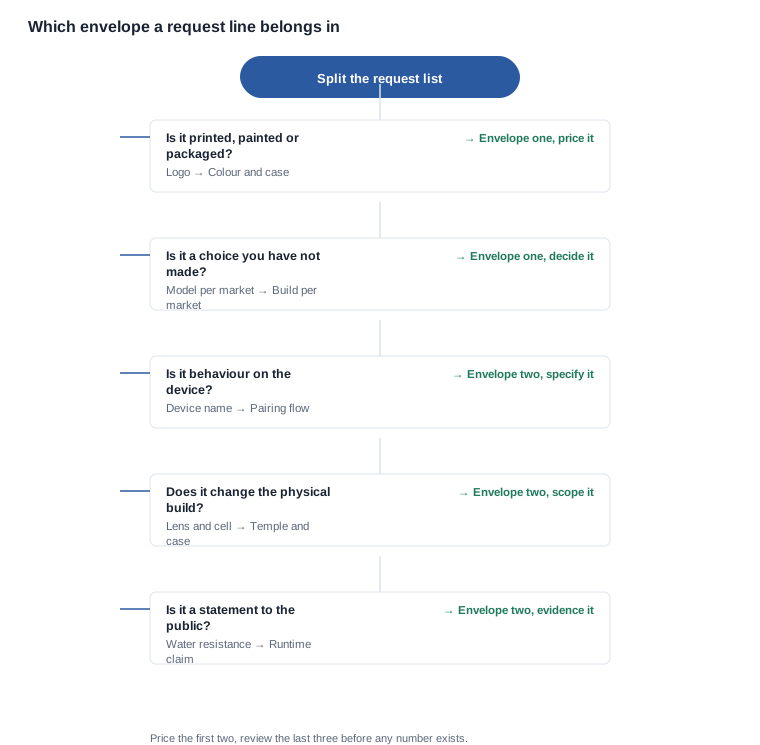
Split the list before it leaves your building, then send it in two envelopes.
Envelope one — the inputs and the configurations — goes out immediately for quotation. For each line, specify the reference, the quantity assumption and the deadline for the factory's answer. This is where a normal quotation round belongs, and it is where you should expect a price back rather than a study.
Envelope two — firmware, hardware and claims — goes out as a scoped request for engineering review, with the explicit statement that no price is expected yet and that the review will identify what must be decided before a price exists. This framing is the single highest-value change most brands can make to their first supplier conversation, because it removes the pressure to produce a number that cannot be produced, and it moves the conversation onto the only question that matters: what is the scope.
Attach to envelope two the specific information the factory cannot guess: the target markets, the model you intend to start from, the published configuration facts you are relying on, and the claims you want to reach. The published facts matter because they bound the answer. If you ask for a photochromic variant and the model you named publishes photochromic lenses — V03 Pro — you will get a scoping answer. If you ask for a photochromic variant of a model that does not publish them, you will get a product-development answer, which is a different conversation with a different budget.
The internal process matters as much as the envelope. A brand with genuine consumer electronics capability usually has three functions that must agree before a request goes out: purchasing, which will want a price, engineering, which will want a specification, and legal or regulatory, which will want evidence for anything that will be said publicly. When these three disagree, the request list becomes ambiguous and the factory prices the cheapest reading. Getting them to agree before the list is sent is what makes the answer usable, and it is cheaper than resolving the disagreement after a quotation has been accepted.
One last point about sequencing. The five categories have a natural dependency order: claims depend on the configuration, configuration depends on the model and the market, and hardware changes can change the configuration that the claims describe. Sending the list in that order — or at least flagging the dependency — means the supplier can tell you which claims survive the hardware change before you have committed to the artwork.
Related reading
- The manufacturing side of the same tiers: smart glasses for consumer electronics brands quality assurance.
- Material and structural specifics: customization options and temple materials.
- Where the engineering risk sits: engineering customization risk assessment.
- What genuinely cannot be known before starting: what is not possible to know about engineering customization.
Send us your request list split across these five tiers and we will price the first two and scope the rest.


