

Smart glasses oem quality expectations agreed after the first shipment has landed are not quality expectations; they are damage control with an invoice attached. Every judgement that governs acceptance — which defect counts as critical, how a unit is observed, who is allowed to call a batch rejected, what evidence closes the argument — has to exist in writing before the purchase order is issued. After that point each judgement becomes a negotiation the buyer conducts alone, on the factory's schedule, with the goods already moving. This article is about constructing that document for a smart glasses OEM programme, and about the specific rows a published catalogue can and cannot carry for you.
The argument runs through four stages: why the pre-order moment is the only cheap one, how a product class changes what "acceptable" has to mean, which published specification rows can anchor an acceptance rule, and the sequence in which acceptance terms become decidable. It is deliberately a framework rather than a set of thresholds, because the thresholds that decide whether a unit is acceptable are yours to set, and the rows that make them settable are what a catalogue can supply.
Why quality expectations set after the order are damage control
The order is the only point at which both parties still have something to lose from vagueness. Before it, the factory has quoted a configuration and the buyer has a clear expectation of what is being bought. Once production starts, that symmetry is gone: the factory's exposure is sunk cost, and the buyer's exposure has not yet become visible. An acceptance rule introduced at that point is negotiated by the party with less leverage, against a date that is no longer the buyer's to set.
What a quality expectation has to name
An acceptance rule becomes enforceable only when it names three things, and the third is the one most often left out.
-
The condition. A specific, observable state of the specific unit being judged. "The battery" is not a condition; "the cell fitted to the unit presented" is.
-
The method. How the condition is observed — against which reference, under which stated conditions, using which instrument or which trained person. A method that changes between the first article and the production run is not a method.
-
The consequence. What happens when the observation fails: the unit is rejected, the batch is held, the goods are reworked, or the deviation is accepted and written down with a named owner. A rule without a consequence is a preference.
Compare that with a clause reading "the goods shall be of good quality and free from defects". It names no condition, no method and no consequence, so no goods-in team can act on it and no supplier can be measured against it. That clause is not a stronger standard; it is the absence of one.
Why the pre-order moment is the only cheap one
The cost of revising an acceptance term rises at every stage, and it rises faster than the calendar suggests. Before the purchase order, a revised term is a redline in a document nobody has yet acted on. After the order, it is a commercial negotiation with the factory, who by then have committed material and labour. After the first article, it is a schedule conversation, because the line has been set up to build to the term that was agreed. After shipment, it is a dispute about goods that have already crossed a border, where the buyer's practical remedy is a credit or a return.
A useful side effect of writing the term early is that resistance becomes diagnostic. A supplier who objects to a written acceptance rule is usually objecting to the measurement it implies, not to the paperwork. Where the supplier cannot currently evidence the condition — a per-model report, a reference unit, a repeatable test — that is a due diligence finding about their process, and it is far cheaper to discover it at the specification stage than at the first article. Treat the objection as information about what the factory can measure, and ask for the method before asking for the pass.
What a catalogue can and cannot settle about quality
Our catalogue publishes specification rows. It does not publish quality metrics, and the distinction matters more than it may appear: a published specification is a fact about the design, while a quality metric is a statement about a population of manufactured units under a stated method. The first can be asserted in an agreement. The second has to be earned, measured and witnessed.
So the practical role of the catalogue in a quality plan is narrower than buyers sometimes expect, and more useful than it may seem. It cannot tell you whether a factory's output is good. It can tell you exactly what object a quality plan is being written about, which is the one thing that most often goes missing from an acceptance dispute.

Classifying the product before setting any tolerance
A tolerance means nothing until the object being tolerated is known. The first act of writing an acceptance plan is therefore not to write a threshold but to decide what kind of thing is being accepted, because the answer determines which defects are even possible, which of them matter, and who has the standing to judge them.
Four defect classes and who judges them
Working across this category, defects divide into four classes, and each class has a different natural judge. The classification is worth making explicitly because the same physical event lands in a different class depending on the product, and the class determines the evidence needed and the authority required to act.
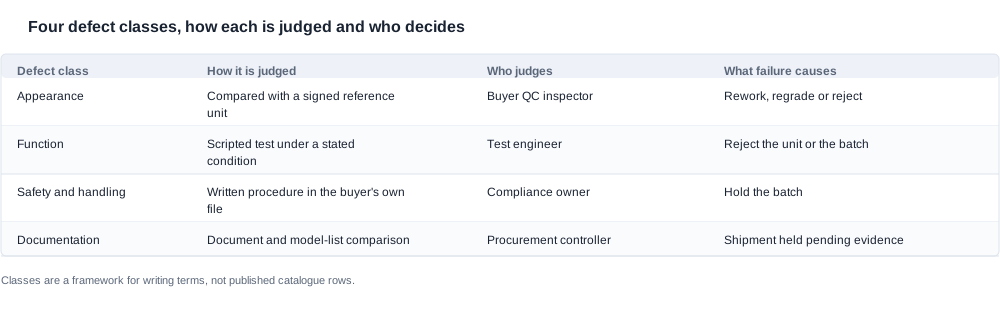
The authority point is the one buyers under-specify. Appearance defects are judged by a person against a signed reference unit, which means the reference unit has to exist and be held by both sides; a defect class judged without one is a matter of taste. Functional defects are judged by a script, which means the script and its stated conditions have to be part of the file. Safety and handling defects are judged against the buyer's own written procedure, which means the procedure has to exist before the first shipment rather than after the incident. Documentation defects are judged by comparing a document against the order, which means the model list printed on that document is part of the acceptance criterion.
The three structures that change the risk profile
Within the 28 published models across seven categories, three structural differences do most of the work in deciding what your acceptance file has to cover.
The camera group changes what you inspect. Eleven camera models carry an optical and an electronic assembly at the same time, and the published resolution splits them into eight models at 8 MP and three at 13 MP — the S7, the L2 Utral and the L1 Pro. Capture function is one defect class; lens surface and temple finish are another; and the charging interface adds a third, because the interface is published as magnetic on five of the eleven camera models, as Type-C on the V03 Pro and the L2 Utral, and is not published at all for the CY03, the L1 Pro and the CY05, and the MT6. Four models with no published interface row cannot be handed to a bench without an answer from the supplier first.
The audio group changes what you can inspect at all. The eight audio models publish either a Type-C interface — on the D11 and the D12 only — or magnetic charging, and as a group they publish neither a charging-case row nor an ingress row. That is not a detail; it means two entire categories of acceptance question have no published anchor for this group, and a buyer who does not close them will discover them at goods-in.
The sport and children's groups change the kind of criterion. The three sport models include the D17 and the ZH12, which are the only two models in the catalogue publishing a charge time of about one hour, and the only two with a remote shutter, which makes the shutter a distinct inspection item rather than a feature line. The three children's models publish behavioural rows rather than mechanical ones: the catalogue lists a fogging unit, correct and incorrect posture-and-distance prompts, and lens clarity and lens fogging for the A05 and the A06. Criteria for those rows are behavioural and time-bound, so they need an observation window written down, not a measurement instrument.
Two catalogue entries are published without a model code at all: an electrochromic entry and a bone conduction entry, the latter with an amplification gain of 35 dB. For a bone conduction unit the gain figure is a published row, which means the acceptance rule around it must be drafted so that a functional unit cannot be judged to have made a hearing-aid claim — that is a compliance boundary rather than an engineering one, and it belongs in the file as a wording constraint.
Where classification stops and compliance begins
A unit that functions correctly but makes a claim the supporting documentation does not cover is not an acceptable unit. The defect in that case is the claim, not the function, and it cannot be cured by rework. This is the point at which defect classification becomes compliance classification, and it is why an acceptance file has to reference the documents the product's claims depend on.
Our catalogue carries a company-level export certification page whose content is images rather than text, and the catalogue text contains no reference to CE, FCC or RoHS. There is no per-model certification row anywhere. What can be named as a framework is the Radio Equipment Directive (EU) 2014/53/EU for radio equipment and the EMC directive 2014/32/EU for electromagnetic compatibility; what cannot be named is the status of any particular model under either, because the catalogue does not publish it. The certification page shows ten patent certificates — eight appearance-design patents and two utility-model patents — which is a company-level fact about intellectual property rather than a per-model conformity statement.
The practical consequence for a quality plan is precise: the model list printed on each conformity document is the acceptance criterion. A document that exists but does not name your configuration is coverage that is not yet coverage, and the check that catches it is a document comparison performed before the purchase order rather than after customs asks.

The published rows a quality plan can anchor on
An acceptance rule needs an anchor — a row that is already fixed, so that a disagreement is about the rule rather than about the underlying fact. Our catalogue publishes enough rows to anchor a good part of a plan, and the structure of what is published is itself useful information.
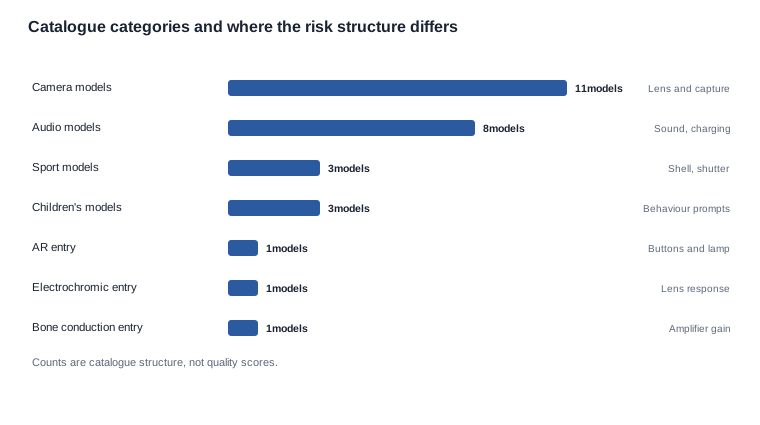
The grouping matters because the categories are not risk-equivalent. The eleven camera models present the widest inspection surface — an optical assembly, an electronic assembly, a charging interface and in several cases a separate case. The eight audio models present the narrowest published surface, which is precisely why their unpublished rows matter more. The three sport models carry the remote shutter and the faster published charge time. The three children's models carry behavioural rows. And the three entries without a model code sit outside all of that, which is why an acceptance plan should not treat them as ordinary catalogue rows.
The rows that can carry a judgement
The table below sets out the published rows that can anchor an acceptance rule, what each one can legitimately support, what it cannot support on its own, and where the missing half has to come from.
| Published catalogue row | What it can anchor | What it cannot anchor | Where the missing half has to come from |
|---|---|---|---|
| Charge time — published for all 28 models; 26 at two hours or less, the D17 and the ZH12 at about one hour | The duration of a charge-cycle test on the bench | The point at which a charge counts as complete, since no starting state or termination criterion is published | The supplier's written test procedure |
| Rated runtime — published for all 11 camera models | The load condition a runtime test has to reproduce | Radio environment, temperature and the starting state of charge | The supplier's written test procedure |
| Resolution class — 8 MP on eight camera models, 13 MP on the L1 Pro and the L2 Utral, and the S7 | Which capture unit the approval sample belongs to | Sensor model, field of view, frame rate and video format | A supplier data sheet plus a bench test |
| Charging interface — magnetic on five camera models, Type-C on the V03 Pro and the L2 Utral, no published row on the CY05 and the L1 Pro, and the MT6 and the CY03 | Which connector or contact set the acceptance bench uses | The interface on the four models where no row is published | Supplier confirmation, then a bench check |
| Charging-case capacity — 1400 mAh on the CY05 and the CY03, and the L1 Pro, 900 or 1400 mAh on the L2 Utral, a 1200 mAh folding case on the MT6 | Which case ships in the box and what its endurance test covers | Which of the two published variant names on the L2 Utral page goes with which capacity | Supplier correspondence, then a label check on the first article |
| Ingress marking — IP54 appears on the V06 and the S7 only | That a specific marking exists for two named models | Any third-party test report standing behind that marking | A supplier document that names the model |
| Published colour options — three on the V03 Pro, four on the V06 | The colour band of an approved reference unit | Whether a production run stays inside that band | A batch colour check against the signed reference unit |
Reading it as a whole, the pattern is consistent: published rows identify objects reliably and describe behaviour poorly. Cell capacity, resolution class, interface type, case capacity and colour are all fixed facts you can put in an agreement. Everything that describes how a unit behaves under load — how long it actually runs, what "fully charged" means, whether the capture module holds up, how a case performs over a shift — is absent from the catalogue and has to arrive as a method.
The four layers of quality evidence
Every acceptance question falls into one of four layers, and mixing them up is the most common way a quality plan fails to be executable.
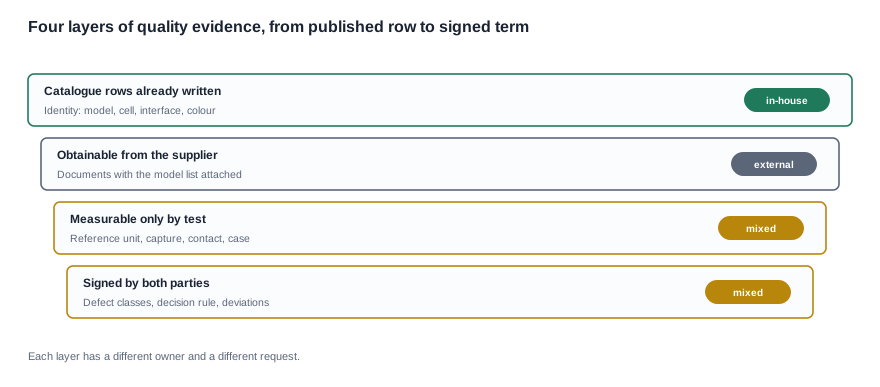
The first layer is already written: model designations, cell capacities, resolution classes, charging interfaces, case capacities, colour options, the ingress markings, rated runtimes and charge times. Nothing needs to be requested, because it is published. The second layer is obtainable from the supplier on request, and it is the layer that decides whether your programme is documentable: per-model conformity documents with the model list attached, the test report behind an ingress marking, the build revision of the sample, the correspondence between the L2 Utral's two published variant names and its two published case capacities. The third layer can only be reached by testing, and it is where the acceptance plan earns its keep: appearance against a reference unit, capture and audio performance under a stated condition, charging-contact continuity, case endurance, runtime under a stated load. The fourth layer is the only one nobody can source from a catalogue, because it is bilateral — the defect class definitions, the reference unit, the decision rule and the deviation log, each signed by both parties before the order is placed.
The value of the layering is that it tells you where to spend effort. A buyer who treats layer one as the whole plan discovers at goods-in that nothing was measured. A buyer who treats layer four as the whole plan discovers at the pre-production sample that the factory never agreed to anything. The layers have to be worked in order, and the order is not negotiable in either direction.
The rows the catalogue does not publish
The catalogue does not publish unit prices, price tiers, minimum order quantities, lead times, production capacity, warranty periods, certificate numbers, yield, defect rates, tolerances, test coverage or certification status for any model. That is a long list, and every item on it has to be obtained in writing before an order, because none of them can be inferred from a specification page.
Two of those absences change how a quality plan is written. There is no published tolerance anywhere in the range, so a tolerance band cannot be copied from the catalogue and must instead be expressed as a reference to a signed unit plus a stated judgement procedure. And there is no published test coverage figure, so the plan cannot borrow a coverage percentage to justify a sampling level; the coverage has to be written as a list of functions, and the list becomes the standard.
There is also no published certification status per model, which is the row most often assumed to exist and the one whose absence most changes the order of operations. Document retrieval has to start before the purchase order, not after.

The order to settle the acceptance terms in
Acceptance terms are not interchangeable, and they do not all have to be settled at the same moment — but they have a sequence, and the sequence follows one question: does this term become decidable from a document, or does it require a physical unit in front of somebody?
Three questions that decide who judges
For each acceptance term, three questions settle how it will be handled, and answering them in order prevents the most common failure in this category: a term that is written down but that nobody has the authority to act on.
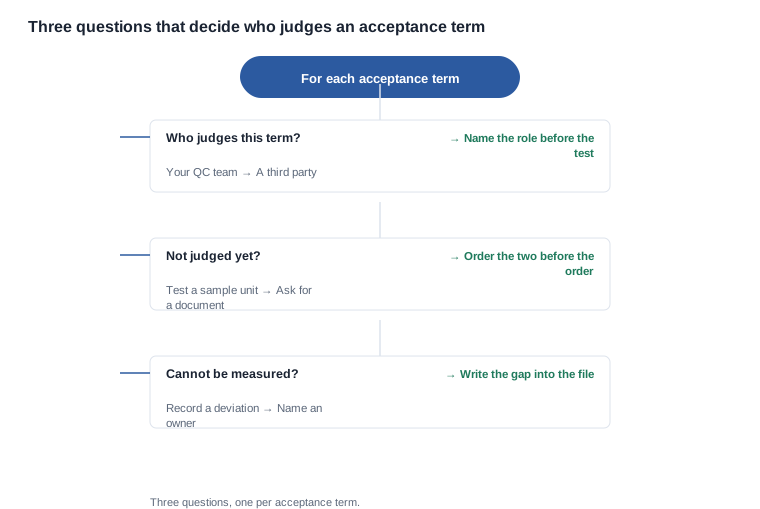
The first question asks who judges. If the answer is your own quality function, the term is under your control and you can write the method as you want it. If the answer is an independent inspection body, the method has to be written so that a third party can execute it without a briefing, which usually means stating conditions rather than outcomes. If the answer turns out to be the supplier's own quality function, you should know that before the first article, because it tells you that the acceptance of the first shipment depends on the party that built it. The second question asks what to measure first when nobody can judge yet, and the answer is nearly always a sample unit rather than a document, because a document describes a design while a sample describes a build. The third question asks what goes into the agreement when a term cannot be measured at all, and the honest answer is a recorded deviation with a named owner rather than a silent omission — an unmeasurable term written as "not applicable" is indistinguishable from a term that was never addressed.
The acceptance terms, settled in the order they become decidable
Settled by this logic, the terms fall into a workable order, from the most fixed to the least.
-
The unit identity. Which model, which configuration, which published variant, which colour, which case. This is decided from catalogue rows and a supplier confirmation, and it must be first because every later term is measured against it.
-
The defect classes. The four classes, each with a written definition and a stated consequence. These are decided in negotiation, they cost nothing but a meeting, and they cannot be borrowed from a catalogue.
-
The reference unit. A signed and retained unit that separates acceptable from not, with an agreed retention period and an agreed procedure for handling damage to it. For appearance terms this is the whole mechanism.
-
The observation conditions. For each functional test, the starting state, the environment, the load and the duration. The catalogue's charge times and runtimes can be reproduced only if these are stated, because neither figure comes with a condition.
-
The inspection stage. Whether inspection happens at the factory, through an independent body, on receipt, or at a combination of them. Each stage catches different problems, and each carries a cost and a lead time that a buyer should decide deliberately rather than inherit by default.
-
The documentary evidence. Which documents support the claims, what each one must name, and who verifies the model list on each. For this catalogue that list starts with the per-model conformity documents, the report behind the ingress marking, and the correspondence between published variant names and published capacities.
-
The decision rule. Who records the acceptance decision, against which reference, where the record is filed, and what happens to a unit whose class is disputed. This is the term that converts the rest of the file from a description into a process.
The terms that cannot be settled verbally
Three items in particular should never be left as an understood arrangement, because each one is cheap to write down and expensive to reconstruct from memory after a rejection.
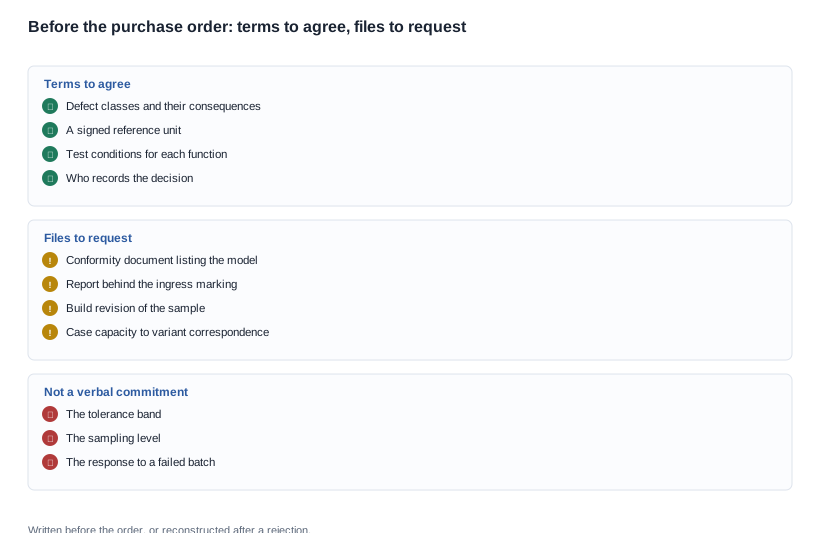
The tolerance band belongs in writing because tolerance is expressed relative to a reference unit and a judgement procedure, and both of those disappear when nobody can remember which unit was the reference. The sampling level belongs in writing, together with the stage at which it is applied, because an inspection level quoted without its stage or its sample is a number with no denominator behind it. The response to a failed batch belongs in writing because it is the term that decides whether a problem is an inconvenience or a crisis, and the decision is usually needed on a day when nobody is in a position to be generous.
The decision itself should also leave a record. A judgement written on an inspection sheet, with a date, a signature, the unit reference and a pointer to the criterion that was applied, is evidence. The same judgement remembered two years later, in a conversation about a batch that has long since been sold, is an argument. The difference between the two is entirely a matter of whether somebody wrote it down at the time.
The smart glasses oem quality expectations
The honest summary of what a published catalogue contributes to a quality plan is narrower than buyers expect and more useful than they assume. It fixes the identity of the object being accepted: 28 models across seven categories, 11 camera models split between 8 MP and 13 MP, 8 audio models, 3 sport models, 3 children's models and three entries published without a model code. It marks the structural points where the risk profile changes — the IP54 markings that exist on the V06 and the S7 only, the 158 g published weight of the MT6 glasses body excluding its folding case, the remote shutter that appears on the D17 and the ZH12 only, the detachable inner frames on the V06 and the S7 and the detachable temple on the G07.
What it cannot do is supply the judgement layer. The catalogue publishes no yield, no defect rate, no tolerance, no pass rate and no test coverage figure for any model, and it publishes no certification status per model either. Those rows are not withheld as a commercial matter; they are properties of a manufacturing run under a stated method, and the only party who can produce them honestly is the party that runs the production and the inspection.
In that respect our position is narrow and deliberate. We publish the specification rows we hold, and where a quality metric is not published we would rather mark it as not published and tell you what to request than hand over a figure whose method we have not shown you. We will help you draft the acceptance terms against the rows that do exist, and where a term cannot be written from a catalogue row we will tell you that the supplier has to supply it, in writing, before the order — because a term discovered at goods-in is not a term, it is a claim.
The practical sequence is short. Write the defect classes first, because they cost nothing and they decide everything else. Anchor them against the published rows where a row exists, and mark the rest as supplier-supplied. Ask for the documents while there is still a programme to influence, which means before the purchase order rather than after. And keep the decision record, because that is the one artefact that decides disputes rather than starting them. The scope of what sits underneath all of this is set out on the OEM and ODM services page.
Related reading
- Where each of these terms is normally settled during development — the smart glasses development process.
- The engineering side of a specification freeze — engineering customization risk assessment.
- What happens to a batch after it has been accepted — after sales support channels.
- Handling the confidential documents behind an acceptance file — smart glasses oem confidentiality.
- Quality assurance for a brand that owns the specification — smart glasses for eyewear brands quality assurance.
The acceptance file is the cheapest document in an OEM programme, and the one most often left unwritten.


