
Support channels are usually discussed after the first return arrives, which is the worst possible moment, because every term is then negotiated under time pressure by two parties who would rather be doing something else. After sales support is cheap to define and expensive to retrofit, and the terms worth defining are specific enough to write into the purchase order rather than settle over a call.
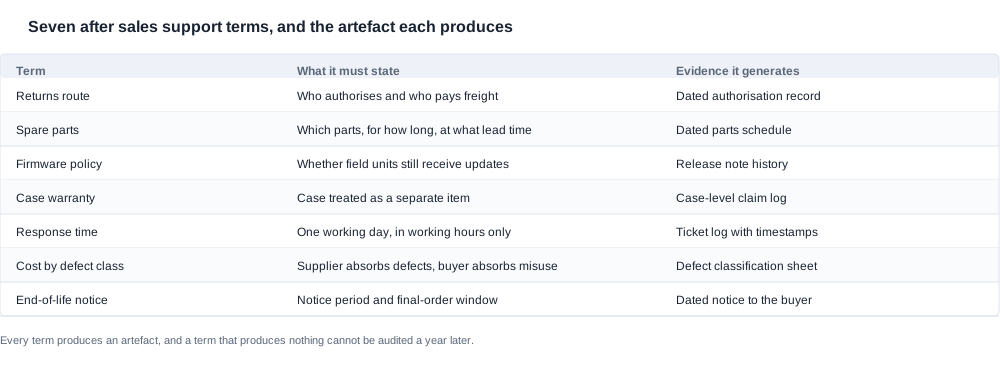
After sales support channels: seven terms and what each one is really about
1. The returns route, not a contact name. A contact name is a person who may have left. A route is a defined process: who raises the return, how it is authorised, what documentation travels with it, where it goes, and who pays freight in each direction. Freight is the term that causes the arguments, so state who pays it explicitly rather than leaving it to custom.
2. Spare parts, as a list. Which parts are orderable separately — charging cables, cases, temples, ear tips, bands — for how long, and at what lead time. A channel with a three-year product life and a two-year spare-parts list has a problem it discovers in year three, when nobody is watching.
3. Firmware policy for field units. Do units already shipped receive updates, and for how long? This matters more than it sounds, because a user who changes phone may need to reconnect the device, and reconnecting depends on firmware that must still be downloadable.
4. Warranty on the case, separately. Where a charging case is supplied, it is a second product with its own failure modes and a higher drop rate than the glasses it charges. Three case capacities are published across this range — 900, 1200 and 1400 mAh — which makes cases a meaningful fraction of the shipped item count rather than a trivial accessory.
5. A response-time commitment in working hours. Not a resolution time — a response time. A response within one working day bounds how long a customer waits, and it is a commitment most factories can actually meet. Resolution times are promises nobody should make, because the variables behind them are not yours to control.
6. Who absorbs the cost, by defect class. Agree that the supplier absorbs cost for defects against the agreed specification and that the buyer absorbs it for damage in transit or misuse. Without this, every claim becomes a negotiation about fault, and the negotiation happens when the customer is already unhappy.
7. End-of-life notice. How you are told a model is ending, how much lead time you get for a final order, and what happens to firmware and spares after that date. This is the most commonly omitted term in this category and the one with the largest long-tail cost.
The order of these seven is not arbitrary. The returns route and the freight rule bind on the very first claim, so they are the two that cost the most when they are wrong. Firmware policy and spare parts bind later but bind for longer, because they apply to units already in the field. The end-of-life notice binds last and hardest, because by the time it matters it is the only lever you still hold.
What makes a term real is that it can be written down and pointed at. A term that exists only as an understanding has no owner, no measurement and no remedy, and it will be tested for the first time on the day something goes wrong.
One practical consequence deserves emphasis for channel buyers specifically: the returns route has to be defined for the market, not just the language. A support channel that works for a single territory will not survive expansion, because the freight rule, the customs treatment of returned goods and the address on the RMA are all jurisdiction-dependent. Deciding these before the second market opens is considerably cheaper than retrofitting them once two territories are shipping.


Channel design: three topologies and the trade-off in each
The word "channel" hides a decision. In practice there are only three arrangements, and each has a different failure mode.
Direct-to-customer through your own desk. Your team receives the claim, decides the remedy, and reclaims the unit. Maximum control over the customer experience and maximum exposure to your handling labour per unit. This works when volume is predictable and the return rate is low, and it degrades quickly when either assumption breaks.
Distributor or reseller relay. The channel partner receives the claim and passes it to you for authorisation. Lower handling cost per unit and far better local language coverage, but the customer experience is now something you influence indirectly. The agreement needs a defined response standard that binds the partner, or you have delegated the problem without retaining the outcome.
Supplier-hosted. The manufacturer runs the support desk and settles claims against agreed terms. The cheapest option per unit and the one that most exposes you to a slow response, because you are no longer the party the customer is waiting on. It works when the supplier is measured on response time and nothing else.
Most programmes run the direct desk during the pilot and drift toward the relay model at volume without ever choosing it. The drift is normal; the absence of a decision is not. Whichever topology you run, the terms above are what make it function.
Escalation is the fourth thing, and it is not a topology. Where does a claim go when the first channel cannot resolve it, who owns the decision at that point, and how long does it sit there? An escalation path with no named owner at the top is the most common reason a claim stays open past a month. Write the ladder with roles rather than names, because names change and the obligation does not.
The channel decision also determines what you can measure. The direct desk produces a claim rate per hundred shipped that means something, because every claim passes through you. A relay model produces a claim rate that depends on the partner's diligence, so you have to ask for their numbers rather than assume them. Before you commit, establish which of the two you will be working with, because the answer determines whether your return-rate data can be trusted at all.
Whichever topology you choose, the buyer keeps two obligations that never transfer. The first is the product record: what configuration was shipped to which customer, with which accessories, against which purchase order. The second is the end-of-life decision, because only you can decide when to stop selling. Both are easy to delegate in a relay model and neither should be, since a partner optimising for their own sell-through has a different date in mind than you do.
Ask the supplier which of the three topologies they have run before, and for what volumes. The answer tells you more about how their support operation actually works than any service description in a quotation, and it costs one question to ask during due diligence.
What support actually costs, and where the cost hides
Support cost in hardware is dominated by three things, and none of them is the unit price: freight on returns, handling labour per unit, and units that fail for reasons the specification never covered.
Freight is the term most often left implicit. A two-way return on a low-value accessory is frequently more expensive than the accessory, and if neither party has stated who pays, the claim stalls while both sides calculate. Handling labour is the second term, and it scales with the number of touches rather than the number of claims: a claim resolved by a reset instruction costs nothing, while the same claim resolved by a return costs a unit in labour regardless of outcome.
The way to reduce both is to define the terms above so that the cheap resolutions — a replacement cable from your own stock, a documented reset procedure, a reconnect step the user can follow — are available without a return at all. This is a design decision made at the channel-terms stage, and it costs nothing to get right there.
Measure the three cost drivers separately rather than as one support figure, because they respond to different fixes. Freight responds to who pays and to whether the item was worth returning; handling labour responds to the number of touches per claim; uncovered failures respond to the specification itself. A programme that reports only total support cost cannot tell you which of the three is moving, and will therefore keep paying for the expensive one.
The first ninety days of return data is worth more than the following year, because it is the only period where the specification, the packaging and the user expectation are all still inside your control. Count returns per hundred shipped, split by cause, from the first batch — even if the cause codes are crude, because the series is what you need and the precision of any single month is not.
Expect the first quarter to be dominated by accessory causes rather than unit causes, and treat that as a specification finding rather than a quality finding. A high cable return rate usually reflects the in-box contents, and a high case return rate usually reflects drop exposure in transit. Neither is visible in a factory acceptance report, and both are cheaper to fix in the packaging specification than in a discount on the unit.
Keep the three cost drivers on separate lines even after they are under control, because the relationship between them changes as volume grows. At pilot volume freight dominates and handling labour is invisible. At programme volume handling labour dominates because touch counts accumulate, and freight has already been optimised. A programme that watched only one line would have drawn the wrong conclusion in both periods.
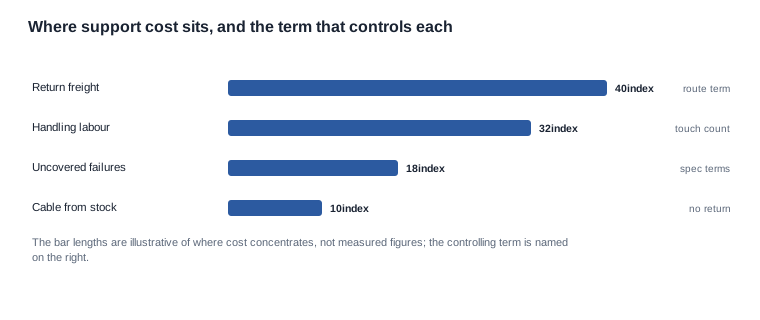
The bar lengths above are illustrative of where cost concentrates, not measured figures for this range, and the right-hand column names the term that controls each one. That distinction matters when you take the model to a supplier: the useful part of the chart is the mapping, because it is the mapping that has to be negotiated, not the ranking.

The checklist that turns a term into an obligation
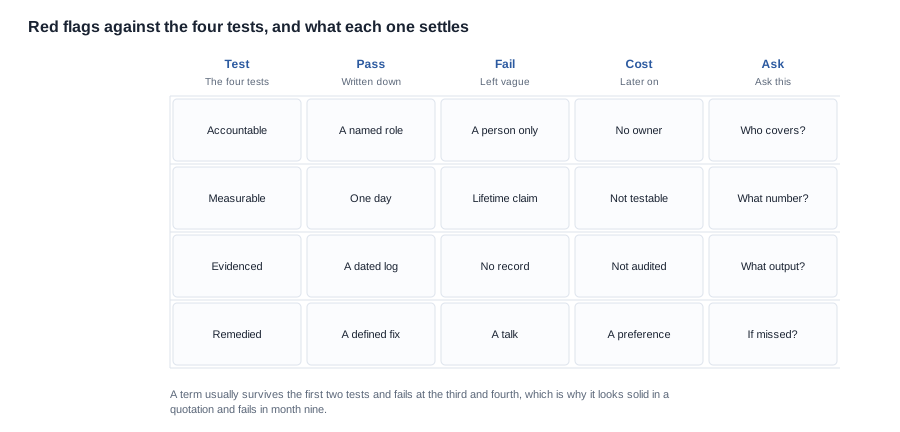
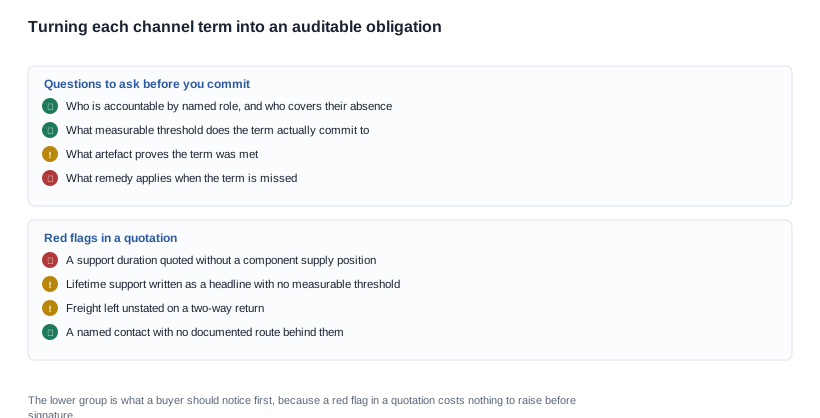
A term becomes real when somebody can be held to it. Run each of the seven through the same four questions before you sign.
Who is accountable? Not the department, the named role. If the answer is "the account manager", ask what happens in the week the account manager is absent, because in a small factory that is most weeks.
What is the measurable commitment? A response in one working day, a spare-parts list maintained for a stated period, an end-of-life notice given a stated number of days ahead. Anything expressed as an intention is not a commitment and will not survive a difficult quarter.
What evidence proves it was met? A ticket log, a dated notice, a signed spare-parts schedule. If nothing is generated, the term cannot be audited, and an unauditable term is an aspiration.
What is the consequence of a miss? A defined remedy, or at minimum a defined escalation. Without a consequence, a term degrades into a preference, and a preference does not survive contact with a peak season.
These four questions are the same on every one of the seven terms, which means you can apply them in a single pass with a spreadsheet and finish before the quotation comes back.
Run the pass with the supplier present rather than by correspondence. Half the answers are clarifications of wording rather than disagreements about intent, and a clarification settled in a call takes a minute, while the same clarification settled over email takes a week and reopens on the next revision.
Then keep the completed sheet. It becomes the first page of the support annex, and it is the document you refer back to when a term is tested for the first time — which is always later than anyone expects.
A worked example shows why the pass is worth doing. Take the response-time term on a cased model. The commitment reads "one working day" and passes the measurable-threshold test. The artefact question exposes the problem: a ticket log with timestamps is easy for the supplier to generate, so the term looks satisfied even when the customer waited nine days, because the first timestamp is when the ticket was assigned rather than when it arrived. Two minutes of questioning moves the threshold to first response by a customer, and the term then means what the buyer assumed it meant. The same pattern repeats on freight, where "supplier pays return freight" is unambiguous until someone asks whether the original outward freight is included.
The fourth question is where terms usually have no answer at all. Ask what happens when the response-time commitment is missed and the supplier's answer is a discussion about circumstances rather than a remedy. That answer tells you the term is aspirational, and you now know it before signature rather than in the first difficult month.
Sequence the pass by risk rather than by document order. Start with the two terms that cost the most when they are wrong — the returns route and the freight rule — because those are the ones tested within weeks of the first shipment. End with end-of-life notice, because it is the term you will not exercise for years and therefore the one a supplier is most likely to agree to quickly and least likely to resource. Record each answer with a date and a name against it, so the sheet remains usable as evidence when the term is finally tested rather than merely remembered.

The boundary we will not cross
We will support a product. We will not commit to a support duration we cannot guarantee across component supply, and our published materials do not state a support window, so we will not quote one here. What we can do is tell you, for your product, which of the seven terms we can meet as written, which need a commercial conversation, and which depend on a component supply position we would have to check at the time.
A supplier who writes lifetime support into a quotation has usually not asked anyone in engineering. Treat it as an aspiration until it has an owner, a measurable threshold and an audit trail, because those three things are what separate a term from a slogan.
The same boundary applies to figures. Our published materials do not state a response window, a spare-parts duration or a lead time as fixed values, and we will not invent one in a document that later gets read as a commitment. Where a number turns on the configuration and on the stage a model has reached, we will say that it is confirmed per enquiry and put the confirmed value in the agreement, which is the only place a number becomes enforceable.
This matters more than it appears. A quoted figure that later proves optimistic is not merely inconvenient; it converts a commercial conversation into a credibility problem that affects the parts of the relationship you have not yet tested.
What we can commit to, and what we will not
We would rather negotiate these seven terms before the first shipment than explain them afterwards. Most of them cost the supplier nothing to agree at the start and a great deal to agree late, which is why the same conversation is easy in month one and expensive in month nine.
In practice we can commit to the mechanical terms — the returns route, the freight rule, the cost split by defect class, the response time in working hours — because those depend on how we run rather than on what the component market does. What we will discuss rather than promise in advance is anything tied to component availability: a spare-parts duration, an end-of-life date, a configuration held open specifically for you. Those are answers we can give against your actual product and your actual volumes, and they are meaningless as a general commitment.
The distinction is worth holding onto during negotiation. A supplier who refuses to commit to a duration may simply be protecting you from a commitment they cannot keep, and a supplier who commits to everything is telling you that engineering has not been in the conversation.
Before you commit, put the seven terms in writing and ask for them as part of the quotation rather than as a follow-up document. A term included in the quotation has been priced into somebody's decision; the same term arriving by email two weeks later is an add-on that someone has to find budget for, and add-ons are the first thing removed when a project is re-scoped.
The same pass should establish who signs for each side. A support annex signed by a sales manager and countersigned by nobody in operations is a document that describes an intention, and it will be read that way the first time it matters.
The development stages that create the artefacts these terms refer to are set out in the smart glasses development process, the customised-product version of the same long-term question is in engineering customization long term support, and the response-time commitments themselves are broken down in after sales support response times.
Related reading
- Agreeing acceptance criteria in the first place: smart glasses oem quality expectations.
- The returns route in practice: after sales support returns and RMA.
- Sample handling, which is where aftersales problems usually begin: what to check when a sample arrives.
Send us the markets and the volumes and we will tell you which of the seven terms we can meet as written.


