

A consumer-electronics brand that has decided to put its name on a pair of smart glasses usually starts with a question that sounds like a scheduling question and is not one. "How long does this take?" is the wrong first question, because the published supplier catalogue for smart glasses contains no stage durations, no lead times, and no indicative schedule at all. Nothing in the published material tells you that a compliance file closes in a given number of weeks or that a pilot order ships in a given number of months. That absence is not a gap in the information; it is the actual condition of this supply chain, and any timetable a buyer is shown has to be reconstructed from the framework rather than read off a list.
What the published material does give you is a development framework: a fixed order of gates, each closed by a document rather than by a date. Six gates run in sequence — requirements frozen, feasibility reviewed, engineering and tooling, samples built and verified, compliance file closed, pilot run before mass production — and each one produces a named output that the brand can hold, read, and sign. That is the only timeline a buyer can honestly publish internally, and it is a stronger negotiating position than a calendar, because it converts an open-ended promise into a list of conditions that can each be checked.
This article walks the framework the way a consumer-electronics brand actually experiences it: the ordered path from a first conversation to a shippable programme, the decisions the brand must take before the programme opens, the choices that are expensive to undo once tooling exists, and a practical way to track progress when no schedule is published. Read it alongside how to get started with smart glasses, which covers what a buyer should prepare before the first conversation, and the ODM development design phase, which goes deeper into the earliest gate. Use the OEM-ready product range as the catalogue entry point and the consumer electronics brands solution page as the place where this framework is described in context.
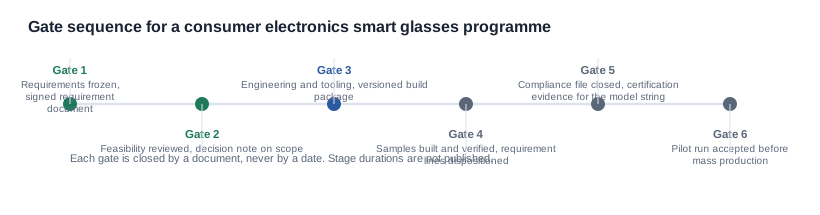
Smart glasses programme: the gate sequence
We will treat the sequence as a chain of documents, because that is the only way it can be tracked without a published schedule. Each gate below is closed by an artefact that exists in the brand's own files, and each artefact is the thing the brand signs off before the next gate opens. If a gate cannot produce its document, the gate is not closed, no matter who says it is.
Gate 1 — Requirements frozen. The programme opens with a written requirements document, and it is the most consequential document in the chain because everything downstream inherits from it. The document names the target market, the reference catalogue group, the required capabilities, the intended claim set, and the accessory and packaging expectations. Nothing physical has been ordered at this point and no quotation can be final, but the brand has committed to a specification in writing. A verbal brief is the most common cause of a mismatch discovered after tooling exists, so we will not advance past this gate on one. The requirements document is also where the brand records its own constraints — the retail channel, the certification evidence the brand needs for its market, the warranty position it intends to offer, the packaging language — so that the supplier can respond to the whole picture rather than to a feature list.
Gate 2 — Feasibility reviewed. The supplier reads the frozen requirements and returns a feasibility assessment: which published models and platforms can satisfy them, which parts of the request fall outside the current catalogue capability, and what would have to change. This is where trade-offs surface honestly. A requirement can be met with an off-the-shelf configuration, met with a modification, met with a new engineering path, or cannot be met at all. Each outcome carries a different commercial consequence, and the brand needs to see which one applies before it commits further. We will record the feasibility outcome as a short decision note so that the reasoning survives the departure of the person who wrote it — a programme that spans several product cycles will outlive at least one of its own stakeholders, and undocumented reasoning cannot be reopened, only inherited.
Gate 3 — Engineering and tooling. Only after feasibility is settled does engineering work begin, and tooling is commissioned here. This is where the brand's specification turns into a buildable configuration: the enclosure, the optics, the printed circuit board, the firmware image, the accessory set, the packaging insert. The document that closes this gate is the engineering package — the configuration record, the tooling drawings, the firmware baseline, the bill of materials as it stands at that moment. Tooling is a sunk commitment, which is why the next section treats it separately as an expensive-to-reverse decision. We will insist that this package is issued as a versioned record rather than a set of files on a shared drive, because the version that a compliance file is later built against has to be identifiable after several revisions.
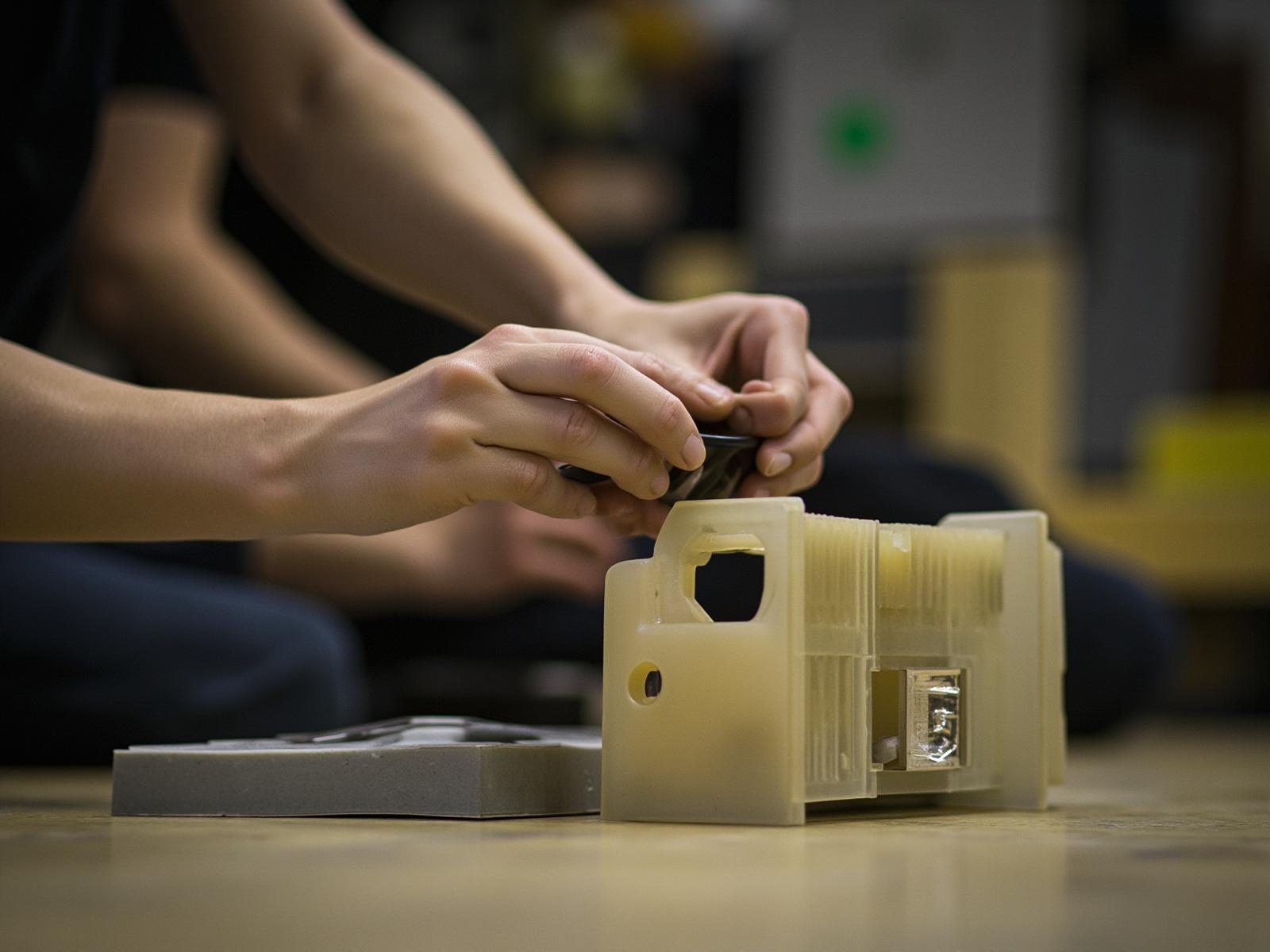
Gate 4 — Samples built and verified. Sample units are built and verified against the frozen requirements. The verification record is the document that closes the gate: each requirement line from Gate 1 is marked as met, not met, or accepted as a deviation with a stated reason. Deviations are the normal output of this gate, and they are only acceptable when they are written down and accepted by both sides. A sample that is quietly better than the specification and one that is quietly worse both create risk downstream, because Gate 5 evaluates the model that actually exists. We will also make sure the sample units are the samples of record — the specific units whose configuration matches the verification record — because an unrecorded sample sent for a trade show cannot support a compliance file later.
Gate 5 — Compliance file closed. The compliance file is assembled and closed against the specific model string that was built and verified. The point that matters for a consumer-electronics brand is this: the compliance file belongs to a named model configuration, not to a product category, not to a supplier in general, and not to a reference model with a similar appearance. Renaming or re-configuring the model after this gate means the file no longer describes what is being shipped. Certification evidence for the shipped configuration is the document that closes this gate. Per-model certification status is not published, so a brand that needs it must ask for it in writing against the exact configuration, with the exact model string, before treating it as available.
Gate 6 — Pilot run before mass production. The pilot run exercises the whole chain at production intent: assembly, test, packaging, the accessory flow, and the retail presentation. The pilot's document is the pilot report — yield observations, test pass rates, packaging outcomes, and the corrections that follow from them. Mass production opens only after the pilot has been accepted by the brand. We will not treat a successful sample run as a substitute for a pilot, because samples are built one at a time by people who know them intimately, while a pilot is built by the line under production conditions. The pilot also surfaces the commercial terms that the catalogue does not publish: the incoterms that will apply, the MOQ the programme will run at, the packaging cost structure, and the purchase order terms the brand and the supplier will operate under.
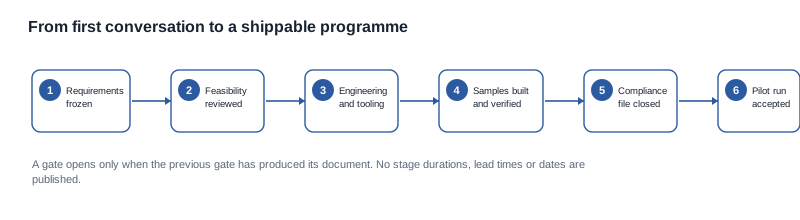
Two rules govern the sequence, and both are worth stating explicitly because they are what buyers test against. First, the order is fixed. The compliance file cannot be closed before the model exists, because a compliance file describes a physical configuration; the pilot cannot run before the configuration is stable, because a pilot of an unstable configuration proves nothing about the line. Second, no gate is closed by a date. A stage is finished when it produces a document, and the document is what the brand asks to see. Brands that ask instead "how long until the next stage" usually receive an estimate that quietly becomes a commitment, and the brand then discovers that its own planning assumed a number nobody published.

What a consumer electronics brand decides before starting
The brand, not the supplier, owns the inputs that determine whether the programme is coherent. We will make these explicit before Gate 1 opens, because each of them is cheap to decide and expensive to discover late. None of them requires the supplier's agreement; they are decisions the brand makes and then hands over in the form we will describe — a document the supplier can work from rather than a conversation to reconstruct.
The target market. Geography drives regulatory expectations, carrier expectations, interface language, and the retail channel. The same reference hardware can be positioned very differently in different markets, and the brand's decision here narrows every later option. If a market is not yet decided, the honest position is to decide the first market and treat the rest as a later variation rather than attempting one configuration that satisfies every regulatory context at once.
Which catalogue group fits. The published catalogue covers 28 models across distinct groups — eight audio models, three sport models, eleven camera models, three kids models, and three further models published without a model number, covering AR glasses, electrochromic and bone conduction. The group a brand selects determines almost everything that follows: whether a camera is present, whether the claim set can be visual, what the packaging and the retail experience can promise. We will use the group as the first filter when comparing a request to what exists, and we will write the chosen group into the requirements document by name, so that later reference to "the model" always resolves to one thing.
Whether a camera is required. This is not a small question, because it splits the catalogue cleanly. Eleven models carry a camera — V03 Pro and KY06, V03 and S7, MT6 and MT5, V06 and L2 Utral, CY05 and L1 Pro, and CY03 — while the audio-group and sport-group models do not. A camera changes the privacy conversation, the packaging copy, the retail experience and the accessory set, and it changes which claims marketing is permitted to make. The decision also has a cost consequence that the brand should price into the programme rather than discover afterwards.
What the brand can claim. Before the first sample, the brand should state in writing the claims it intends to make and the claims it will not make. Some capabilities in this catalogue are published as specific rows and others are simply not published, and the difference is not a matter of wording. We will hold the claim set as an explicit list attached to the requirements document, so that marketing copy is reviewed against a source rather than drafted around one. If a claim is not published, the answer to "can we still say it" is no, and no incoterms negotiation or MOQ concession changes that.
Packaging and the retail experience. Box, insert, accessory layout, charging language, the model string printed on the box, the regulatory and identifier text on the packaging — these are brand-side decisions that interact with the physical product, so they belong inside the requirement freeze rather than after the pilot. The model string printed on the box should be the same string that appears on the compliance file. That single consistency check prevents a class of downstream problem that is otherwise discovered late, when the printed identifiers, the filed documentation and the purchase order no longer refer to the same object.
We will also put the commercial frame in the same place, even though the catalogue publishes none of it: the expected incoterms, the MOQ the brand can run at, the packaging and accessory cost structure, the purchase order and payment pattern, the warranty position the brand intends to resell, and the certification evidence the brand's own market requires. Stating these as requirements at Gate 1 is what makes a quotation comparable between suppliers, because otherwise each supplier quotes a different scope and the comparison is meaningless.

The decisions that are expensive to reverse
Three decisions dominate the cost of changing direction later: the tooling commitment, the model string on the compliance file, and the claim set. We will handle them in that order, because the reversibility of the three differs sharply and a brand that understands the ranking negotiates better. In each case the brand is negotiating against unpublished numbers — nothing in the catalogue publishes tooling cost, tooling lead time, or the cost of re-qualification — so the protection comes from ordering the work correctly rather than from a favourable price, and we will record the reasoning behind each irreversible choice as it is made.
- Tooling. Tooling is commissioned at Gate 3 and it is a sunk cost at the moment of commissioning. Nothing in the published catalogue publishes tooling cost, tooling lead time, or tooling life, so the requirement freeze has to be complete before the order is placed. We will treat the tooling decision as irreversible in principle: change the specification after tooling exists and the cost is not the tooling cost, it is the entire re-qualification of the compliance file and the pilot that follows.
- The model string on the compliance file. The compliance file is closed at Gate 5 against one named configuration. That name is what the certification evidence describes and what the packaging identifiers must match. Changing the model string after Gate 5 is not a typographical edit; it is the opening of a new document, because the file as it stands no longer describes the product. We will therefore fix the model string before Gate 5 and freeze it there, and we will require that any subsequent market variation is expressed as a documented variation rather than a rename.
- The claim set. Claims are made in packaging, in retail copy, in the product listing, and in the channel's own material. Once they are made they are difficult to withdraw, because they have been seen by customers and repeated by resellers. The claim set therefore belongs to Gate 1, where it is cheap to change, and it should be reviewed against what is actually published rather than against what is plausible. We will not let an unverified capability into the claim set on the strength of a sample demonstration, because a sample proves that something happened once, not that it works reliably or offline or in a market with different connectivity.
The smaller decisions still deserve discipline, and there are three that come up repeatedly in consumer-electronics programmes. The accessory set is a physical commitment with a packaging consequence, so it is settled before the pilot, not after it. The firmware baseline is a version, and a version is only meaningful if it is written down; an unversioned firmware image makes the compliance file unresolvable, because there is no single artefact the file can describe. And the packaging artwork, including the identifiers and any model string, is approved before the pilot runs, so that the pilot actually tests the packaging that will ship.
There is one more reversibility trap, and it is the most common one in this category: the request that cannot be met. When feasibility returns "not available in the current catalogue" for something the brand had assumed, the temptation is to accept a compromise that will be discovered by the customer rather than by the team. We will put the unmet requirement in the decision note, describe the acceptable substitute explicitly, and have the brand accept it in writing. A limitation that the brand has signed off is a product decision. A limitation that surfaces after the purchase order is a dispute.
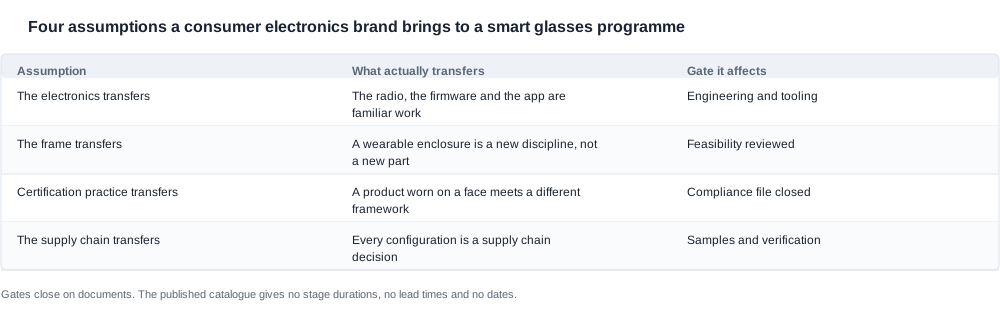
How progress is visible without a published schedule
Because no stage durations are published, a buyer needs a progress mechanism that does not depend on the calendar. The framework already provides one: a gate is open or a gate is closed, and a gate is closed when its document exists. That gives a status vocabulary of three states — open, closed, and blocked — which can be reported upward without anyone inventing a completion percentage.
We will run the programme against a standing gate checklist. For each gate the programme tracks four things: the name of the gate, whether its closing document exists, who signs it on the brand side, and what is outstanding if it is not closed. Nothing in that list is a duration, and nothing in it requires the supplier to publish a schedule. The same discipline applies to the commercial frame: the brand asks what to ask the supplier about each commercial term rather than assuming published values, because the values are not published.
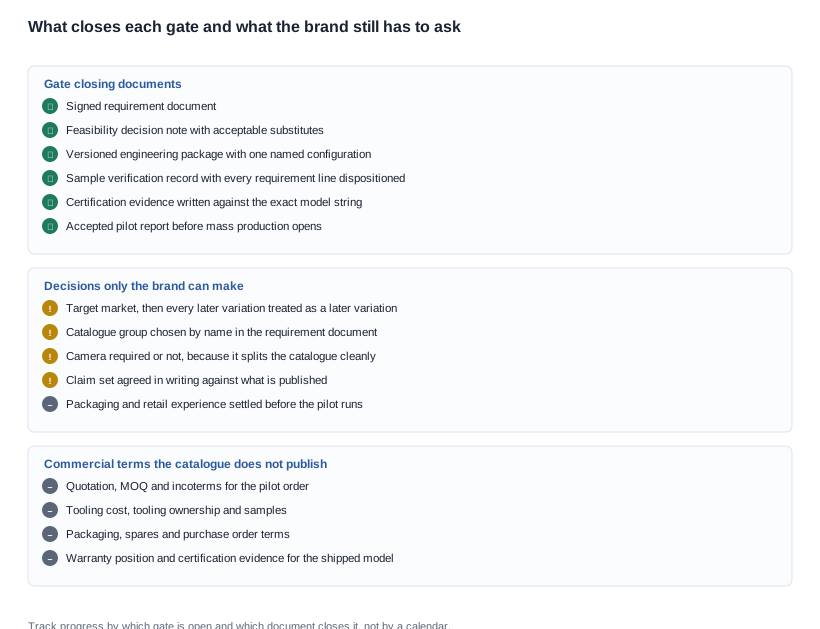
The standing checklist works because each row is a question with a documentary answer. At the requirement freeze, the answer is a signed document. At feasibility, the answer is a decision note naming the acceptable substitute where one exists. At engineering and tooling, the answer is a versioned engineering package with a named configuration. At samples, the answer is a verification record with every requirement line dispositioned. At the compliance file, the answer is certification evidence tied to the exact model string. At the pilot, the answer is a pilot report that the brand has accepted, together with the purchase order terms, incoterms, MOQ, packaging, spares, warranty, and the certification evidence the brand's market expects.
Three habits make the checklist work in practice. First, every gate closure is a document the brand holds, not a status message the brand receives. Second, the requirement lines from Gate 1 are the index of the whole programme, because every later document is checked against them. Third, the commercial terms are collected as a single negotiated package at the pilot, where the volume picture is visible and the negotiation has something to trade against — MOQ, incoterms, packaging, spares, warranty, and the certification evidence the brand's market expects. This is also the point at which a brand can negotiate the quotation on a real scope rather than on a catalogue line, because the pilot has already shown what the line can actually build.
We will close with the point that matters most for a consumer-electronics brand planning this from scratch. The absence of a published schedule is not a reason to delay the programme; it is a reason to buy a discipline rather than a date, and we will keep saying so in every status update we send. A supplier that will show you the gates, the documents and the decisions in order has told you everything that can honestly be told. A supplier that quotes a calendar without naming the gate structure has told you something, but not necessarily something you can hold. The consumer electronics brands solution page describes this framework for buyers who want the same sequence described from the product side, and the OEM-ready range is where the published catalogue groups referenced throughout this article can be reviewed.


