

Starting a smart glasses OEM programme with a manufacturer is a two-week process when it is done properly and a two-month process when it is not, and the difference is almost entirely about how much of the first conversation is spent establishing facts.
Most first conversations are spent on features, because features are the comfortable part of talking about a product. The facts are harder: what actually exists, what does not, what will take time, and what the certification position is. Those four questions determine whether the programme is realistic, and they are the ones a buyer is least likely to ask in the opening call.
So smart glasses oem how to get started is best understood as a description of the opening steps, written for a buyer who has not yet decided whether to proceed and needs to know what proceeding actually involves before committing budget to it.
The reason this matters commercially is that the cost of a misjudged start is not the meeting; it is the engineering phase. A requirement that was assumed to sit inside an existing configuration and turns out to need a development is discovered most expensively at the pre-production sample, when the tooling has already been ordered and the artwork has already been approved.
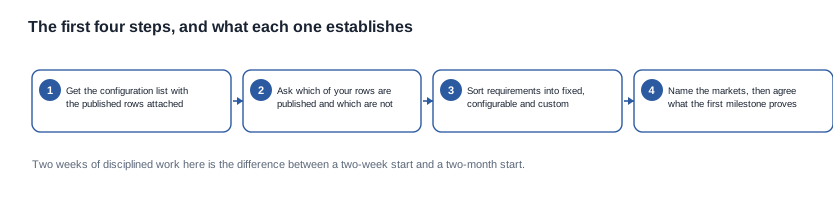
Step one: what a smart glasses range actually publishes
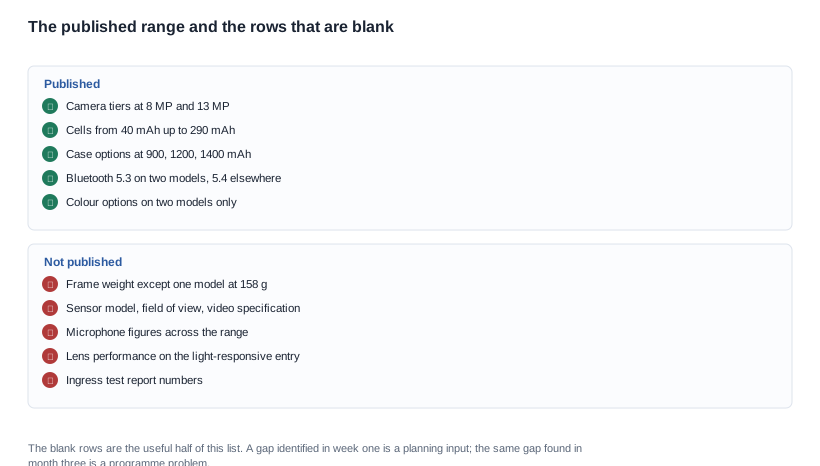
The first thing worth getting is a list of the configurations that are actually available, with the published rows attached. In our range that list is concrete: camera models at 8 MP and 13 MP, cell configurations from 220 mAh up to 290 mAh, charging by magnetic or Type-C, and case options at 900, 1200 and 1400 mAh. In the audio tier, dual cells at 55 mAh × 2, 70 mAh × 2 and 90 mAh × 2, plus single 100 mAh and 115 mAh cells, with runtimes of roughly six to eight hours. The sport tier publishes IP54 catalogue markings and four colour options on the V06. The children's tier publishes 40 mAh and 70 mAh cells with roughly twenty hours of runtime and posture and distance detection. The light-responsive entry publishes Bluetooth 5.4, a 100 mAh cell, roughly seven hours of runtime, magnetic charging and an electrochromic lens. The bone conduction entry publishes a 35 dB gain, a 200 mAh cell, roughly seven hours of runtime and Type-C charging.
That is a real catalogue and it is a long way from a specification. The point of asking for it is to find out which of your requirements already have an answer, and which are genuinely new.
Ask for it as a document rather than as a summary in a meeting, and ask for the rows rather than the highlights. A catalogue that describes twenty-eight models without stating which rows are blank is a brochure; a catalogue that says the frame weight is published for one model is an instrument. The second document lets a buyer build a requirement matrix in an afternoon, and the first does not.
Building that matrix is the work that pays for the whole opening phase. Take every requirement in the buyer's own list and place it in one of three columns: covered by a published row, covered by a published row with a stated difference, or not covered at all. The first column is a configuration choice. The second is usually a development with a modest scope. The third is where the programme's real cost lives, and it is invisible until somebody writes it down.
The matrix also settles an argument that otherwise happens in month four. When a buyer says the requirement was agreed, what they usually mean is that it was mentioned — and the supplier's record of what was mentioned may be considerably narrower than the buyer's. A matrix sent back and countersigned converts a memory into a document, which is the single cheapest risk reduction available in the opening phase.
It is worth noting what a requirement matrix should not contain. It should not contain adjectives, because "long battery life" maps to no published row and generates a disagreement later about what was meant. It should not contain implied requirements such as "looks premium", which are really design briefs and belong in a separate conversation. And it should not contain a feature request that has not been tested against the platform, because the difference between a request and a requirement is precisely the difference between the second and third columns.

Step two: name the rows that are not published
This is the step that separates a useful first conversation from a pleasant one, and it is the step most buyers skip because it feels adversarial.
In our published position, the frame weight is published for one model in the entire range — 158 g for the MT6 — and Not published for everything else. The sensor model, field of view, video resolution, frame rate, stabilisation and storage behaviour are Not published for the camera tier. The microphone specification is Not published for every model. The lens performance figures are Not published for the electrochromic entry. The seal material and the ingress test report numbers are Not published. The certification position for the children's models is Not published, and the specific model and certificate numbers for the adult models await confirmation.
A buyer who asks about these rows at the start learns what is knowable and how long it takes to know it. A buyer who asks at the pre-production sample learns that the programme has a problem.
The reason to ask early is not to obtain the numbers — they may genuinely not exist — but to learn the shape of the gap. A supplier who says a figure is not published but can describe the method that produced a related figure has given you something workable. A supplier who produces a precise number on request has given you something you will have to defend in a technical file later, because a number with no stated method cannot be substantiated.
It is worth asking the question in a form that makes it easy to answer honestly. "What are your battery figures?" invites a best answer. "Which published rows are blank for the models we are considering, and which of those can you populate for us?" invites a list. The second phrasing produces the useful answer, because it asks for a position rather than for a number.
There is a second reason to ask early that is easy to miss, which is that the answer determines who your supplier's technical contact has to be. A programme where most rows are published proceeds through a commercial conversation. A programme where several rows are blank proceeds through an engineering one, and that conversation has a different tempo, different participants and a different definition of done. Discovering in month four that the programme needs an engineering resource rather than a sales one is a change of project shape, and it is far cheaper to discover it in the first call.
The blanks also tell you something about the negotiating position. A supplier that publishes a wide configuration space and is candid about the blanks is offering you a wide range of decisions it can absorb. A supplier with a narrow published space and no acknowledged blanks is offering you a narrow range of options and asking you to treat the absence of information as an absence of difference. Those are very different propositions, and the difference only becomes visible if you ask for the list.
The same logic applies to the certificate numbers specifically, because they are the blank that causes the most downstream work. Our documentation claims CE, FCC and RoHS at company level and does not publish model-level certificate numbers, issuing bodies or validity periods. A buyer who needs those numbers for a technical file has to obtain them, and the time required is entirely different from the time required to obtain a company-level statement. Asking which of the two is available is a question about your programme's critical path, not a question about paperwork.
Step three: sort the requirement list
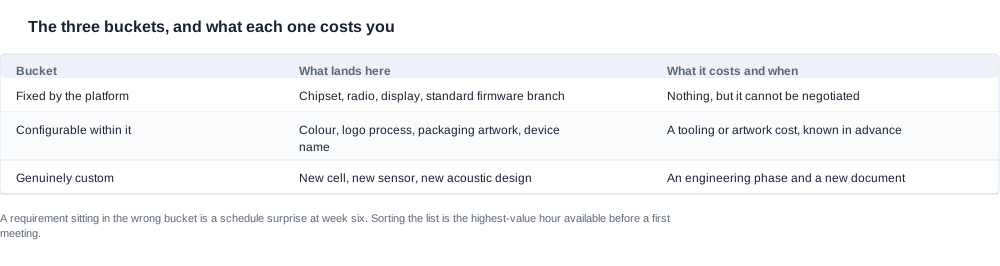
Every requirement goes into one of three buckets: fixed by the platform, configurable within it, or genuinely custom. This is described in detail in the design phase piece, and it is the single most valuable thing a buyer can do before the first meeting.
The reason it matters is that the three buckets have different costs and different schedules. A requirement that is sitting in the wrong bucket is a schedule surprise waiting for week six, and week six is the point at which the tooling has been ordered and changing the configuration means re-opening it.
Sorting the list also changes who decides what. A requirement in the first bucket is not a negotiation, because there is nothing to negotiate — the platform does what it does. A requirement in the third is a development that has to be funded, scheduled and signed off. A requirement in the middle is where most of the useful work sits, because that is where customisation happens without a new platform.
The discipline that makes the sorting stick is to write the buckets down and send them back. A requirement list that has been sorted once and then re-read by the supplier at quotation time is worth considerably more than the same list read once in a meeting, because it forces both parties to notice the same disagreements at the same time.
Sorting also exposes requirements that were never requirements at all. A buyer who has asked for a particular feature may discover that no channel in their plan actually uses it, which converts a development into nothing and is one of the largest single reductions in programme cost available before any engineering has started. The reverse discovery is more common and more uncomfortable: a requirement that was assumed to be implied by a broader brief turns out to sit in the third column, and it has to be either funded or dropped.
There is a fourth bucket that experienced buyers add informally and that is worth making explicit: requirements that are deferred. A deferred requirement is not a dropped one — it is a decision to launch without it, and it needs to be recorded as a decision with a date rather than left as an absence. Deferred requirements have a habit of reappearing during production, when the cheapest moment to implement them has already passed.
The sort is also where negotiation starts, and it is worth remembering that the buckets are not fixed positions. A requirement in the second bucket can often be moved to the first by choosing a different model, and that trade-off — one model closer to the requirement versus a development on this one — is a legitimate commercial negotiation that only becomes possible once the buckets are visible.

Step four: name the markets, then agree the first milestone
Markets determine the compliance work, and the compliance work is usually on the critical path. For the European Union the baseline is the General Product Safety Regulation (EU) 2023/988, applicable from 13 December 2024, with the Radio Equipment Directive (EU) 2014/53/EU applying to a radio product and the EN 18031 harmonised standards cited into it. The United Kingdom applies UKCA with a diverging framework. The United States applies FCC equipment authorisation and, for a children's product, the separate frameworks that come with it. Two questions at this stage: which documents already exist for the model, and which markets need one that does not.
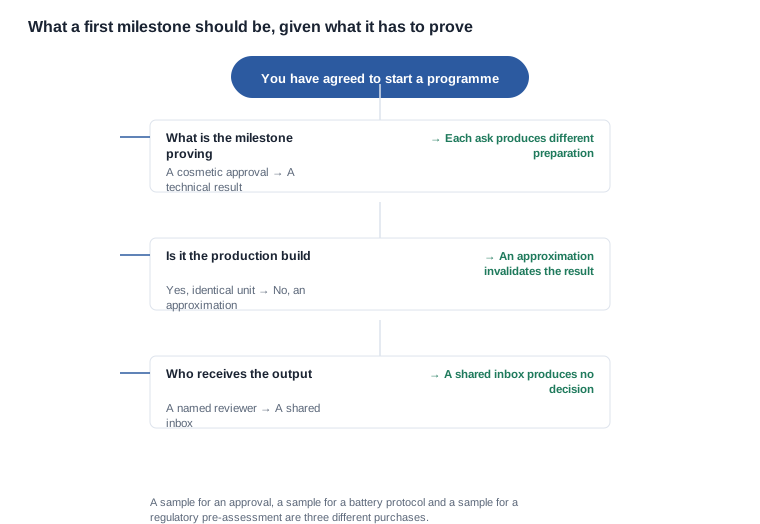
Then agree the first milestone and what it proves. It should be a sample, and the conversation about it should specify what the sample is for. A sample intended to check a cosmetic approval, a sample intended to run a battery protocol, and a sample intended to test a microphone in a specific environment are three different asks, and they produce different preparation on the manufacturer's side.
There is a fourth step that is frequently skipped and that costs more than it appears to: agreeing who does what. On an OEM programme the buyer owns the brand, the channel, the listings and the claims; the manufacturer owns the production, the technical file and the configuration. The boundary between those two lists is where most disputes originate, and it is much cheaper to write it down in week one than to infer it in month three.
The most common item on that list of omissions is the claims. Listing copy, packaging copy and the instruction leaflet are all produced by somebody, and in a small programme nobody is assigned to produce them. The result is usually that a specification gets written to match whatever the packaging says rather than the other way round, which is a poor foundation for a technical file and a worse one for a market-access obligation. Assigning claims ownership in week one costs an afternoon and removes a whole category of later argument.

The four things worth asking in the first call
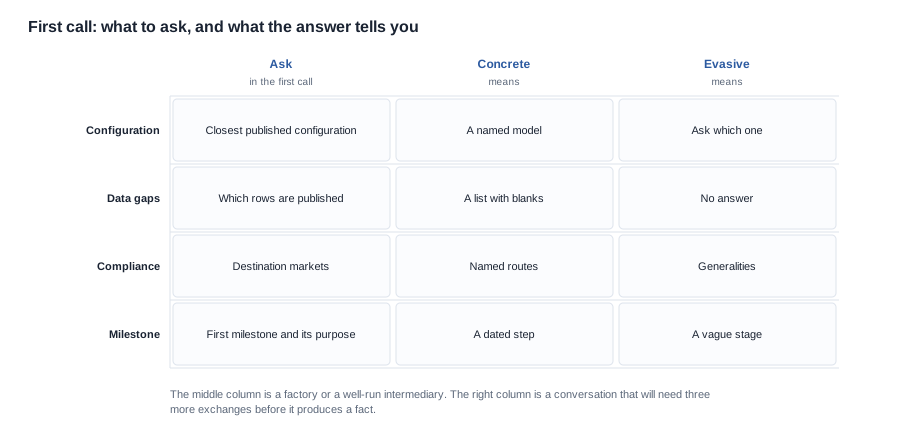
- Which of our published configurations is closest to our requirement, and what is different about it? The second half of the question is the one that produces the useful answer, because the first half is easy to produce a flattering reply to.
- Which of the rows we need are published, and which are not? Ask for the list rather than for the numbers, and ask whether any of the blanks can be populated and on what timescale.
- Which markets, and what is the documentation position for each? Press specifically on whether the position is model-level or company-level, because the two have very different consequences for the file you will have to assemble.
- What is the first milestone, what does it prove, and what do we need to send to make it happen? The third part is the one that converts an enquiry into a process, because it tells you which document or requirement list actually starts the work.
A fifth question is worth adding for any buyer who has not run a programme in this category before: what does the supplier need from us that we have not thought to ask for? It is a disarming question and it produces candid answers more often than a direct request for a quotation, because it asks about the buyer's gaps rather than the supplier's capabilities.
There is also a question about failure that belongs in the opening call rather than in the purchase order. Ask what happens if the programme fails at the sample stage — whether tooling costs are recoverable, whether artwork fees are refundable, and what happens to the samples. Suppliers have standard answers to this and the answers differ materially between programmes, and finding out afterwards is a poor use of leverage.
It is worth adding a question about the supplier's own constraints, because they determine how the programme will actually behave. Ask what would make the date move. A supplier that answers with a specific constraint has a schedule; a supplier that answers that the date depends on everything has not built one. And ask what they would cut first if the programme ran late — a supplier who answers honestly will usually name something you had not considered protecting, which tells you where your own exposure sits.
A question about resourcing is also worth asking, framed carefully. Not headcount, which is rarely a useful answer, but who specifically would run this programme and who would run it if that person left. A single point of failure in a supplier's project team is a real risk in a programme that will run for months, and it is much cheaper to establish who the backup is at the start than to experience the change halfway through a tooling order.
Finally, it is worth asking what has gone wrong for them recently. The question produces candid answers because it asks about their experience rather than their capability, and the answers are unusually informative: they name the failure mode, they reveal where the process is genuinely weak, and they indicate whether the supplier is willing to be candid at all. A supplier that answers that nothing has gone wrong recently is telling you something, and it is probably about the conversation rather than about the year.
Being clear about what we publish and what we confirm
We will send the published configuration list and the gaps list at the start rather than at the end, because a buyer who knows on day one that the frame weight is Not published for nine models out of ten can plan around it, and a buyer who finds out in month three cannot.
We will not publish unit prices, minimum order quantities or production lead times on this site, because they depend on configuration, quantity, documentation scope and the current schedule, and a number quoted without that context is not one you can plan against. These are confirmed per enquiry.
We will also not skip the second step because it is uncomfortable. The rows that are not published are the rows that determine your programme, and knowing them early is worth considerably more than a pleasant first meeting — particularly where one of them turns out to be a legal determination rather than a specification detail, which is a different kind of project with a different budget attached.
What we can commit to on an opening call is the shape of the answer rather than its contents: a configuration list with the published rows attached, an explicit list of the blanks, a requirement sort into three buckets, and a statement of the certification position for the destination markets with the model-level and company-level distinction made plainly.
Two things we will not do are worth stating for the same reason. We will not produce a quotation built on figures our documentation does not hold, because that figure would return as an obligation at technical file stage. And we will not let a programme proceed on an unstated requirement, because the gap between what was assumed and what was agreed is the most reliable source of expensive surprises in this industry, and it is entirely avoidable in week one.
Send your requirement list and destination markets and we will come back with the configurations, the gaps and the first milestone.
The service scope is set out in Smart Glasses OEM service scope, the ready platforms are described under Smart Glasses OEM ready platforms, and the engagement models are compared in OEM engagement models compared.
One closing point about the second call. The opening call establishes what exists; the second call establishes what can be done about it. By the second call the requirement sort should exist in writing on both sides, the gap list should be attached to specific models, and at least one destination market should have a route attached to it. A programme that reaches the second call without those three things has not started, however productive the conversation has been.
Related reading
- Smart Glasses OEM service scope
- ODM development design phase
- OEM engagement models compared
- Smart Glasses OEM ready platforms
Send your requirement list and destination markets and we will come back with the configurations, the gaps and the first milestone.


