
Choosing smart glasses for content creation overview work comes down to one structural fact and a short list of published rows. The structural fact is that only eleven of the catalogue's models publish a camera row at all, so a content-creation programme is built from the camera group or it is not built from this catalogue's camera group. The short list is the set of rows the catalogue actually publishes for those eleven models: resolution tier, cell capacity, runtime band, charging method, charge time, charging case, and a handful of feature rows that exist for only one or two models each. Everything else a creator programme needs to be credible on a listing page — certification status, per-model price, weight, touch control, translation, an assistant — is not published, and the correct response to each gap is a question to the supplier rather than a claim on the page.
This overview walks through what the three catalogue groups can and cannot do, what the two resolution tiers do and do not decide, which published rows should drive a shortlist, what cannot honestly be promised in a creator-facing listing, and how to move from a shortlist to an open programme. It is written for a brand owner, a channel buyer, or an e-commerce seller who has to put devices in front of creators and needs the published evidence, not the marketing version.
Smart glasses for content creation: the overview
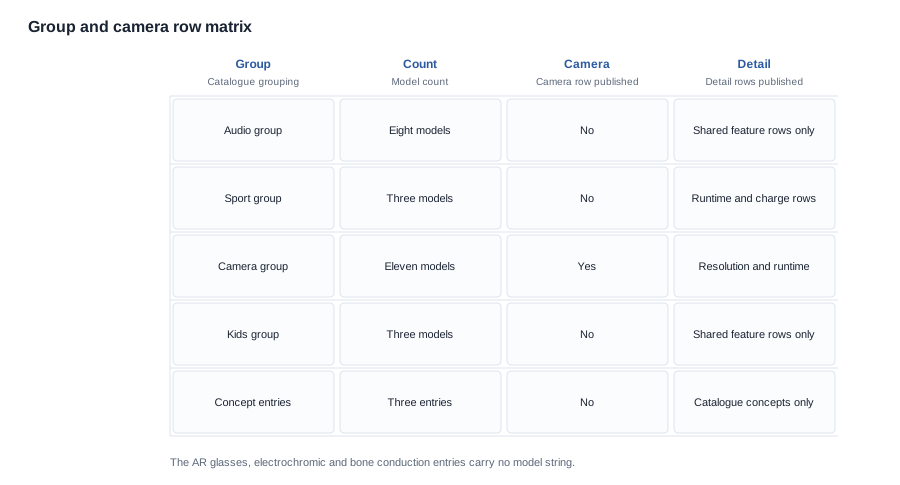
Our catalogue is organised into three groups and three unnumbered entries, and the camera row is the dividing line between them.
The audio group holds eight models — G07 and D12, LC-105-2 and K01, YK12 and D11, and LC-105-1 and K02 — and publishes no camera row. The sport group holds three models — YKC02, D17 and ZH12 — and also publishes no camera row. The camera group holds eleven models — V03 Pro and KY06, CY05 and CY03, MT6 and L1 Pro, V06 and L2 Utral, S7 and V03, and MT5 — and every one of them publishes a resolution tier. Three further entries carry no model number at all: AR glasses, electrochromic and bone conduction. These are catalogue entries you can discuss, but a quotation without a model number is a quotation you will have to pin down before it can become a purchase order, and a programme that lists an unnumbered entry in creator-facing copy creates a support problem the moment a customer asks which unit they received.
So the answer to the camera question is precise: eleven models publish a camera row, and only those eleven. An audio-group or sport-group device cannot be described as recording anything, and a creator listing built on those models has to be about audio, monitoring, or capture worn as an accessory rather than about capture produced by the device. That is not a weakness in the catalogue — it is a clean separation that makes the shortlist faster, because a buyer who knows the programme needs hands-free video can skip twenty-one models in one step.
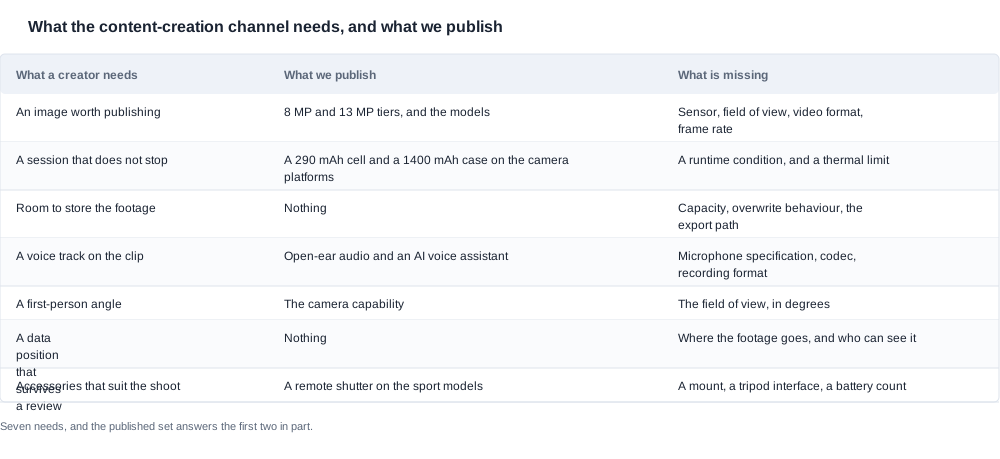
For programmes that need both hands-free capture and narration, the realistic starting set is the camera group, and the audio question for those models has to be settled in writing with the supplier rather than read off a catalogue row. The catalogue publishes no microphone row for the camera group, so nothing about the microphone on any camera model can be assumed from it, and a listing that implies a broadcast-quality voice is making a claim nobody has tested. We will keep the camera question separate from the microphone question in every shortlist we run, because they are answered by different evidence: the camera row by the catalogue, the microphone by a sample test.
Two further points about the group structure matter for how a programme is assembled. First, the camera group's own narrow feature rows — a remote control shutter, an IP54 marking, a photochromic lens — exist for a handful of models only, so a programme built on those features will be a programme built on one or two models, not on the group. Second, the camera group is the only place in the catalogue where a resolution tier exists at all, which means the resolution tier is a usable selection axis for camera work and is meaningless for the other two groups. We will therefore start every shortlist by discarding the groups that cannot carry the camera, rather than by comparing specifications across groups that are not comparable.
The three unnumbered entries deserve one more note, because a buyer who counts the catalogue can be caught out by the arithmetic. Three named groups plus three entries do not add up to a set of purchasable SKUs in the ordinary sense: the AR glasses, electrochromic and bone conduction entries are catalogue concepts rather than ordered model numbers. A channel buyer who needs a bone-conduction model for a commentator, or an electrochromic pair for an indoor studio, has to get the exact configuration named in writing before a quotation can be issued against it, and we will make that naming step explicit rather than let it sit in an assumption.
The published rows that decide a content programme
The camera group publishes two resolution tiers, and it is important to be clear about what each tier does and does not decide for a creator.
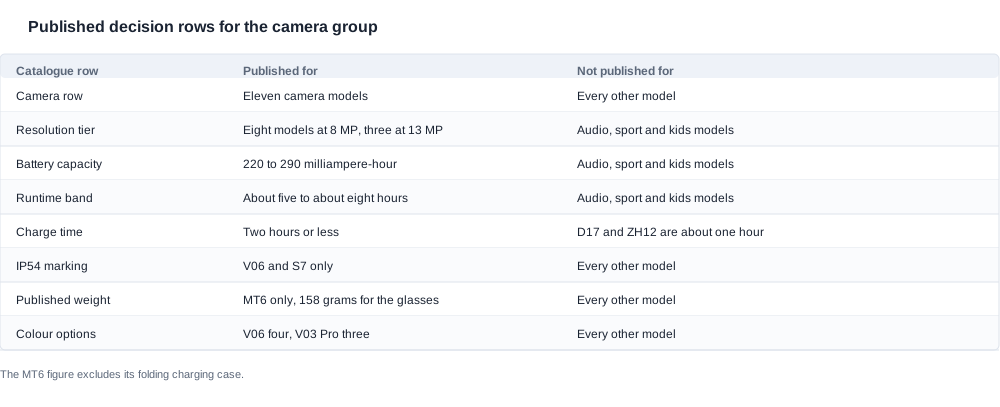
Eight models publish an 8 MP tier: V06 and V03, MT6 and V03 Pro, and MT5 and KY06, and CY03 and CY05. Three models publish a 13 MP tier: S7 and L1 Pro, and L2 Utral. A resolution tier tells you how many pixels the sensor records. It does not tell you the frame rate, the dynamic range, the low-light behaviour, the stabilisation, the field of view, the focus behaviour, the file format, or the microphone situation. A creator choosing between an 8 MP model and a 13 MP tier is choosing between two published tiers and a set of unpublished characteristics that have to be observed on a sample. The tier also does not tell you where the models sit in a creator workflow: 13 MP is not automatically a better choice for a short-form format where the deliverable is a vertical clip that will be re-encoded anyway, and 8 MP is not automatically wrong for a long-form programme where stability and endurance matter more than detail.
The rows that carry the operational weight of a programme are the ones the catalogue does publish consistently. We will work through them in the order a programme actually hits them, which is runtime first, then charging, then the narrow feature rows:
- Runtime band. The camera group publishes a runtime band per model: V03 and V03 Pro at 5 to 8 hours, KY06 at 6 to 8 hours, CY03 and L1 Pro, and CY05 at about 7 hours, L2 Utral at about 7 hours, MT6 at about 7 hours, MT5 at 6 to 8 hours, and V06 and S7 at 5 to 8 hours. These are bands, not guarantees, and a programme that schedules a full shooting day needs the lower end of the band, not the upper end. The trade-off is obvious once the numbers are side by side: the models with a charging case in the pack are the ones whose field endurance is not the binding constraint, and the models without a case are the ones where a charging plan has to exist.
- Cell capacity. CY03 and CY05, and L1 Pro publish 290 mAh, L2 Utral publishes 290 mAh, MT6 publishes 265 mAh, MT5 publishes 220 mAh, S7 and KY06, and V06 publish 260 mAh, and V03 and V03 Pro publish 220 mAh. Cell capacity is the number behind the runtime band, and it is also the number the transport paperwork has to cover for a device shipping a lithium cell.
- Charging method. Magnetic across 17 models, Type C across 7, and not published for L1 Pro and CY03, and CY05 and MT6. Four models in the camera group therefore need the charging question answered by the supplier rather than read from the catalogue, and three of those four are models with a published charging case, so a buyer who plans around a case should not assume the case charges the same way as the frame.
- Charge time. Twenty-six models across the catalogue publish "2 hours or less", which is an upper bound rather than a measured value. Only the D17 and the ZH12 publish "about one hour". Full details on the charging side are set out in /tech/charging-solutions. Because the figure is an upper bound, a charging plan built on it should assume the full allowance rather than a mid-point.
- Charging case. Five models publish a case capacity — CY05 and CY03, and L1 Pro — each at 1400 mAh, L2 Utral with 900 and 1400 options, MT6 with a 1200 mAh folding case. KY06 and MT5 have a case with no published capacity. S7 and V06, and V03 have no case, and the V03 Pro explicitly states no case. Two models in the camera group therefore carry a case whose capacity you cannot quote, which matters if the listing is going to make a claim about how long a creator can shoot away from a socket.
- Bluetooth version. Published for 14 models and not published for the eleven camera models, nor for A05, A06, or the bone-conduction entry. Pairing behaviour therefore has to be described by the supplier for every camera model in a content programme, and this is one of the most common causes of a returned unit in a creator channel.
Three feature rows exist narrowly enough that they should be handled model by model rather than generalised. The remote control shutter is published only on the D17 and the ZH12, both of which sit in the sport group rather than the camera group. The IP54 marking is published only on the V06 and the S7. Colour options are published as four for the V06, and the V03 Pro is the only camera model with a photochromic lens and three colour options. The one published weight in the whole catalogue is the MT6 at 158 grams for the glasses body, excluding the 1200 mAh folding case. Weight for every other model is not published, so a creator listing that quotes a weight can only quote it for the MT6, and even there the folding case is excluded and a buyer should say so rather than let the number stand unqualified.
One way to make these rows operational is to convert them into a single scorecard per candidate model, with one column per published row and one cell per answer, filling the cell with the published figure where the catalogue states one and with "not published" where it does not. The value of the exercise is that the empty cells become the question list. A model that shows a published cell capacity, a published runtime band, a published charging method, a published charge-time bound and a published case capacity has a complete operating picture, and a model that shows three empties has an unknown field workflow that will be discovered by the creator rather than by the brand. Because the number of published rows varies sharply between the camera models, we will always present the scorecard alongside the empty cells rather than hiding them, and the buyer can then decide which unknowns are acceptable for the programme and which are not.
There is a second discipline that goes with the scorecard, and it concerns how the rows are quoted rather than what they say. A runtime band of 5 to 8 hours quoted as "up to 8 hours" is a different commercial statement from the same band quoted as "5 to 8 hours", and the second one is the honest form because the band is what the catalogue publishes. The same applies to the charge-time bound: "2 hours or less" is an upper bound, and quoting it as "charges in 2 hours" turns a ceiling into a claim. And a case capacity quoted without saying which models ship with a case and which do not is a promise that a third of the camera group cannot keep. We will quote the published form of every row exactly as it appears, because the moment a listing rounds a band into a single number, the buyer loses the ability to plan against it.
What cannot be promised in a creator listing
There is a short list of things a content-creation listing wants to say and our catalogue does not support. Saying them anyway is the fastest way to turn a device that works into a device that returns.
- Certification status. No certification status is published for any model. A listing cannot state that a model is certified, and a supplier claim must arrive as certification evidence with the certificate number, the issuing body and the scope. The background on what evidence to request is in /blog/smart-glasses-camera-technology-smart-glasses-certification-requirements. A number that is not in the evidence pack is not a number that goes on the listing.
- Price. No per-model price is published in the catalogue. A listing should point to a quotation rather than a figure, and the MOQ, lead time and incoterms should appear on the quotation itself.
- Weight. Only the MT6 publishes a weight, at 158 grams for the glasses body and excluding its folding case. Every other model needs a measured figure from a sample, and the measurement has to state what was measured and what was excluded.
- Capacitive touch. No capacitive-touch row exists anywhere in the catalogue. Do not describe touch control on the frame or on the temple.
- Translation. No translation row exists anywhere in the catalogue. Do not describe a translation feature, in a listing or in a caption.
- A named assistant. No row in the catalogue describes a named AI assistant, a voice assistant, or an AI capture feature. The product families we build for are described by their hardware rows, not by a software persona.
We will keep creator-facing listings inside what the published rows support, and we will convert every gap on that list into a specific question to the supplier rather than a line of copy. The catalogue rows that do support a listing are simple enough to write plainly: the resolution tier, the runtime band, the cell capacity, the charging method, the charge-time bound, the case configuration, and the narrow feature rows where they exist for that model.
There is a second category of claim that is harder to police, because it is not obviously false. Terms like "hands-free", "first-person", "point of view", "immersive" and "all-day" are all defensible as descriptions of what a device does, and all of them become misleading when the runtime band, the case configuration or the control set underneath them does not support them. Hands-free is true of a device with no reachable control, but it is only useful if a creator can start a take without breaking their eyeline, which is exactly the row that exists for two models. Point of view is a camera description, and it belongs to the eleven camera models only. All-day is a claim about endurance, and the published bands run from 5 to 8 hours, so it needs to be written as a band or dropped.
A third category is the commercial claim. A creator listing that carries a per-model price, a lead time, a warranty period or a certification status is making four promises that no published row supports. Those four are also the four most common sources of a dispute between a brand and a channel buyer, because they are the four a buyer remembers. If they appear on the quotation and in the purchase order, they are terms. If they appear on a product page with no matching document behind them, they are the reason a listing gets pulled.
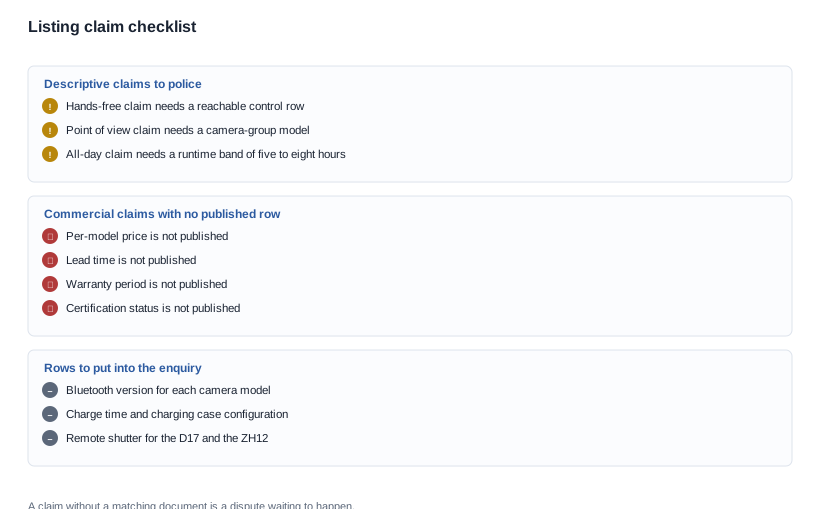
Every gap on that list has a specific question attached to it, and a buyer who converts each gap into a question gets a far stronger evidence pack than a buyer who asks a general question about quality. For certification, the question is which certificate, for which model, issued by which body, covering which standard, with what validity and what scope. For price, the question is what the quotation says, at which MOQ, on which lead time, under which incoterms, and what happens to those terms when the pilot order converts into a repeat purchase order. For weight, the question is what the sample measures and whether the case and the packaging are included. For capacitive touch, for translation and for a named assistant, the question is whether the feature exists in the firmware at all, and if it does not, whether it can be developed — and if it can, what that does to the MOQ, the tooling and the lead time. Answering these in writing is what to ask the supplier work actually looks like, and it converts a vague assurance into something a buyer can put in front of a channel partner.

How to shortlist and then start
A content programme for smart glasses for content creation overview purposes is best run as six gates, and each gate has a defined exit condition before the next one opens.
- Gate one, the shortlist. Reduce the camera group to the models that fit the programme shape. If the programme is long-session capture with a case in the pack, the candidates are L2 Utral and L1 Pro, MT6 and CY05, and CY03. If it is a lightweight everyday format, V03 and V03 Pro, S7 and MT5, and V06 are the ones with published runtime bands and published cell configurations. Write the shortlist down with the reason each model is on it, because the reason is what you will test against later.
- Gate two, the written answers. Collect the microphone path, the Bluetooth and pairing behaviour, the charging method for the four models where it is not published, the weight, the pack list, the certification evidence, and the commercial terms — MOQ, lead time, incoterms, tooling, packaging, spares and warranty. Ask for them in writing on the quotation, with the question phrased so that the answer can be copied straight into a product listing where it belongs.
- Gate three, the samples. Order samples of the shortlisted models. Test method is set out in /blog/how-to-test-smart-glasses-camera-technology-smart-glasses, and the camera-facing rows we compare against are in /products/ai-camera-glasses. Sample testing is where the unpublished rows get their first real evidence, and it is the last cheap moment to change model.
- Gate four, the golden sample. Agree one unit per shortlisted model as the golden sample, with the sample configuration, the firmware version, the packaging, and the accessories recorded in writing, so that a production unit can be compared against it later. A golden sample without a written record is just a sample.
- Gate five, the pilot order. Place a pilot order at the quoted MOQ, on the quoted lead time and incoterms, and check the delivered units against the golden sample on arrival — the pack list, the charging method, the case, the runtime band and the capture behaviour. Confirm the warranty position and the spares arrangement at the same time, so that a defect found at the pilot stage is handled under the terms that will apply later.
- Gate six, the programme. Only once the pilot clears do you open the programme: publish the listing against the published rows, brief the creators on the control that actually exists, and negotiate the repeat purchase order terms.
The programme-level context for this work sits in /solutions/ai-content-creation, and the shortlist decision is where we will spend most of the time with a buyer, because the published rows are few enough that the decision is genuinely about which trade-off the programme can absorb: a heavier frame with a case in the pack, or a lighter frame that runs flat and charges on the desk.
There is a version of this process that fails, and it fails in a predictable way. It skips the written answers and goes straight from a supplier deck to a purchase order, on the assumption that the deck is the specification. What comes back is a shipment whose charging method was never confirmed, whose Bluetooth behaviour was never described, whose certification evidence does not exist in the form that the channel asked for, and whose pack list differs from the sample that was approved. The cost of the shortcut is paid in returns and in listings that have to be pulled, and it is entirely avoidable.
A closing note on negotiation. The published rows constrain what you can claim, and they also constrain what you can price against. A buyer who asks for a model weight, a certification status, or a per-model price before the supplier has produced evidence will get an answer that cannot be defended later in the channel. A buyer who asks for the same three items as a condition of the quotation gets them on paper. We will run that way: shortlist on published rows, test on samples, negotiate on the quotation, and keep the listing aligned with the hardware that actually ships.
One practical note for buyers running a mixed catalogue. A channel that sells smart glasses for content creation across several formats will usually end up with a mix of models in one shipment, and those models will not share a charging method, a case configuration, or a runtime band. Ask for the mixed pack to be described explicitly — which models, which charging method each one uses, which models ship with a case and which do not — and ask for the packing to be arranged by model so that a creator receiving the wrong device in the wrong box is not a normal Tuesday. That single packaging detail removes a surprisingly large share of the support volume in a creator channel, and it is negotiated on the quotation rather than discovered afterwards.


