
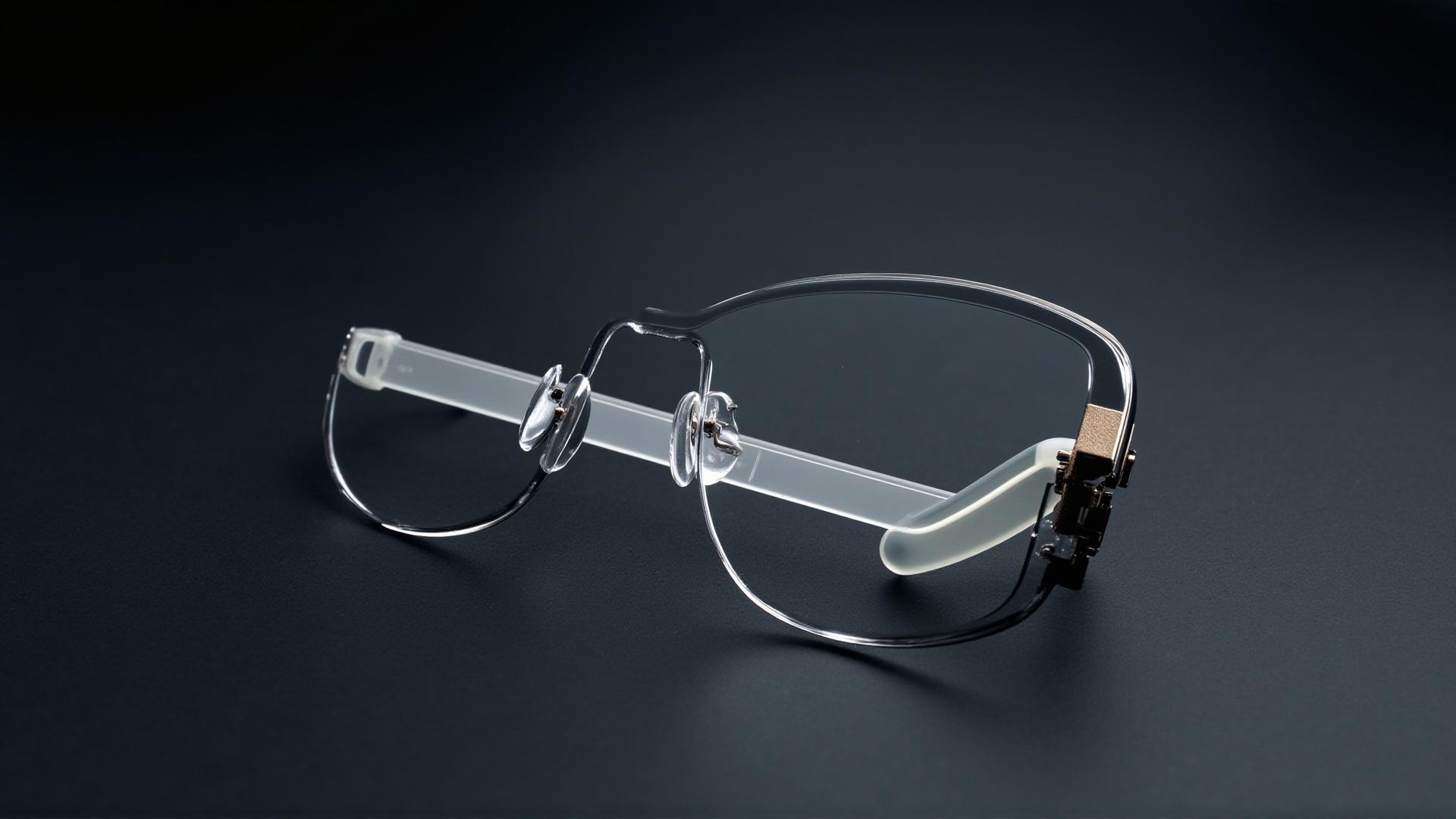
A camera specification that says "8 MP" or "13 MP" tells a buyer the resolution class and almost nothing else. The parameters that decide whether a camera platform is fit for purpose — sensor, aperture, field of view, video format, frame rate, stabilisation, low-light behaviour and how storage is managed — are not published for any model in our range, and the fact that two resolution tiers exist does not tell you which one to buy. What a camera platform is actually bought for is a usable recording, and usability is produced by five layers stacked on top of each other: optics, sensor, processing, storage and heat. A finding that arrives without a layer attached is a complaint. A finding that arrives with a layer attached is a change request somebody can price and schedule. So the programme is: qualify on a sample through six steps, attribute every observation to a layer, and put the attribution in the purchase order — because the layer decides who owns the remedy, and that is the difference between a five-day fix and a re-tooling.
Smart glasses camera technology: attribution, not megapixels
The buyer choosing between two resolution tiers
The camera models in our range are published at two resolution tiers: 8 megapixels on the V06 and the MT5, the V03 Pro and the V03, and the MT6 and the CY03, and the KY06 and the CY05, and 13 megapixels on the L2 Utral and the S7, and the L1 Pro. Cell capacities on these models run from 220 mAh to 290 mAh, with rated runtimes clustering between five and eight hours.
Not published for any model: the sensor model, the aperture, the field of view, the video resolution and frame rate, stabilisation, low-light performance, the storage capacity, and the overwrite behaviour. The technical background is at AI camera glasses imaging and the product range is at AI camera glasses.
The reader here is a brand product manager or a sourcing buyer choosing a camera platform for a product line, and the specific problem is that camera products in this category are sold on megapixels. Megapixels is the one camera figure that does not predict the outcome the customer cares about, which is usable footage in the light the customer actually has. A buyer who compares two candidates on resolution has bought the wrong variable and will find out at the first customer review.
The task is therefore to build a test sequence that produces comparable results across two candidates, and to decide in advance which results would disqualify a platform and which would merely shape its configuration. The risk being managed is a launch where the product is reviewed on its pixel count and criticised on its footage, which is a packaging and marketing problem that could have been caught on a sample.
The five layers, and where the remedy is bought from
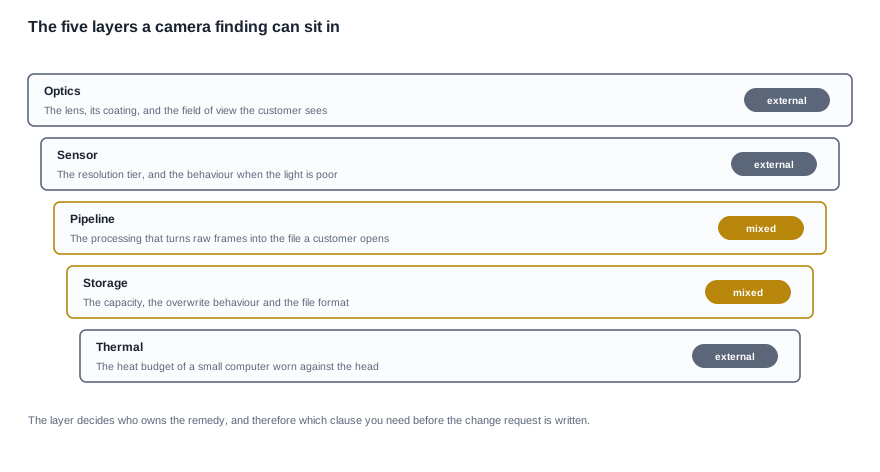
The five layers are the structure of the whole category, and each one behaves according to its own rules.
Optics is the lens, its coating, and the field of view the customer sees. A finding here is usually a design decision that was taken before tooling, and a design decision taken before tooling is the cheapest kind of finding in the category. A finding here taken afterwards is a re-tool.
Sensor is the resolution tier and the behaviour when the light is poor. A finding here is usually a selection question — the tier you chose is the wrong tier for the channel — and a selection question is resolved by choosing a different model rather than by changing this one.
Processing is what turns raw frames into the file a customer opens. A finding here is a firmware change, which is the cheapest remedy in the category and the one most often misfiled as a sensor problem because the symptom looks similar.
Storage is the capacity, the overwrite behaviour and the file format. A finding here is a product decision about what happens when the device fills up, and that decision has to be made consciously, because the default behaviour is what the customer experiences.
Heat is the budget of a small computer worn against the head. A finding here is a power or thermal design decision, and it is the one that most often decides the session length a brand can print in its copy.
The reason the ladder matters is that each layer is bought from a different place. Optics is bought from the tooling budget. Sensor is bought from the selection. Processing is bought from the firmware. Storage is bought from a product decision. Heat is bought from the power budget. A buyer who sends a thermal finding to a supplier as an acoustic-class complaint will get an acoustic answer, and a month will pass.
The buying task: building a fault-attribution ladder before the sample order
The six steps, and the measurement each one yields
Step one is still capture in controlled light. A fixed scene, fixed lighting, fixed distance, across the whole range. The number it produces is a consistent file set that can be compared frame by frame. What a failure indicates is that the capture path is unstable, which no later step will fix.
Step two is the field of view, measured. Photograph a known grid at arm's length and measure the covered width and height. The number is a field-of-view figure in degrees, or a coverage ratio. What a failure indicates is that the product frames the customer's content differently from the listing images, and that is a marketing exposure which reappears in every review.
Step three is video, watching the frame rate hold. Record while moving, then replay the file and check that the frame rate holds. The number is a sustained frame rate and a stated video format. What a failure indicates is a product that drops frames exactly when the customer is moving, which is the most common way a recording gets rejected.
Step four is the first scene again, in low light. Repeat step one at a stated, low light level. The number is a comparable set that can be judged against the daylight set. This is where the resolution tier stops being the deciding factor, because the tier that looked better in daylight may not be the tier that holds up in the channel the brand actually sells into.
Step five is filling the storage. Record until the stated or observed capacity is reached. The number is a time to fill, and the behaviour at the limit. What a failure indicates is whether the customer loses a recording without warning, which they will not distinguish from a defect.
Step six is running it until it is warm. Record continuously until the frame is uncomfortable to hold. The number is the time to thermal throttle, and what degrades first. A device that throttles after forty minutes is a different product from one that runs for two hours, and neither fact appears in a catalogue.
The two steps where the commercial surprise lives
Step five and step six are the two where the buyer discovers something that changes the bill of materials rather than the marketing. A camera glasses platform is a small computer worn against the head, and heat is the usual failure mode on a long session. The storage behaviour matters for the same reason: a customer who loses the last ten minutes of a recording because the device silently overwrote the oldest files will describe it as a broken product, and the support team will be arguing about a defect that is actually a policy.
Step two is the one buyers forget, and it is the one that has a marketing consequence rather than a technical one. Field of view determines whether the product is right for the customer's content, and it also determines whether the listing photographs are reproducible. A product with a narrow field of view, photographed with a wide lens, looks better than it performs — and that gap is what shows up in a review written by somebody who has read the listing and then tried the product.
The conditions that make a camera test comparable
- Confirm the unit is the production configuration, using the procedure at sample evaluation. A promotional batch is not the shipping product.
- Confirm the model designation and the resolution tier on the unit against the purchase order. 8 megapixels and 13 megapixels are the two published tiers, and a mix-up between them is a straightforward sourcing error that is easy to make and expensive to find late.
- Look up every certificate number in the issuing body's public register, checking the model, the configuration covered and the validity date, against the register at certification checklist.
- Check the battery transport documentation, which is a shipping gate rather than a quality item, at battery transport.
- Re-run steps one, three and six on a second unit from the same batch. Inconsistency across units is a manufacturing question and needs a different remedy from a design change, and the two should not be argued about as one issue.
That fifth condition is the one that protects the attribution. A result that differs between two units of the same batch is not a layer finding at all — it is a process finding, and it belongs to a conversation with the factory about consistency rather than to a change request against the optics or the sensor.
From a sample finding to a change request somebody can price
The attribution ladder, observation by observation
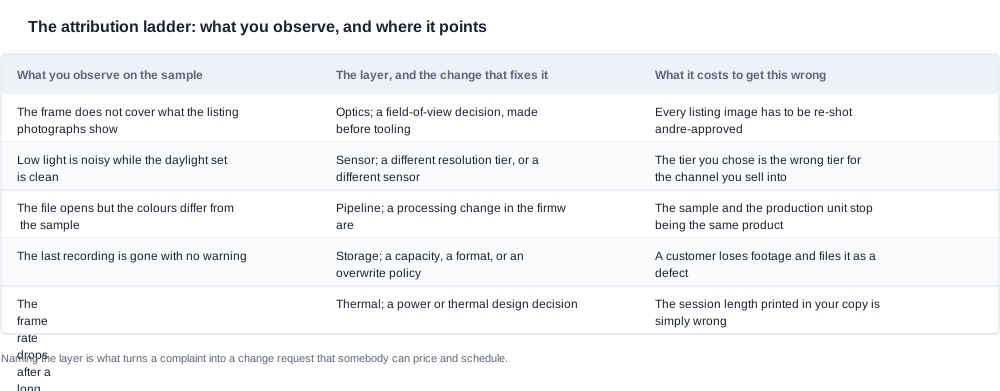
Each row in that table is an observation a buyer can make on a sample, the layer it usually sits in, the change that fixes it, and what it costs to get the attribution wrong. The last column is the one that justifies the whole exercise, because the cost of a misattributed finding is not the finding itself — it is the schedule.
The frame does not cover what the listing photographs show. Optics, and the remedy is a field-of-view decision that has to be made before tooling. Get the attribution wrong and every listing image has to be re-shot and re-approved, in a channel where the images are usually the entire sales argument.
Low light is noisy while the daylight set is clean. Sensor, and the remedy is a different resolution tier or a different sensor behind it. Get the attribution wrong and the brand has committed to the wrong tier for the channel it sells into, which is a mistake that surfaces as a return rate rather than as a review.
The file opens on a phone but the colours differ from the sample. Processing, and the remedy is a firmware change. Get the attribution wrong and the sample and the production unit stop being the same product, which means the first article no longer qualifies the production run.
The last recording is gone with no warning. Storage, and the remedy is a capacity, a format, or an overwrite policy decision. Get the attribution wrong and a customer loses footage and files it as a defect, and the defect file is priced as a hardware problem.
The frame rate drops after a long recording. Heat, and the remedy is a power or thermal design decision. Get the attribution wrong and the session length printed in the copy is simply wrong, which is the kind of error that appears in a review rather than in a return.
The path from an observation to a priced change request
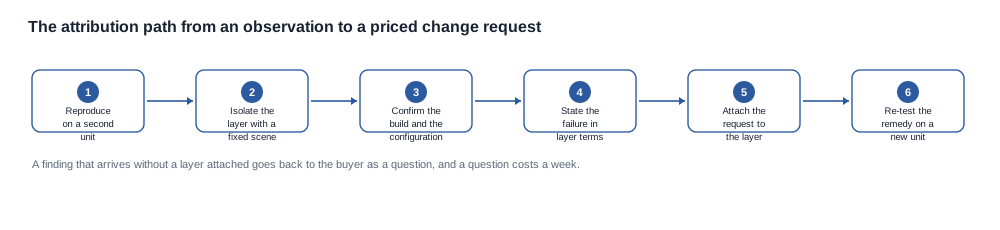
Reproduce it on a second unit before writing it down. A finding that appears on one unit is a unit; a finding that appears on two is a product.
Isolate the layer with a fixed scene. The point of the fixed scene is to remove the variables that are not the suspected layer, so that the remaining difference points somewhere.
Confirm the build and the configuration. A finding recorded against the wrong build is a finding against a product that will never ship.
State the failure in that layer's own terms. "The frame rate fell below the stated figure after the recording reached the stated duration" is a statement a thermal engineer can act on. "The video was bad" is a complaint.
Attach the request to the layer. The request goes to the person who owns that layer, with the measurement attached, and the question of who pays is settled by the contract rather than by whoever answers first.
Re-test the remedy on a new unit. A remedy that is verified on the unit that failed proves very little, because the unit that failed is not a typical unit.
Which layer to open first
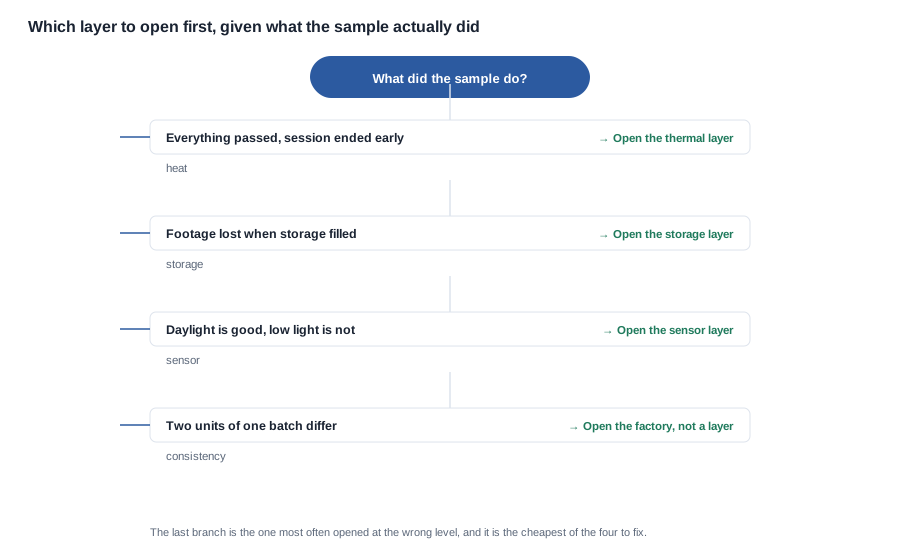
The four branches are the four ways a camera sample session usually ends, and the last one is the one most often opened at the wrong level. Two units of the same batch behaving differently is not a design layer at all — it is a process question, and it is the cheapest of the four to fix, because a process finding is a control change rather than a design change.
Where a camera programme loses its schedule and its margin
The listing photographs do not match what the camera frames. The symptom is a review that says the pictures look better than the product performs. The root cause is that the field of view was never measured, so the listing was shot with a lens the product does not have. The prevention is step two, and a listing rule that requires the photography to be shot on a production unit at the stated field of view.
The last ten minutes of every recording is gone. The symptom is customers reporting that their recordings are shorter than expected. The root cause is that the overwrite behaviour was never specified and the default took over. The prevention is to decide the behaviour, publish it, and put the time-to-fill in the product page.
The frame throttles after half an hour and the copy says two hours. The symptom is a review about the product "slowing down" or "getting hot". The root cause is that the session length was never measured, so the copy carried the rated runtime instead of the thermal limit. The prevention is step six and a copy that quotes the measured session.
A change request is filed against the wrong layer and comes back unanswered. The symptom is a month of silence on a finding the buyer was sure about. The root cause is that the observation was described as a symptom rather than as a measurement in a layer's own terms. The prevention is the attribution ladder, written down before the request goes out.
The two resolution tiers were mixed up on the purchase order. The symptom is a delivery that does not match the approved listing images, or a price that does not match the quotation. The root cause is that the tier was identified verbally rather than from the designation on the unit. The prevention is to attach the model designation and the tier to the purchase order as line items.
The second order is a different product from the first. The symptom is a consistency problem that appears only in the later batches. The root cause is that the processing and the storage behaviour were firmware decisions and nobody wrote down which build shipped. The prevention is to record the firmware build on receipt for every unit, and to put a change notice obligation in the contract.
A worked scenario: a brand qualifying a camera platform for a trade channel
This is a hypothetical scenario rather than a client project, and it is written to show the decision sequence rather than to report a result.
Assume a brand supplying a trade channel whose users record short clips of their work for internal review, in a workshop and outdoors, with a session length of around forty minutes. Two candidate platforms are on the table, one at each published resolution tier. The binding constraint is that the brand's previous product returned at a rate the channel attributed to recordings being lost.
The session length is set before the samples are ordered, because it decides which steps matter. Forty minutes of recording in a workshop and outdoors is a low-light case and a thermal case, and it is not a long-session case. That sets the emphasis: step four and step six carry more weight than step five.
The six steps run on two units of each candidate, with step six taken to the point where the frame is uncomfortable rather than to a fixed time, because the brand does not yet know where the limit is.
The thermal limit is found first, and it is lower than the rated runtime suggests. The candidate at the higher published tier throttles sooner in the video case than the lower tier does, which is a finding that inverts the expectation the brand arrived with, because the tiers were compared on resolution.
The attribution is assigned to the thermal layer, and the remedy is a power decision rather than a sensor one. That matters commercially, because the remedy is an engineering change rather than a re-tool.
The storage behaviour is then specified, with a time to fill and a written overwrite policy, because the previous product's returns came from that and the brand is not going to have it again. The policy is published on the product page rather than left in the firmware.
The listing is written from the measurements. The images are shot on a production unit at the measured field of view, the session length in the copy is the measured thermal limit rather than the rated runtime, and the recording length in the copy is the measured time to fill.
The commercial structure follows the two tiers. The brand negotiates whether the two tiers can share one purchase order, which for a brand that wants a price ladder is worth more than a unit price reduction, and asks for a split first run against a staged payment because the thermal behaviour was unknown at the start.
The result is a platform whose copy is reproducible and whose known limits are written down before the launch rather than discovered after it. The decisive decision was to set the session length first, because that determined which of the six steps would decide the project.
What we publish about the camera platform, and what stays unmeasured
Concretely, we publish the two resolution tiers, the cell capacities, the rated runtimes, the colour availability, the charging interfaces and the charge times exactly as the catalogue states them, and we publish the absence of sensor, aperture, field of view, video specification, stabilisation, low-light and storage data with the same prominence.
We will not rank the 8-megapixel and 13-megapixel tiers on image quality, because nobody has published a measurement that would support the comparison, and the scenario above is a worked example rather than a result. We will not estimate a field of view, a frame rate or a thermal limit, and we will not present a rated runtime as if it were a session length, because they are different quantities and only one of them is measured.
What we will do is take a test sheet and tell you which results are comparable across the two tiers, which are the deciding results for your use case, and what has to be settled in writing before a purchase order is signed. The platform selection procedure is at how to choose a camera platform, the questionnaire form is at the camera technology buying checklist, and the published rows are at camera technology key specifications.
Four actions before the camera sample is ordered
Set the session length and the environment before the samples are ordered. They decide which of the six steps will decide the project, and the questions to ask a supplier are the same either way.
Attribute every observation to a layer before you write it down. The cost of a misattributed finding is not the finding; it is the schedule, and the schedule is the thing you cannot recover.
Put the field of view, the time to fill, the overwrite policy and the thermal limit into the purchase order. These are the acceptance criteria that protect the listing, and the criteria to hold are the ones your own protocol produces.
Send us the models, the environment and the session length. We will tell you which of the six steps decides the project for that combination, which published rows apply, and which parameters have to be confirmed on a production unit before you commit to a volume. Clause language is published at contract terms, and the commercial structure of a first order is published at pricing.
Related reading
- The imaging background — AI camera glasses imaging
- The models in the range — AI camera glasses
- The selection procedure — how to choose a camera platform
- The published specifications — camera technology key specifications
Tell us the models, the environment and the session length, and we will say which of the six tests decides the purchase.


