

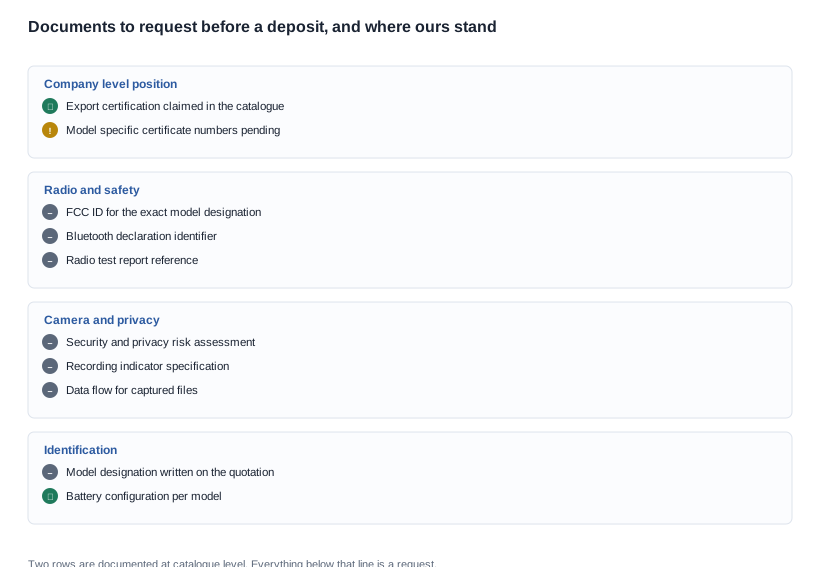
A camera turns a smart glasses programme into a two-tier compliance job. The radio, the cell and the substances are the same obligations an audio product carries, and they are the ones that can stop a shipment at the border. The camera adds a second tier: a security and privacy risk assessment, an explicit statement in the user information that the product records, and a data-flow description that has to exist before the copy is written. Our catalogue's export-certification page shows ten patent certificates — eight appearance-design patents and two utility-model patents — and names no CE, FCC or RoHS marking, so this article is about the structure of the requirement set rather than a list of numbers we hold.
Two decisions come before the file. Which models are in the programme, and which markets the units ship to. Everything else — the technical file, the user instructions, the test evidence, the declaration of conformity — is derived from those two. A procurement team that fixes them first can schedule backwards from a launch date. A team that leaves them open discovers the schedule in a customs query, six weeks after the units left the factory.

Smart glasses camera technology: what the camera adds
The buyer at the table, and the two decisions in front of them
The person who owns this decision is usually a product manager with a compliance budget and a launch date, or a sourcing lead who has been handed a retail requirement and a supplier shortlist. What they are approving is not a certificate; it is a document set that has to survive an audit, a marketplace listing review, a customs query and possibly a product recall in a market where the brand has no legal entity. The failure they fear is not a rejected application. It is a document set that names a different model string than the units in the carton.
Two decisions sit upstream of everything else, and both are commercial rather than technical. The first is the model list. Our catalogue carries eleven camera models, and the choice among them changes the file because the radio row is not published for the camera family at all, because four of the eleven ship without a charging case, and because one of them, the L2 Utral, publishes a Type-C charging interface badge on its catalogue page, a badge the V03 Pro also carries, while the L1 Pro and the CY03, and the CY05 and the MT6 publish no interface row at all and the remaining camera models publish magnetic charging. A programme that mixes the eleven models needs a file that covers all eleven, and a programme that picks three needs a file that covers three. Those are not the same amount of work and they are not the same amount of test evidence.
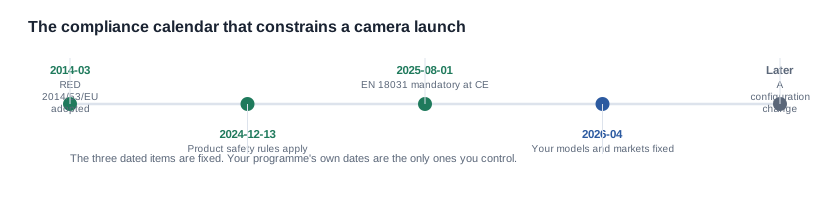
The second decision is the market list, and it is where the schedule actually lives. A brand selling into the European Union meets the radio equipment framework, the horizontal cybersecurity standard that became a mandatory component of the CE mark on 1 August 2025, the general product safety regime applicable since 13 December 2024, and the substance rules. A brand shipping into the United States meets the FCC authorisation route, which is evidenced by an FCC ID and which is the row with the most immediate commercial consequence: goods without one cannot be cleared for import, and major marketplaces will remove the listing. Add Brazil, add the Gulf, add Japan, and every additional market is either a new approval, a new paper trail, or a decision not to sell there.
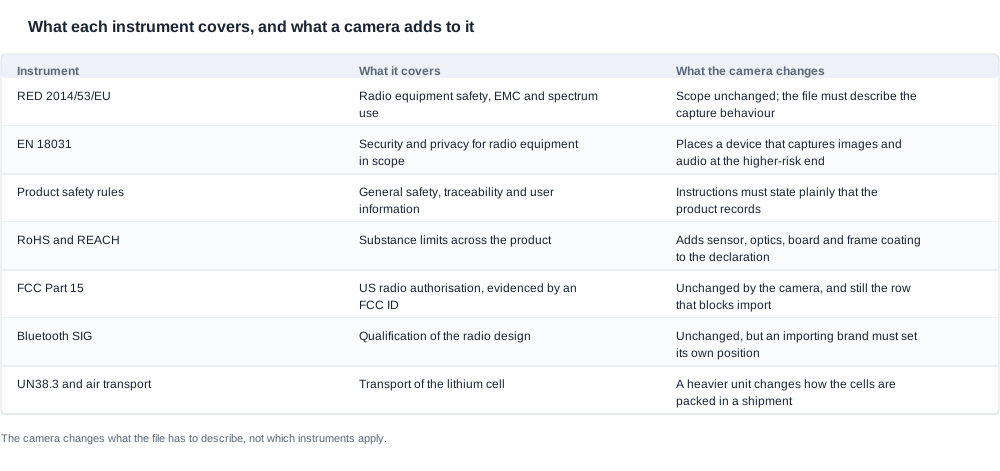
The instruments, and the one line the camera rewrites
The radio equipment framework, Directive 2014/53/EU, covers safety and health, electromagnetic compatibility and efficient use of the radio spectrum. A camera does not change the scope of that directive. The radio is the same radio. What the camera changes is the technical file: the file has to describe what the device does with the data it captures, and for a device that captures images and audio and can transmit them, that description is the part of the file that gets read first.
The horizontal cybersecurity standard is where the camera makes the largest difference. EN 18031 has been a mandatory component of the CE mark since 1 August 2025. It requires a security and privacy risk assessment, testing and documentation, and a vulnerability handling process for radio equipment in scope. Equipment that captures audio and video and transmits it sits at the higher-risk end of that scope. The risk assessment is not a formality: it is the document that states where the captured data goes, and it is the document a buyer should read before agreeing to a launch date, because the answer usually determines how much engineering the firmware needs.
The general product safety regime, applicable since 13 December 2024, covers general safety, traceability and a responsible economic operator in the European Union. For a camera product it reaches the user information directly, because a device that records people needs instructions that say so plainly. Those instructions become part of the product's safety case, which means they are written, reviewed and version-controlled rather than drafted by whoever built the listing.
Substance rules reach further than they do for an audio product. The image sensor, the optics, the image processing board and the frame coating all sit inside the declaration for a camera model, where an audio model with the same frame has fewer parts to declare.
FCC Part 15 does not change because a camera was added, and it remains the row that blocks a shipment. Bluetooth SIG qualification also does not change; the Declaration ID requirement still applies, and a brand importing into the United States still has to establish its own position on it. UN38.3 and the air transport rules govern the cell, and a camera product is a heavier unit than an audio product, which changes how the cells are packed and at what state of charge they travel.
The question the camera adds that the audio version never asks
Where does the footage go? Is it stored on the device, in the companion app, or on a service? In which jurisdiction does the service sit? Who can retrieve it, and for how long? A buyer who cannot answer this cannot write the user information, cannot complete the risk assessment, and cannot draft the privacy paragraph on the product page. This is the question to put to a supplier first, and it is the one most often answered with a description of the feature rather than a description of the data.

The order that keeps a camera programme out of customs trouble
Fix the models and the markets before anything else
The sequence below is deliberate, and the order is the argument. Each step assumes the previous one passed, and a failure at any step tells you what the next step would have told you anyway. Buyers who start at the documentation step produce a beautiful file for the wrong models.
Step one is the model list and the market list, written down. Step two is the radio and the battery position for each model, because those are the two that can stop a shipment physically. Step three is the technical file, including the security and privacy risk assessment, because that is the longest-lead engineering item and it cannot start until the behaviour is described. Step four is the user information, which has to describe what the camera does and, just as importantly, what it does not do. Step five is the match between the model designation and every document, character by character. Step six is the freeze, and the standing obligation to reissue the file when a configuration changes.
What each step produces, and what it stops
The radio step produces evidence that the product may legally be sold in the destination market. It stops a unit from being held at the border, and it stops a marketplace listing from being taken down after launch, which is the more expensive of the two because it happens when the stock is already in the channel.
The battery step produces the transport summary for the fitted cell, and it stops a shipment from being rejected by a carrier. For a camera programme the cell is one of the heavier configurations in our catalogue: 220 mAh on the V03 and the V03 Pro, 260 mAh on the S7 and the V06, and the KY06, 265 mAh on the MT6, and 290 mAh on the L2 Utral and the L1 Pro, and the CY05 and the CY03. Seven of the eleven camera models also ship with a charging case, and two of those cases are not published at all: the KY06 and the MT5 are shown with a case whose capacity the catalogue does not state. A buyer who assumes the case capacity matches the sibling models is planning a packing configuration nobody has confirmed.
The technical file step produces the evidence that links the units to the models. It stops a product recall from becoming a search through paperwork, and it stops a supplier audit from turning into an argument.
The user information step produces the document that travels with the product and that the retail channel will read. It stops a claim dispute. A listing that says the device records and the instructions that say it stores nothing are two different products, and only one of them can be defended when a customer complains.

Judging a supplier's compliance answer: what settles it and what does not
Seven questions to put to a compliance contact
The following list is the one we would send before a deposit. It is ordered by how expensive the omission is, not by how technical it sounds.
- What is the exact model designation that appears on each certificate, and can the string be checked against the units? A number without a model string is not coverage.
- Does the security and privacy risk assessment exist for this configuration, and can it be shared? If the answer is that it is being drafted, the launch date is not the supplier's to give.
- Where does captured data go, and in which jurisdiction? Device, app, service, or a combination.
- Is there a recording indicator, and is it published? Our catalogue publishes no indicator specification for any camera model.
- What does the technical file say about the battery configuration for each model? Including the case, if the model ships with one.
- Which markets has this exact model been assessed for? Company-level capability is not the same as model-level coverage.
- What is the process when a configuration changes? A lens, a coating, a firmware behaviour or a charging interface each potentially reopen the file.
The thresholds that turn a claim into a checkable record
The useful test for any compliance answer is whether a third party can check it later. A PDF attachment is a claim. A certificate number with an issuing body and a validity date is a record, because a broker, a marketplace listing reviewer or a buyer's own compliance team can look it up independently. The threshold to hold is simple: before the first sample ships, the certificate numbers appear in the body of an email, with the issuing body and the expiry date, and the model string on each document matches the model on the purchase order.
The second threshold concerns the data-flow description. A camera product without a written answer to where the captured files go cannot complete the risk assessment, cannot complete the user information, and cannot support a privacy paragraph on the product page. Asking the question in writing costs one email and produces an answer that either exists or does not. The third threshold is the change-control question: if the answer is that a configuration change is handled by a conversation, then the buyer has no process, and the programme has no schedule.
There is one more warning that applies to every row in the table above. These documents are not directly comparable across suppliers, and the reason is usually the scope rather than the product. A company-level export certification tells you that the organisation has the capability. It does not tell you that the model your buyer is receiving, with the lens variant and the firmware build your firmware team configured, is covered by the document you were shown.

Where camera programmes fail on paperwork, and the early signal for each
Five failures, their symptom and their root cause
The certificate arrives and names a different model string. The symptom is a customs query, a marketplace listing rejection or a warranty claim that cannot be settled. The root cause is that a family-level document was treated as coverage for a branded configuration. The early signal is a quotation that lists certification as a single line for the whole range rather than per model. The prevention is to make the exact model designation a condition of the purchase order and to check the string physically on the units on receipt.
The risk assessment is drafted after the listing copy. The symptom is a launch that slips at the last stage because the product page and the technical file describe different behaviour. The root cause is that the copy was treated as a marketing deliverable rather than as part of the compliance file. The early signal is a supplier asking for the product page wording before the technical file is complete.
A configuration change lands after the freeze. The symptom is a production lot that a customs authority or a platform compliance team rejects. The root cause is that a lens option, a colour or a firmware behaviour was treated as cosmetic when it altered the description of the product. Our catalogue publishes a photochromic lens configuration on the V03 Pro alongside its 8 MP camera, which changes the optical description of that product rather than its appearance. The prevention is a change-control clause with a notice obligation and a reissue duty attached.
The child range is treated as an adult range. The symptom is a marketplace refusal in a market where the buyers are schools or parents. The root cause is a company-level certification position being read as product-level coverage for a children's model. Our catalogue shows the certification situation for the kids range as entirely not provided. The early signal is a supplier who quotes the same document set for every model on the quotation.
The programme ships without the cell paperwork. The symptom is a shipment held by the carrier rather than by a regulator. The root cause is that the transport summary was requested after the packing list was fixed. The prevention is to request the summary for the fitted cell and the case configuration at the same time as the radio evidence.
What a camera compliance file can and cannot be bought for
The lines you can negotiate and the lines you cannot
The certification cost and the certification time are a fixed cost per product family and a queue at a qualified test facility. Pressing on either of them produces a longer schedule rather than a shorter one, and a buyer who negotiates hard on a date is usually negotiating away the evidence that makes the product sellable in the market the date was for.
Tooling is a one-off charge usually amortised across the first order. The useful questions are over what volume it is amortised, and what happens to the tool if the programme is discontinued or moved. If a brand expects to change the frame tooling for a second channel, that is a NRE conversation and it belongs in the contract rather than in a quotation.
What genuinely moves is the scope of the file. A programme that covers three models instead of eleven moves the test evidence, the documentation effort and the reissue burden. A programme that covers one market instead of four moves the approval work and the cycle time. The per-model test evidence can sometimes be shared across variants that differ only in colour; it cannot be shared across variants that differ in a way that changes the electrical description, and the buyer has to define which differences count before the supplier quotes.
The documents to request before the deposit are the certificate numbers with issuing body and validity dates per model designation, the model string on the quotation, the security and privacy risk assessment for the configuration, the written data-flow description, the recording indicator specification or a statement that it is not published, the material documentation for the sensor, optics, board and coating, and the battery transport summary for the fitted cell and the case.
The clauses to write into the purchase order are the exact model designation attached to the order, a notice obligation before any change to lens, coating, colour or charging interface, a duty to reissue the documentation pack after a configuration change, the acceptance criteria that the file must satisfy, and the destination markets that the file must cover.
The boundary we will not cross
The working rule we apply: we publish no certification claim the catalogue does not make, we publish no certificate number because the catalogue carries no per-model certification row and names no CE, FCC or RoHS, and we will not print a number we cannot quote. We will not write a data-residency claim for a product whose data flow we cannot describe, and we will not present an audio-only product's compliance set as if it applied to a camera model. We publish no recording indicator specification, no data-flow detail and no ingress rating for the camera models beyond the two entries that carry one, and we would rather name those gaps than fill them with plausible values.
What we can do is tell you which instruments apply to a given model and a given market, where the file set has to be built, and which of our rows are documented today and which have to be established on your own units. The compliance context is under market compliance centre, the cybersecurity requirement is under EN 18031, the United States route is under FCC compliance, and the camera-specific notes are in camera glasses certification notes.
Related reading
- The verification sequence — certification verification checklist
- The imaging side — ai camera glasses imaging
- The customisation consequence — customization options certification impact
Tell us the model and the destination markets, and we will tell you which instruments apply and what the file set has to contain.


