A first-person camera changes who is in the shot, not just how the shot is framed. That single fact creates the exposure that most sellers of smart glasses for content creation discover only after a complaint: the person recording did not consent to being recorded, the location has a rule about it, and the platform the footage is posted to has its own policy on top of both. None of those three is a hardware question, and none of them is resolved by choosing a better sensor.
Smart glasses for content creation: the question that keeps three rule sets apart
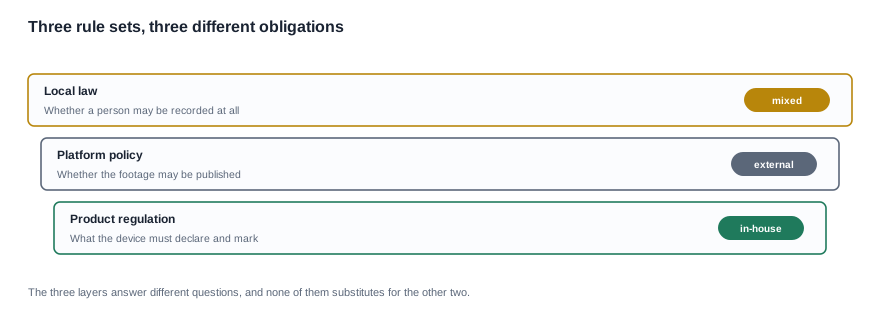
The short answer. A first-person camera sold for content creation is governed by three separate rule sets, and the most common mistake in this category is assuming that satisfying one of them satisfies the other two. Local law governs whether you may record. Platform policy governs whether you may publish. Product regulation governs what the device must declare, mark and be traceable as. A device can be perfectly lawful to sell and still produce footage that a platform will remove, and it can be sold with complete conformity documentation and still produce footage that is unlawful to record. The three are managed separately, by three different owners, and the cost of managing them separately is real.
Who is carrying this exposure and what it decides. A brand owner deciding whether to put its own name on the product is deciding whether it becomes the party responsible for the declaration of conformity in its own name, which changes the documentation route from an inherited file to a produced one. A procurement manager is deciding which evidence to hold before the first shipment leaves, because a shipment held at a border is a schedule failure and not a paperwork failure. A channel buyer is deciding what the customer guidance says about consent, because the guidance is the first line of defence and the second line is the customer. A manufacturer or factory is deciding what it can actually evidence, and therefore what it can put its name against.
What is genuinely a legal question and what is a commercial one. Whether a person may be recorded is legal advice territory, and a factory cannot answer it for you. Whether the model designation on the test evidence matches the model on your purchase order is a commercial question with a documentary answer, and it is the one that most often stops a shipment. Separating the two is what stops a buyer from asking a factory to give legal opinions, and stops a factory from quietly making one.
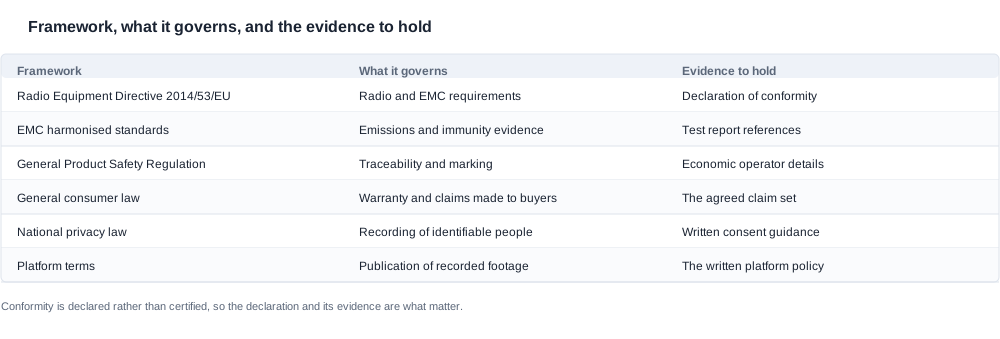
The frameworks, named without claiming anything about our own file. A wearable camera that connects over Bluetooth falls inside radio equipment rules in the European Union and equivalent frameworks elsewhere. The relevant regime is the Radio Equipment Directive, Directive (EU) 2014/53/EU, with the UK covered by an equivalent conformity route. The EMC harmonised standards sit alongside it as the technical evidence, and they should not be confused with the directive itself — the directive is the legal instrument, the standards are how conformity with it is demonstrated. For traceability and marking, the general consumer-law framework in the EU is the General Product Safety Regulation, Regulation (EU) 2023/988, applicable since 13 December 2024, which adds manufacturer identification, a responsible economic operator in the EU, and traceability information to the product and its packaging. National privacy law and platform terms sit outside all of these and apply on top.

What the product has to carry, not just what the manual says
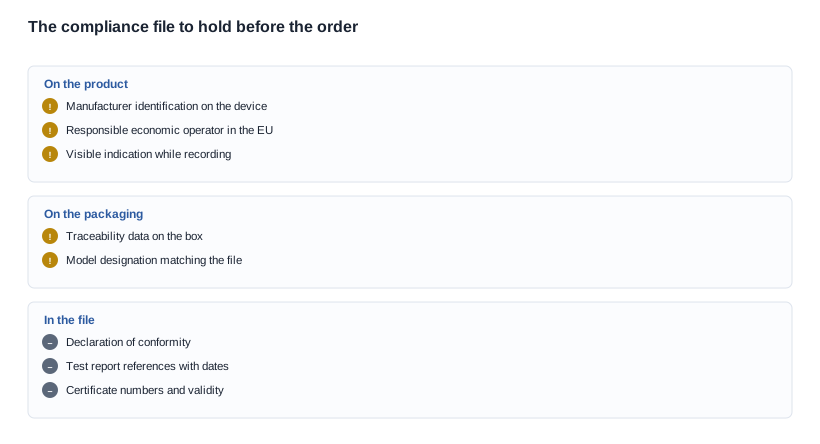
Conformance in this category is declared rather than certified by a third party, and that single fact changes what the buyer has to hold. A declaration of conformity is a statement the manufacturer makes, and it is only as good as the technical file behind it. A logo on a box is not evidence, and a supplier's assurance in an email is not a file. The buyer therefore needs the declaration itself, the test evidence it references, and the dates on both.
For a brand selling under its own name, the marking requirements are not decoration. A wearable camera sold in the EU has to carry a visible indication that it is recording, and the traceability rules add manufacturer identification, a responsible economic operator and traceability data to the outside of the product and its packaging. A listing that survives an inspection and a listing that does not differ by exactly these items, and the difference between them is decided long before the first container is loaded.
Two practical consequences for anyone specifying a supplier. First, ask where the recording indicator is implemented — hardware, firmware-only, or application-only — because an application-only indicator fails the moment the phone disconnects, which is the moment a bystander is most likely to ask whether they are being recorded. Second, ask whether the model designation printed on the box matches the designation in the test evidence, because a mismatch between the physical product and the declared model is the most common reason a shipment is held at a border.
The third consequence, which is about your own operation rather than about the device. Ask what the storage and deletion path is. Whether footage can be reviewed, deleted off the device and exported matters the moment there is a complaint, and it also matters for your own retention obligations as a controller of that footage. The storage behaviour is not published for any model in this range, which makes it a request rather than a published row.
Consent, signage and the filming locations that decide the argument
The consent question is where most of the practical risk sits, and it is a question for your adviser rather than for a factory. In much of the European Union and in a number of US states, recording a conversation you are part of is treated differently from recording a stranger in a public place, and the difference often turns on whether the other person had a reasonable expectation of privacy. Public is not the same as private, and a shop floor, a gym, a school corridor and a client's premises are each treated differently by different jurisdictions. Two consequences follow for a buyer who is building a content programme. The first is that the answer is jurisdiction-specific, so a channel serving several markets cannot have one consent policy. The second is that the recording indicator is a disclosure mechanism, and a disclosure that can be switched off by disconnecting a phone is not a disclosure.
What an operational consent policy needs to contain. Four elements, in this order. First, where recording happens and where it does not, expressed as places rather than as intentions, because "private areas" is not an instruction a creator can apply on site. Second, how the recording is indicated, whether by a device indicator, a visible notice at the entrance, or both. Third, what happens when someone objects, which in practice means a stop procedure that does not require the creator to make a judgement call. Fourth, how long footage is kept before it is deleted, and who can authorise deletion, because a retention policy is what converts a recording programme into a manageable one. None of these four elements is a hardware question and none of them is answered by the catalogue.
The filming locations that generate the disputes. Retail floors and showrooms, where people are being filmed while they are trying products. Fitness and studio spaces, where the sound recording picks up conversations. Client sites, where the client did not agree to be part of someone else's content. Any location where filming is incidental to a shoot that was arranged for another purpose. The pattern is that in each case the recording was lawful in the sense that nobody objected at the time, and the objection arrived later, usually from a person who watched the published video. A programme that has an indication mechanism and a stop procedure handles that objection at the point of filming. A programme that does not handles it with money.
Why the customers and staff in a retail channel need their own line. A creator filming in a shop is filming the staff and the other customers, and the staff are employees of somebody else. That creates an obligation for the retail customer that has nothing to do with the device and everything to do with the footage. The commercial consequence is that a brand selling into retail channels should expect the retailer to ask what the recording indication is and what the consent position is, and a brand that cannot answer those two questions will lose the channel rather than the order.
The platform layer is stricter than the legal floor in several markets. Every major social platform has its own rule about recording people and publishing footage of them, and a video that is lawful in the country where it was shot can still be removed. This is worth stating plainly to a brand team because it changes the order of operations: the platform policy is the constraint that bites last and hardest, because removal happens after publication and after the campaign has run. The two things a buyer can do about it are to agree the claim set with the factory in advance — so that the footage supports what the listing says and nothing more — and to keep a record of the consent position for each location, so that a takedown can be answered with evidence rather than with an apology.
Our position on the legal question itself is narrow and we will not widen it for a buyer who asks. We do not provide legal advice, we do not tell you that a product is compliant in your market, and we do not quote certificate numbers we cannot evidence. What we do is tell you which documents exist for a given configuration and which ones we do not hold.

The document request that produces a usable compliance file
The request is six questions, and the order matters because the answers narrow each other.

Name the target markets first, and then the frameworks that apply to them. A device sold into the European Union, into the United Kingdom and into the United States is under three separate regimes, and the evidence sets do not substitute for each other. A request that does not name the market produces a file that is too broad to be useful and too narrow to be relied on.
Then ask which directive or regulation the current evidence names. Not "do you have CE" but "which directive, which standard, which report does it name". A framework name is not a document; the report number and its date are the document. That distinction is the whole difference between a compliance file and a box.
Then ask which model designations that evidence covers. Every suffix matters, including the case configuration and the colourway, and this is where a buyer discovers that the evidence was produced for a variant that is no longer in the range.
Then match the model on the report against the model on the purchase order, line by line. This is the check that stops a held shipment, and it costs nothing but attention. The evidence for one configuration is not evidence for another, and the differences between configurations in this range are small enough — an interface, a case size, a lens configuration — that they are easy to overlook and expensive to discover in a customs terminal.
Then ask where the recording indicator is implemented and what it is specified to do when the application is not running. The second half of that question is the part that is usually skipped, and it is the part that determines whether the indication is meaningful.
Finally, record the answers with the report numbers and their dates. A compliance file without dates is an archive rather than a file, and an archive cannot be used to close a question when a market authority asks for current evidence.

Where the honest gaps are, and why they matter more here
What our published catalogue gives. Pixel count, battery capacity, charge time, rated use, charging method, and on some models the charging interface, the ingress marking and the case capacity. What it does not give. The sensor model, the field of view, the video resolution and frame rate, the unit weight for every model except one, the ingress marking for most models, the storage capacity and overwrite behaviour, the transfer path, and — the point that matters in this article — any per-model conformity record, certificate number, issuing body or validity date.
The reason that list matters more for a camera product than for an audio-only product. A camera product cannot be responsibly evaluated without the video specification and the storage behaviour, because both are the substrate of a recording. A buyer who receives a file with a declaration of conformity and no video specification has received a device that is documented as radio-compliant and undocumented as a camera. Those are two different claims and they sit in two different places in the file.
**The certification position we can state honestly.A single company-level export certification page appears in the catalogue made up of ten appearance-design patent certificate images. It does not carry a per-model certification row, and the catalogue text contains no CE, FCC or RoHS reference for any model. We will not present that page as a per-model conformity record, and we will not quote a certificate number we cannot evidence. For a brand placing an order, the correct conclusion is not that the models are uncertified; it is that the per-model evidence is a written request against the exact configuration, and that the documents have to be in the buyer's file before the first shipment rather than after it.
The camera models publish no Bluetooth version row. That is relevant here because the radio framework is the framework, and a file that has to cover a radio requirement is easier to assemble when the radio configuration is a published row rather than an inference.
The commercial consequences of an incomplete file
A held shipment is the most expensive outcome, and it is entirely avoidable. The cost is not the duty or the demurrage; it is the schedule. A launch date that assumes a document which turns out not to exist becomes a launch date that depends on a document arriving from a third party, and that is a dependency no buyer can accelerate. The insurance is procedural and cheap: request the file against the exact configuration, hold it, and re-check it before each shipment against the model on the order.
A conformity file that belongs to your name is a recurring cost, not a one-off. If your brand appears on the product, the declaration has to be reissued in your name and kept current, and every configuration change or model addition reopens it. The commercial question to ask is therefore not only what the file costs but how many files you are going to maintain, because the number of SKUs in the range is the number of files. That is an argument for keeping the range narrow, and it is the same argument the how to compare models method produces for a different reason.
The commercial terms worth putting in the enquiry. Unit price and volume tiers. The documentation scope: which models are covered by the evidence the factory holds, and which require a fresh test. Who owns the declaration in the buyer's name and who maintains it. The cost and lead time of a conformity route that is not already held, which are quoted rather than negotiated because they follow the process and the testing body. Packaging specification, and whether the printed model designation is generated from the artwork file or typed by hand, because a typo in a box is a held container. Delivery splitting and payment nodes against inspection. The warranty period with a stated response and the return terms. The certification checklist and the contract terms pages cover the structure of both, and the GPSR requirements page sets out the traceability items in full. A useful way to frame the documentation scope in the enquiry is to ask for it per configuration and per market rather than as a single package, because a single package cannot be audited and a per-configuration list can be checked line by line against the purchase order.
What to leave out of the agreement. Any statement that a model is compliant in a market, in either direction. A market's legal requirement is a matter for that market and for the buyer's adviser, and a factory can only commit to what it holds.
Sending the markets and the configuration list
Send the target markets, the models you intend to list and the number of configurations you expect to run. We will tell you which documents exist for each configuration in our file, which are company-level rather than model-level, and which have to be requested from a testing body before the first shipment.
If you are running content in retail or on client sites, send the locations as well, because the consent and indication design is part of the product decision and the answer changes with the filming environment rather than with the model.
The models and their published rows are at the AI camera glasses range, and the scenario entry point is smart glasses for content creation.
Related reading
- AI camera glasses range — published camera configurations
- GPSR compliance requirements — the traceability items above
- Certification checklist before ordering — what to request in writing
Tell us the target market and the configuration, and we will tell you what we hold and what has to be requested.