
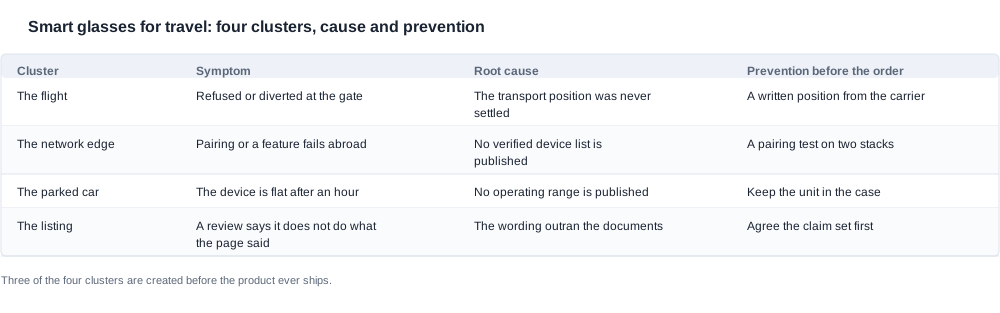
The common problems with smart glasses for travel arrive in four clusters, and the cluster is what determines who has to act. A device that will not charge at a transit hub is usually a configuration problem and belongs to the packaging and the bundle list. A device that will not pair with the phone in the hand is usually a compatibility problem and belongs to a sample test. A device that dies in a parked vehicle is usually an operating-range problem, and the catalogue publishes no operating temperature range for any model, so it belongs to a written instruction. A device that does something the listing promised and the documentation never said is an expectation problem, and it belongs to the wording. The reason this matters commercially is that all four arrive at the support desk looking identical — a customer, a device and a complaint — and only one of the four is a product defect in the sense that a supplier can be asked to correct it. Sorting the cluster before the reply is the difference between a corrective action and an apology.
Smart glasses for travel: the four clusters where travel problems arrive
The reader is a buyer working for a brand, a channel buyer or a product manager who already has a travel line in the field and is now reading the returns log. The decision in front of them is not "is the product good" but "which of these complaints is ours to fix, which is the channel's, and which is the listing's", and the second question that follows it is which of the four clusters can be designed out before the next order.
The published rows make the sorting possible, and they also explain why the sorting is necessary. Cell capacities run from 40 mAh on the A05 and the A06 through 70 mAh on the A07, 90 mAh times two on the K01 and the K02, 100 mAh on the D11 and the D12, 115 mAh on the D17, 220 mAh on the MT5 and the V03 Pro, and the V03, 260 mAh on the S7 and the KY06, and the V06, 265 mAh on the MT6, and 290 mAh on the CY05 and the L1 Pro, and the CY03 and the L2 Utral. Every model publishes a charge time, two hours or less across the range with about one hour on the D17 and the ZH12. The interface splits magnetic, Type-C and unpublished. The camera models publish a resolution class and, on two of them, an IP54 marking. And the catalogue publishes none of the four things a travel complaint is usually about: the operating temperature range, the standby draw, the runtime test condition, the verified device list, the field of view, the video specification, the storage path, the audio capture behaviour and the coating type.
Travel is where those absences become inconvenient for a reason that has nothing to do with the product and everything to do with the supply chain. A product specified for a desk is evaluated by the person who chose it. A product specified for travel is used by someone the specifier may never meet, in a market where the support desk is on the other side of a time zone and the customer cannot read the model designation off the device. Every unpublished row becomes an instruction that has to travel with the product, and every instruction that is missing becomes a support contact that the factory cannot answer either. The clustering below is therefore a description of where the instructions are missing, not a description of where the hardware fails.
Cluster one: the flight and the lithium cell nobody planned for
Every model in this range ships with a lithium cell, so the passenger rules apply to the product in a bag exactly as they apply to a spare power bank, and the rules differ between the cabin and the hold. The catalogue publishes no transport document set, and the framework is at battery transport.
The symptom in this cluster is a device refused, diverted or confiscated at the gate, and the root cause is almost never the device. It is that the transport position was never settled for the actual itinerary, and it was never settled because the travel product is usually specified by a person who is not the person who carries the cell. The distinction that matters for a buyer is between a device that a carrier will not accept in the cabin, which is a product specification question about the cell, and a device that a traveller did not declare, which is an instruction question. The first belongs in the configuration sheet; the second belongs in the travel instruction and in the carton print.
A second symptom in the same cluster is the case treated as an accessory rather than as a second cell. Case capacity is published for the CY03 and the L1 Pro, and the CY05 — each at 1400 mAh, for the L2 Utral as a 900 or 1400 mAh configuration choice and for the MT6's foldable case at 1200 mAh, so a cased configuration is a two-cell shipment with a different file from a bare one. The prevention is cheap and it is a packaging decision rather than a legal one: the case has to be named inside the transport file for the configuration that actually ships.
Cluster two: the network edge, where a device stops being a device
The symptom is that the device works at home and does not work in another country, which is reported as "it stopped working abroad" and is almost always one of three distinct faults wearing the same coat. The first is the radio: Bluetooth 5.3 is published on the K01 and the K02 and 5.4 on the D11, the LC-105-2, the D12, the YK12, the G07, the LC-105-1, the YKC02, the D17, the ZH12, the A07, the AR model and the electrochromic entry, while the eleven camera models publish no Bluetooth version row at all. The version is fixed and the compatibility is not, because no verified device list is published for any model.
The second is the phone stack, which is a different phone from the one the device was paired to at home. The third is the feature: twenty of the twenty-eight models carry an AI function entry, the AI voice assistant is listed across the range and the K01 publishes an AI translation capability, while the model behind those entries, the language list, the offline behaviour, whether a subscription applies and where data is processed are not published.
The root cause across all three is the same, and it is the row that is missing rather than the row that is wrong. The prevention is a sample test with a recorded result per phone stack and per network, plus a listing that treats a network-dependent feature as untested until it has been tested on the network the channel sells into. The procedures are at testing the Bluetooth version before ordering and does the AI feature need internet.
Cluster three: the parked vehicle and the operating range nobody published
The symptom is a device that is flat after an afternoon in a car, or that behaves badly in the cold, and the report arrives as "it does not work outside". No operating temperature range is published for any model in the range, no cycle-life rating is published, and no thermal behaviour is published, so there is no specification against which the behaviour can be judged and no defensible answer in either direction.
The root cause here is structural rather than accidental: an empty row in a specification is treated as an acceptable row, and the instruction that should have been written was never written because nobody owned it. The prevention is a written instruction that says the device belongs in its case and the case belongs in the bag rather than on a dashboard, written per configuration so that it is actionable for the models whose catalogue publishes a case row. The thermal questions are at does it overheat during long takes and does cold weather affect the battery.
There is a quieter variant of this cluster, and it belongs in the same bucket. A device that drains overnight in a bag is a standby problem, and no standby draw is published for any model. The published runtime bands — five to eight hours on the camera models and six to eight on the audio models — carry no test condition and therefore say nothing about what happens in the gaps between use. A buyer who wants the gap behaviour has to ask for the standby figure or measure it, and the instruction that results from it is a charging routine rather than a specification.
Cluster four: the listing that outran the documentation
The symptom is a review that says the product does something the product page promised. The root cause is a claim, and the two claims that cause most of them in this category are the ingress marking and the runtime. The IP54 marking is published on the V06 and the S7 and on no other model, it covers a dust protection level and splashing water rather than immersion or a sustained downpour, and no test report behind it is published anywhere in the catalogue. A travel listing that repeats it as "waterproof" has created a defect claim out of a catalogue attribute, and in a travel market the customer is going to test it in the rain.
The runtime claim fails in the same way for the same reason. The published figures are ceilings and carry no test condition, so a listing that writes "eight hours" has converted a published band into a promise that a customer will measure from whatever state their device was in.
The prevention in both cases is the claim set: one document listing the permitted wording per model, signed before the artwork is approved, with the marking stated as a catalogue attribute and the runtime written with its band or its condition attached. The certification position in this category is worth stating precisely, because it is the assumption most often made: the catalogue carries a company-level export certification page whose content is images rather than text, the catalogue text contains no reference to CE, FCC or RoHS, and there is no per-model certification row anywhere. The digit reading is at what the second digit means.

The prevention list, and the criteria it produces
The four clusters above share a shape: each is a row that is either unpublished or quoted without its qualification. That is why the remedy for all four is a request and a measurement rather than a redesign, and why the whole list of preventive actions is short enough to put in a single page.
Cluster one is closed by a written transport position. What to ask is the carrier's own position, in writing, for the cabin and the hold, for the itineraries the channel actually sells into, plus the transport file for the shipped configuration with the case named inside it. The criterion it produces is a per-configuration file reference and a per-itinerary instruction line.
Cluster two is closed by a recorded test. What to ask is the verified device list, or a written statement that none is held, and the implementation details behind any listed AI function. The criterion it produces is a pairing result per phone stack and a feature result per network, both dated, so that the listing can say what was observed rather than what was published.
Cluster three is closed by an instruction. What to ask is the operating temperature range, the standby draw and the runtime test condition. The criterion it produces is a written storage and charging routine per configuration, which is actionable only for the models whose catalogue publishes a case row.
Cluster four is closed by a claim set. What to ask is the wording the documentation behind the marking can carry, and it is not a question for the factory, because the answer is that no test report is published. The criterion it produces is a signed list of permitted wordings per model, approved before the artwork.
Three red flags are worth stopping on before you order a travel line, and all three are visible on a one-page plan rather than in a support log. A plan whose instructions apply to "the range" rather than to a configuration will be wrong for at least one model in it. A marketing page that lists a network-dependent feature and a test table that does not will produce a complaint that no document can answer. And a transport file that mentions the device but not the case will stop a shipment rather than generate a complaint, which is the better of the two failures.
The total cost consequence is the reason this page is worth writing before the order rather than after the first returns. A travel line that needs a written workaround for compatibility, a per-configuration instruction set and a second battery in the bag is a different product from one that needs none of them, and the difference lands in the returns rate, the support cost per order and the freight line of a cased configuration. The correct question to ask of a travel supplier is therefore not "what is the unit price" but "which of these four rows does your documentation already close for the configuration I am about to order", because the first question is answered by every supplier and the second is the one that decides the year.
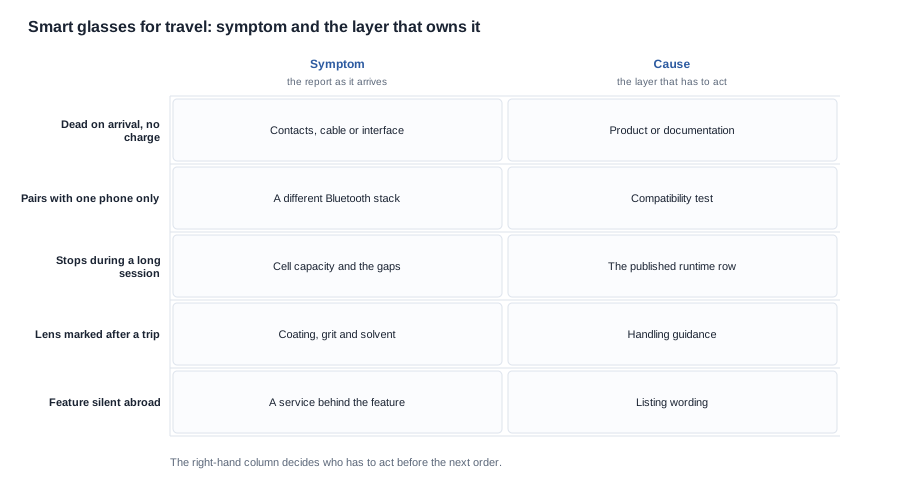
Who closes a travel fault, and what that means for the order

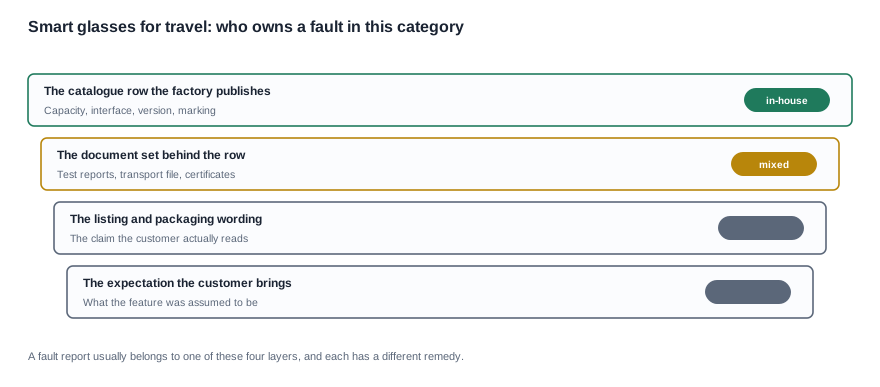
The four layers in the diagram above are the diagnostic order, and the point of the order is that the cheapest remedy is usually found first. A fault report should be reproduced on two units from the same batch with the same phone and the same network before anything is concluded, because one unit cannot separate a design characteristic from a manufacturing inconsistency and the two need completely different remedies. Then the published row that touches the fault should be written down, because the row is what decides whether the fault is a product fault at all. Then the listing wording has to be read, because a wording fault and a product fault look identical from the outside and only one of them is correctable by the factory.
The commercial consequence is that the remedy for each cluster lands in a different part of the business. Cluster one produces a packaging and document change. Cluster two produces a sample test and a listing change. Cluster three produces an instruction. Cluster four produces a claim set. Only a genuine manufacturing inconsistency produces a supplier corrective action, and it is the one cluster where the factory can act on the product itself.
That is why the prevention list for the next order is worth more than the reply to the last complaint. The request list that closes each gap is short. The case capacity, the case charge time and the case weight, per configuration. The interface row for the four camera models that publish none. The standby draw and the runtime test condition. The verified device list, or a written statement that none is held. The operating temperature range. The field of view, the video specification and the storage path, on a sample. And the transport file for the configuration as shipped, with the case named inside it.
Where the catalogue stops and the request begins
Here, a travel complaint has to be sorted before it is answered, and the sorting is only possible because the catalogue is specific about what it holds. We publish the resolution class for the camera models, the cell capacity for every model, the charge time as the upper bound it is, the charging interface wherever the catalogue states it, the case capacities where they are published, the Bluetooth version where a version row exists, the structural features that are published, the photochromic configuration on the V03 Pro, the remote photo capability on the D17 and the ZH12, and the IP54 marking on the V06 and the S7 stated as a catalogue attribute.
We do not publish and will not estimate the sensor, the field of view, the video specification, the low-light behaviour, the storage and overwrite behaviour, the capture latency, the audio capture behaviour, the coating type and hardness, the standby draw, the operating temperature range, the cycle life rating, the runtime test condition, the verified device list, the transport document set, the case charge time, the case weight, and the unit weight of every model except the MT6, where the catalogue publishes 158 g for the glasses whole unit with the battery and camera included and the foldable case excluded. We will not state that any model is tested to IP54, we will not describe a listed AI function as working when its implementation is not published, and we will not present a demonstration as a measurement.
Send us the fault descriptions you are seeing, the configurations involved and the markets, and we will tell you which cluster each one sits in, which published row governs it, and which part of the order has to change so that the next one does not arrive. The problem-handling counterpart is at the travel common problems companion, the model comparison is at comparing models for travel, and the scenario entry point is smart glasses for travel.
Related reading
- The entry point for this scenario — smart glasses for travel
- The model comparison — comparing models for travel
- The transport framework — battery transport
- The ingress wording — what the second digit means


