

Content creation is the only smart glasses use case where a fault does not degrade the product — it destroys the output, and it destroys it silently, on a shoot, with no error message. A creator who loses twenty minutes of footage will not open a ticket; they will quietly stop using the device and never tell the brand why. That is why troubleshooting discipline matters commercially here in a way it does not for an audio-only pair, and it is why the triage has to be written into the buyer's own process rather than left to a support line. This page is written for the buyer supporting a content channel, and it gives the five-step triage, the completion criterion for each step, and the rows to request so that the triage can be built on something.
The commercial framing. Every step of the triage below is a place where a ticket is avoided, and every avoided ticket is staff time that a channel does not spend and a creator does not experience as friction. The triage is also the cheapest available source of the missing specification, because a step that cannot be completed is a step that has exposed a row nobody published.

Smart glasses for content creation: a triage that ends in a decision
A triage is only worth writing down if each step ends in a yes or a no. A procedure that says "check the device" ends nowhere, and a support team following it will either escalate everything or resolve nothing. The five steps below each carry a completion criterion, and if a step cannot reach its criterion, moving to the next one wastes an afternoon.
Who is doing the triage and what it protects. A channel operator is supporting creators and needs the order of the checks to be the one that resolves the most cases in the fewest steps. A brand owner is watching the repeat-purchase rate rather than the ticket count, and in this category the two diverge sharply. A procurement manager is deciding which rows have to be closed before the deployment, and this triage is that list — every step depends on a row that is currently not published, which is why the request for those rows is part of the triage rather than a separate task.
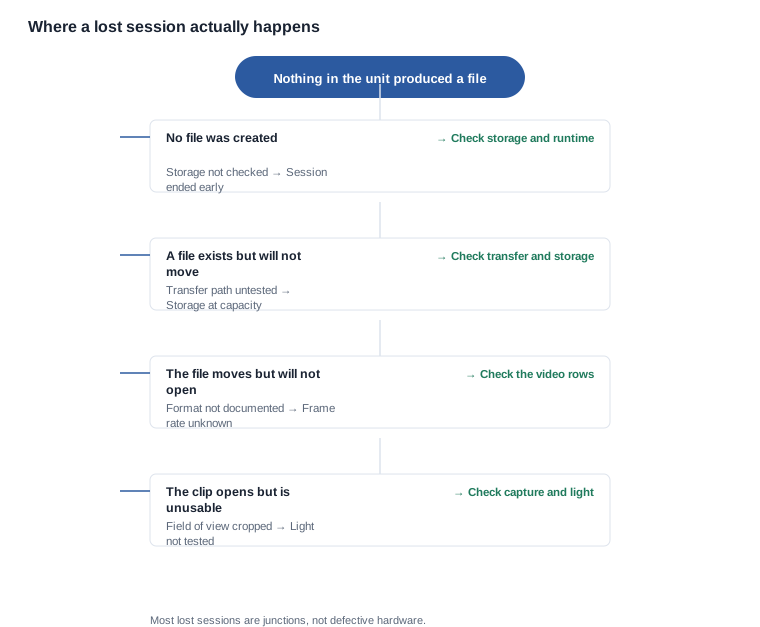
The decision at the end of the triage is not "is it broken". It is one of four: replace the part, replace the unit, escalate to the supplier with the conditions attached, or close it as a workflow error and change the guide. A triage that cannot reach one of those four is a triage that produces a ticket. That is the standard to hold it to.
The order of the five checks, and why the order matters
Step one is to reproduce the fault on your own phone, not on the demo unit. The completion criterion is that the same failure occurs on a second, unrelated phone. If it only fails on one phone, the device is not at fault and a support ticket has been avoided in a single step. This step alone removes every fault that is really a phone-side fault, and in a channel where creators connect to their own devices rather than to a house system, that is a large fraction of the contacts. The rows it depends on are the pairing sequence, the app name and the compatible device list — none of them published for any model in the range.
Step two is to establish what the device is actually doing, rather than what the creator thinks it is doing. The completion criterion is that the device state, the storage level and the transfer state are all known. Indicator behaviour is the row that makes this step possible, and it is not published. Without it, the support team is inferring a device state from a description, and the inference is usually wrong in the direction of "the device has failed" when the more common truth is that the device is working and the file has not moved.
Step three is to check the three junctions in order — storage, transfer, edit. The completion criterion is that the file is on the editing machine, opens and plays. Each junction has behaviour that our catalogue records as not published, and each junction is where a creator's afternoon disappears. The order matters because a file that has not left the device cannot be judged at the edit, and a file that cannot be stored cannot be transferred; checking the edit before the transfer produces a conclusion about the file format when the actual problem is that the file never arrived.
Step four is to separate the capture fault from the workflow fault. The completion criterion is that the capture works and the file is right, or that the file is wrong in a way the workflow cannot fix. The resolution, the frame rate and the field of view decide which one it is, and a clip from the creator's own shoot settles it faster than any conversation.
Step five is to check the thermal and the endurance, because a long session degrades quietly. The completion criterion is that the end-of-session state is recorded and compared with the start-of-session clip. A device that holds for ten minutes and reduces after forty is a different product from one that holds for two hours, and the difference is invisible until somebody compares the two clips. The runtime condition and the thermal behaviour are the rows behind this step, and neither is published.
Why the order is the deliverable. The steps are ordered by how many cases each one resolves, not by how technical it is. That distinction is the whole value of a written triage, because the instinct under pressure is to start at the most technical check, and the most technical check is both the slowest and the least likely. A triage that is written down, tested on somebody who has not used the product, and put on the quick-start card is an asset; a triage that lives in the head of a support lead is a cost that scales with the channel.
The junctions where a session is lost
The three junctions are worth setting out separately, because they are where the time goes and because each one has a different cost when it fails.
The storage junction. Storage capacity and the behaviour when storage fills are not published for our models. The failure is silent and total: the recording stops, the take is lost, and the creator describes the product as broken. The check is to fill the storage on a sample and observe what happens — does it stop, does it overwrite, does it warn. Whichever of those it does, the answer belongs in the guide, and the guide is what turns the next occurrence from a lost take into a thirty-second check. The alternative is a channel that loses a fraction of a take every time a creator fills the device, which is a cost that never appears in a return figure because the unit was never returned.
The transfer junction. The transfer path, the transfer time for a large file and the file format the recording produces are all not published. A camera product where the transfer is slow gets used once, and the creator does not file a complaint; they stop. This is the junction with the highest cost per occurrence and the lowest cost to close, because a large-file test on a sample takes twenty minutes. The result belongs in the card, because the creator who knows that a large file takes a specific amount of time will wait for it, and the creator who does not know will assume the device has failed.
The edit junction. The file format, the video resolution and the frame rate are not published, and the field of view decides whether the clip is usable at all. The check is to open the file in the editor on the machine the channel actually uses, not on a handset. A clip that seems acceptable on a phone screen can be unusable in the edit, and the judgement that gets made on a phone is a judgement about a different workflow. The how battery runtime is measured page covers the endurance row, the smart glasses for content creation page covers the channel context, and the AI camera glasses page lists the configurations and their published rows.
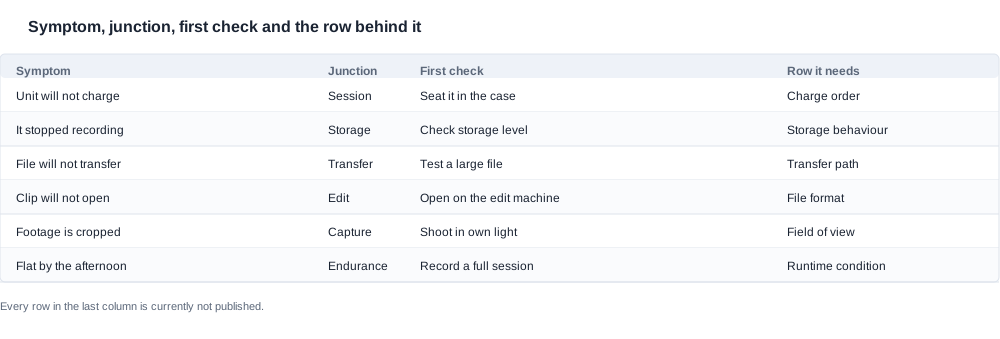
The three junction checks, in the order they should be run.
- Storage. Check the storage level before anything else, and on a sample, fill the device deliberately and record what happens when it reaches the end. Write the behaviour into the guide in one line, because that one line is what prevents the next lost take.
- Transfer. Move a large file, time it, and record the path it takes and the format it arrives in. A number here is worth more than a description, because a creator can plan around a duration and cannot plan around a description.
- Edit. Open the file in the editor on the channel's own machine and play it back. If it survives that, the capture and the transfer have both worked, and whatever remains is a claim about the output rather than a fault.
Why the junctions deserve their own step in a written triage. A support team that organises its matrix by component — camera, battery, app, cable — will send a creator to the wrong section in most cases, because the component is rarely where the failure lives. Organising by junction sends the creator to the place where the outcome is decided, and it does so in a way that a non-technical reader can follow without a diagram. That is the difference between a matrix that reduces tickets and one that relocates them.
A fourth junction worth naming, although it is not a technical one. The handover junction: the moment the footage moves from the creator to the editor. A great deal of channel time is lost here, because the file exists on a device, a card or a cloud account that the editor does not have access to, and the fix is a process rather than a specification. It belongs in the same guide for the same reason the other three do, because a creator who is told where the file goes will put it there, and one who is not will ask a colleague.

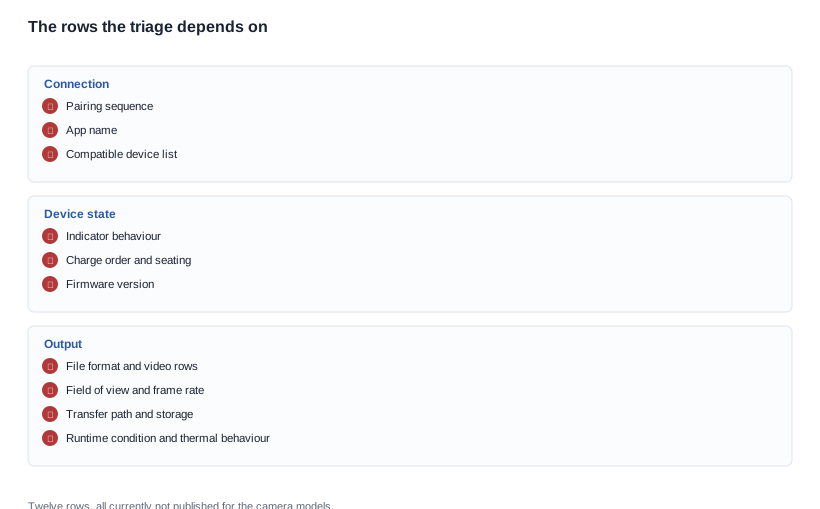
The twelve rows the triage depends on
Twelve rows, and every one of them is currently not published for the camera models. The request is worth making as a single message, in the same form the catalogue publishes its own rows, because a request that arrives as one list gets answered as one list.
| # | Row | Which step it unblocks | What it settles |
|---|---|---|---|
| 1 | Pairing sequence | Step one | Whether the phone is the fault |
| 2 | App name | Step one | Which software the guide describes |
| 3 | Compatible device list | Step one | Which phones are supported |
| 4 | Indicator behaviour | Step two | What the light means |
| 5 | Charge order and seating | Step two | Whether the unit is charging |
| 6 | Firmware version | Step two | Which build the card describes |
| 7 | Storage capacity | Step three | How much a session holds |
| 8 | Storage behaviour at capacity | Step three | What happens when it fills |
| 9 | Transfer path and time | Step three | How the file moves |
| 10 | File format and video rows | Steps three and four | Whether the file opens |
| 11 | Field of view and frame rate | Step four | Whether the clip is usable |
| 12 | Runtime condition and thermal behaviour | Step five | Whether a long session holds |
The order of that list is not arbitrary. Rows one to six belong to the connection and the device state, and they are the cheapest to obtain because most suppliers hold them internally even when they do not publish them. Rows seven to ten are the ones a supplier is most likely to answer with a sample test rather than a document, which is why the request should name the test. Rows eleven and twelve are the hardest, and they are also the two that decide whether a channel can sell a first-person proposition at all.
What to do with a row that stays open. Record it as open with the date, and use it as a condition on the claim set. A listing that says the field of view is not published is a truthful listing; a listing that says nothing is a listing that implies a specification the buyer cannot demonstrate. The cost of that difference is paid at the returns desk, and it is paid by the brand rather than by the supplier.
The request is also a supplier evaluation instrument, and it is worth treating it as one. A supplier that answers all twelve rows in writing, in the format the catalogue publishes its own rows, is a supplier whose documentation discipline will hold up under a client audit later. A supplier that answers four of them is telling a buyer something about how the next order will go, and the point at which a buyer discovers it is at the quotation stage rather than after a shipment. Buyers who run a structured due diligence on a new supplier should run this request as one of the exercises, because it produces comparable answers across suppliers in a way that a general capability questionnaire does not.
Where troubleshooting becomes a replacement habit
Six misuses of a triage account for most of the support cost in this category, and each one looks reasonable from the inside.
The fault was assumed to be in the device. The symptom is a replacement issued for a phone-side problem. The root cause is that step one was skipped. The prevention is to reproduce on a second phone first, every time, without exception.
The storage was never checked. The symptom is a creator who lost a take. The root cause is that the capacity and the overwrite behaviour are not published and nobody asked. The prevention is to fill the storage on a sample and put the behaviour in the guide.
The transfer was never tested. The symptom is a creator who stopped using the device. The root cause is that a slow transfer is invisible in a demonstration. The prevention is a large-file test, with the result on the card.
The endurance was quoted without a condition. The symptom is a complaint that the battery is faulty. The root cause is that a rating with no condition was applied to a duty cycle. The prevention is the condition, or the measured number.
The footage was judged on a device screen. The symptom is a clip that seems fine on the phone and is unusable in the edit. The root cause is that the framing and the format were never checked on the editing machine. The prevention is to open the file in the editor.
The silent failures were not tracked. The symptom is a repeat-purchase rate that falls with no ticket trend. The root cause is that creators who stop do not complain. The prevention is to track the repeat-purchase rate against the ticket count, because the gap between them is the failure signal, and the ticket count on its own only measures the failures that produced a complaint.
What a disciplined triage is worth commercially
The cheapest support intervention in this category is a guide that resolves the common cases, and the most expensive is discovering that a creator has quietly stopped using the product. The triage is what turns the first into the second's absence: written into the quick-start card, it resolves the common cases at the creator's desk, and written as a supplier escalation form, it resolves the rest at the factory without a second round trip.
The commercial terms that follow from it are specific. The unit price and the volume tier, the spare and accessory set with its minimum order quantity per creator, the guide and the insert design, the packaging specification, delivery splitting, the payment nodes against inspection, the warranty period with a stated response, the return terms and the terms of a pilot order. The line that decides the rest is the per-creator spare quantity, because a triage that ends in "replace the part" is only cheap if the part is in the same building as the creator.
The total cost of the support side of a channel is the sum of four lines, and only three of them appear in a quotation: the guide design, the spare quantity per creator, and the escalation time at the factory. The fourth is the staff time spent answering contacts, and it is the one that scales badly, because it scales with the creator count while the other three scale with the device count. A triage that reduces the number of contacts by even a small fraction therefore has a larger effect on the support budget than a negotiation on any unit price, and the measurement to make is the contact rate per creator per month rather than the ticket count, because the ticket count misses the failures that never produced a complaint.
Two terms are not negotiable and are worth naming so the negotiation is shorter. The cost of a certification and the time it takes are given by the schedule and by whoever certifies it. Tooling is frequently amortised across the first order while certification cost is incurred per product family, so the question to ask is which of the two you have been quoted. The AI camera glasses page lists the configurations whose rows are published, and the smart glasses for content creation page covers where the workflow sits.
Stated plainly: in this category the failures live at the junctions and in the conditions, not in the hardware, and a triage built on that is what reduces the ticket count and protects the repeat-purchase rate. We will not publish a pairing sequence, an app name, a compatible device list, an indicator behaviour, a storage behaviour, a transfer path, a file format, a video resolution, a frame rate, a field of view, a runtime condition or a thermal behaviour for a model where the manufacturer has not provided one, and we will not fill a gap with a typical value.
What we will do is give you the order, the completion criteria and the twelve rows to request. Send us the creator count, the models and the target markets, and we will tell you which rows the triage needs and which the documentation cannot supply.


