

Not one of the eight pitfalls below is a hardware defect. Every one of them is an assumption that nobody wrote down before launch, and every one of them surfaces on a bike, which is the least forgiving place to discover a planning error. Cycling programmes that run well are the ones where these were designed out in advance rather than reported afterwards. A brand owner, a channel buyer or an e-commerce seller can read this list against their own specification and find out how many of the eight are still live — and each of them has a correction that costs a line of text at the specification stage rather than a return rate at the volume stage.
Smart glasses for cycling: eight assumptions that turn into returns
The decision this article supports. Before a purchase order for smart glasses for cycling is released, the buyer should be able to answer eight questions with a yes or a no. Does the programme assume that open-ear audio leaves the rider's awareness untouched? Does it assume the device can be operated while moving? Does it present the device as a safety aid? Does it treat a rated hour as a route length? Does it choose a camera on its pixel number? Does it describe IP54 as weatherproof? Does it treat one approved sample as the production population? Does it assume pairing works in every market? Each of those assumptions looks reasonable in a meeting and unreasonable in a returns analysis.
Who is holding the decision. The reader is a brand owner assembling a cycling line, a channel buyer placing a range with a dealer network, and the product or quality lead who will be asked to explain a defect rate in the second quarter. In every case the work is the same: someone upstream has written a specification, and someone downstream has to build a product that matches it. The cost of an unwritten assumption is paid at the wrong end of the chain — the factory sees a purchase order, the dealer sees a return, and the brand sees a margin problem with no single cause attached to it.
How the eight are grouped, and why the grouping matters. The first three are arguments that a rider or a customer will have with the product on the road, and they are safety-adjacent even though the hardware is not a safety device. The next three come from reading a published row too quickly, and every one of them traces back to a number that is correct and a conclusion that is not. The last two appear only once the volume is real: one is about a population that a single unit cannot represent, and the other is about a market that the factory's region cannot stand in for. Each group has a different owner and a different gate, which is why a single programme review usually catches some of them and misses others.
The common structure of all eight. Each pitfall follows the same pattern. There is a published fact, a reasonable inference drawn from it, and a commercial decision made on the inference. The fact is fine. The inference is where the error is. That is why the correction is never "get more data" — it is "state the assumption, and attach a test that would prove it wrong." A programme that accepts a fact without naming the inference has no place to put a correction when the inference fails.
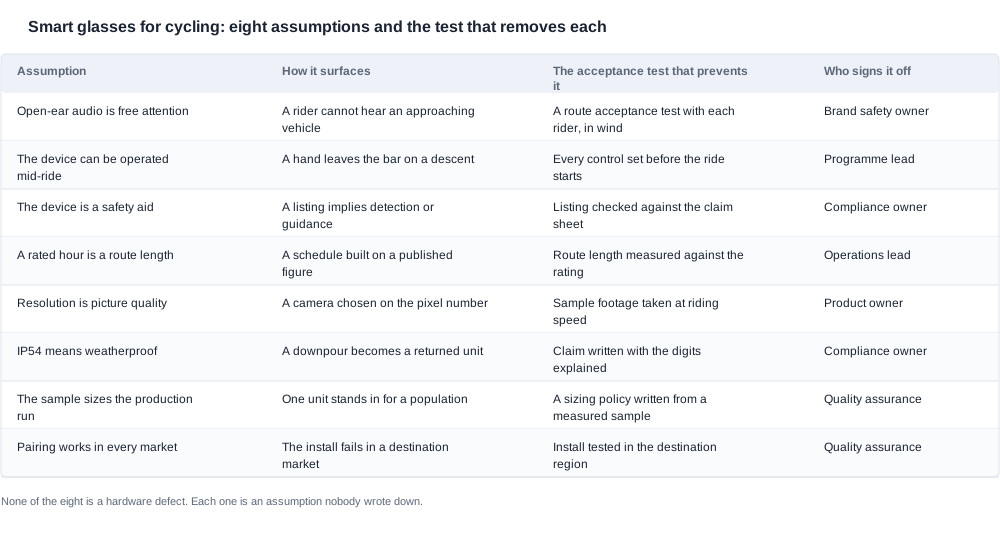
The table above is the working version: assumption, how it surfaces, the acceptance test that prevents it, and the person who signs against it. The last column matters more than it looks. An acceptance test with nobody signed against it is a wish, and the eight failures in this category are almost always tests that were discussed and never assigned.
The three that get argued as safety issues on the road
Pitfall one: treating open-ear audio as free attention. A rider who plays audio hears the device and loses part of the ambient awareness cycling depends on most — an approaching vehicle, a warning from another rider. This is a design property of the category rather than a defect, and it becomes a problem only when it is left to individual judgement on the day. The correction is an explicit acceptance test with each rider: if you cannot hear a vehicle approaching, the audio is not usable on that route. For a brand this is a configuration and training decision, not a hardware decision, and it belongs in the same acceptance list as the fault rate criteria.
Pitfall two: reaching for the device while moving. Every cycling glasses programme has a version of this, and most prohibit it in writing, which is not the same as preventing it. The correction that works is to set every control before the ride starts and to build the training sequence around that rule rather than around a warning. A programme that wants a mid-ride control has to specify which one and prove it is operable without a hand — the D17 and the ZH12 publish a remote capture control, which is the published feature that makes some of this possible on those two models and only on those two models.
Pitfall three: presenting the device as a safety aid. It is a recorder and an audio device. It does not detect vehicles, it does not navigate, and no published specification makes it one. Any listing or training material that implies otherwise is a misrepresentation, whatever the hardware does — and in a category with a strong review culture, it is the kind of misrepresentation that returns as a public comment rather than as a private complaint. The correction is a claims sheet written before the copy, with a named owner who reviews every listing variant, every dealer sheet and every instruction insert against it. The boundaries in that sheet are the ones our own catalogue cannot cross either: no health or hearing claim, no detection or navigation claim, and no waterproof claim wider than the published ingress marking.
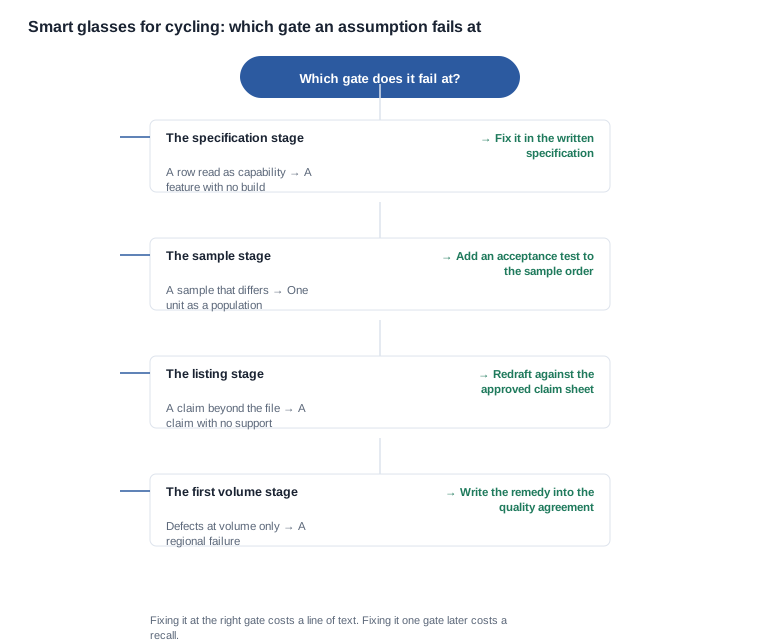
The decision chart above is the triage a buyer needs when one of the eight surfaces late. A specification-stage fault is closed with a line in the written specification and costs nothing but a re-issue. A listing-stage fault is closed by rewriting the copy, which is cheap until the copy is printed on insert cards and packaging artwork. A first-volume-stage fault is closed with a remedy written into the quality agreement, and that is the expensive one, because by then the defect rate is in the accounts.
The three that come from reading a published row too quickly
Pitfall four: reading a rated hour as a route length. Rated use across this range runs from about five to eight hours depending on model — the V06 and the S7 publish five to eight, the KY06 and the MT5 publish six to eight, the D17 publishes about seven, the ZH12 and the YKC02 publish about eight — and no runtime figure in the catalogue carries a test condition. A rider planning a six-hour route against a seven-hour rating has built a schedule on an assumption about the ambient volume, the signal conditions and the temperature. The correction is to measure the route and the programme's real duty cycle before quoting anyone a figure, and to read how runtime is defined at battery life rather than assuming that two hours of charging and eight hours of use describe the same day.
Pitfall five: choosing a camera on resolution alone. The camera models here publish 8 MP on eight of them and 13 MP on three of them — the S7 and the L1 Pro, and the L2 Utral. Resolution tells you how many samples the sensor takes, not how much of the scene it sees, and the field of view is not published for any model in this range. A higher number is therefore not automatically a better picture on a moving subject. The correction is sample footage at riding speed, compared as footage and not as a specification table. For a buyer this also settles a sourcing question: the 13 MP class is three models, which is a narrow shortlist and a different negotiating position from an 8 MP shortlist of eight.
Pitfall six: reading IP54 as weatherproof. The V06 and the S7 are the only models in our range that publish an ingress marking, and it reads IP54. The first digit is a dust protection level and the second covers splashing water; it does not cover immersion and it does not cover a sustained downpour. No third-party test report behind that marking is published, so the marking is a catalogue attribute rather than a verified performance figure. The digits are explained at ingress protection ratings. For a year-round programme, wet-weather tolerance is a wipe-and-dry routine plus an honest listing, not a specification. The cost of getting this wrong lands on the returns line of the wettest month of the year, which is exactly when a channel has the least margin to absorb it.
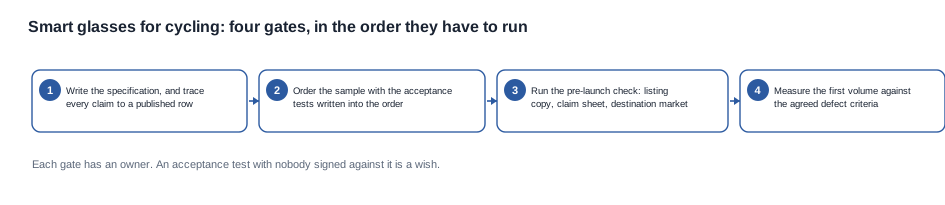
The four gates above are the sequence the corrections have to run in. The specification gate produces the claim list and the acceptance tests. The sample gate proves them on one unit. The pre-launch gate checks the copy and the destination market. The volume gate measures the defect rate against criteria that were agreed before the goods shipped. A programme that runs these in a different order usually ends up paying for the specification gate twice.
The two that only appear once the volume is real
Pitfall seven: treating one approved sample as the production population. Sizing is the parameter that decides return rates in this category, and the published data cannot close the question: our catalogue carries a single unit weight figure of 158 g, and that figure belongs to the MT6, a foldable-case camera model rather than a cycling model, and it is the whole-unit weight including the 265 mAh cell and the camera, with the 1200 mAh folding case listed separately and its own weight unpublished. The per-model frame weight for every cycling candidate is therefore not published. A sample can pass a sizing test and tell you almost nothing about the production population, because the unit that was approved and the unit that arrives in the fourth quarter are not the same unit. The correction is to treat the sample as one unit rather than as the specification: write a sizing policy from a measured sample, measure a sample size that a real production run would support, and put the return reasons into a fixed vocabulary so the data is usable when it arrives.
Pitfall eight: expecting the app to work in the buyer's market. Pairing that works in the factory's region can fail in the destination market, and the resulting return gets booked as a hardware fault because that is what the returns form offers. Our catalogue does not settle which regions a given model's software supports, so this is an assumption rather than a fact, and the only way to close it is a test. The correction is to install on a real unit, on the destination region's network, before launch, and to record the result as a binary outcome rather than as an impression. It costs an afternoon and it removes a defect category that is otherwise indistinguishable from a factory fault.
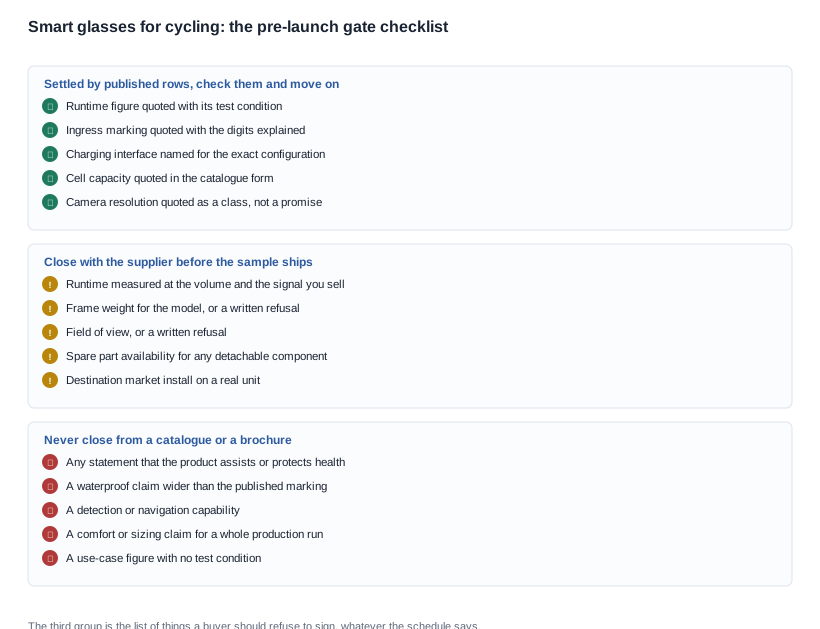
The checklist above separates the three groups that get mixed together in a pre-launch review. The first group is already settled by published rows and only needs checking. The second has to be closed with the supplier, and the schedule pressure belongs to whoever owns that conversation. The third group is the list a buyer should refuse to sign, whatever the launch date says: a health or hearing claim, a waterproof claim wider than the marking, a detection or navigation capability, a sizing claim applied to a whole production run, and a use-case figure with no test condition behind it.

Why every one of these eight is cheap to design out and expensive to find
Each of the eight has a different cost signature, and the cost lands on a different party in each case, which is why a programme can carry two of them at once without anyone noticing the link.
The assumption that costs a return rate. The open-ear attention point, the sizing point and the ingress point all end in a unit coming back. Their common characteristic is that the fault is attributed to the product rather than to the assumption, so the returns data shows a product problem where the real cause was a planning decision. This is the group where the fix is in the acceptance criteria, and it is also the group where the measurement discipline pays for itself fastest.
The assumption that costs a margin. Choosing a camera on resolution alone, or a model on a runtime figure that has no test condition, produces a product that works and a product that does not sell at the expected price. The margin loss is invisible because the unit cost was correct and the volume was simply lower than planned. The correction is a comparison against the shortlist at the specification stage, when changing the model is cheap.
The assumption that costs a schedule. The destination-market install and the mid-ride control both surface after the copy is written and the artwork is committed. A correction at that point touches packaging, inserts, training material and dealer sheets at once, and every one of those has its own supplier lead time.
The commercial reading of all three. A buyer's total cost for a cycling programme is not the unit price. It is the unit price plus the compliance and testing cost, plus the returns reserve, plus the cost of the rework that an assumption forces, plus the carrying cost of a launch that moves. Which of the eight to design out first is not a rule that applies to everybody: it depends on where the programme is weakest, which is usually the point the buyer already suspects but has not written down.
Where the negotiating room is, if the programme already has some of these live. Some of the eight can be closed with a supplier without changing the product. A destination-market install test is a supplier obligation that costs the supplier little and the buyer a great deal. A written runtime test condition for a named configuration is a specification clause. A spare part availability statement for a detachable component is a service commitment. Each of those is a line in the agreement, and each is worth more to a buyer than a unit price discount, because a discount does not close an assumption.
What makes an acceptance test binding rather than decorative. Four things, and a test missing any one of them is a conversation rather than a control. It needs a stated pass condition, in a form that can be judged the same way by two different people on two different days — not "acceptable sound" but "the approach is heard on a specified route at a specified speed". It needs a sample size, because one unit cannot clear a population claim, and the size has to be stated before the result is known rather than chosen after it. It needs an owner with the authority to stop the launch, which is why the last column of the table above is a job rather than a department. And it needs a record that survives the launch, so that the next programme inherits the result instead of repeating the test. Those four requirements are what convert the eight assumptions from a risk register into a set of controls, and they are the reason a procurement checklist is the right home for them rather than a design review.
The two questions a buyer should add to the request for quotation. The first is: which of these eight has your team already closed, and on what evidence. A supplier who has run a cycling programme before will have closed several of them and will be able to name the evidence, and the answer tells you more about the supplier than a unit price does. The second is: which of these eight does your organisation intend to close with us. Putting the answer in writing at quotation stage is what stops the two organisations from each assuming the other has handled it.
The gap list behind the eight, and what we will not fill in
The working rule we apply: we will support a cycling programme with what we can actually answer — cell capacity, charge time, rated use, charging interface, Bluetooth version where the catalogue publishes it, camera colour availability, the case capacities where they are published, resolution class, and the presence of an ingress marking on the V06 and the S7 — and we will not fill the rest with figures we would have to invent.
That list of gaps is longer than it looks for a sport product. Frame weight, field of view, video specification, low-light performance and mount stability data are all absent from what we publish, and so are the test conditions behind the rated runtimes, the spare part numbers, the service life of a cell and the availability of the detachable temples on the G07 or the removable inner frame on the V06 and the S7. A cycling programme built on estimates for those will discover the estimates on the road rather than in a meeting.
The sport models are on the sport range page, the audio alternatives on Bluetooth audio glasses, and the scenario background under smart glasses for cycling.
What to send us next. Send the route profile and the typical ride length, the models you are comparing, the quantity and the launch market, and we will tell you which of these eight your programme is exposed to, which published rows would settle them, and which ones have to be closed with an acceptance test and a signature rather than with a number.
Related reading
- The sport models — sport smart glasses
- The audio alternatives — Bluetooth audio glasses
- How runtime is defined — battery life
- How the ingress digits read — IP ratings
- The scenario background — smart glasses for cycling
Send the routes, the models and the launch market, and we will tell you which of the eight your programme is still exposed to.


