

Smart glasses for ecommerce programmes are quoted on a unit price and evaluated on a twelve-month total cost, and the gap between those two numbers is where the margin goes. Long-term use by the people who buy them is not a comfort topic for a factory — it is the returns reserve, the warranty exposure, the second order and the claim rate, and it is the part of the decision that a supplier's catalogue is least able to settle for you.
Smart glasses for ecommerce: a year-one cost sheet absent from the quotation
Who is buying, and what a twelve-month view changes
The reader is a brand-side buyer, a channel buyer or an ecommerce operator who has a quotation in hand and is trying to work out whether the programme underneath it makes money. The typical situation is not the first sample order — it is the second or third, when the returns data has arrived and the unit price has stopped being the interesting number. At that point the decision is whether the product performs well enough over a year of ownership that the channel can keep selling it without the reserve growing every quarter.
The fear underneath that enquiry is not a bad price. It is a product that returns in month three for a reason nobody predicted, a support line that costs more per unit than the unit margin, and a second order that has to be placed before anyone knows which of the two configurations was the problem. A buyer who has priced the first shipment but not the second has a total cost model with a hole in it, and the hole is always in the same place: the behaviour of the product after the customer has owned it for a while.
Long-term use is also where the published specification stops helping. Most of what a buyer needs in month six is not a number; it is a behaviour, a threshold and a response. Will the unit still hold its charge after a month of daily use? Does the battery behave the same at the end of a working day as at the start? Does the firmware on the unit in the customer's hand still match what the listing describes? None of those questions can be answered from a catalogue, and all of them determine whether the second order is profitable.
Why the quoted price and the delivered cost diverge
The delivered cost of an ecommerce programme has five components, and the quotation normally carries one of them.
- The unit price, which is the part everyone compares and the part that moves least once the configuration is fixed.
- The returns reserve, which is the block that is almost never quoted and which a seller ends up funding out of the margin, usually after the first bad month rather than before it.
- The documentation route, which is per market and per model and which cannot be compressed by ordering more units.
- The packaging and accessory set, which changes the freight weight, the transit file and the artwork at the same time.
- The aftersales handling, which is a per-claim cost that a supplier either absorbs or passes on, and which nobody prices until the first claim arrives.
The reason the quotation carries only the first is structural: the other four are hard to commit to before a shipment exists, so they are treated as the seller's problem and end up in the reserve. A buyer who names them in the enquiry gets them priced or contracted instead, which is the difference between a margin that is known and a margin that is discovered.
The returns reserve deserves particular attention because it is the largest and the least predictable. It scales with the claim rate, and the claim rate is set by two things a buyer controls: how accurately the listing describes the product, and how the packaging protects it in the first weeks. Neither is technical. Both are decided before the first order.
What the catalogue publishes about endurance, and what it leaves open
The endurance rows in this range are published and they are useful. The charge time is published for every model, as two hours or less for twenty-six of them and approximately one hour for the D17 and the ZH12. The rated use is published per model and falls between five and eight hours on the camera models, with around twenty hours on the three children's models. Cell capacities are published per model, and case capacities are published for five camera models.
What is not published is the part that governs the second order.
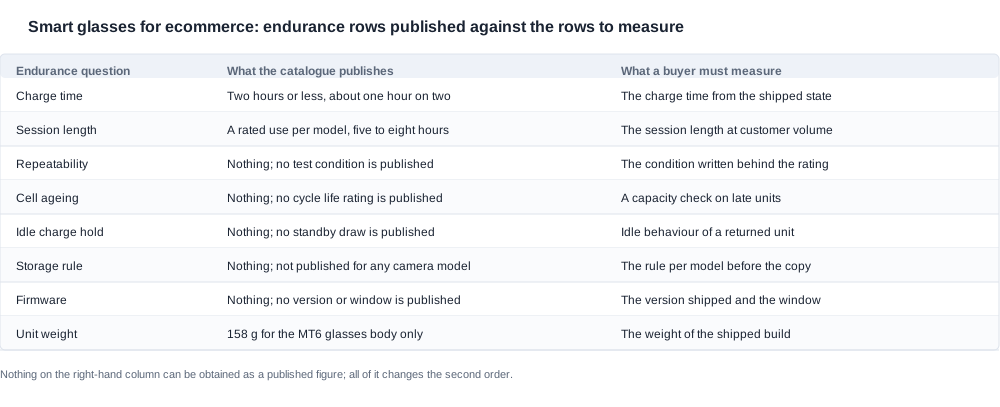
The table below separates the two sets. The right-hand column is the list a buyer should carry into the first shipment as a measurement plan, because none of it can be obtained as a published figure and all of it changes the second order.
| Endurance question | What the catalogue publishes | What a buyer must measure or contract |
|---|---|---|
| How long a charge takes | Two hours or less on every model except the D17 and the ZH12, which publish about one hour | The charge time from the state the unit ships in |
| How long a session lasts | A rated use per model, between five and eight hours on the camera range | The session length at the customer's own volume level |
| Whether the rating is repeatable | Nothing; no test condition is published for any runtime | The condition behind the rating, in writing |
| How the cell ages | Nothing; no cycle life rating is published | A capacity check on units returned or resold late |
| How long the unit holds a charge when idle | Nothing; no standby draw is published | The idle behaviour of a returned unit |
| Whether storage overwrites or stops | Nothing; storage behaviour is not published for any camera model | The storage rule, per model, before the copy is written |
| Which firmware ships | Nothing; no firmware version or support window is published | The firmware in the unit and the support window on the label |
| How the unit is built | The catalogue publishes no frame material, lens material or coating | The material position, if the page is going to mention it |
| What it weighs | 158 g for the MT6 glasses body only, excluding its foldable case | The weight of the configuration actually shipped |
Two of those areas change the commercial model rather than the technical one, and they are worth pulling out.
The first is the runtime condition. A rated use published without a condition is a bound that a customer's own test will exceed or fall short of, and a customer who measures it will compare their result with the number on the page. That comparison is the origin of a disproportionate share of the negative reviews in this category, and it is also the origin of the claim that the listing was misleading. The condition does not have to be a laboratory protocol; it has to be written down.
The second is the firmware and storage rows. Both are unpublished for every camera model, and both are what a customer notices within a week of ownership rather than in the first session. A unit whose recording stops because storage filled up is a product that appears to have failed, and the cause is invisible to the customer. If the copy is going to promise capture, the storage rule is part of the promise whether or not it is documented.
Measuring the first shipment so the second order has evidence
The verification for a long-term view is a measurement programme on real units, and it is the cheapest evidence available in this category because it uses goods that have already been paid for.
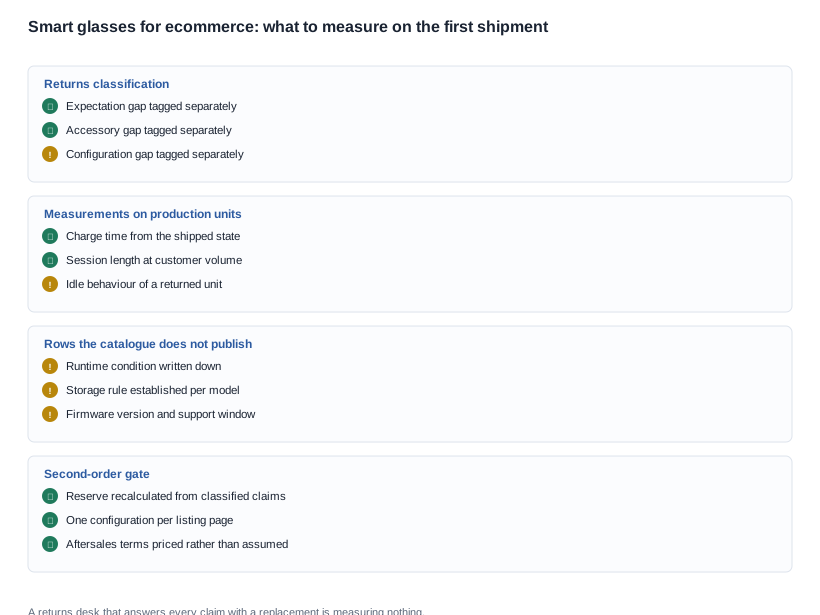
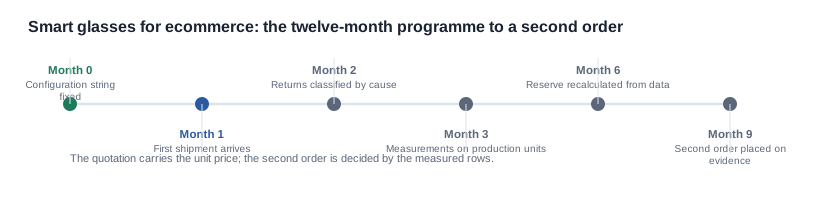
- Classify every return by cause before anything else. The categories that matter are the expectation gap (the customer wanted something the page did not promise), the accessory gap (something the page implied was in the box), the configuration gap (the unit does not match the configuration that was ordered), and the genuine fault. A returns desk that answers every claim with a replacement is measuring nothing and is buying the seller a second month of the same problem.
- Record the charge state the unit shipped in and the interval between order and first use. A long interval in a hot warehouse or a slow freight leg changes the first impression, and it is a cause that has nothing to do with the product.
- Measure the rated use on a unit from the production lot at the customer's own volume level. The completion test is a written condition attached to the number, and the point of doing it on production units rather than samples is that the number then appears in the listing.
- Check the storage behaviour on a camera configuration before the copy is written. The completion test is a rule per model, and a model whose rule cannot be established should be listed without a capture promise.
- Establish the firmware position and the support window. Ask for the version that ships and for how long updates are provided. If it is not published, the listing should not imply a support window.
- Ask for the unit weight of the configuration that ships. The catalogue publishes a whole-unit figure for one model only, so for every other configuration this is a question, and it is the question behind the highest-volume return reason in eyewear generally.
- Ask what the supplier does with a unit that comes back. The three things to settle are whether a replacement ships separately from the return, who carries the two-way freight, and what evidence closes the claim. The written approach is at contract terms.
- Reconcile the claim rate against the configuration string. If two configurations share a listing page, the claims cannot be attributed to either one, and a programme that carries two configurations on one page needs the page split before the data means anything.

The order of those steps is the point. Steps one and two happen on the first shipment, steps three to six happen before the listing is finalised, and steps seven and eight are contract and configuration questions that are cheaper to settle in the first round of an enquiry than to reconstruct after the second order.

The warranty and returns terms that decide the second order
The aftersales terms are the block a buyer should negotiate hardest and most rarely does, because they do not appear on a price list and because the unit price comparison tends to absorb the negotiating attention that should have gone to them. Four terms matter more than the rest.
Replacement speed. A unit replaced quickly costs a fraction of a unit refunded slowly, because a refunded unit costs the product, the freight and the platform fee. The question to ask is concrete: what is the stated turnaround, and is it contractual or aspirational.
A claim route the customer can complete without a call. Every additional interaction with a support route multiplies the handling cost per claim. A route that is completed on the platform, in the language of the market, with the evidence the supplier asked for, is cheaper on both sides.
A spare part that can be bought separately. In this range the catalogue publishes detachable temples on the G07 and the YK12 and a detachable inner frame on the V06 and the S7, which makes a part-level replacement possible in principle on those four models. A buyer who has not asked has quietly decided to replace whole devices instead, and that decision sits in the margin.
Packaging that prevents the fault in the first place. Most of the early-life damage in a shipped product is caused in transit or in the first week of storage, and it is a packaging specification rather than a product specification. A factory-applied protective film is often the cheapest reduction in claims available anywhere in the bill of materials.
The reason these terms are worth more attention than the unit price is arithmetic rather than sentimental. A refund costs the product, the outbound freight, the platform fee and the customer acquisition that will not return. A fast replacement costs a unit and one freight leg, and it keeps the customer inside the channel rather than sending them to a competitor with a better aftersales answer. Over a twelve-month programme the difference between those two costs is larger than most price negotiations achieve, and it is the item a buyer can actually verify before the order rather than after it.
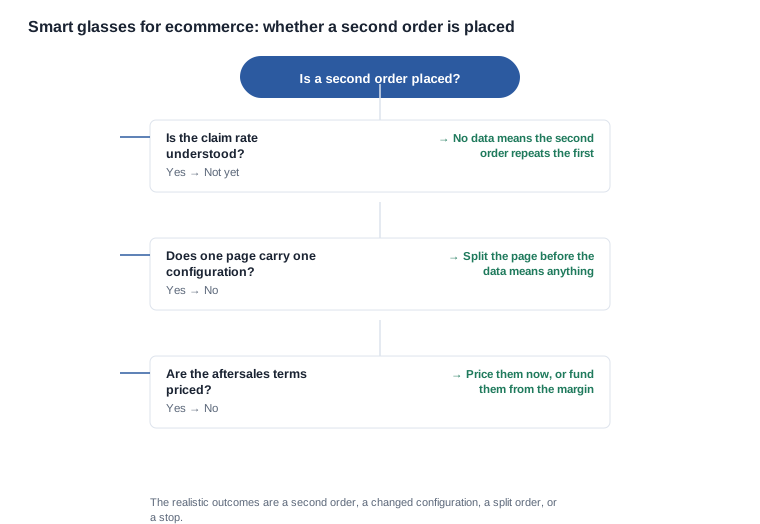
What to ask about the terms before you order. The four terms above are not the only aftersales questions worth putting in the first round, and the cheapest moment to ask them is while there is still a second supplier to compare against. The questions that change the price or the schedule are specific: what is the stated replacement turnaround and is it contractual; can the customer complete a claim without a support call, and in which language; can a spare part be bought separately rather than replacing the whole device; what is the freight responsibility on a unit that arrives faulty; and what evidence closes a claim. A buyer who asks all five in the first round is establishing which quotation is complete, and the comparison between two suppliers only works between quotations that answer the same questions. The total cost of the programme is then the unit price plus the reserve plus the documentation route, and the trade-offs between those three are settled in the quotation rather than after the first shipment.
The decision this produces is not binary. The realistic outcomes are a second order at the same configuration, a second order at a changed configuration, a split order that moves the volume to the configurations that performed, and a programme that stops. The evidence that distinguishes them is the classified returns data from the first shipment plus the two or three measurements that the catalogue cannot supply, and a buyer who has neither will place the second order on the same evidence as the first.

A worked example: one storefront, two shipments, twelve months
Take a channel operator that has decided to list smart glasses in one European market through its own store and one marketplace. The first shipment is a pilot with two camera configurations: an entry model and a higher-tier model, both with a published case, so the freight file covers the configuration as shipped.
The pilot is deliberately small, because the purpose is not volume but classification. The returns desk is instructed to tag every claim by cause rather than by outcome, and the two tags that decide everything are the expectation gap and the accessory gap. The measurement programme runs on the returned units: the charge time from the shipped state, the session length at the operator's own volume level, the idle behaviour of a unit that sat for six weeks, and the storage rule on the camera configuration.
The results arrive in month four, and they are not what the quotation assumed. The expectation gap dominates, and it traces to one cause: the listing describes capture without describing what happens when the recording fills up, because the storage rule was never established. The second cause is the accessory gap, and it traces to a photograph that shows a cable on a configuration whose charging interface the catalogue publishes as magnetic. Neither cause is a fault in the product. Both were designed out with a copy change and a photograph change.
The supplier is asked for two things as a condition of the second order: the storage rule for the camera configuration in writing, and the charging interface confirmed for the entry configuration in writing, including what the customer uses to charge it. The first is a specification row that did not exist. The second is a row that existed in the catalogue and was misread by the copywriter.
The warranty terms are renegotiated at the same time, because the second order is the point at which the claim volume is known and the terms can be priced: a stated replacement turnaround, a platform-completable claim route, and a freight responsibility that is allocated rather than assumed. The protective film question goes to the supplier as a packaging change with a cost attached.
At the end of twelve months the programme has a reserve that is calculated from classified claims rather than guessed, two configurations with a documented configuration string each, a listing that says only what the file supports, and a second order that was placed on evidence. The cost of the pilot was a small shipment and a disciplined returns desk. The alternative was the same programme run for a year on a quotation that carried one number.
What we publish about long-term use, and what we will not estimate
The published rows are the part of a long-term view that we can stand behind, and the rest is a measurement a buyer has to make rather than a figure we should invent. For this range that means we publish the camera tiers, the cell capacities, the charge times as a ceiling of two hours or less with approximately one hour on the D17 and the ZH12, the rated use per model, the charging interface per model, the case capacities where they are published, the colour counts, and the structural features the catalogue records.
What we do not publish, and will not estimate: the runtime test condition, the cycle life rating, the standby draw, the firmware version and support window, the storage behaviour, the camera sensor model, the field of view, the video specification, the lens material and coating, the frame material, the hinge specification, the operating temperature range, and any per-model unit weight beyond the 158 g whole-unit figure for the MT6 glasses body, which excludes its foldable case. We will not supply a plausible number for a field we do not hold, and we will not present a typical figure from a supplier's general data as though it were ours.
What we will do is take the configurations you are running, the market you are running them in and the volume you are working to, and tell you which rows are settled, which rows have to be measured on the first shipment, and which ones have to come from a sub-supplier in writing. The scenario entry point is smart glasses for ecommerce, the published figures are collected at battery life, and the sample route is at samples.
Related reading
- The published figures behind a rating — battery life
- What a buyer asks before ordering — sample evaluation
- The audio-only listing option — Bluetooth audio glasses
- The channel framework — ecommerce
Send the configuration, the volume and the market, and we will say which rows are settled, which have to be measured, and which have to be obtained in writing.


