

The phrase in this article that matters most is "what to avoid selling" — because most of the problems below are not solved by changing the product, the supplier or the price. They are solved by removing a sentence from a product page. Seven claim types cause disproportionate trouble in this category, and the pattern behind them is consistent: each one converts a genuine uncertainty into a confident statement, and the customer eventually finds out.
The second pattern matters just as much, and it is the one this article is actually about. A product page is not a brochure. It is a document that a platform, a competitor, a regulator and a customer will all read, and each of them will read it differently. A page that is defensible as marketing copy is frequently indefensible as a specification, and the difference between the two is a governance problem: who reviews the page, against what checklist, and what happens to a claim that is already live when the catalogue changes underneath it.
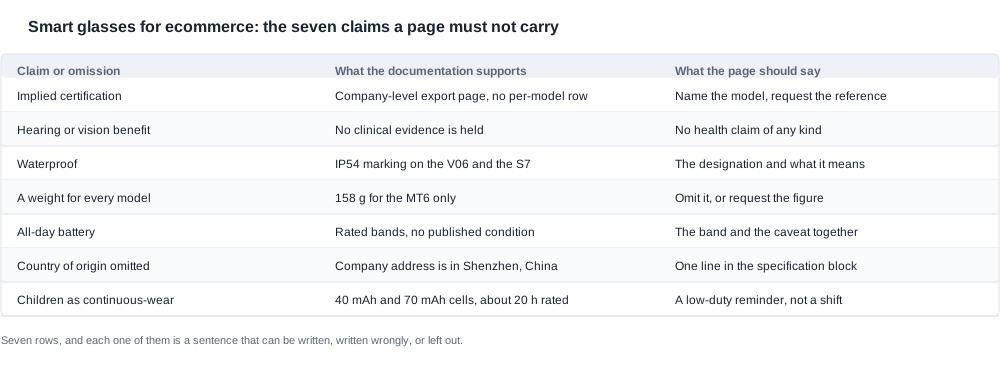
Smart glasses for ecommerce: the seven claims a page must not carry
| Claim or omission | What the documentation supports | What the page should say |
|---|---|---|
| Implied certification | Company-level export page, no per-model row | Name the model, request the reference |
| Hearing or vision benefit | No clinical evidence is held | No health claim of any kind |
| Waterproof | IP54 marking on the V06 and the S7 | The designation and what it means |
| A weight for every model | 158 g for the MT6 only | Omit it, or request the figure |
| All-day battery | Rated bands, no published condition | The band and the caveat together |
| Country of origin omitted | Company address is in Shenzhen, China | One line in the specification block |
| Children as continuous-wear | 40 mAh and 70 mAh cells, about 20 h rated | A low-duty reminder, not a shift |
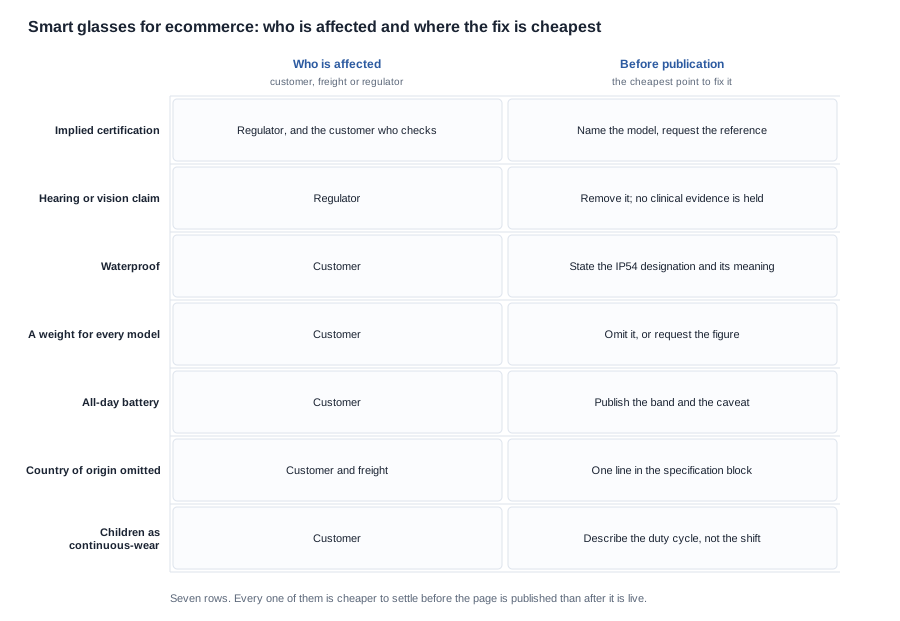
Why the removal is cheaper than the correction. Every claim in the table can be written correctly, and several of them are worth writing. The point is not that a page must be thin; it is that a claim without a row behind it is a liability that a customer can convert into a refund at any time, and a page is judged by the weakest sentence on it rather than by the number of features it lists. A page that publishes four rows accurately and removes three risky sentences converts better than a page that publishes eleven claims, because the buyer who reads the four can act on them.
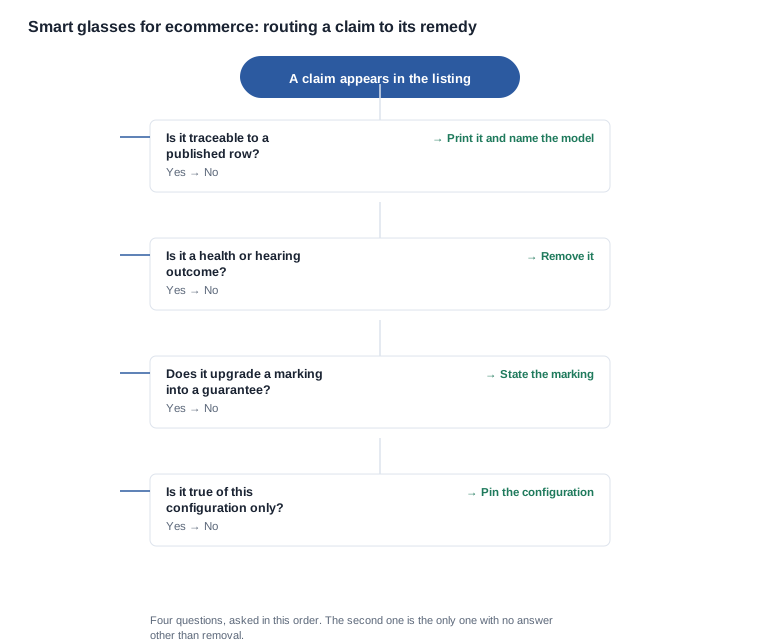
How a claim is routed before it reaches the page. Four questions, asked in this order, and the second one is the only one with no answer other than removal. Is the claim traceable to a published row? If it is, print it and name the model it covers. If it is not, move on: is it a health or hearing outcome? If it is, remove it, with no alternative wording. If it is not, does the claim upgrade a marking into a guarantee? If it does, state the marking instead. And finally: is the claim true of this configuration only? If it is, pin the configuration, because a claim that is true of one colourway and not another is a claim that will be reviewed against the wrong unit.
The commercial cost of getting this wrong. It is not symmetric. A listing that under-claims loses a small amount of conversion on the day it is published. A listing that over-claims loses the difference between the two on the day a customer checks, and that difference is a refund, a return handling cost, a review and a platform enforcement action, and in a market where a regulator reads the page it is a withdrawal. The expected cost of an unsupported claim is not the cost of writing the claim; it is the cost of the claim being found.
What the buyer is actually managing. A category manager or a channel operator in ecommerce is not managing a product; they are managing a set of pages, each of which has a version, an approval and a publication date. The job is to make sure that the page a customer sees and the documentation behind it are the same thing, and that when the documentation changes, the page is re-reviewed. That is a process, and the seven rows above are the process's test cases.

Certification that is implied rather than cited
CE, FCC and RoHS are the words a buyer reaches for when a page needs a compliance signal, and they are the words that most often end a listing. The distinction that matters is between a listing that says the product is certified, and a listing that names a certificate, an issuing body, a date and a model. The first is describing a compliance position. The second is making a factual claim about a document. Only the second creates withdrawal risk in a market where the claim is checked.
What our catalogue actually contains. The catalogue carries a company-level export certification page whose content is images rather than text, and the catalogue text contains no reference to CE, FCC or RoHS anywhere. There is no per-model certification row, and there is no pending-confirmation record either — the catalogue is not a document that holds a model in a certification queue. The company address published in the catalogue is in Shenzhen, China, and the company describes itself as an OEM and ODM provider with its own production base, which is a legitimate compliance position to describe in a listing. What it is not is a per-model certification claim.
The four-part rule for a certification line. If a page carries a certification statement at all, it should carry four things: the model, the regulation or standard, the issuing body, and the date or validity. A statement that cannot supply all four is an implication rather than a citation, and the remedy for an implication is either a written request to the supplier or a removal. In this category the request is the right answer often enough to be worth sending as a standing item in the sample programme, because the per-model certification scope is a due diligence question that a procurement lead has to close before a listing goes live in a regulated market.
What the certification page is, stated exactly. The catalogue's export certification page shows ten patent certificates — eight appearance-design patents and two utility-model patents. That is a company-level asset and it is a legitimate thing to say about a factory. It is not a conformity assessment of a product, it does not attach to a model, and it is not evidence of conformity with any market access regime. A page that says "fully certified" on the strength of a patent portfolio has confused a different kind of document.
Why the marketplace makes this worse. Ecommerce platforms do not publish an advisory when a listing is challenged; they act on it, and they act on the whole account rather than on the single listing in many cases. The commercial exposure of one bad sentence is therefore not bounded by the page it sits on. A page review gate that is applied before publication is the only control that keeps the exposure at one sentence, and it costs a checklist.
Health language is one word away from a regulated claim
Hearing assistance, vision protection, myopia control and similar framing are outside what we can support for any model in this range, and we will not supply copy that uses them. This is not a marketing preference: in the jurisdictions that regulate them these are efficacy claims, and a claim that cannot be substantiated is a claim that cannot be defended, in a market where the pages are public and the enforcement is public too.
Why the wording drifts. A page starts with a factual function and drifts into an outcome. The catalogue publishes posture and distance detection and a lens-type electronic atomiser as functions on the two children's reminder models, the A05 and the A06, and the function is a reminder, which is a neutral description of a sensor. The drift happens in the adjective: a reminder becomes a protection, a protection becomes a prevention, and a prevention becomes a clinical outcome. Each step looks like a small copy decision and the last one is a different regulatory category. The distance between the function and the claim is where the review gate has to sit.
The red line, stated once. No product in this range is described as preventing, treating, correcting, diagnosing or improving any medical or visual condition, and we publish no clinical evidence because we hold none. That is a single sentence a copywriter can apply without judgement, and it removes the most common source of removal in this category. FDA 21 CFR 800.30 is the reference point in the United States, and in the European Union the boundary runs through the medical device regulation; both are matters for the seller's own legal function in the destination market, not for the factory.
The children's category is the strictest. Products intended for children can attract additional requirements depending on the destination market — EN 71 in Europe, the applicable consumer product requirements in the United States, and ASTM F963 as a commonly referenced standard. Whether any of these apply depends on the product, the market and the claims made, and that determination is not a factory's to make and not a catalogue's to answer. A page for a children's model that carries a health or vision claim has therefore created two exposures at once, and the second one is the more serious.
What to write instead. The function, the mechanism and the published rows. The A05 and the A06 publish a 40 mAh cell, magnetic charging and a rated runtime of about 20 h, together with the posture and distance detection and the lens-type atomiser function. That is a complete and interesting description of a device. It describes what the device does, it names the rows, and it makes no claim about any outcome.

A catalogue marking is not a test result
Where IP54 appears in this category it appears as a catalogue marking. That is not the same as a certified ingress rating from a named test body, and the difference is not academic: the second digit of an ingress rating distinguishes spray resistance from immersion, and a marketing page that says "waterproof" on the strength of a marking is making a claim the underlying document does not support.
The published position. The IP54 marking is published on the V06 and the S7, and on no other model in the range. The second digit covers splashing water from any direction and the first is a dust protection level. No test report number is published behind the marking, and no third-party test body is named for it anywhere in our documentation. So the correct page sentence is a sentence about a designation: an IP54 marking on the two models that carry it, describing protection against splashing water and a dust protection level. It is longer than the adjective, and it is the only version that survives a customer reading the page with the specification open.
What the customer does with the adjective. The customer in this category reads "waterproof" and buys a product for a shower, a rainstorm or a poolside, and tests it in the rain, because the word makes the weather the test condition. When the device does not survive that test, the review does not say "the marking was narrower than the adjective"; it says the product was not as described. The loss is the review, and the review is the part of the listing that keeps selling after the first order.
What a page can say about a model with no marking. That it carries no ingress marking, if the page needs to say something. A model with no marking is not defective and it is not a lesser product; it is a product whose ingress position is simply unpublished, and saying so is more useful than silence, because a buyer who is deciding between two models can then see that one of them has a documented position and the other does not.
What to ask the supplier. Ask for the ingress position in writing per model, ask whether it is a catalogue attribute or a tested result, and ask for the report number and the standard if it is a tested result. Where a model has no marking, ask what the position is, because "no marking" and "not tested" and "tested and failed" are three different answers and only the first two are available to a listing.

Weight, runtime and the two omissions that cause friction
Two claim types are pure omission problems, and two specification blocks are pure omission problems too. Together they account for a disproportionate share of the delivery questions a channel receives, because each one is a question a customer can only ask after the goods have arrived.
The weight. Unit weight is not published across the camera range, with one exception in the whole catalogue: 158 g for the MT6, and that is the whole unit including its 265 mAh cell and its camera, excluding the foldable case. A listing that states a weight for any other model has either guessed it or borrowed it from a different product, and a buyer who weighs the unit and disagrees will treat that as a misrepresentation. The remedy is not a careful wording; it is to leave it out, because nobody buys these glasses because of a number they did not ask for, and because the page that carries a guessed number is a page that has to be re-reviewed when the guess is found.
The runtime. Our published figures are rated runtimes without published test conditions, and they differ by model: 5~8 h on the S7 and the V06, and the V03 and the V03 Pro, 6~8 h on the KY06 and the MT5, and about 7 h on the L1 Pro and the L2 Utral, and the MT6 and the CY05, and the CY03. In a listing, a bare hour figure is read as usable working time, and the gap between the two is where the refund request comes from. If you state runtime, state what it is — a rated band, on a named model, with the condition marked as not published.
Country of origin. Customs wants it and the customer will ask for it. The company address published in our catalogue is in Shenzhen, China, and the product is built in the company's own production base. A listing without that line generates a delivery-time question that damages the order even when the answer is simple, and in an ecommerce context it is the line that stops a cross-border customer from assuming the worst about a delivery estimate. It costs one line.
Children's models and continuous use. The children's reminder models publish 40 mAh cells on the A05 and the A06 and a 70 mAh cell on the A07, against a stated runtime of about 20 h. That figure describes a low-duty-cycle reminder product with substantial standby time. Listing it as continuous use sets an expectation those cells cannot meet, and for a child-focused product that expectation gap is where the complaint comes from, because the buyer is a parent rather than a specification reader.
The two mistakes that are easy to make and expensive to find. A page that omits a row is a missing detail. A page that carries a row with the wrong scope is a misrepresentation, and the two behave differently in a returns conversation. "Weight not published" and "158 g" are not the same kind of statement, and only one of them is safe.
A claim register, a review gate and a withdrawal procedure
The seven rows above are test cases, not a list to memorise. What a channel needs is a process that applies them consistently, and that process has three parts: a register of the claims in use, a gate that reviews a page before it is published, and a procedure for when a claim turns out to be wrong after publication.
The claim register. One sheet, one row per claim, with four columns: the claim as written, the model it applies to, the published row behind it, and the date the row was confirmed. It sounds bureaucratic and it is the cheapest thing in this article, because it is what turns a review from an argument into a lookup, and it is what makes the difference between a channel that can answer "where did this sentence come from" in ten seconds and one that cannot answer it at all. The register is also the withdrawal procedure's evidence: a claim that is withdrawn is a row in the register with a date on it.
The review gate. Six steps, and they are worth writing down because a gate that is held in someone's head is not a gate: collect every sentence in the draft that states a fact, trace each claim to a published row model by model, mark the claims that have no row behind them, send the marked claims to the supplier in writing, write the copy from the claims that survived step two, and re-run the gate whenever a model is added or changed. The last step is the one that keeps a listing honest after the first launch, and it is the one most often dropped.

The withdrawal procedure. Three triggers, and each one has a different owner. A claim that a supplier has corrected in writing is a documentation change, and the owner is whoever maintains the page. A claim that a customer has challenged with evidence is a product question, and the owner is the returns desk, with a defined escalation path and a defined deadline. A claim that a platform or a regulator has challenged is a compliance question, and the owner is the legal function, and the page comes down first and the argument comes second. Writing those three down before the first one happens is the whole of the procedure.
The commercial terms that make the gate affordable. A page review is a labour cost, and the way to reduce it is to reduce the number of pages and the number of models. That is a range decision with a procurement consequence: every model on the line is a configuration that has to be specified, a claim set that has to be checked and a page that has to be maintained. A narrower range, tested properly, is cheaper to run than a wide range with an unmanaged claim set, and the unit price difference between two configurations is usually smaller than the cost of the extra page revision that a configuration change triggers.
The other commercial terms that matter in this category are the minimum order quantity tiers, the bulk order volume, the price tier each configuration lands on, the payment terms and the deposit, and the tooling and new tooling expense for private label packaging. The returns policy is the term that decides the category: a policy written for domestic use will not survive a customer who used the product as advertised, and a channel that has a page under an active claim register can show the claims that were in force at the time of the purchase. That is the argument for the register, stated in commercial terms.
The trade-offs worth pressing on. A buyer deciding how much to spend on claim governance is really deciding where the risk sits, and the trade-offs are unusually clear in ecommerce. A narrower range costs less to govern and converts more slowly. A wider range converts faster and costs more to keep honest. A model with a fully published row set is cheap to list and boring to differentiate; a model with an unpublished row set is interesting to list and expensive to defend. When you evaluate which model to take to a channel, the criteria that decide it are the number of rows the page has to carry, the number of claims the register has to track, and how often the supplier changes the configuration behind a model name — because that last one is what turns a governed page into an ungoverned one.
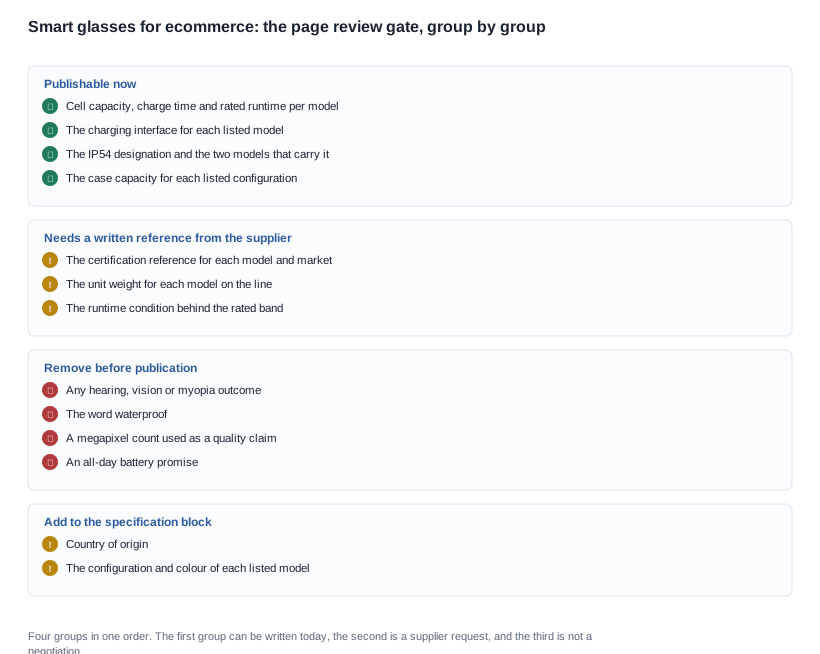
How to verify a page before it ships, in four checks. Check that every factual sentence maps to a row in the register, with the model named. Check that the specification block carries the country of origin, the configuration and the colour of each listed model. Check that the certification sentence, if there is one, names the model, the regulation, the issuing body and the date. And check the red flags list one more time: the word waterproof, a health or hearing outcome, a megapixel count used as a quality claim, an all-day battery promise, and a weight the supplier has not confirmed. Those five are the ones that recur, and they are the ones a competitor will report if a customer does not.
The questions to ask before you order. Three of them decide whether the page can be governed at all. Which published rows will be supplied in writing for the models on the line, and by when. What happens to the page when a model's configuration changes — is there a notice period, and does the factory commit to a change-control process. And what the supplier's own red flags list is, because a factory that has already documented its own risky claims has saved the channel a review cycle.
The red flags in the supply relationship itself. A supplier who answers the certification question with "yes, we are certified" rather than with a model and a reference is telling you something about the documentation behind the row. A supplier who quotes an hourly figure without a condition has told you the row will not survive a customer check. A supplier who cannot name the runtime condition cannot support a requirement written against it. These are the early signals, and the due diligence questions to ask about a supplier are at supplier evaluation and the contract terms reference.
The five sentences that recur, and what to do with each. They are worth keeping on one line of the review sheet, because they account for most of what a competitor or a customer reports in this category:
- Waterproof — replace with the IP54 designation and the two models that carry it.
- All-day battery — replace with the rated band for the named model and the caveat.
- A weight in the specification block — remove it unless the supplier has confirmed the figure in writing.
- A megapixel count used as a quality claim — keep the class, drop the claim.
- Anything that says a device helps a person hear or see better — remove it, with no alternative wording.
Our position. We publish the figures that can be sourced, and we mark the rest as not published. We will give you the complete published set for your chosen model so you can build a listing from it, and where a marketing plan depends on a figure we do not publish we will tell you plainly rather than supplying something plausible. We will not provide copy containing medical claims, unmarked certification implications, or an ingress rating presented as a test result — for any market, at any volume. If you send us your draft listing before it goes live we will tell you which claims are supportable from our documentation and which are not. The ecommerce application page carries the wider framework, and the complete published set by model is at AI camera glasses.


