

A classroom or campus deployment puts a specific set of demands on the build, and a buyer who treats it as a general product decision pays for the wrong configuration. What follows is the budget view of that decision, written as the lines a proposal has to carry rather than as a device price.
Smart glasses for education: because unit price hides the larger budget lines
The short answer. In an education deployment the device unit price is usually the smallest line on the sheet, and the proposals that get cut are cut on the largest one. Seven lines matter: the hardware itself, the deployment kit, the charging equipment, the service interval the cell figures imply, the replacement reserve, the documentation route and the staff time the routine consumes. Only one of them is bounded by published data. The other six have to be priced from your own inputs, and the difference between a proposal that prices them and one that does not is the difference between a deployment that runs and one that quietly stops.
Who this is written for. The reader is a programme manager, a procurement officer or a channel buyer who has a fixed budget envelope and a set of classrooms to fill with it. The situation is rarely "which device should I buy"; it is "this amount, this many units, this many classrooms, this deadline, and I have to show a finance reviewer where the money goes". The fear underneath the enquiry is not that the hardware is expensive. It is that the proposal looks cheap on the device line, gets approved, and then the programme runs out of money on the kit, the documentation and the replacement units in the same year, which is the version where nobody can say which decision caused it.
Why the price comparison is misleading. Two quotations for the same classroom can differ by a few per cent on the unit price and by a factor of two on the total. The gap comes from the lines that are usually missing from the quote: the kit, the charging equipment, the documentation and the staff hours. The published configuration for the children's range tells you the electrical behaviour precisely — the A05 and the A06 publish a 40 mAh cell, a charge time of two hours or less, roughly twenty hours of rated use and magnetic charging; the A07 publishes Bluetooth V5.4, a 70 mAh cell and the same rated use — and that is enough to derive the charging equipment count and the service interval. It is not enough to price anything else, because the catalogue publishes no unit price, no minimum order quantity, no lead time, no tooling charge and no warranty duration for any model.
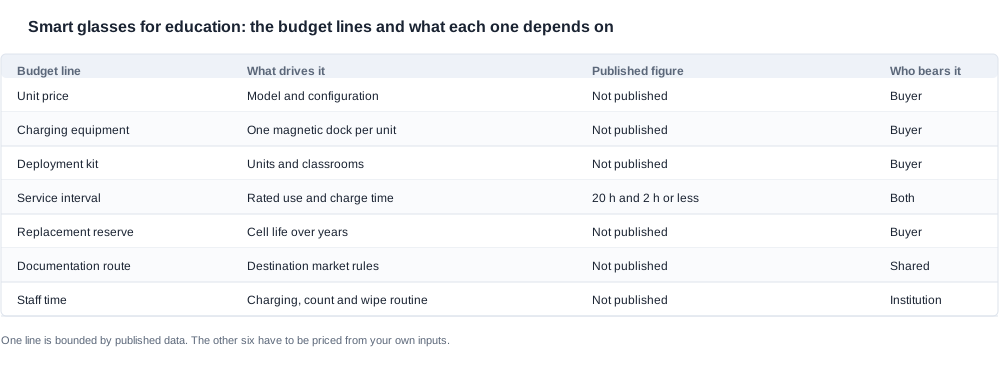

The seven budget lines a classroom deployment carries
The hardware line is the unit price for the chosen model at the chosen quantity. It is the only line most proposals develop, and it is the line with the least information behind it, because the catalogue publishes no price for anything. Its size is set entirely by the quotation and by the quantity band you are buying in, so it is negotiable in a way the other lines are not.
The deployment kit line covers the four items a classroom cannot be administered without: a numbered tray with a place per unit, wipe-down material, a printed quick-start card per class, and the register the school keeps. Its quantity rules are different from the device's. The tray is ordered per classroom, the card per class, the wipe material per device. That difference matters commercially, because a supplier who will not split the two deliveries will hold the kit until the devices are ready — and a printed card that arrives in week three protects nothing.
The charging equipment line is the largest non-hardware line in most deployments, and its quantity is determined by the published interface, while its cost is not published. The children's range charges magnetically, which means one magnetic cable or dock per device. Multiply the device count by one, add a margin of roughly ten per cent for the cables that get damaged or taken away, and you have the line. A deployment that shares one cable between two rooms will produce support tickets that read as defective products, and the school will draw the conclusion that the hardware is unreliable rather than that the kit was short.
The service interval is not a cost line in itself but it decides two others. Rated use of around twenty hours and a charge time of two hours or less tell you that a unit can plausibly cover a teaching day and then be recharged overnight, provided it is on the shelf with its own charger and somebody owns the routine. The charge time is a ceiling rather than a fixed duration, with no published starting state and no published end point, so it cannot be treated as a guaranteed turnaround. The service interval therefore determines how many charging points are needed, which determines the equipment line and the storage the school has to provide.
The replacement reserve is the line nobody budgets and everybody pays. Cell life over years is not published for this range, so the reserve has to be an agreed estimate rather than a figure that can be quoted, and the estimate has to be reviewed annually against what actually failed. For a range published at around twenty hours of rated use on a 40 mAh or 70 mAh cell, the reserve is a real line, not a rounding error, and it is the line that decides whether year two needs a new budget or a reallocation.
The documentation route is the line that is either negligible or fatal. For a destination market that requires a model-level conformity file, that file has to exist, be transferable to the institution in the form the institution needs, and arrive before the teaching term starts. The catalogue publishes no per-model certification row and contains no reference to CE, FCC or RoHS anywhere in its text; the export certification page in the catalogue carries images rather than text. So the documentation route is a cost and a lead time that have to be obtained in writing from the company that holds the evidence, and it is the line most likely to be invisible in a quotation.
The staff time line is the one that never appears in a supplier quotation because it sits with the institution rather than with the buyer. Charging the fleet, wiping each unit as it comes back, returning it to its numbered place, signing the count sheet and reading the open tickets once a week is a routine, and a routine is staff hours. A proposal that costs the routine as zero is not describing a free deployment; it is describing a deployment that stops.
A cost that arrives outside the seven: freight and transport. Every model in this range runs on a lithium cell, so the transport classification and the cell documentation have to be settled before the freight is booked rather than discovered by the forwarder afterwards. Where a configuration includes a case, the case is a second cell with its own published capacity, which changes the parcel weight, the packed dimensions and the scope of the documentation. The transport file is not a purchase-order line in the strict sense, but the freight cost, the added lead time and the paperwork hours it generates are all costs the proposal has to carry, and a deployment that discovers the transport scope after the booking pays for it in a surcharge and a delay.
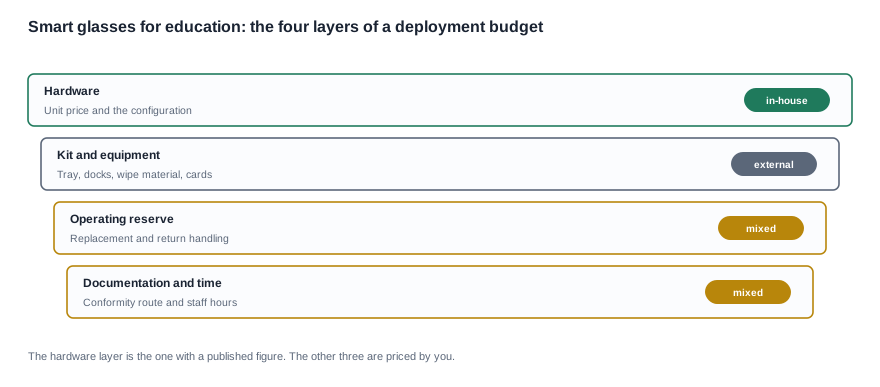
What the published figures let you budget and what they do not
The published figures in this category are unusually good at constraining some lines and unusually silent on others, and the discipline is to use them for what they cover.
What you can budget from published data. The cell capacity tells you the class of device and, together with the rated use, gives you the service interval assumption. The charge time of two hours or less tells you the overnight charging window the timetable has to accommodate. The charging interface tells you the equipment count exactly. The rated use figures — around twenty hours on the A05, the A06 and the A07 — tell you whether a mid-day top-up is needed, and for this range it is not, provided the units are on the shelf at the end of the day. The Bluetooth version on the A07 tells you the radio class of the device, which matters for a school that manages its own network.
What you cannot budget from published data. The unit price, the minimum order quantity, the lead time, the tooling or non-recurring engineering charge, the warranty duration, the return window, the cell life, the per-model unit weight and the certification cost. For most of these the answer is that the company quotes them, and for one of them — the certification cost — the catalogue does not record a per-model row at all, so the honest budget line is a placeholder with a question mark on it and an owner attached.
The one published figure that is easy to misuse. The weight. There is exactly one weight figure in the whole catalogue: 158 grams for the MT6 glasses themselves, including the 265 mAh cell and the camera and excluding the 1200 mAh foldable case. It is a camera model, not an education model, it does not include the case, and the case weight is not published for any model. It cannot be used to sanity-check an education quotation, and a proposal that quotes a weight for the children's range is quoting a number we do not hold.
How to handle an unpublished input in a budget. Do not estimate it silently and do not leave it out. Write it into the proposal as an open line with a named owner and a date by which it will be closed. A proposal with four honest open lines is defensible to a finance reviewer; a proposal with the same four lines quietly embedded in a rounded total is not, and it is the second kind that fails at the end of the year when the number turns out to have been wrong.
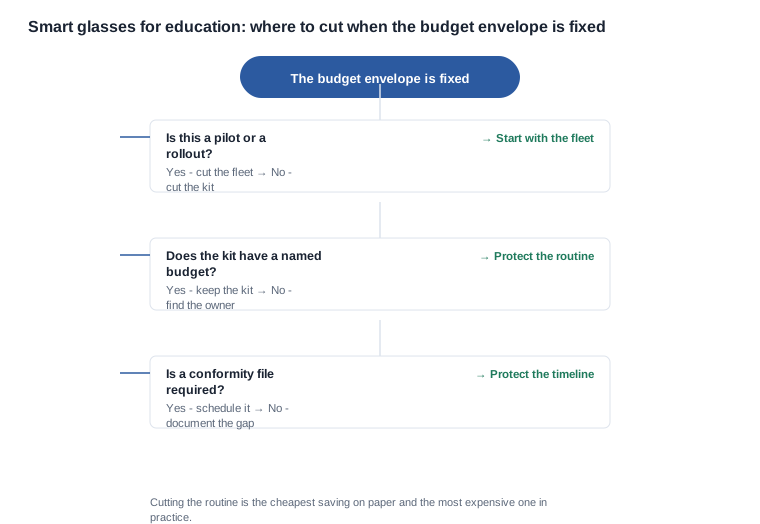

Building the replacement reserve without a cell life figure
A reserve built on a cell life nobody can quote is still a better budget line than no reserve at all, and the method is straightforward: three inputs, one of which you control.
Input one is the agreed estimate. Write a figure into the proposal as an assumption, state that it is an assumption, and say who will review it. An annual replacement rate expressed as a percentage of the fleet is easier to defend than a year count, because a percentage survives a change in fleet size. What matters commercially is that the assumption is visible, because the day it is wrong is the day the reviewer asks why it was wrong and nobody can answer.
Input two is the season. A lithium cell stored charged and warm over a long break shows its condition in the first charge back, and a school that stores devices in a cupboard over the summer will generate exactly the failures that the reserve was supposed to cover, in the same month that the new budget is being argued. Storing the units discharged, in a cool place, away from sun and heat, and logging them out and back in is a free control that reduces the reserve line more reliably than any specification argument. It belongs in the storage plan and it belongs in the annual calendar, not in a maintenance note.
Input three is the failure record. Once the deployment is running, the count sheet and the ticket log together give a replacement rate for this fleet, in this school, under this routine. That is a much better number than any assumed rate, and it is also the number that supports the renewal conversation with the institution rather than against it. A proposal that says "we will replace up to X per cent of the fleet annually, revised against the pilot record" is a stronger commercial position than one that promises a device lifetime it cannot support.
The trade-off worth naming. A larger reserve costs more this year and reduces the risk of an unbudgeted spend next year. A smaller reserve frees money for the fleet now and transfers the risk to the institution, which is a decision the institution has to make explicitly rather than by default. Neither is wrong, but the default — an unnamed reserve that is discovered in year two — is the one that damages the channel relationship, because it makes the programme look like it was mis-sold.
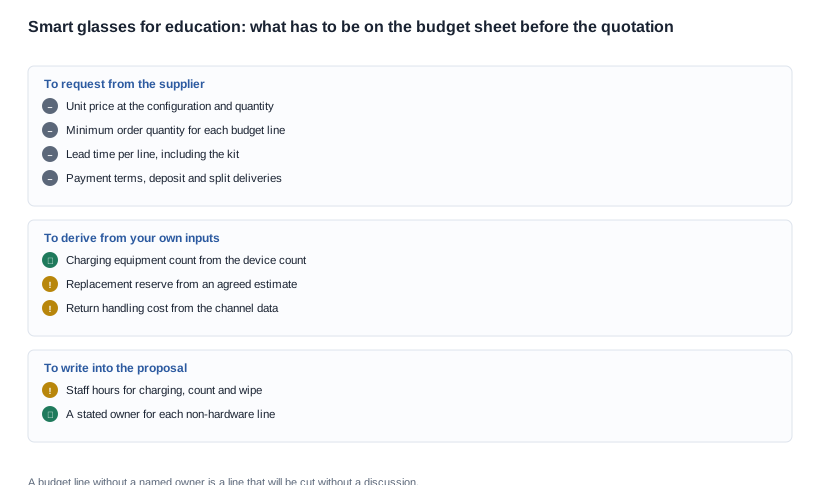

The documentation and staff-time lines that never appear in a quotation
The documentation line is the one to budget first. A model-level conformity file is a deliverable with a lead time, and in a category where the catalogue publishes no per-model certification row, that lead time belongs to the company that holds the evidence rather than to the factory that assembles the order. The budget consequences are three: the cost of obtaining and transferring the file, the staff time for whoever files it, and the schedule risk if it arrives after the teaching term has started. A programme that has budgeted the hardware and not the documentation will discover the gap during the first week, when the institution's own process is already running.
The staff-time line is the one to budget honestly. Write it as hours per week, with the owner named. The routine is: count the units against the register, charge the fleet on the shelf, wipe the lens surface and the contacts as each unit comes back, return each unit to its place and sign the count sheet, and read the open tickets once a week. For a class set that is a fixed and small number of hours, and the number of classrooms multiplies it linearly. A proposal that puts "staffing: nil" against a deployment that needs a daily count is a proposal whose delivery is dependent on somebody doing unpaid administration, and it will stop.
The claim line is the one to budget nothing on. Any proposal line that implies the product prevents or reduces myopia, protects eyesight or produces a clinical outcome is a line with no cost because it is a line that should not exist. The catalogue lists a posture and distance detection function with a reminder on the A05 and the A06, and a lens-type electronic atomiser module. Those are behaviour and hardware features. We will not help build a health claim, and a channel that includes one is telling a school something it cannot defend. The boundary is at medical boundary, and a proposal that stays inside it is cheaper to defend than one that reaches outside it.
The commercial lines that are worth arguing for. The payment structure is the lever that matches a programme to its budget cycle, and the terms available are at payment terms. A split delivery against a staged payment lets a first shipment be smaller without a discount conversation, and a staged payment against a documentation milestone keeps the documentation route funded rather than optional. Sample cost and the sample terms are at samples, and a sample that demonstrates the charging routine is worth more than a sample that demonstrates the device.
Which lines a supplier can move and which are fixed
The lines with real negotiation room are commercial. Minimum order quantity per line, whether two lines can share a purchase order, whether the kit can be delivered separately from the hardware, whether a pilot tier and a rollout tier can sit on the same agreement, and the payment structure against delivery stages. The trade-off is worth naming: a split delivery protects the programme schedule and costs freight twice, while a single delivery protects the freight cost and puts the whole programme on one date. Neither is a supplier preference; it is a schedule decision the buyer makes with the facts.
The lines with no room are the ones the hardware determines. The charging interface, and therefore the equipment count. The cell configuration, and therefore the service interval assumption. The rated use, and therefore whether a mid-day top-up exists. These are not negotiable because they are published rows, and a quotation that changes them is not quoting a better product, it is quoting a different one.
The line that cannot be moved but is often mis-set is the claim line. The published configuration decides what the listing and the proposal can say. Nothing in the commercial negotiation moves that boundary, and a proposal that negotiates against it is negotiating with itself.
What to send us. The classroom count, the units per classroom, the destination market, the teaching calendar and the budget envelope. We will tell you which of the seven lines the published configuration already determines, which ones have to come back as quotes, and which ones we would rather you carried as open items with an owner than as invented figures. Two further inputs speed this up: whether the programme is a pilot with a defined end date or a rollout with a renewal decision, and whether the institution has already written its own requirements list. The second document is the one a supplier can answer point by point, and a programme that has one can be quoted against rather than discussed. The published configurations are at kids smart glasses and the deployment framework is at smart glasses for education.
Related reading
Send the classroom count, the destination market and the budget envelope, and we will say which budget lines the published configuration already settles.


