
Education is the market where a single unchecked claim reaches more people than any other, because the buyer is usually an institution, the audience is parents, and the claim ends up in a tender document that nobody re-reads. Six things are worth actively avoiding when specifying smart glasses for education, and in most cases the reason is that the underlying data does not exist — not that it is inconvenient.
The reason education deserves its own discipline is structural rather than emotional. A commercial product page can be corrected by editing a page. A tender document cannot: once a claim is written into an issued specification it has been answered against, it has been read by an evaluation panel, and it has been relied on by a parent whose child is using the device. The cost of a claim written into a specification is therefore paid at the point where it is hardest to withdraw, which is why the six items below are specification problems rather than copy problems.
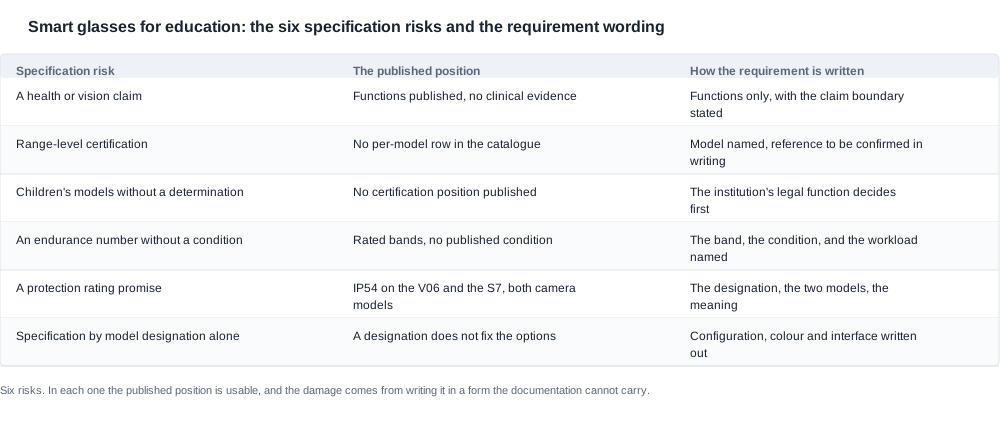
Smart glasses for education: six things a specification must not contain
| Specification risk | The published position | How the requirement is written |
|---|---|---|
| A health or vision claim | Functions published, no clinical evidence | Functions only, with the claim boundary stated |
| Range-level certification | No per-model row in the catalogue | Model named, reference to be confirmed in writing |
| Children's models without a determination | No certification position published | The institution's legal function decides first |
| An endurance number without a condition | Rated bands, no published condition | The band, the condition, and the workload named |
| A protection rating promise | IP54 on the V06 and the S7, both camera models | The designation, the two models, the meaning |
| Specification by model designation alone | A designation does not fix the options | Configuration, colour and interface written out |
Who is reading this and what they are holding. Three readers, three different pressures. A procurement officer is holding a budget and a delivery date and a duty to justify the selection to an evaluation panel. A product or channel manager is holding a supplier quotation and a margin and a launch plan. And a parent is holding a page that describes a device their child will use, and the parent's question is not about cells at all — it is about whether the device is safe, whether the school decided properly, and whether the claim in front of them is real. All three readers are served by the same document, and the document is only useful to any of them if every line in it is traceable.
Why the six are ranked in this order. The first three stop a launch. The second three stop a claim. That distinction is worth holding, because a specification that treats them all as equal priority ends up with a document that is thorough on cosmetics and vague on the legal boundary, which is the opposite of the right allocation of effort.

The health claim boundary, which is a legal line and not a copy line
This is the most serious of the six, and it is the easiest to write by accident. Three models in this range are positioned for children, and two of them — the A05 and the A06 — publish posture and distance detection together with a lens-type electronic atomiser function. A product manager looking at that row while writing a tender document can easily produce a sentence about protecting children's vision.
Posture and distance detection are functions. They are not a health benefit, and the difference is regulatory rather than editorial. A claim about preventing or controlling myopia, or about protecting vision, converts a consumer product into a regulated device. FDA 21 CFR 800.30 is the reference point in the United States; in the European Union the boundary runs through the medical device regulation, and the medical boundary page sets out how we hold that line.
Why education is the worst place to get it wrong. In other categories a health claim is a compliance event. In education it is a compliance event with a child as the subject, in a market where the parent reads the page, where the institution carries a duty of care, and where the claim will be repeated in a tender response that a supplier has never seen. The claim also becomes very hard to withdraw, because the institution has a legitimate interest in the answer and will ask for it in writing.
There is also a practical reason beyond the legal one. The A05 and the A06 publish identical rows: a 40 mAh cell, magnetic charging, a rated runtime of about 20 h, the posture and distance detection and the lens-type atomiser function. Nothing in the published material distinguishes the two model names, and no certification position is published for either. Building a health narrative on an undocumented function of an undocumented product is the worst possible foundation, because there is no second document to fall back on if the first one is challenged.
What to write instead. The function, the mechanism and the published rows, in that order, and nothing else. "The device senses viewing distance and posture and provides a reminder; it makes no medical or vision claim; no clinical evidence is held." That is a complete sentence, it satisfies a tender panel, and it gives the institution a wording boundary it can enforce on every downstream document including the parent-facing one.
The supplier's position matters here. A supplier who will not put the claim boundary in writing has not decided what the product is, and that is a due diligence finding rather than a copy problem. It belongs in the same evaluation as the delivery date and the defect rate, because it is the finding most likely to become expensive after the contract is signed.
Range-level certification is not a document
CE, FCC and RoHS are the words most often used to close a compliance section of a tender. In a tender document, "CE and FCC certified" without a model list reads as a completed compliance position. It is not one, and in education procurement it is the kind of line that gets picked up in a later audit, when re-opening an awarded contract is expensive.
What the catalogue actually holds. The catalogue carries a company-level export certification page whose content is images rather than text, and the catalogue text contains no reference to CE, FCC or RoHS anywhere. There is no per-model certification row, and there is no pending-confirmation record either — a specification that says "certification pending" is not more accurate than one that says "certified", because neither is backed by a row. The company describes itself as an OEM and ODM provider with its own production base in Shenzhen, China, which is a legitimate capability to describe. It is not a per-model conformity statement.
The safe formulation, and why it is the one to use. Name the model, state the regulation or standard that applies in the destination market, state that the certificate reference and the covered model list are to be confirmed for the specific model ordered, and attach a date. A procurement officer can defend that line in front of a panel, because it says exactly what is known and exactly what is outstanding. A line that says the product is certified is not defensible at all, and it is not defensible by the buyer either — the buyer cannot produce the certificate either.

What the request should contain. Per model and per destination market, the certificate reference, the issuing body, the covered model list, the validity date and the technical file that supports it. The certification checklist is where that request is framed, and asking it before the tender is drafted is what keeps the tender from having to be re-issued.
The cost of a late answer. A tender that goes out with an unresolved certification line usually returns three kinds of bid: a bid from a supplier who answers it, a bid from a supplier who ignores it, and a bid from a supplier who states something the buyer's own legal function then has to reconcile. The reconciliation is the expensive part, and it happens against the evaluation timetable rather than the supplier's.

A tender for children's models needs a determination from the institution
Certification status is not published for the three children's models. Products intended for children can attract additional requirements depending on the destination market — EN 71 in Europe, the applicable consumer product requirements in the United States, and ASTM F963 as a commonly referenced standard. Whether any of these apply depends on the product, the market and the claims made.
That determination is not a factory's to make and not a catalogue's to answer. It belongs with the institution's own legal function, before the product is listed and before the tender is issued. A buyer who skips it has made a compliance decision without noticing that they had made one — and in a category where the claim wording is where the determination bites, skipping the determination is also what creates the health-claim risk described above.
The published rows for the three children's models. The A05 and the A06 publish a 40 mAh cell, magnetic charging and a rated runtime of about 20 h, with the posture and distance detection and the lens-type atomiser function. The A07 is the children's audio model, publishing a 70 mAh cell, magnetic charging, a rated runtime of about 20 h and Bluetooth 5.4. Those are the rows, and they are the rows a tender can be written from. What is not published for any of the three is a certification position, and that absence is the reason the legal determination has to happen first rather than last.
What the institution's legal function needs in order to decide. Three things, and they are the same three that a supplier can supply and cannot decide. The materials the device is made from and the parts it contains. The claims that will be made about it, in the institution's own wording and in the parent-facing wording. The destination markets and the channels in which it will be sold. Give the legal function those three and it can make a determination; give it a catalogue and it can only ask questions.
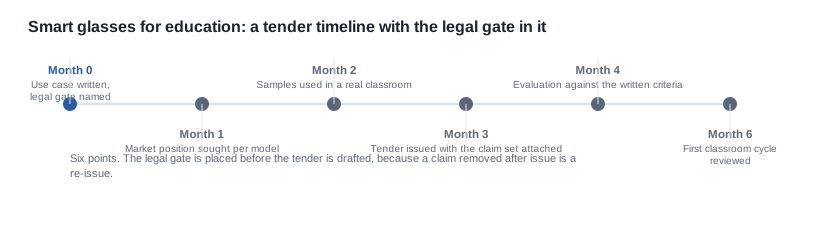
The sequencing that keeps this cheap. Put the legal gate in the specification process at the start, not at the end. The [timeline above] places it in month zero, before the market position is sought and long before the tender is drafted, because a claim removed after issue is a re-issue: a re-tender, a re-evaluation, a delayed delivery and a parent group that has already been told one thing.
A note on the adult range in the same document. Most of the range is adult-positioned, and an education programme that mixes the two has to keep the two claim sets apart in writing. The adult models can carry an audio, camera or sport positioning; the children's models carry a reminder positioning and no outcome claim. A tender that lists both in one table without separating the claim boundary invites the wrong sentence into the wrong row.
Endurance requirements, and why a number without a condition cannot be failed
The published endurance figures in this range run from about 20 h on the three children's models, through about 6 h to 8 h on the audio models, to 5~8 h or about 7 h on the camera models. A school day is six to eight hours of wear, which means the low end of the audio range does not cover a day and the children's models do.
The trap is specifying "around 8 hours" as a procurement requirement, because the published figure is a rated range measured under conditions the catalogue does not state, and the camera is the dominant draw in every camera-equipped model here. A requirement written without a condition is a requirement that will fail for reasons that have nothing to do with the product — and in education procurement, a requirement that fails after delivery is a re-tender, not a credit note.
The requirement, written so it can be failed. Three parts, and each one is a sentence a supplier can answer. The rated band for the named model, as published. The measurement condition, stated separately, to be supplied in writing. And the workload, named by the buyer: a school day is a mixture, and the mix is the buyer's own, so the buyer should say what the mix is. A requirement of that shape can be passed or failed, and a requirement that cannot fail is not a requirement.
What the classroom mix does to the figure. A camera model in a classroom is a different workload from a camera model on a desk, and a mixed day of lessons, corridors and break time is a different workload again. This is not a criticism of the published bands; it is the reason the bands are rated figures with no condition. The buyer's job is to name the workload, not to discount the band by an invented percentage, and a requirement that says "rated band for the named model, with the condition to be provided in writing, under the workload described in appendix two" is both honest and enforceable.
What to do about the requirement that cannot be met. Some institutions will find that no model in the range covers a full school day on a single charge with the camera running, and that is a useful finding at the specification stage. The options are then the charging regime, a model with a published case, or a different use case. A case changes the arithmetic in a way that is worth specifying: the L1 Pro and the CY05, and the CY03 publish a 1400 mAh case, the L2 Utral publishes 900 mAh or 1400 mAh as a configuration choice, and the MT6 publishes a 1200 mAh foldable case. What none of those figures tells you is how many full charges a case delivers in practice, and that is a written question.
The commercial terms that sit behind a school programme. The minimum order quantity tiers, the bulk order volume and the price tier each configuration lands on, the payment terms and the deposit, the lead time the factory can commit to, and the tooling and new tooling expense for private label packaging. Two of those matter more than the unit price in education: the delivery date, because a school year has a fixed start and a late delivery is not recoverable, and the warranty, because a device issued to a child and returned at the end of a term has a different condition profile from a shelf product. A warranty measured in months is a poor fit for a school cycle, and the returns policy should say what condition a returned device is expected to be in.
Configuration, not designation, and the document that has to come out of it
The last of the six is the quietest and the most expensive. A specification written as "model X" is specifying a set of possible products, and the set is larger than it looks.
What the designations do not fix. The L2 Utral publishes a case of 900 mAh or 1400 mAh, so the designation covers two different configurations with different case weights, different artwork and different transit documentation. The V03 Pro is published with a photochromic lens, a flexible temple and a Type-C charging port, so the designation covers a lens behaviour and a charging interface that other models in the same family do not share. The models differ by charging interface across the range, and by colour within most models. And the A05 and the A06 publish identical rows, so those two designations are not distinguished by any published specification at all.
Why the specification has to name the configuration. Four attributes, written out for every model on the line:
- The model designation, as the prefix to the rest rather than as the whole of it.
- The colour, because most models publish more than one and the artwork, the SKU and the shelf label all follow from it.
- The charging interface, because it decides the cable, the dock and the accessory line in the tender.
- The case configuration, where a case exists, because the case capacity changes the freight weight, the transit file and the configuration a school would actually receive.
Add the firmware revision if the channel is maintaining one. A specification at that level of detail is longer, and it is also the only version that survives incoming inspection, because a shipment can be checked against it. A specification written at designation level cannot be checked against anything, and the mismatch is found by a teacher rather than by a quality inspector.
The criteria that decide how many models the programme should carry. Three, in this order, and they are worth settling before any model is shortlisted rather than after. How many rows the tender has to carry for each model, because each unpublished row is a question that has to be answered in writing and a test that has to be planned. Whether the configuration is stable, because a model whose configuration moves is a specification that has to be reissued. And how many configurations the institution can actually administer — a school with a hundred devices and a hundred configurations is an asset-management problem before it is a procurement achievement. When you evaluate which model to shortlist for a programme, those three criteria decide it long before any feature comparison does.
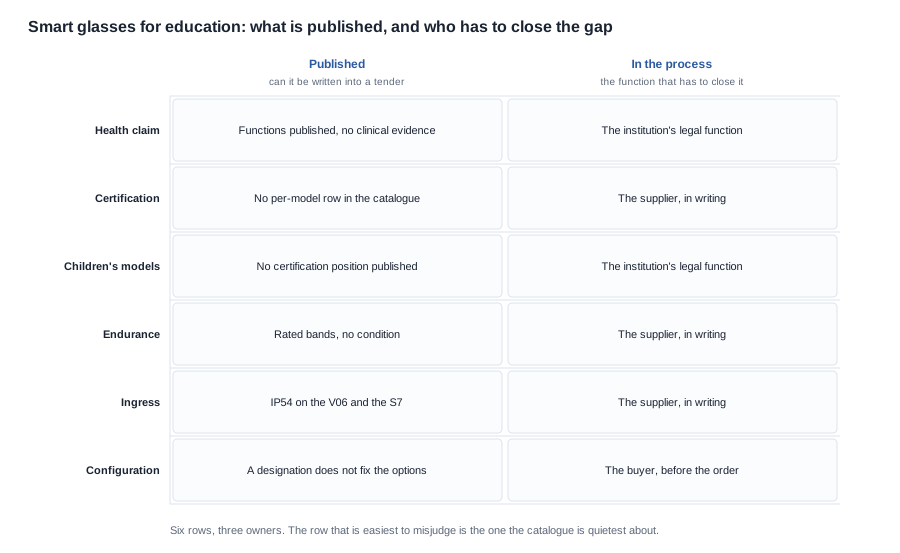
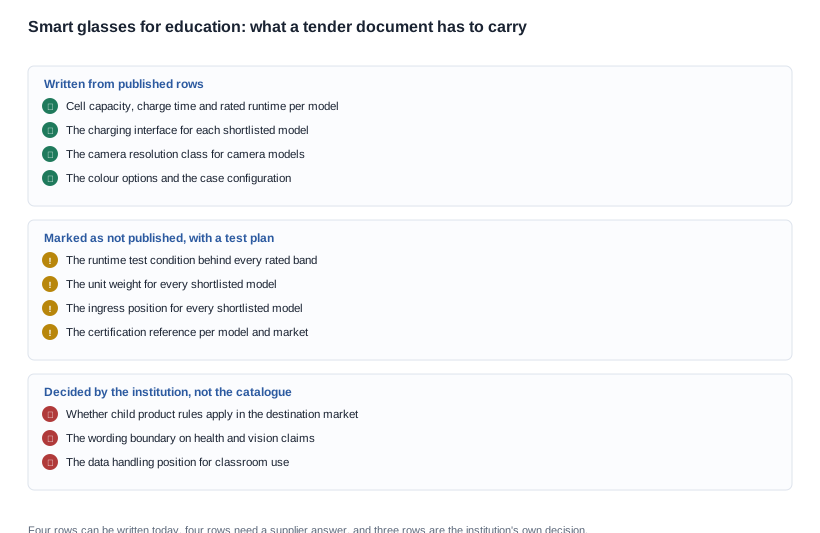
What the document has to record as unpublished. Four things, and the discipline is to write them down rather than to leave them out: the runtime test condition behind every rated band, the unit weight for every shortlisted model, the ingress position for every shortlisted model, and the certification reference per model and market. Unit weight is published for one model in the whole catalogue, at 158 g for the MT6, and that figure is the whole unit including its 265 mAh cell and its camera and excluding the foldable case. Every other model's weight is not published, and a specification that states a weight the supplier has not confirmed in writing has created a defect claim waiting for a child to return the device.
The contract clauses that follow from the specification. The specification says what is required; the contract says what happens when the requirement is missed. Four clauses earn their place in an education programme. A clause requiring the certification reference for the ordered model to be supplied before shipment, with the right to hold the shipment if it is not. A clause fixing the incoming inspection criteria, so that a configuration mismatch is a documented finding rather than a disagreement. A clause on the warranty term and the condition a returned device is expected to be in at the end of a school cycle. And a clause on change control, so that a supplier changing a configuration behind a model name triggers a notice rather than a discovery. The contract terms page covers the structure, and the model comparison covers the selection side.
Our position. So here is the wording we will sign up to on an education programme. What we publish, we publish accurately and in full — cell capacity, charge time, rated endurance, camera resolution, Bluetooth version, charging interface, colour, and the case capacities where they are published. What nobody publishes stays blank on your evaluation sheet with a test plan attached to it. And what we will not do, at any stage of a tender, is support wording that turns a reminder function into a health or vision claim; that answer comes early, from us, on the record, rather than surfacing later as a compliance finding against a school. We will also not state an ingress position for a model whose position is not published, and we will not extend the IP54 marking beyond the two models that carry it.
If you tell us the age range, the session length and the destination market, we can usually narrow this to two models and name the rows you still need to test. The channel context for a consumer-facing family brand is under smart glasses for parenting, and the education application page carries the wider framework.


