

A product recommendation for smart glasses for field work is only useful if it is a procedure rather than a preference. The catalogue is arranged by product — by camera range, by audio range, by sport range — and a buyer who works through it in that order ends up comparing models against constraints they have not yet stated, which is how a procurement process turns into a shortlist that has to be rebuilt at every quotation. The recommendation that holds up is built the other way round: from the four constraints of the deployment, to a family, to a model, to the rows the catalogue publishes and the rows it does not.
Smart glasses for field work: the shortlist starts with the constraint, not the catalogue
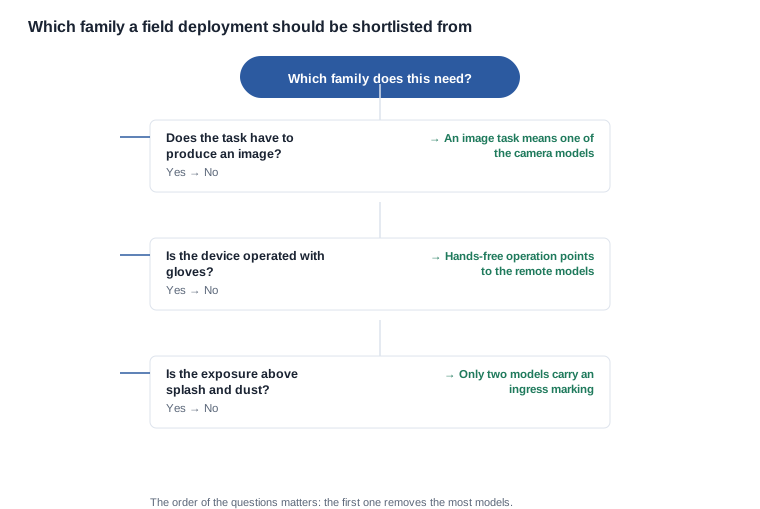
The conclusion. Four constraints decide which model a field deployment should be shortlisted from, and the order in which they are asked decides how much work the rest of the procedure takes. Does the task have to produce an image? That question alone removes the two families that have no camera. How long is the shift, and does the device have to survive it? That question removes the models whose published runtime does not reach the shift. What is the exposure, and what is the operating method? Those two remove models on ingress and on control. What the remains is a shortlist of two or three models with a written list of the rows the catalogue does not publish for them, and that list is the real output of a recommendation procedure.
Who is asking and what they need. The reader is a brand owner, a channel buyer or an integrator choosing what to put on a quotation. Their situation is normally one of three: a customer has named a task and the buyer has to find the hardware; two suppliers have quoted different models for the same task and the buyer has to work out which is actually comparable; or a fleet is being renewed and the buyer has to decide whether the incumbent configuration is still the right answer. All three need a procedure, because all three involve models with gaps, and a recommendation that ignores the gaps produces a shortlist that fails at the sample.
Why the catalogue order is the wrong order. The catalogue's own organisation is by family, and the families are a reasonable way to browse. They are a poor way to choose, because the boundaries between families do not align with the boundaries of a deployment. A field surveyor needs an image, a long shift and a dust exposure; that combination lands on the camera range rather than the sport range, because the ingress marking in this range sits on the V06 and the S7 and on nothing else. A technician who only needs hands-free notes for two hours lands on the sport range because of the remote shutter, not because of the sport. A warehouse picker who needs audio for eight hours lands on the audio range, and the specific model inside it is decided by the published runtime band rather than by the family name. Choosing from the catalogue backwards means rediscovering the constraints in every model, and the buyer who does not have a procedure ends up with a shortlist that is really a list of the models that happened to be in front of them.
What a recommendation has to produce
Three outputs, not one. The first is the shortlist itself, with the constraint that eliminated each dropped model recorded against it, because the next buyer in the organisation will ask why a model they liked is not on the list and the answer should take a sentence rather than a meeting. The second is the set of published rows for the surviving models, read in one order on one sheet, so that two quotations can be set side by side. The third is the open rows — the figures the catalogue does not publish for those models — each converted into a written question with a named measurement method. A recommendation that delivers only the first output is a shopping list; a recommendation that delivers all three is a procurement input.
The four constraints that decide the family
Constraint one: does the task produce an image?
This is the hardest constraint and the one that eliminates the most models, so it should be asked first. Eleven models in this range publish a camera: the S7 and the V03 Pro, the V06 and the L2 Utral, the MT5 and the L1 Pro, the CY03 and the MT6, the KY06 and the V03, and the CY05. Eight publish 8 MP and three publish 13 MP, the S7 and the L2 Utral, and the L1 Pro. Eight of the models in the range publish no camera at all, and a deployment whose task does not produce an image has no reason to pay for one, nor to accept the storage and handling obligations that come with it.
The question behind the constraint is worth stating precisely, because "does it take photos" is answered differently from "does the record of the task need to exist". A site where a technician photographs a damaged asset has a different requirement from a site where the capture is the evidence in a dispute, and the second one carries retention and access obligations that the first does not. The catalogue publishes no storage behaviour and no capture mode for any camera model, so the second question cannot be answered from the rows. It has to be asked in writing, and it is a good early question because the answer sometimes eliminates the camera range from a deployment that arrived described as a recording one.
Constraint two: how long is the task, and does the device have to survive it?
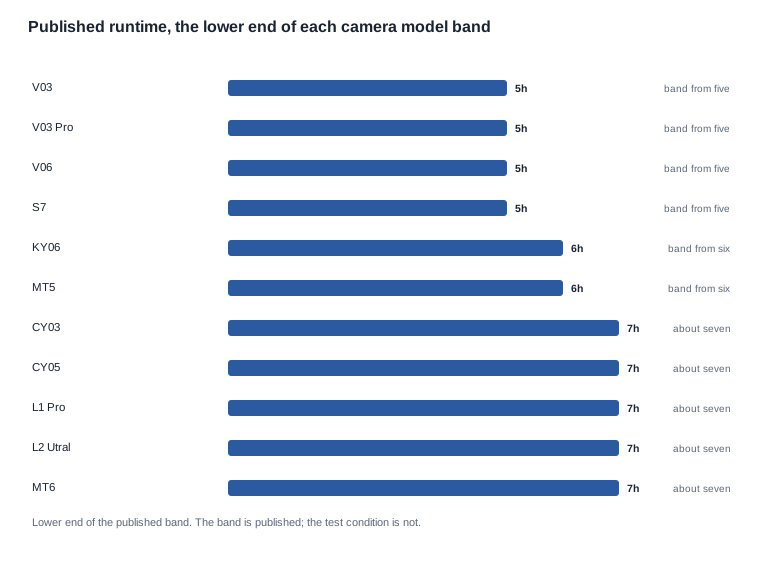
The published runtime figures make this a calculation rather than a judgement, provided the buyer uses the lower end of a band rather than the middle. The camera range publishes five to eight hours on the V03 and the S7, and the V03 Pro and the V06, six to eight on the KY06 and the MT5, and around seven on the L2 Utral and the MT6, and the CY03 and the CY05, and the L1 Pro. The connected range publishes a single figure per model: around eight hours on the K01 and the K02, around seven on the D11 and the D12, around eight on the LC-105-1 and the LC-105-2, and around six on the G07 and the YK12. A twelve-hour shift is not a shift this hardware can complete on one charge, and a buyer who plans for it needs a spare-power plan rather than a better model.
The mistake this constraint exists to prevent is using the upper end of a band. A deployment with a ten-hour shift reads as acceptable against a five-to-eight band and is not fine against it. The lower end of the band is the planning number, and if the shift exceeds it, the answer is a case, a second device or a shift structure — not a different model, because the models in the range do not publish longer runtimes than these.
Constraint three: what is the exposure?
Two things are published on exposure and nothing else. The IP54 marking appears on the V06 and the S7 and on no other model, and it is a catalogue attribute with no test report behind it. The catalogue publishes no operating temperature range, no drop or shock tolerance, no chemical exposure figure and no storage condition between uses. So the exposure constraint has a hard and a soft part: the hard part is that a deployment with a water or dust requirement narrows to two models, and the soft part is that a buyer with a chemical or a temperature requirement has no published figure to compare and must obtain one in writing.
Constraint four: how is the device operated?
The operating method decides several rows at once. The D17 and the ZH12 publish remote shutter control, which is the answer for a device that is operated without touching the frame. The V06 and the S7 publish a detachable inner frame, and the G07 publishes an ultra-slim detachable temple, which is the answer for a fleet that has to survive a season without replacing whole devices. No model in the audio range publishes capacitive touch, so a touch-based control requirement cannot be narrowed from the catalogue at all and has to be settled with the supplier model by model. None of these rows is a preference. Each of them either removes models or opens a question that has to be closed before a model is fixed.
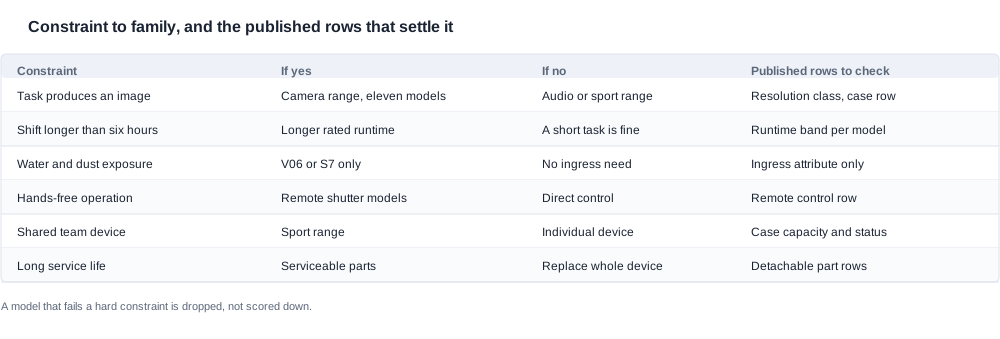
| Constraint | If yes | If no | Published rows to check |
|---|---|---|---|
| Task produces an image | Camera range, eleven models | Audio or sport range | Resolution class, case row |
| Shift longer than six hours | Longer rated runtime | A short task is fine | Runtime band per model |
| Water and dust exposure | V06 or S7 only | No ingress need | Ingress attribute only |
| Hands-free operation | Remote shutter models | Direct control | Remote control row |
| Shared team device | Sport range | Individual device | Case capacity and status |
| Long service life | Serviceable parts | Replace whole device | Detachable part rows |
Walking the tree: from constraint to model
Step one: narrow to a family
Applying the four constraints in order produces a family, and usually a family with a small number of candidates. A camera deployment with a wet site and a ten-hour shift lands on the V06 or the S7 and on nothing else, because those are the two models with an ingress marking and both sit in the five-to-eight band. A camera deployment with a dry site and an eight-hour shift has nine candidates and needs the next step. A no-image deployment with a two-hour shift and hands-free operation lands on the sport range and on the models with a remote.
The discipline at this step is to record the eliminations. A model that failed a hard constraint is dropped, not scored down, and the reason is written next to it. Scoring produces a weighted list in which a strong score on an unimportant row compensates for a failed hard constraint, and the failed constraint comes back in the field as a return.
Step two: choose inside the family
Inside a family the choice is made on the published rows, read in the same order for every candidate. For the camera range that order is: resolution class, then runtime band, then cell and case configuration, then charging interface, then the serviceable parts, then the ingress attribute. Two models with the same resolution class and the same band are separated by the case row and the interface row, and those two rows are where the operational difference between them usually sits.
The two runtime bands are worth separating carefully. A band of five to eight hours and a band of six to eight hours read almost identically in a specification summary, and the difference is an hour at the bottom of the shift, which is exactly where the planning number comes from. The published lower end is what the deployment should be designed against, and if two candidates have different lower ends, that difference outranks a resolution difference unless the resolution difference is itself a hard requirement.
Step three: record the open rows
For the surviving two or three models, the recommendation ends with a list of what the catalogue does not publish for them. The recurring items are the charge time's starting state and end point, the runtime test condition and mode, the charging method on the four camera models where the catalogue publishes no method row — the L1 Pro, the CY05 and the CY03, and the MT6 — the case status on the three camera models where no case row appears at all, the frame weight on every model other than the MT6, the mounting method, the ingress test report, and the certification evidence for the model and market.
Each of these is a question with a named method rather than a request for a figure. A charge time asked as "how long from empty, and how is full determined" is a question that produces an answer that can be evaluated; a charge time asked as "what is the charge time" produces a restatement of the published row. This is the step where a recommendation becomes a due-diligence request, and it is the step most often skipped, because the shortlist already reads as an answer.


What a recommendation cannot cover
Three things are outside what this range's published rows can settle, and naming them protects the buyer from a recommendation that is confidently wrong.
Weight and mounting. The catalogue publishes one weight, 158 g for the MT6 whole unit, covering the glasses themselves and excluding the folding case. It publishes no frame material, no lens material, no coating, no hinge specification and no mounting method for any model. A recommendation that names a weight for a model other than the MT6 is inventing a figure, and a recommendation that asserts a device will stay in place during a specific activity is asserting a mounting specification that nobody has published. Both of those belong to a sample test.
Environmental survival. The IP54 marking is an attribute, not a report, and it covers two models. A recommendation that says a model is suitable for a wet site because the range carries an ingress marking somewhere is borrowing a figure from the wrong model. The honest recommendation says which models carry the marking and then asks for the report behind it, because the report is what a customer's engineer will ask to see.
Certification and market access. The catalogue carries a company-level export certification page whose content is images rather than text, the catalogue text contains no reference to CE, FCC or RoHS, and there is no per-model certification row anywhere. The export page presents ten patent certificates — eight appearance-design patents and two utility-model patents — which are patent documents rather than market-access approvals. A recommendation can therefore state the model and the market and ask for the evidence, but it cannot state that a model is approved for a market, and a buyer who needs that answer needs it in writing before the order rather than after the listing is printed.
What we will recommend, and what we will not
Stated plainly: a recommendation in this category is a shortlisting procedure, and the value we can add is the published rows and the honest boundary around them. We publish the cell capacity or configuration, the charge time, the rated runtime, the charging interface where the catalogue states it, the radio version where it is published, the resolution class on the camera models, the case capacity and case status where they are published, the detachable part terms, the remote control terms, the ingress marking on the two models that carry it stated as a catalogue attribute, and the 158 g whole-unit weight for the MT6. Given a task description, a shift length, an exposure profile and an operating method, we can return the models that survive those four constraints and the rows behind each of them, and we can name the models that fail each constraint and why.
What we will not do is recommend a weight for a model whose weight the catalogue does not publish, assert that a model is approved for a market on the strength of a company-level export certification page, extend the IP54 attribute from the two models that carry it to the rest of the range, or present the upper end of a published runtime band as the planning figure. We also will not name a model for a task whose deciding requirement is a specification nobody has published — frame material, lens material, coating, hinge, field of view, operating temperature range, storage behaviour or the runtime test condition. In those cases the recommendation stops at the shortlist and the remaining question becomes a written request, because a confident answer that cannot be traced to a document is worth less to a buyer than an open item with a named method.
Turning a shortlist into a quotation request
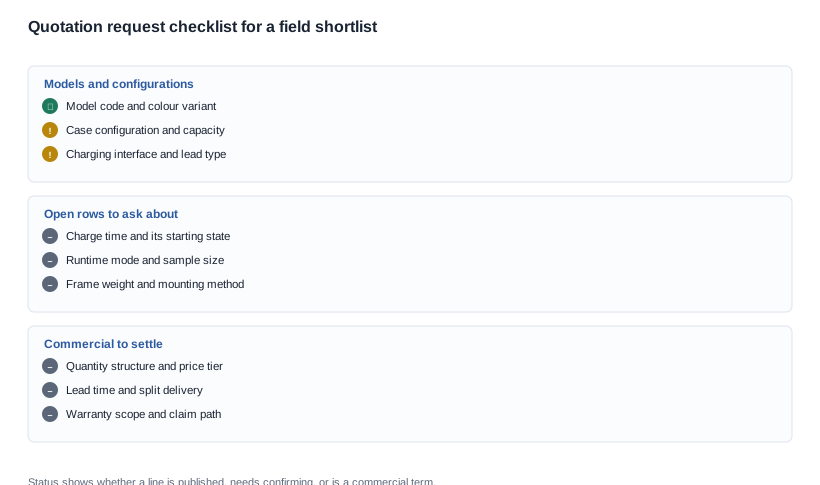
The last step of a recommendation procedure is to write the request, and the format of the request decides how comparable the answers will be. Six fields, and every candidate supplier answers the same six in the same order:
- Model code and configuration — the exact model, the colour, the case configuration and the charging interface, written as a configuration string rather than as a product name.
- The published rows for that model — quoted back from the catalogue, so the supplier's answer can be checked against the same document the buyer holds.
- The open rows — the flagged items from step three, with the measurement method written into the question.
- Quantity structure — the split by model, the case split, the lead quantity, and whether the order is a repeat of a previous configuration.
- Lead time and delivery shape — the date for the whole order and the date for any split, since a case sourced separately can move one without the other.
- Commercial terms — the price tier, the payment schedule, the warranty scope, the claim path and the freight allocation on a claim.
The checklist below is the working set for that request. The status marks whether a line is already published, needs a written confirmation, or is a commercial term that only a quotation can settle.
A request written this way has one property that a casual request does not: the answers are comparable. Two suppliers answering the same six fields in the same order can be set side by side without interpretation, and the differences that remain are the real ones — configuration, evidence, lead time and price — rather than the artefacts of two questionnaires asking different questions. The family comparison in the connected range is at bluetooth audio glasses, the sport range is at sport smart glasses, and the model selection logic that sits behind this procedure is set out in full at how to choose the right model for field work.


