Livestreaming puts a different load on the same hardware than filming does, and the difference is that the load is continuous. A creator can switch a camera off between shots; a stream cannot. That makes three things decide whether a device survives a deployment rather than a session — the power draw, the heat it produces while sustaining that draw, and the behaviour of the phone on the other end of the link. All three need to be planned, and two of them are not described in the published specifications. What a buyer actually takes away from this page is not a maintenance routine but a duty cycle: the number of hours a unit is asked to work per week, the number of units that have to be held as spares, and the month at which the replacement volume for year two can be set with evidence rather than with a guess.
Smart glasses for livestreaming: the duty cycle is the real specification
Who this is written for. The reader is a brand owner, a channel operator or a procurement manager who has units in a room and is now thinking about what happens in month four. The task is not to keep a device alive; it is to size a deployment. A livestreaming deployment has a per-unit duty cycle, a spare ratio, a degradation curve and a replacement date, and every one of those four is a commercial decision that has to be made before the year-two order rather than after it. The fear that motivates the page is the arithmetic one: a channel that bought a hundred units and treated them as a hundred durable units discovers in month five that it owns fifty usable ones and a spare-stock problem it did not price.
Why the deployment is a different animal from the session. A single session is a test with a known start and end. A deployment is the same test repeated, on a schedule, for months, with the units accumulating every ordinary accident of handling. The published runtime tells a buyer how long one charge lasts under a stated condition. It does not tell the buyer how many hours a week the unit will be asked to work, how many of those hours are back to back, or what the cell does after a few hundred cycles. None of the three is published, and all three decide the replacement order.
What the catalogue publishes about endurance. The camera models publish a rated runtime of between five and eight hours: a band of 5~8 h on the V03 Pro and the V03, and the V06 and the S7, a band of 6~8 h on the KY06 and the MT5, and about seven hours on the CY03 and the MT6, the L1 Pro and the L2 Utral, and the CY05. The cell capacities run from 220 mAh to 290 mAh, with the MT6 at 265 mAh. Every camera model publishes a charge time of two hours or less, and the charging method is published per model: magnetic on the MT5 and the S7, and the KY06 and the V03, and the V06, a Type-C port on the V03 Pro and the L2 Utral, and no published charging method for the CY03 and the MT6, and the L1 Pro and the CY05. Those are real numbers and they are enough to size a session. They are not enough to size a year.
What the published runtimes do and do not settle
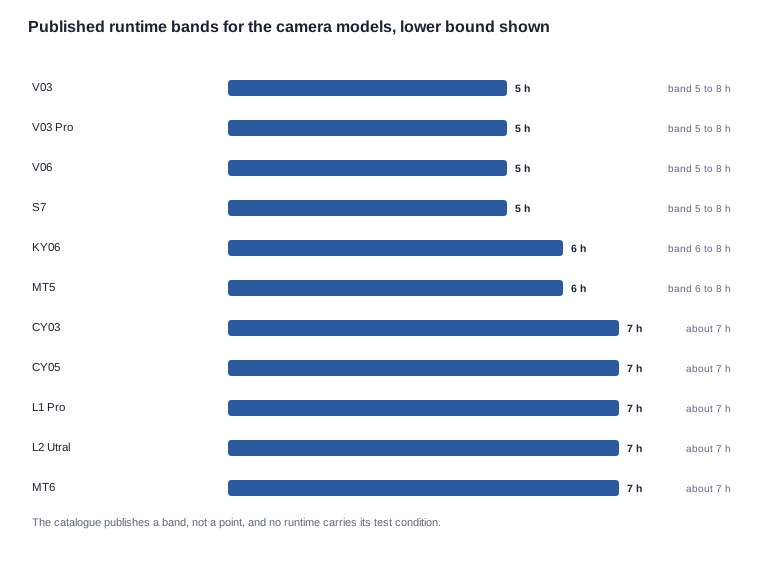
The chart shows the lower bound of each published band, because the lower bound is the number a duty cycle has to be built around. Four camera models sit at five hours, two sit at six, and five sit at about seven. The gap between the lower and the upper end of a band is three hours in the widest cases, and nothing in the catalogue says which end a given unit will deliver, because no runtime in the range carries its test condition.
The band is not a session length
A published band of five to eight hours is not an eight-hour device. It is a device whose rated use falls somewhere inside a three-hour-wide band, measured under a condition the catalogue does not state, and the condition is the whole of the answer: a runtime measured on a bench and a runtime measured on a live feed are not the same measurement. A buyer who plans a six-hour session against a 5~8 h band has built a schedule on the assumption that the unit lands in the middle of the band, and the assumption has no published support.
What to do with the band instead. Two options, and both are defensible. The first is to plan every session against the lower bound, which costs spare units and buys certainty. The second is to request the test condition and the expected variance from the manufacturer, which costs a round trip and buys a real schedule. Buyers who do neither end up with a deployment that works in the first month and starts failing in the third, because the units that were delivered at the bottom of the band are the ones that fail first.
The charge ceiling is a ceiling, and it is the only published figure about power
Two hours or less is the published charge time on every model in the range, and it is a limit rather than a promise. The practical consequence for a deployment is a turnround window: a unit that has been fully drained needs up to two hours before it is usable again, and a fleet that runs two sessions a day needs a swap procedure that works with that window rather than a hope that someone finds a cable. Only the D17 and the ZH12, which are sport models rather than camera models, publish roughly one hour, and that figure is a different kind of statement again.
The turnround window is what determines the spare ratio, and the spare ratio is the number a channel forgets to price. A one-session-a-week creator needs no spare. A creator running three sessions a day from the same kit needs a spare on site, because the window is longer than the gap between sessions.

The four constraints that accumulate over a deployment
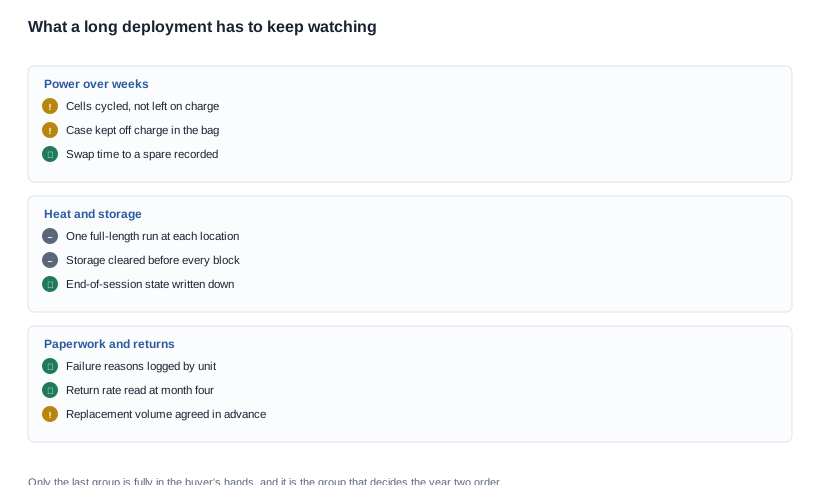
The four constraints in that image do not arrive at once. They accumulate, and the reason a deployment fails in month five rather than in week one is that each of them is small on its own. A cell that is cycled hard every day loses capacity gradually, and the first visible symptom is a session that ends five minutes early. That symptom gets attributed to the platform, and the platform is where the attention goes.
Cell ageing is the one nobody can see
Nothing in the catalogue publishes a cycle life rating, a standby draw or a cell degradation curve for any model. That is a genuine gap in the specification and it is also the reason a buyer should measure rather than model. The measurement is simple and it is the cheapest number in the category to produce: log the runtime of a small sample of units at the start of the deployment, log it again at month four, and log it again at month eight. The difference between the first and the second reading is the degradation rate, and the buyer can then project the replacement volume for year two from the fleet's own history instead of from a general assumption.
How to log it without a laboratory. Run one fixed session on one fixed unit, in one fixed position, at a fixed room state, and write down when the session ended. Five units, one hour each, once a month, produces a curve that is good enough to set a replacement volume. The comparison has to be like for like, because a session that runs shorter because the room was hotter is not a cell measurement, and the temptation to blame the cell is exactly what makes the number worthless.
Storage and thermal behaviour are the two that arrive first
Storage fills quietly, and in a long deployment it fills every session. The catalogue publishes no storage capacity, no file format and no overwrite behaviour for any model, so a deployment cannot plan a clearing routine against a published number. The routine has to be attached to a moment the creator already has — the end of a block — and it has to be in the setup sheet rather than in a policy document. The second constraint is thermal: a continuous load is a different load from a series of short captures, and the thermal behaviour of the unit is unpublished, so the only way to learn it is to run one full-length session and record where the end state sits. Both constraints are cheap to observe and expensive to discover late.

Where the runtime row decides the kit
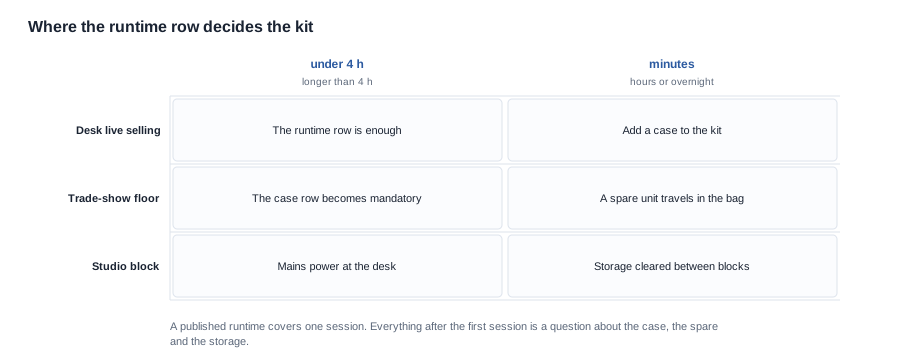
The matrix reads across from a session length to a recovery window, and it is the clearest statement of the whole page. A short session with a short recovery window is settled by the published runtime row and by nothing else. A long session with a short recovery window needs a published case, because the cell has to be replaced rather than recharged. A long session with a long recovery window needs storage management and a spare, and the spare is the item that scales with the number of creators rather than with the number of units shipped.
Three deployments, three duty cycles
A desk-based live selling session is the easiest case to size. The session is short, the recovery window is overnight, and the published runtime is not the constraint. The constraint is the swap procedure when a unit dies mid-session, which is a spare unit and a rehearsed handover rather than a charging decision.
A trade-show or field session is the case where the case row becomes mandatory. The unit travels, the recovery window is short, and the published case capacity is what decides whether one battery covers the day. Here the buyer is choosing between models on a published number, which is the rare situation in this category where the decision is genuinely closed by the catalogue.
A long studio block is the case where the cell matters least and the storage matters most, because a desk has mains power and a long block is long enough to fill the device. The published rows barely enter into it, and the operational routine carries the whole deployment. The power rows are at battery life and the charging decisions are at charging solutions.
How to choose a duty cycle rather than guess at one
The criteria that decide a deployment are four numbers, and every one of them can be collected in the first eight weeks without any supplier cooperation. The reason this is worth stating plainly is that the alternative — sizing a fleet on a published runtime band and hoping — is the single most common cause of an unprofitable livestream channel, and it is entirely avoidable.
- The session length, which the buyer knows on day zero. It sets the runtime requirement and it eliminates models that cannot cover one session twice over.
- The sessions per creator per week, which the buyer also knows on day zero. It converts the runtime requirement into a weekly duty cycle.
- The recovery window, which is the gap between the end of one session and the start of the next. It decides whether the cell has to be recharged or replaced, and therefore whether a published case capacity is a preference or a requirement.
- The swap time, which is the only one of the four that has to be measured, and the only one that a supplier cannot supply.
The trade-off worth naming before you order. A larger spare ratio costs working capital and shipping weight and removes the risk of a cancelled session. A smaller spare ratio saves both and accepts the risk. There is no third option, and the decision is not a technical one — it is a question of what a cancelled session costs in that particular channel, which is why the answer is a business number rather than a specification number.
The total cost view, briefly. The unit price is the smallest line in the comparison once the spare ratio, the case, the shipping weight and the return rate are added. A buyer who compares two camera models on unit price alone is comparing two configurations that differ in the number of units a channel has to hold. The pricing structure is at pricing and the questions worth putting to a supplier before you order are collected at certification checklist.
Measuring a deployment before the replacement order
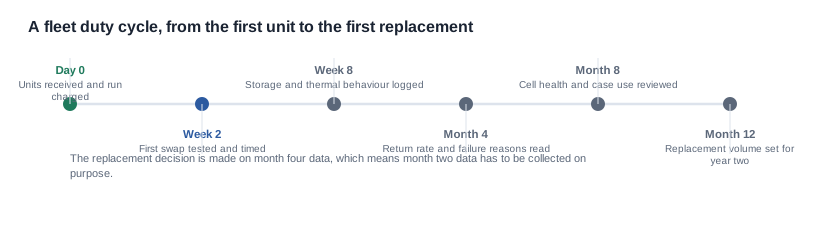
The timeline above starts at day zero and ends at the month twelve decision, and the middle of it is the part that is usually skipped. The first swap test at week two establishes the turnround window. The week eight log establishes the storage and thermal behaviour that the catalogue does not publish. The month four read of the return rate is the point at which the replacement volume for year two can be set from data, because by then there are enough units and enough incidents to produce a rate that means something. The month eight review of cell health and case use is what turns the year-two order from a repeat of year one into a different order.
The three numbers that decide year two
A buyer who wants one number rather than a report should ask for three. They are the swap time, the return rate split by reason, and the runtime delta between the first reading and the most recent one.
- The swap time, measured on a pilot, from the moment a unit fails to the moment a charged one is carrying the feed. It sets the spare ratio and it is the number a deployment plan is built on.
- The return rate split by reason, separating failures during a session, failures during a charge, and physical faults. The first is a specification question, the second is a charging-interface question, and the third is a manufacturing question, and a single combined number is useless for deciding which conversation to have.
- The runtime delta between the first reading and the current one, on the same fixed session. It is the only measurement in this list that produces a replacement date.
The commercial consequence. The share of units taken at the pilot tier rather than the run tier is where most of the room in a livestream order sits, because it is the factory's own risk exposure being priced, and a buyer who has a measured swap time and a measured return rate can negotiate that share with evidence rather than with a request. A buyer who negotiates hard on the unit price and holds the whole order at the run tier has given away the only lever that the pilot exists to exercise. The terms are at pricing and the pilot structure is at samples. The quality control structure that catches the third number is at quality consistency.
The three pitfalls that cost a deployment the most
Sizing a fleet from a published band rather than from a measured duty cycle. The band is a range under an unstated condition, and the lower end is the only part of it that a buyer can rely on. This is the pitfall that shows up in month five, and it is invisible until it does.
Treating the spare ratio as a rounding error in the quotation. The spare is a working-capital item that scales with the number of creators rather than with the number of units shipped, and it is frequently the second largest number in the whole deployment once the case and the freight weight are added. A buyer who negotiated the unit price to a tenth of a cent and never costed the spare has optimised the line that was never the risk.
Letting the storage and thermal behaviour stay unmeasured. Both are unpublished, both accumulate, and both are cheap to observe on a pilot and expensive to discover in production. The measurement is one full-length session and a note of the end state; the cost of skipping it is a second pilot and a second round of questions.
What a due diligence visit can and cannot settle. A factory audit settles the manufacturing side — the process, the inspection points, the consistency of the electrical rows between batches. It cannot settle the streaming behaviour, because that behaviour is not produced at the factory, it is produced by a device, a phone, a platform and a room. Buyers who expect an audit to answer the streaming questions are waiting for the wrong document. The audit scope is at factory audit.
What we publish, and where we stop. Our position is that we publish the rows a buyer can order from and we will not estimate the rest. For the camera family that means the resolution class, the cell capacities from 220 mAh to 290 mAh, a charge time of two hours or less on every model, the rated runtimes between five and eight hours, the charging method per model, the case capacities where a case row exists, and the single published weight of 158 g for the MT6 glasses. We will not publish a cycle life rating, a standby draw, a runtime test condition, a thermal behaviour, a storage capacity or an overwrite behaviour for any model where the manufacturer has not provided one, and we will not turn a runtime band into a session length for a buyer who has not asked us to. The model list is at ai camera glasses and the deployment context is at smart glasses for livestreaming.
What to send us next. Send us the models in the fleet, the number of sessions per week, the session length and the number of creators, and we will return the published rows that apply, the duty cycle those rows support, the measurements that will have to be taken in the first eight weeks because the catalogue does not carry them, and the case and spare configuration that each duty cycle implies.
Send us the models, the session count and the creator count, and we will return the duty cycle each configuration supports and the measurements you will have to take in the first eight weeks.