
The gap between the demonstration and the fourth hour of a live session is where livestreaming with smart glasses is won or lost, and almost nothing in the product documentation describes that gap. What the published rows tell a buyer what the device is: a resolution class of 8 MP or 13 MP, a cell between 220 mAh and 290 mAh, a charge time stated as two hours or less, a rated runtime between five and eight hours, a charging method per model, and a case capacity where a case row exists. The video format, the frame rate, the field of view, the storage path and the transfer method are not published for any model, and the difference between the demonstration and the session is almost entirely made of those unpublished rows. Six expectations meet reality below, each with the adjustment that keeps a session on the air. None of them is a defect, and all of them are predictable.
Smart glasses for livestreaming: where the demo and the session part company
Who this is for. The reader is a brand owner, a channel operator or a procurement manager who has watched a demonstration, or received one from a supplier, and is now deciding whether to commit. The task is not to decide whether the device is good. It is to decide whether the gap between the demonstration and a real session is acceptable for the deployment, and if it is, what the session has to do differently. The failure this page exists to prevent is a specific one: a channel that buys on the strength of a demonstration, deploys into a real room, and then treats the resulting gap as a product defect rather than as a condition that was never specified.
Why the gap is predictable rather than a fault. A demonstration is a controlled environment, and a controlled environment is a set of conditions, not a neutral baseline. The room is quiet, the light is even, the device has been charged, the session is short, the storage is empty and the network is the setup room's own. Every one of those conditions is a choice, and every one of them is different in a real session. Nothing about the device changes between the two; the conditions change, and the device shows the conditions. That is why the gap is not a defect and why it cannot be closed by replacing units.
The consequence for a buyer. A demonstration is a valid test of exactly one thing: that the device produces a picture, a sound and a recording. It is not a valid test of endurance, framing, audio, storage, heat or workflow, because none of those was varied in it. A buyer who asks the right question of a demonstration is asking which of the six conditions below were present, and the answer tells the buyer how much of the session remains untested. The pilot procedure that answers it is at how to test smart glasses for livestreaming.
Six expectations, what actually happens, and the adjustment
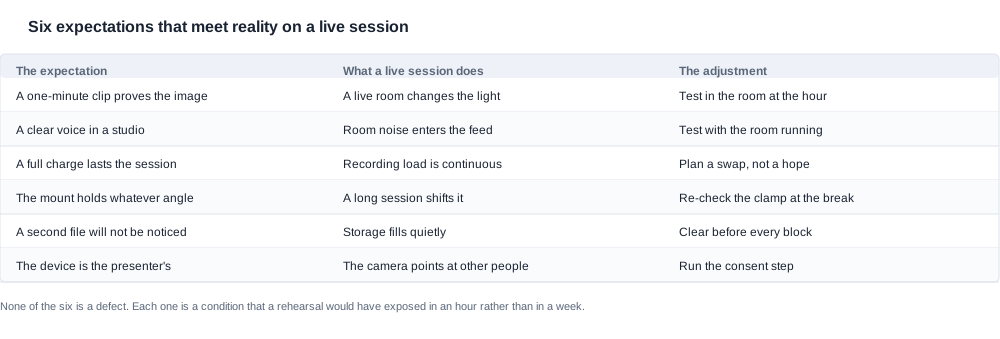
The middle column is the reality, and it is the column that matters. The third column is the adjustment, and every adjustment in that column is available to a buyer before the first session, at a cost that is almost always a routine rather than a budget line.
The belief that a one-minute clip proves the image
What the belief is. The clip was made in good light, close to the subject, and it is the most persuasive artefact in the whole supplier conversation. What a live session does. A room lit from behind turns a sharp picture into a noisy one, and a subject at the far end of a room turns a sharp image into a soft one. The low-light behaviour is not published for any model, and the field of view is not published either, so the demonstration cannot be corrected for the room. The adjustment. Test in the actual room, at the actual hour, with the actual lighting, and treat the demonstration as a statement about the capture rather than as a statement about the room.
The belief that a full charge lasts the session
What the belief is. The published runtime is a figure on a page, and a buyer reads it as a session length. What a live session does. Recording is a continuous load, and the published runtimes are bands — 5~8 h on the V03 Pro and the V03, and the S7 and the V06, 6~8 h on the KY06 and the MT5, and about seven hours on the L1 Pro and the MT6, and the CY03 and the CY05, and the L2 Utral — with no test condition stated for any of them. A band is not a session length. The adjustment. Plan against the lower bound, and schedule a swap rather than hope for one. The turnround window is up to the published charge ceiling of two hours or less, and the spare ratio follows from the gap between sessions.
The belief that the mount holds whatever angle
What the belief is. The unit was set once, by someone holding it, and the frame was correct. What a live session does. A long session shifts a head-mounted or clipped device, and a shift of a few degrees is enough to put the subject at the edge of the frame. The adjustment. Re-check the clamp at a defined moment — the handover between presenters, or the break — and make it part of the setup sheet rather than a matter of attention.
The belief that a second file will not be noticed
What the belief is. Storage filled up once, in a different deployment, and nothing happened. What a live session does. Storage fills quietly, and the overwrite behaviour is not published for any model, so the failure arrives as a stopped recording in the middle of a segment. The adjustment. Clear before every block, attached to the moment the creator already has rather than to a reminder.
The belief that the device is the presenter's business
What the belief is. The unit belongs to the brand, so the people in front of it are part of the brand's own production. What a live session does. The camera points at whoever is in front of it, and in a live selling session that includes people who never agreed to be recorded. The adjustment. Run the consent step as a rehearsed script rather than as a policy, and the framework is at smart glasses for livestreaming legal considerations.
The belief that the sound in the demonstration is the sound in the room
What the belief is. The demonstration was made in a quiet room. What a live session does. Room noise enters the feed, and the microphone count, the pickup distance and the processing mode are not published for any model, so there is no published way to predict the result. The adjustment. Test with the room running, at the level the room will be at, and record the result rather than the impression.
The demo condition against the session condition
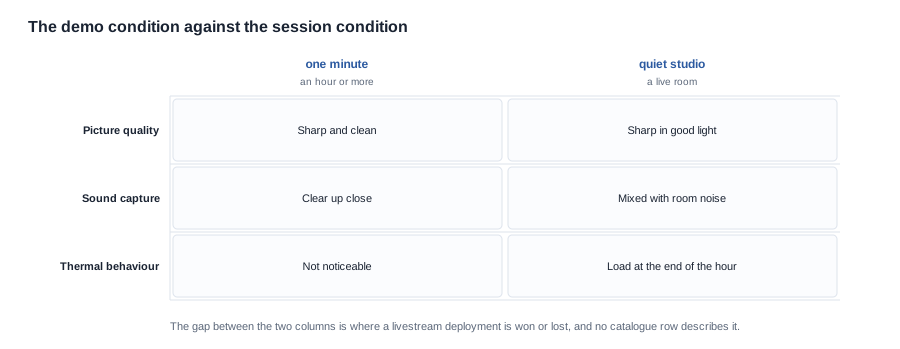
The matrix reads across from the length of the demonstration to the length of the session, and down from a quiet studio to a live room. The two axes are the ones that actually change the outcome, and the three rows are the three things a buyer is usually surprised by. Picture quality is the surprise that arrives first and gets attributed to the camera. Sound capture is the surprise that arrives second and gets attributed to the room. Thermal behaviour is the surprise that arrives third, in the last hour, and gets attributed to the device — which is the one attribution in this list that is wrong.
The two columns that decide the picture and the sound
The picture degrades with light, and the light is a property of the room. A one-minute demonstration in even light says nothing about a room lit from a window at four in the afternoon, and the two cannot be compared because the exposure is the thing that changed. The measurement that matters is the picture in the worst light in the deployment, not the picture in the best.
The sound degrades with noise, and the noise is a property of the people. A quiet demonstration is the easiest possible test for an open acoustic path, and a live room full of people talking is the hardest. The published rows cannot help here, which is why the audio test belongs in the pilot and not in the specification.
The heat is the one that belongs to the device, and it belongs to the session length. Thermal behaviour is not published for any model, so the only way to know it is to run one full-length session and record the end state. A pilot that runs thirty minutes has not tested this at all, and a pilot that runs the full session has tested it exactly once.
The attribution problem, and why it costs a channel money. A degraded picture in a bright room is blamed on the camera, a weak sound in a busy room is blamed on the room, and a session that ends early in the second hour is blamed on the device. Only the third of those three is even possibly the device, and even it may be the charge state rather than the heat. The cost of the misattribution is not the replacement unit — it is the time. Every week spent replacing units against a condition that will not change is a week in which the same condition recurs, and the log that would have identified it is not being written because the team believes it has already found the cause.
The discipline that prevents it. Treat the first unexplained session as an observation rather than as a fault, and write it down before anybody acts on it. A buyer who takes one session of evidence before a claim is a buyer whose returns data is still usable a year later, and a buyer who claims on the first symptom ends up with a returns rate that describes a reporting habit rather than a product. The return rate is the number that decides the year-two order, and it is the number most easily destroyed by reacting rather than recording.
The adjustment routine that makes the second week quieter

The routine above is six steps, and the fifth one is the one that most teams skip. Changing one variable per session is not a discipline for neatness; it is the only way the log stays informative. A session in which the mount was changed and the light was different and the room was busier produces three possible causes for one observation, and the log then records an average rather than a cause.
What to log, and what not to change at the same time
The log has five fields and it takes two minutes to write. The date and the session length. The room condition in one word — quiet, busy, bright, dim. The picture outcome: acceptable, noisy, soft, or interrupted. The sound outcome: clear, mixed, or lost. And the failure, if any, with the time it happened in the session. The value is in the times and the conditions, because a failure with a time is comparable across sessions and a failure without one is an anecdote.
What not to change at the same time. Do not adjust the mount and the room and the session length in the same week. Do not swap a unit and change a setting in the same session. A deployment that changes five things in week one produces a week one that tells the buyer nothing, and a buyer with no information at week four has a fleet and a guess.
The bridge from a log to a supplier conversation. A log entry becomes a useful question only when it is converted into a row. A failure at the fifty-minute mark in a bright room with a clear sound is a request for the thermal behaviour and the runtime test condition. The procedure for turning a log into a specification is at smart glasses for livestreaming common problems.

The six beliefs worth testing before they become a fault report
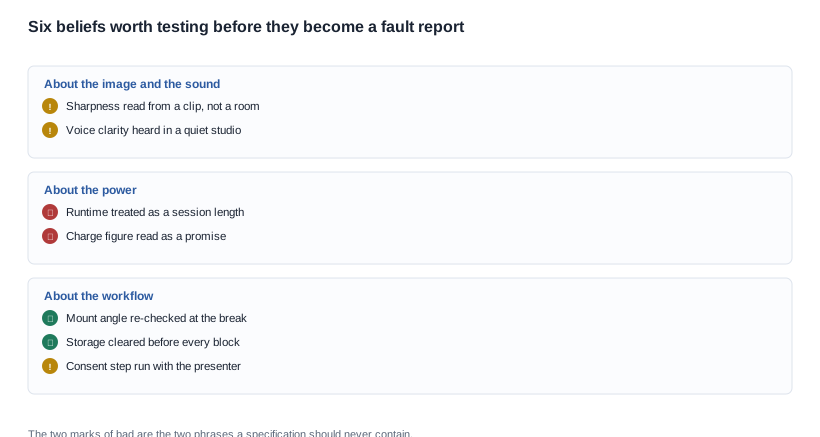
The six groups in that image are arranged by what settles them, and two of them carry the mark that matters most. A mark of bad means the belief, written the way a specification usually writes it, is simply untrue against the published rows: a runtime read as a session length, and a charge figure read as a promise. A mark of warn means the belief is defensible but the condition is missing.
The two phrases a specification should never contain
"Under two hours" is not the published claim, and the published claim is "two hours or less." A ceiling and a promise are different assertions: a ceiling permits exactly two hours, and a promise does not. Every model in the catalogue publishes a charge time of two hours or less, and only the D17 and the ZH12, which are sport models rather than camera models, publish roughly one hour. A specification that asks for a charge shorter than that ceiling has asked for something the catalogue does not state.
"The battery lasts the session" is not a row at all. The catalogue publishes a rated runtime band and no test condition. A session length derived from that band is a derived value, and a derived value written into a specification without being labelled as one becomes an official figure within two months.
How to choose a pilot that actually tests the six
A pilot is usually booked as a demonstration with a longer session attached, and that is the least useful version of it. The criterion for a pilot in this category is simple: it has to vary the conditions that the deployment will vary, and it has to be long enough to reach the end state. That is a different thing from a long session in a quiet room, and the difference is where the money is saved.
The five things a pilot has to vary, and the one it must not. The pilot should vary the room, the light, the session length, the network and the operator. It should not vary the device configuration halfway through, because a change of configuration mid-pilot destroys the comparison. A pilot that varies five conditions and holds the configuration produces observations a buyer can act on; a pilot that varies one condition and changes the configuration produces a result nobody can interpret, and it is the more common failure.
What to ask the supplier to bring to the pilot. The exact configuration being quoted, in the quantity the deployment will use, from the same production batch. A second unit with the same configuration, so that a swap can be tested rather than assumed. The published rows for that configuration in writing, so the acceptance criteria can be written on the day rather than reconstructed afterwards. The charging accessories for the configuration, so that the charge path is tested with the real cable and the real case rather than a bench equivalent. And the questions to ask, in writing, before the session, so that the answers arrive in a form that can go into a specification.
The five criteria that decide whether the pilot was worth the day.
- The session ran to full length, in the real room, with the room's normal noise — because a short session cannot produce a thermal result at all.
- The picture was assessed in the worst light the deployment will see, not the best — because the best light is the condition that never recurs.
- The sound was assessed with people in the room, because a quiet room tests nothing about the audio path.
- The storage was observed at the point of filling, because the overwrite behaviour is unpublished and the failure is silent.
- The swap time was measured on a spare, because that number sets the spare ratio for the year-two order and it is the only one of the five that a supplier cannot supply.
The trade-off worth naming. A pilot that varies everything is thorough and produces no comparable result, because there is no baseline. A pilot that varies one thing produces a clean result and leaves five expectations untested. The middle position is a pilot with one fixed baseline session — same room, same light, same length, same operator — repeated weekly, with a second set of sessions that vary one condition each. That structure is what produces a usable log, and it is what lets a buyer know which of the six expectations above are genuine and which were artefacts of the first week.
What to do with the result. Whatever the pilot shows, it goes into the acceptance criteria for the production order, and the acceptance criteria go into the contract. The clause language is at contract terms, the sample terms are at samples, and the quality control process that catches a drift between batches is at quality consistency. A pilot whose result never reaches the contract is a demonstration with a longer session attached.
What we publish, and where we stop
Our position is that we publish the rows a buyer can order from, and that we will not fill the gaps with typical values. For the camera family that means the resolution class, the cell capacities from 220 mAh to 290 mAh, a charge time of two hours or less on every model, the rated runtimes between five and eight hours, the charging method per model, the case capacities where a case row exists, and the single published weight of 158 g for the MT6 glasses. We will not publish a video format, a frame rate, a field of view, a storage capacity, a transfer path, a linking sequence, a control scheme, a microphone row, a network requirement, a thermal behaviour or a runtime test condition for any model where the manufacturer has not provided one, and we will not turn a runtime band into a session length. The model list is at ai camera glasses and the power rows are at battery life.
What to send us next. Send us the session type, the room, the session length and the models you are comparing, and we will return which of the six expectations above are already settled by the published rows, which are conditions the pilot has to establish, and which of them are simply true for every model in the range.
Send us the room, the session length and the models, and we will return which of the six expectations the published rows settle and which your pilot has to establish.


