
Smart glasses for livestreaming: the symptom list is a fault attribution table, and it belongs in the contract
What a buyer can settle before the first shipment arrives
The first thing a buyer should settle about troubleshooting is not a procedure. It is a boundary. Everything published about this range describes Bluetooth connectivity — V5.3 on the K01 and the K02, V5.4 across the rest of the audio models — with no published Wi-Fi function, no published streaming function and no published integration with any broadcast platform. What is in the catalogue is a recorder. Everything that a viewer sees goes through a phone between the glasses and the encoder, and every stage in that chain adds a condition that can fail without the device being at fault.
That boundary has a commercial consequence, and it is the one this article is about. A troubleshooting list that does not say which layer owns each symptom converts every field failure into a warranty claim, and a warranty claim that arrives without attribution is a claim the supplier cannot either accept or reject on evidence. The result is a replacement rate that measures the deployment rather than the product, and a buyer who has priced the warranty on that rate has priced the phone, the radio room and the encoder stack as if they were the glasses.
Three conclusions follow. Write the attribution table before the order, with a named owning layer for each symptom and the evidence that settles it, because the table is cheaper to agree in advance than to argue after the third replacement. Agree an attribution deadline in the contract, so that a ticket which is still unattributed after a stated number of hours is decided by a stated rule rather than by whoever picks it up. And feed every confirmed cause back into the acceptance criteria, because a symptom that was never in the acceptance criteria is a symptom the specification never excluded.
The four people who have to agree on who owns a fault
Four parties have an interest in the outcome of a fault ticket, and they do not want the same answer.
The channel's operations manager wants the unit back in service, because a session that cannot be recorded costs money immediately and visibly. The buyer wants the cost contained, because a replacement rate that scales with the number of units in the field is a line in the operating budget that nobody planned for. The supplier wants the fault reproduced on a unit it can examine, because a defect it cannot reproduce is a defect it cannot fix and a claim it cannot refuse. And whoever signs the warranty wants a rule that is written down, because a discretionary claim process is a claim process that grows.
These four interests only conflict when the attribution rule is missing. With a rule, the operations manager still gets the unit back, the buyer gets the cost held to the layer that caused it, the supplier gets an examinable unit, and the warranty signatory gets a decision that does not have to be renegotiated. Without a rule, the cheapest resolution is always the same — replace the unit and move on — and the cheapest resolution is the one that is most expensive over a year.
The rule itself is short. Three questions, in this order. Does the symptom reproduce on a single unit? Does it change when the unit moves to a different room? Does it appear only at full session length? A symptom that survives all three is the only kind that returns to the factory, and the process exists to make that answer cheap to reach.
Why the device is usually blamed for a workflow condition
The device is the visible object in the deployment, and the phone is the one doing the work. A recording device that captures without artefacts and hands the file to a phone that is simultaneously receiving a camera stream, encoding video and pushing it to a platform is a component in a chain, and the chain fails at whichever link is under the most load.
The consequence is a structural misattribution. When a session ends early, the first question asked is about the battery. When frames drop, the first question asked is about the radio. When the broadcast sounds wrong, the first question is about the microphone. In every one of those cases the question is reasonable and the conclusion is usually wrong, because the link under the most load is the phone and the operator is the one who owns the phone.
This is not a new phenomenon and it is not a defect in any particular model. It is what happens when a product is specified by what it is rather than by what it does in a chain. The catalogue gives a buyer a device with a pixel class, a cell capacity, a rated runtime, a charging interface and a case configuration. It gives the buyer nothing about how that device behaves as one link in a broadcast chain, which is the only thing that determines whether the deployment works. The gap between those two facts is where the fault attribution table earns its place.
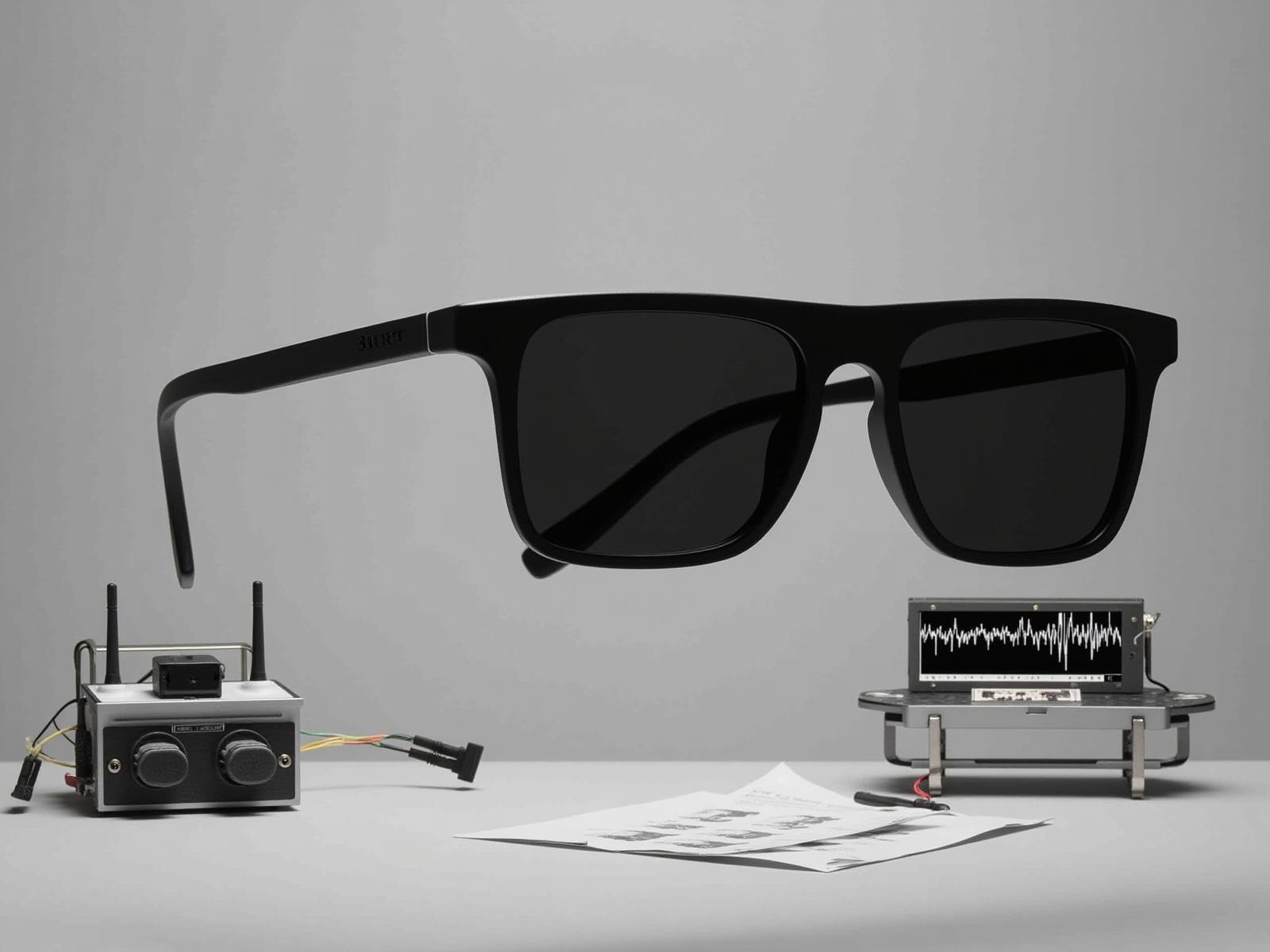
The six symptoms that recur, and the layer that owns each one
The transfer chain, the encoding stack and the radio room
Three of the recurring symptoms belong to the deployment rather than to the device, and they are worth separating because each has a different evidence requirement.
The first is a preview that lags behind the presenter. The glasses record, the phone receives the file over Bluetooth, the application makes it available, the streaming software encodes it, and each stage adds latency. Nothing here is defective and nothing here can be removed. What can be removed is the surprise: measure the transfer of a single clip from record to visible in the streaming software, on the channel's own phone and the channel's own network, and write the number into the rehearsal notes. That measurement is a procurement artefact as much as an operational one, because it is the number that tells a buyer how much of the perceived delay belongs to the chain.
The second is a phone that heats during a long session. Two sustained workloads on one device is a thermal problem, and phones throttle before they admit it. The remedy is operational — rehearse at full session length, reduce the encode bitrate, close everything else, and use a powered setup rather than a phone on a desk for a multi-hour broadcast. The remedy is not available to the supplier at all, which is precisely why the symptom has to be attributed to the encoding stack.
The third is dropped frames when the router is close. Bluetooth and 2.4 GHz Wi-Fi share spectrum, and a phone doing both next to a router in a room with reflective surfaces produces congestion that appears as dropped frames rather than as a clear error. This one is genuinely fixable on site: separate the phone from the router, change the Wi-Fi band where the channel controls it, and keep the streaming hardware physically apart from the glasses. The deeper behaviour is tracked at content creation.
The symptom the catalogue cannot help with at all
The fourth symptom is the one that ends a session: the recording stops before the session does. The published runtime figures for the camera tier are a band of five to eight hours on the S7 and the V06, and the V03 and the V03 Pro, a band of six to eight hours on the KY06 and the MT5, and about seven hours on the CY03 and the CY05, the MT6 and the L1 Pro, and the L2 Utral. No runtime in the range carries a published test condition, and the charge time is a ceiling of two hours or less with no start state and no termination criterion behind it.
That makes this symptom ambiguous in a specific way, and the ambiguity has to be resolved by measurement rather than by argument. A session that ends early at three hours is a duty-cycle question. A session that ends early at three hours on one unit and not on another is a device question. The difference between the two is the entire cost of the ticket, and it is established by running the session at full length on a spare unit — which is also why a case configuration matters here. Seven camera models ship with a case: the KY06 and the MT5 with a capacity that is not published, the CY03, the CY05 and the L1 Pro at 1400 mAh, the L2 Utral at 900 mAh or 1400 mAh, and the MT6 with a 1200 mAh foldable case. The V03 Pro is published without a case, and the catalogue publishes no case row for the V03, the V06 or the S7.
The fifth symptom is doubled or flanged audio on the broadcast. Open-ear audio leaks, so a microphone near the presenter picks up both the voice and the audio playing from the glasses. It reads as a technical fault and it is immediately obvious to a viewer. The remedy is a routing decision made in rehearsal — a directional or lavalier microphone on the broadcast path with the glasses' own audio used only for monitoring, or the reverse — and it involves the eight audio models in the range rather than the camera tier.
The sixth symptom is footage from earlier in the session that is missing. Storage capacity, file format and overwrite behaviour are not published for any model in this catalogue, so the operating rule is to transfer and clear between segments rather than after the session. Here the attribution is to an unpublished behaviour rather than to a defect, and the evidence is a transfer log taken from the unit.
Reproducing a symptom before attributing it
The attribution sequence and its completion conditions
The attribution sequence has five steps, and each one has a completion condition a buyer can check without an engineer.
- Record the symptom with its context. Time of day, point in the session, session length so far, the room, the network and the position of the phone. The completion condition is that someone who was not present could read the ticket and know what to reproduce.
- Reproduce it on a spare unit, in the same room, with the same phone. The completion condition is a written reproduction or a written failure to reproduce. A failure to reproduce on a spare unit is a result and it is a strong one: it moves the fault to the unit that was in the field.
- Move the unit to a second room and repeat exactly the same action. The completion condition is the same symptom appearing or not appearing in the second room. This is the step that separates a radio environment from a device, and skipping it is the single most expensive mistake available in this workflow.
- Run the same action with a different unit on the same phone. The completion condition is the symptom appearing or not appearing on the second unit. This is the step that separates the phone from the glasses.
- Attribute it and write it down. One sentence naming the owning layer, the measured value rather than a description, and the decision the attribution carries.
The order of steps three and four is not arbitrary. Swapping the unit before swapping the room attributes a radio problem to the device, and a device that is replaced for a radio problem comes back working, which makes the attribution seem confirmed while the underlying condition is still there. That produces two consequences at once: a replacement the buyer paid for and did not need, and a false pattern in the failure data that will misdirect the next three tickets.
The evidence pack a fault ticket has to carry
The evidence pack is what turns a claim into a decision, and its contents are the same whether the ticket goes to the factory, to a distributor or to an internal operations team.

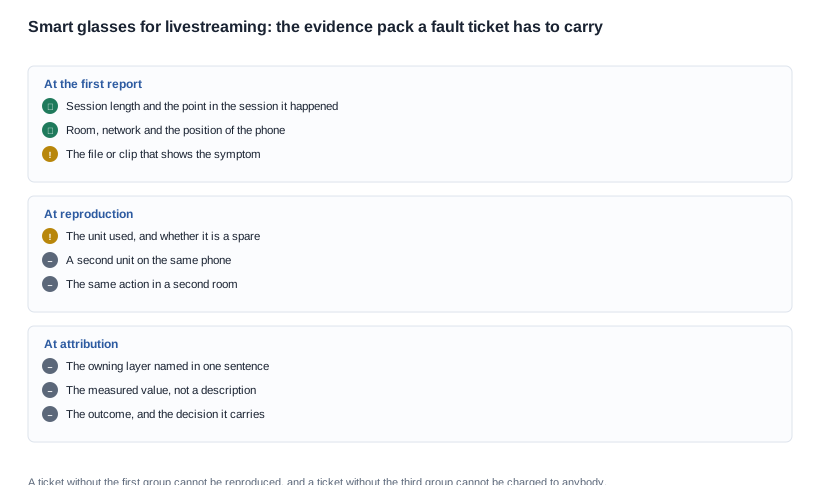
A ticket that carries the first group can be reproduced. A ticket that carries the second group can be attributed. A ticket that carries the third group can be charged to somebody. A ticket that carries none of the three is a return request, and the cheapest thing a buyer can do with it is close it, because nothing about it can be acted on.
The measured value matters as much as the observation. "The session ended at three hours" is actionable; "the battery ran out" is a description that hides the question of whether it happened at three hours on every unit or on one. The same applies to the doubled audio, the dropped frames and the missing footage. Each of them has a number attached to it once it has been measured, and the number is what a supplier can act on.

The escalation clock, and why the attribution deadline is a negotiating position
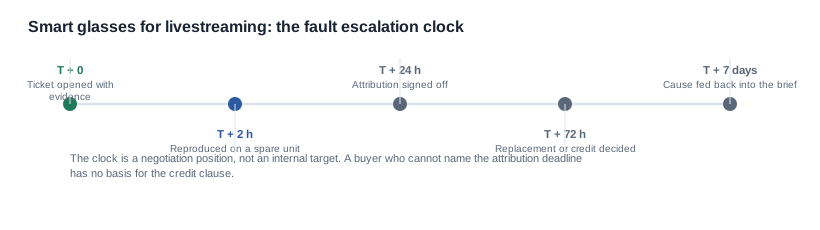
A fault escalation clock is not an internal service target. It is a negotiation position, and the buyer needs one before the first shipment rather than during the first argument.
The clock has five positions. At zero hours the ticket is opened with evidence. Within two hours the symptom is reproduced on a spare unit or explicitly not reproduced. Within twenty-four hours the attribution is signed off by a named person on each side. Within seventy-two hours the replacement, the credit or the refusal is decided. Within seven days the confirmed cause is fed back into the brief and the acceptance criteria.
Each position has a consequence attached to it, and the consequences are what make the clock a negotiating position rather than an aspiration. A ticket that reaches twenty-four hours without an attribution can be decided by the rule the buyer and the supplier agreed in advance, and the rule is usually a presumption rather than a judgement. A ticket that reaches seventy-two hours without a decision escalates to a credit, which is a cost the supplier can predict and price, which is exactly why suppliers agree to the clock at the start.
The attribution deadline also has to apply to the buyer's own failures to provide evidence. A supplier that cannot reproduce a ticket because the evidence was never supplied is not obliged to absorb the cost of the unit, and a contract that reads as though it were is a contract the supplier will price accordingly. The symmetric clause — no claim without evidence, and no charge without attribution — is the one that makes the arrangement work across a year rather than across the first quarter.
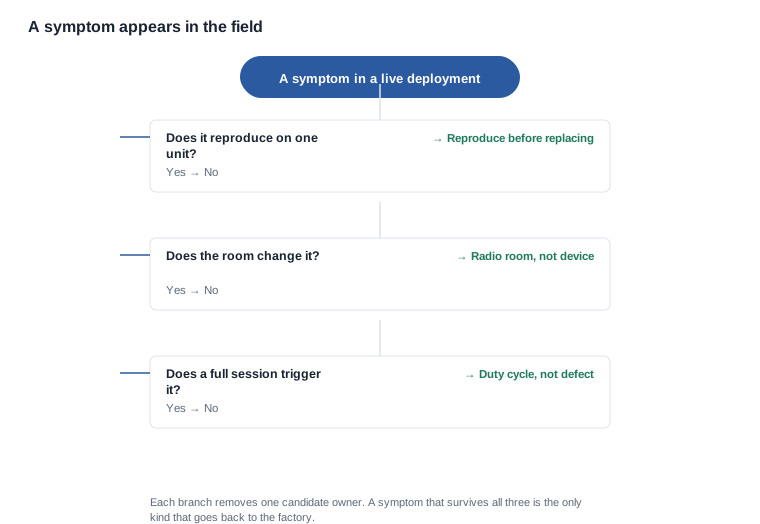

Where field attribution goes wrong, and what the commercial terms allow
Five attribution failures account for most of the field cost in this category, and each has a clear symptom before it has a bill.
Replacing before reproducing. The symptom is a unit that comes back working, which removes the evidence and leaves the cause in place. The cost is one replacement per occurrence, recurring indefinitely, plus the loss of the failure pattern that would have identified the cause. The prevention is the first step of the attribution sequence, which is a rule rather than a suggestion.
Attributing a radio problem to the device. The symptom is a cluster of dropped-frame tickets from one site, each closed by a replacement that works perfectly in the next room. The cost is the replacement units and the false pattern. The prevention is moving the unit to a second room before it is swapped.
Treating a duty-cycle limit as a defect. The symptom is a recurring end-of-session report from the site with the longest sessions, with a measured interval that sits below the published band rather than inside it. The cost is a supply of replacements for a condition that a case configuration or a shorter session would have solved. The prevention is to publish the measured figure against the published band, and to treat a figure inside the band as a duty-cycle question.
The ticket with no evidence. The symptom is a claim that cannot be reproduced and cannot be refused, and it is usually settled by default. The cost is one unit per unresolved ticket plus the loss of the supplier's willingness to engage with the next one. The prevention is the evidence pack, which is a closing condition on the ticket rather than a courtesy.
The attribution table that was never written. The symptom is a rising replacement rate with no discernible pattern, because the data was never captured in a form that could show one. The cost is the whole field budget, and it is invisible until it is large. The prevention is to write the table before the order, which costs one page and changes nothing about the hardware.
None of the five is a hardware quality problem. Each is an information problem, and each one is settled by a document rather than by a better factory.
The commercial terms of a fault, and what a buyer can negotiate
Some elements of a fault arrangement are outside the buyer's reach, and it is worth naming them before the negotiation rather than after. The device configuration is fixed by the model and the hardware, so the runtime ceiling, the charge ceiling and the case architecture follow from it and cannot be improved by a clause. The certification cost and the certification lead time are set by the issuing body rather than by the supplier. The battery transport documentation for a configuration with a case is a cost of that configuration. And the tooling charge is fixed in nature but not in recovery, because it amortises across the first order and belongs as a separate quoted line.
The rest of the arrangement is genuinely negotiable, and it is where the money is.
- The replacement clause with its attribution rule. What is replaced, under what conditions, and by whose decision. The clause is worth more than the warranty period, because the period governs the end of the obligation and the rule governs what the obligation covers in between.
- The attribution deadline and its default. The named position, the named owner on each side, and the stated consequence of a ticket that reaches the deadline without a decision. A default that favours the buyer is priced into the quotation, and it is cheaper than the disputes it prevents.
- The evidence requirement in both directions. What a claim must contain, and what happens when it does not. The reciprocal clause protects the supplier and is the reason the buyer gets a real answer instead of a slow one.
- The spare unit ratio. A number the channel can plan against, agreed against the return rate the first shipment actually produces rather than against a figure from a proposal.
- The sample order and the fault study. A sample order at the beginning of the programme buys the ability to reproduce a fault on a unit the supplier can examine. It is cheaper than a field investigation and it is the only way to get a cause rather than a symptom.
- The feed-back obligation. A clause requiring confirmed causes to be written into the acceptance criteria. This is the cheapest item on the list and the only one that reduces the volume of faults rather than their cost.
The sample order terms are at samples, the clause language is at contract terms, the warranty period and its structure are at pricing, and the runtime measurement method behind the duty-cycle question is at battery life.
A deployment support model worked through, and what we publish
A hypothetical deployment, not a client project
Take a channel with forty camera units in the field across three sites, a two-person operations team, and no dedicated hardware support. Assume no client history: this is a constructed case, walked through to show how the attribution table changes the cost of a fault.
The first decision is the attribution table, written before the shipment. Six symptoms, six owning layers, six evidence requirements. One row — a session that ends early — is provisionally assigned to the duty cycle rather than the device, because the published runtime for the chosen model is a band and the channel's sessions run at the upper end of it. That provisional assignment is then tested: the operations team runs the full session length on a spare unit during rehearsal and measures the interval. The measurement lands inside the published band, which confirms the duty-cycle reading and moves the remedy from the warranty to the case configuration, which is a line in the bill of materials rather than a stream of replacements.
The second decision is the clock, agreed with the supplier before the first shipment, with the two-hour reproduction position, the twenty-four-hour attribution position and the seventy-two-hour decision position, each with a named owner and a stated default. The supplier prices the default into the quotation because it is cheaper for them than the disputes, and the buyer gets a real answer rather than a slow one.
The third decision is the spare unit ratio, set at two units per site after the first shipment's return rate is measured, rather than at the number proposed in the quotation.
The fourth decision is the feed-back clause. Every confirmed cause is written into the acceptance criteria for the next run, which is what stops the same ticket from being raised three times in three months.
The outcome is a deployment where the replacement rate measures the device rather than the deployment, where a fault costs one credit conversation instead of three, and where the case configuration and the session length are managed as the workflow variables they are. None of it required a different model.
The rows a fault investigation can rest on
Concretely, we publish the rows a fault investigation can rest on, and we will not fill the gaps with typical values. For this range that means the pixel class per model, the cell capacities, the charge times stated as a ceiling of two hours or less with about one hour on the D17 and the ZH12, the rated runtimes, the charging interfaces where they are published, the case capacities where they are published, the Bluetooth versions for the audio models, and the IP54 marking printed on the V06 and the S7.
What we do not publish, and will not estimate for a fault investigation: the video format, the frame rate, the storage capacity and overwrite behaviour, the transfer method, the low-light behaviour, the runtime test condition, the standby draw, the cycle life rating, the Bluetooth version for the camera tier, the field of view, or the per-model unit weight beyond the single figure for the MT6, which is 158 g for the glasses body including its battery and its camera and excluding the foldable case.
We will also not describe this product class as a live-streaming device, because nothing in our published data supports that description. There is no published Wi-Fi function, no published streaming function and no published integration with any broadcast platform. The camera models are recorders whose output reaches an encoder through a phone, and a buyer who plans the deployment on that basis will not build a fault process around a capability that was never in the specification.
And we will not put a certification statement into a fault file that the document behind it does not carry. The catalogue has a company-level export certification page whose content is images rather than text, and the catalogue text contains no reference to CE, FCC or RoHS at all. There is no per-model certification row anywhere in it, so a certification question about a specific model has to be settled in writing and checked against the issuing body's register. The page itself carries ten patent certificates — eight appearance-design patents and two utility-model patents. For a wireless product sold into the European Union the relevant framework is the Radio Equipment Directive (EU) 2014/53/EU.
What we will do: take the model, the session length, the site count and the symptom you are seeing, and tell you which published rows constrain the diagnosis, which part of the symptom belongs to the device, which part belongs to the chain around it, and what evidence would settle it. The camera models are set out on the AI camera glasses page, and the scenario background sits under smart glasses for livestreaming.
The symptom, in one sentence
Send the model, the session length, the number of sites, the symptom in one sentence and the platform. We will return the published rows that bear on it, the layer the symptom most likely belongs to, the evidence that would settle it, and the acceptance criterion that should carry it on the next run.
Related reading
- The point where the scenario starts — smart glasses for livestreaming
- Which family this is — AI camera glasses
- The published runtime rows — battery life
- The underlying field behaviour — content creation
Send the model, the session length, the site count and the symptom in one sentence, and we will return the rows that bear on it and the evidence that would settle it.


