
Livestreaming is the scenario where a specification sheet misleads most often, because livestreaming combines three demands — long duration, continuous capture, and audio — and a product can satisfy two of them comfortably while quietly failing the third. The mistakes below are not exotic. They are the six things buyers in this category most often accept, and each of them is fixable with one written question before the sample ships rather than one returned carton after.
What makes livestreaming different from every other scenario in this range is that it is the only one where the product is judged on something the supplier does not control. A camera that records a good file is a camera that works. A camera that records a good file, holds a live connection, and carries intelligible audio for three hours while the streamer moves around a room is a different product, and no catalogue row can tell you which one you are buying. That is why the argument in this article is about protocols rather than specifications: a protocol is a written, repeatable procedure, and a protocol is what converts an unanswerable question into a checkable one.
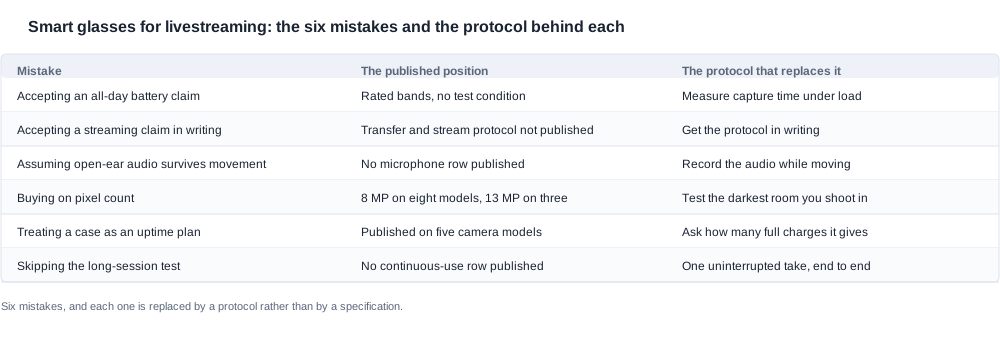
Smart glasses for livestreaming: the six mistakes and the protocol behind each
| Mistake | The published position | The protocol that replaces it |
|---|---|---|
| Accepting an all-day battery claim | Rated bands, no test condition | Measure capture time under load |
| Accepting a streaming claim in writing | Transfer and stream protocol not published | Get the protocol in writing |
| Assuming open-ear audio survives movement | No microphone row published | Record the audio while moving |
| Buying on pixel count | 8 MP on eight models, 13 MP on three | Test the darkest room you shoot in |
| Treating a case as an uptime plan | Published on five camera models | Ask how many full charges it gives |
| Skipping the long-session test | No continuous-use row published | One uninterrupted take, end to end |
Why these six and not the ones a buyer expects. A buyer arriving at this category expects the argument to be about resolution, battery and price. It is not, and the reason is that the published rows in this range are already good enough to make a sound selection: the resolution class, the charge times, the case capacities, the cell capacities, the charging interfaces and the rated runtimes are all published per model. What is not published is everything about the behaviour of the product while it is being used, and in a live scenario the behaviour is the product.
What the reader is holding. A channel operator or a brand manager who has a sample on the desk, a platform to publish to, and a creator who will be filmed for three hours a week. Their exposure is a creator who switches to a different setup after one bad session, which is a product loss rather than a return, and a listing that says "livestream ready" and cannot be defended when a competitor or a customer asks what that means.
A streaming claim without a written protocol is not a feature
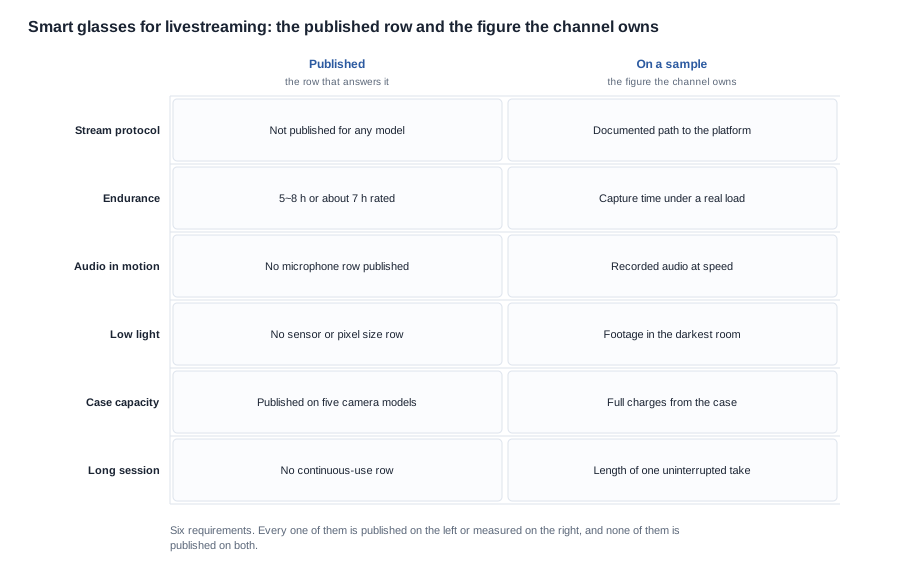
"Livestream ready" and "supports live streaming" appear in listing copy across this category and mean almost nothing on their own. What matters is whether the device streams to the platform the channel uses, by what mechanism, at what latency, and whether that is a documented feature or an inference from "has a camera". The transfer and the streaming protocol is not published for our models, and we would rather say that than let a buyer infer a capability we have not documented.
The four questions a protocol document has to answer. Where the file lives between the device and the platform. How it gets from the device to the encoder. Whether that path depends on a paired handset, and what happens to it when the handset is not there. And what the end-to-end latency actually is, because a three-second delay is a different product from a live one. Each of those is answerable in writing by a supplier, and each of them is unanswerable from a catalogue.
The distinction that costs the most when it is missed. A camera that records to a handset which then streams is a valid product. A camera that streams directly is a different product, with different latency, different battery behaviour and a different failure mode when the phone is out of range. Both are sold as "livestream ready". A buyer who has not asked the mechanism has not bought a live product; they have bought a recording product and hoped.
What to put on the page instead. The claim, stated narrowly and correctly. If the channel has run the protocol on a sample and knows the path and the latency, it can say so, and that sentence is worth more than the adjective. If it has not, the page should not carry the phrase at all, because the phrase is a claim about a mechanism and the mechanism is exactly what nobody can see.
The commercial value of the request. The protocol request belongs in the same written enquiry as the certification reference and the runtime condition, and it costs the supplier an afternoon. What it saves the channel is a launch date: a channel that discovers the mechanism at launch has a creator waiting, a platform upload failing and a return in progress, and those three together are the whole of the damage.
Endurance under continuous capture, not the rated band
A published rated runtime is not a streaming runtime. Our catalogue publishes rated figures per model — 5~8 h on the S7 and the V06, and the V03 and the V03 Pro, 6~8 h on the KY06 and the MT5, and about 7 h on the CY05 and the CY03, and the L2 Utral and the MT6, and the L1 Pro — and it does not publish the test condition behind any of them. Continuous video capture is a materially different load from the condition a rated figure usually describes.
Why the gap is larger here than elsewhere. Three loads stack on top of each other in a live scenario: the camera, the radio, and the transfer. A rated figure generally describes one of them in isolation. A streamer who is told "about 7 hours" and plans a five-hour session has been given a number that was never measured in the conditions they will use, and the shortfall appears on camera rather than in a support ticket — which is worse, because it is the channel's reputation rather than its refund rate.
The question to put in the quotation. Ask for the runtime with capture continuously active, and get the answer per model. If the answer is a repeat of the catalogue figure rather than a test condition, you have learned something about the supplier's answer rather than about the product, and that is still worth knowing before the sample order.
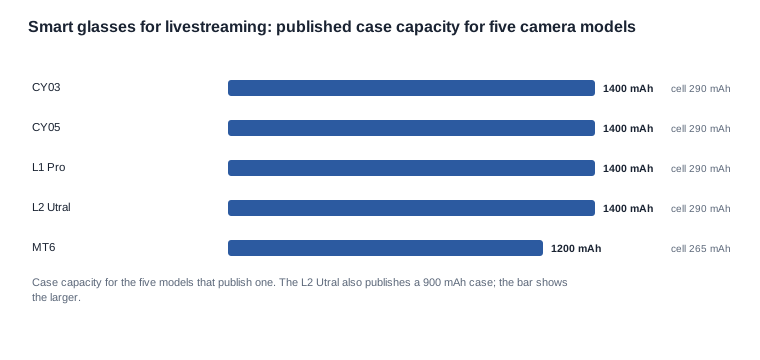
The case is the second half of the answer, and it is a published row. Five of the eleven camera models publish a case capacity: 1400 mAh on the L1 Pro and the CY03, and the CY05, 900 mAh or 1400 mAh as a configuration choice on the L2 Utral, and 1200 mAh on the foldable case for the MT6. Two more — the KY06 and the MT5 — are published with a case whose capacity is not stated. And the picture has to be complete: the catalogue publishes no charging-case row at all for the V03 and the S7, and the V06, while the V03 Pro is published explicitly as a configuration without a case.
The gap that the capacity figure does not close. A case capacity is a number of milliamp-hours; what a streamer needs is a number of full charges. Those are not the same figure, and the conversion depends on the device's own draw, which is the thing the case capacity does not describe. So the right question is not "how big is the case" but "how many full charges does the case deliver in the configuration I am ordering, under the workload I will use" — and the answer to that has to come from the supplier or from a measurement on a sample.

What to publish. A case capacity, with the model named and the configuration stated, plus the number of full charges measured on a sample with the workload attached. A streamer planning a three-hour session needs both numbers, and a page with only the first one is a page that will be read as the second.

Open-ear audio is a measurement made while moving
The audio in this category radiates from the temple in an open architecture, which is what makes it comfortable and what makes it environment-dependent. In still air it works. Walking, cycling or moving through a crowd changes the conditions enough that audio quality degrades noticeably. For a livestream where audio carries the content, that has to be tested while moving — a static demo tells you nothing, and the standard demo every supplier gives is static.
What is published, and what is not. The audio models publish their cell capacities, the charge times, the rated runtimes, the charging interface and the Bluetooth version — 5.3 on the K01 and the K02 and 5.4 on the rest. The D11 publishes surround sound, and the YK12, the D17 and the YKC02 publish surround sound as a feature. What is not published for any model is a microphone specification, a pickup distance, a response curve, a noise rejection figure or a leak level. So a claim about how the microphone behaves in a room is a claim with nothing behind it, and the only honest way to write it is to describe the architecture and to show the measurement.
The test that actually decides it. Record audio on the sample in three conditions and keep all three: standing still in a quiet room, standing still in a room with realistic background noise, and moving at a normal walking pace in that same room. The comparison between the second and the third is the number that matters, and it is the one that no static demonstration can produce. A channel that publishes all three recordings has answered a question that no competitor's page can answer.
The second audio question, which is the other half of the live scenario. The other half is what the audience hears from the device, not what the microphone picks up. Open-ear audio broadcasts, and nothing in our published material states a leak level, so a channel cannot state a privacy claim either way — and a creator who does a live session in a shared space will make that discovery in front of an audience rather than in a test. That is worth a line in the creator briefing: the device is not a private listening device, and the briefing should say so before the first live session rather than after a complaint about a confidential call.
What to request. A microphone specification if one exists, and the answer if it does not. A stated architecture description, so the briefing can explain why the audio changes in movement. And a leak statement, or a published position that there is none. All three are answerable in writing and none of them is in the catalogue today.
Pixel count, low light and the answer nobody published
13 MP is the number that gets compared across brands and it is the least informative one. It does not tell you pixel size, and pixel size determines low-light behaviour — which for indoor livestreaming in the evening is the entire requirement. Two sensors with identical published resolution can differ substantially in performance in exactly the conditions a streamer cares about.
What the catalogue gives you. The resolution class per model: 8 MP on eight of the eleven camera models — the V03 Pro and the MT5, the CY05 and the CY03, and the MT6 and the V06, and the V03 and the KY06 — and 13 MP on three, the L2 Utral and the L1 Pro, and the S7. That is the whole published imaging position. There is no published sensor model, no published pixel size, no published frame rate, no published video format, no published field of view, no published storage path and no published low-light behaviour.
Why the low-light row is the one that decides a channel. A streamer's lighting is a room, not a studio. The published rows do not describe what a camera does in a room lit by a lamp, and a buyer who reasons from the resolution class to "therefore it looks good indoors" has skipped the only measurement that matters for the scenario. The two 13 MP models and the eight 8 MP models may behave very differently in that room, and nothing in the catalogue says which.
The test, and it is cheap. Shoot the darkest room the channel actually streams from, in the settings the channel will actually use, with a fixed subject and a fixed duration. Compare the two pixel classes on that footage and keep the footage. What the channel owns afterwards is a statement about its own room, which is the only statement a buyer of that stream would find useful, and it is a statement no competitor can make for them.
What the measurement replaces. A pixel count in the listing is not a quality claim, and using it as one is a mistake that survives contact with the catalogue because the number is real. The honest alternative is a demonstration: a short clip from the channel's own darkest room, published alongside the model, with the resolution class stated as a specification rather than as a promise.
The long-session test and the documents to request
The last mistake is the one that costs the most and gets skipped most often, because it takes an afternoon and the sample programme is already booked. One uninterrupted take, end to end, at the length a real session runs, with the transfer running. Not a five-minute clip. The session.
Why the length matters more than the total. A device that survives one hour and then fails is a different product from one that survives three, and the failure mode that hurts a channel is not the total runtime — it is the sudden stop in the middle of a take, because the recording is lost, not paused. The long-session test is the only way to find that failure before a viewer finds it.
The four documents to request, and the four figures to record. The documents: the transfer and stream protocol for the model, the video format and frame rate and file size, the case capacity for the exact configuration, and the runtime condition behind the rated band. The figures: the minutes of continuous capture before the device stops, the minutes of audio recorded while moving, the darkest room in the channel's normal settings, and the number of full charges the case delivers. Eight items, four of them written answers and four of them measurements, and between them they cover every claim this article says not to accept.
The commercial terms behind the sample programme. The sample order cost, whether it is credited against a later bulk order, the minimum order quantity tiers, the price tier each configuration lands on, the payment terms and the deposit, the lead time the factory can commit to, and the tooling and new tooling expense for a channel-branded package. Two of those matter more here than the unit price: the sample credit, because the sample programme is the measurement engine for every claim in this article, and the returns policy, because a livestream device is used hard, continuously and in public, and a returns policy written for a shelf product is the clause most likely to make the channel unprofitable.
How to verify the answers you get. Check the protocol document against the sample: if the document says the file reaches the encoder through the paired handset, confirm that the handset stays in range for a whole take. Check the published rows against the unit in the box — the cell capacity, the interface, the case configuration. Check the certification position against the issuing body's register rather than against a photograph. And compare the production sample against the approved sample, because a change in the bill of materials is invisible until somebody looks. The sample programme page is where the measurement belongs, and the battery life page carries the published runtimes.
The criteria to evaluate a supplier's answers against. Four, and they are worth writing on the enquiry itself, because they decide the quality of the answer before the answer arrives:
- Does the answer name the model and the configuration it covers? An answer that covers "the range" covers nothing.
- Does it give a method, a threshold and a condition, rather than a single number? A number without a condition is a number the buyer cannot use in a requirement.
- Does it say what is not published as explicitly as what is? A supplier who names the gaps is a supplier whose file can be relied on.
- Can it be checked against something outside the supplier's own documents? A register, a measurement, a physical comparison.
How to verify a protocol answer when it arrives. Run it on the sample. If the document says the file reaches the encoder through the paired handset, confirm that the handset stays in range for a whole take, in the room the channel actually uses, with the walls the channel actually has. If the document says the device streams directly, measure the end-to-end latency with a second clock on the recording, because a latency figure quoted in a document is a figure from a bench. Either way the check is the same: the document tells you what to test, and the test tells you what to publish.
The questions to ask before you order, in one list. The transfer and stream protocol for the model. The video format, frame rate and file size. The case capacity for the exact configuration, and the number of full charges it delivers. The runtime condition behind the rated band. The certification reference for the model and the destination market. And the unit weight, which is published for one model in the whole catalogue and for no model in this set. Six questions, all of them answerable in writing, and every one of them a question a buyer can check rather than trust.
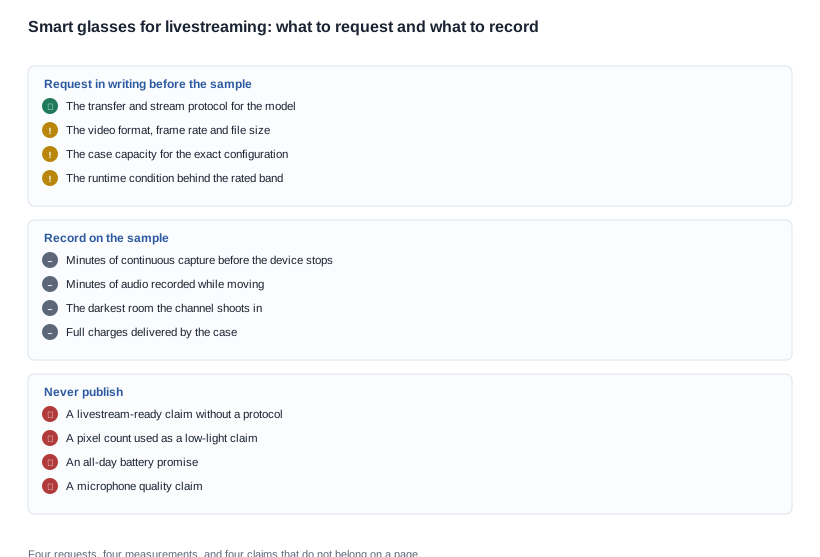
The red flags, in the order they appear. A livestream-ready claim with no protocol behind it. A microphone quality claim with no microphone row. A pixel count used as a low-light promise. An all-day battery figure with no condition. And a warranty written for a shelf product rather than for a device that spends three hours a week being recorded. Any one of them is cheap to remove before publication and expensive to remove after.
A total cost view. The unit price is the smallest number in this channel. The larger ones are the creator who switches setup after one failed session, the upload that fails at the platform because the file was the wrong shape, and the refund that follows the second one. A channel that runs the document enquiry and the measurements before it lists a model pays for that once; a channel that lists first pays for it in the return rate, and it never learns which of the claims caused it.
Our position, and where it stops. We publish the charging interfaces, the resolution class, the charge times, the rated runtimes and the cell capacities, the Bluetooth versions and the case capacities where they are published. We do not publish the video format, the frame rate, the field of view, the storage path, the transfer method, the streaming protocol, the low-light behaviour, the microphone specification, the leak level or the unit weight beyond the single whole-unit figure of 158 g for the MT6, and we will not supply a typical value for any of them. We will also not support a livestream-ready claim without a protocol behind it, and we will not state that any product in our range is tested to IP54, because no test report is published behind that marking.
What to send us next. Send the platform you publish to, the models under consideration, the length of a typical session and the room you shoot in, and we will return the published rows that cover each model, the documents we can supply in writing, and the measurements your channel will have to own. The AI camera glasses family is where the configurations are, and the livestreaming application page carries the wider framework.


