
An education use case is not a retail use case with a different logo on it. The distinction is worth stating precisely at the start, because the buying decision, the acceptance criteria and the risk position all change when the operator of the device is a school rather than a customer, and because the two channels tend to be assessed with the same checklist.
The single largest practical difference is accountability for the unit. A retail customer owns the device after the transaction and the shop's responsibility ends at the point of sale. A school owns the device for its entire service life, which moves the register, the charging routine, the damage process, the replacement provision and the data question onto the buyer's side of the table. Every use case below is read against that difference rather than against a feature list.
This is a hypothetical review of possible deployments, not a description of a customer programme we have delivered. The models referenced are the models our catalogue publishes, and the boundaries described are the boundaries our catalogue actually has.
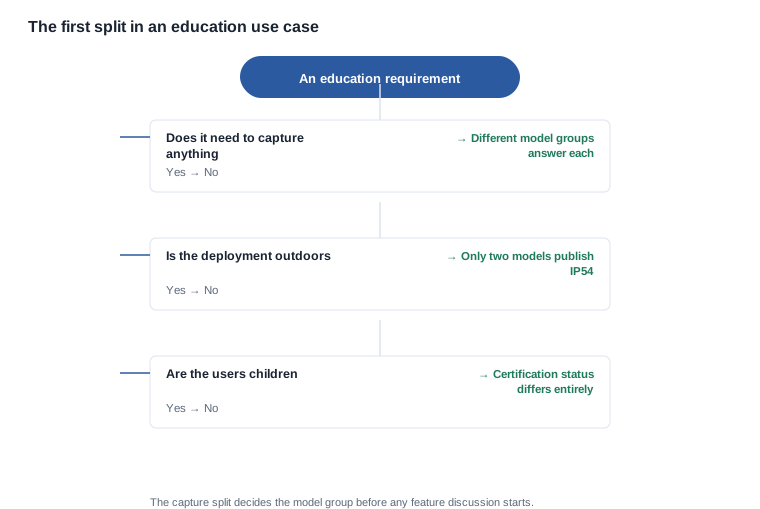
The conclusion that survives the review is that the education use cases divide cleanly into two families. Some need capture, and those run into the fact that the camera models publish a resolution class and almost nothing else. The rest need no capture at all, and for those the audio and sport lines answer the question adequately. What fails in an education review is not usually the product; it is the procurement that assumes a school needs the same thing a retail channel needs.
The camera question comes first
What the eleven camera models actually publish
Any education use case that involves capturing anything has to start from the published position, and the published position is narrow.
The catalogue carries eleven camera models. Each of them publishes a resolution class: eight of them at eight megapixel, and three of them at thirteen megapixel, those being the L1 Pro and the L2 Utral, and the S7. Beyond that class the catalogue is silent about the imaging hardware: which sensor sits behind the lens, how wide the frame reaches, how many frames a second it manages, what container the footage lands in, how much it holds and how it behaves in poor light. None of that appears for any camera model.
That is not a criticism of the catalogue; it is a boundary, and a use case review has to treat it as one. A school that needs to record a lesson and share it later needs to know what it is recording and what happens to the file. The published rows answer the first part at the level of resolution class and do not answer the second at all. The review therefore cannot conclude that a camera model is suitable for that task. It can only conclude that the question has to be answered in writing, and it can identify which questions to ask.
The questions worth asking, before any model is shortlisted, are these:
- What sensor and what output format do the camera models use?
- Is capture continuous or triggered, and what controls the trigger?
- Where does captured content go, and what is the retention period?
- What is the published storage capacity and what happens when it is full?
- Is there an indicator, and is its behaviour published?
The last question has a specific published answer for one entry in the range and none for the camera models. The AR entry carries an indicator light and button control in its feature rows; the camera models carry neither. For a school, an indicator that is not documented is a governance question, not a product question, because the school's own policy on recording students has to be evidenced somehow.
The models that carry no camera at all
The audio models, the sport models and the children's models publish no camera row, and for a large share of education use cases that is the correct answer rather than a limitation.
The eight audio models publish a Bluetooth version, and they publish a charge duration, a runtime, a cell configuration and a charging method as well, and nothing about imaging. The K01 and the K02 publish Bluetooth version 5.3 with two 90 mAh cells, a charge duration of two hours or less, roughly eight hours of runtime and magnetic charging. The LC-105 pair publish version 5.4, two 55 mAh cells, the same two-hour-or-less ceiling, roughly eight hours and magnetic charging. The D11 and the D12 publish version 5.4, a single 100 mAh cell, the same ceiling, roughly seven hours and Type-C charging, and the D11 additionally publishes a surround-sound feature row while the D12 publishes no feature row at all. The G07 and the YK12 publish version 5.4, two 55 mAh cells, the same ceiling, roughly six hours and magnetic charging, with the G07 publishing a slim frame with detachable temples and the YK12 publishing surround sound and a slim temple.
Note what that inventory does and does not permit a review to say. It permits saying that two models in the audio range share an identical set of five published rows, and that the only published difference between them is the feature row. It does not permit saying that one of them is better, because nothing published ranks them.
The same is true of the sport models, which publish a Bluetooth version 5.4, a cell configuration, a charge duration, a runtime, a charging method and, in each case, a feature row. The YKC02 publishes two 70 mAh cells, roughly eight hours and magnetic charging. The D17 publishes a single 115 mAh cell, roughly seven hours, Type-C charging and the shortest published charge duration in the range at approximately one hour, together with a remote control photo feature row and a surround-sound row. The ZH12 publishes a single 100 mAh cell, roughly eight hours, Type-C charging and the same approximate one-hour charge duration, with a remote-photo row and a spatial surround-sound row.
The education use cases, and which of them work
Four use cases, tested against the published rows
The use case review works better when it tests a small number of specific deployments against the published record, rather than describing the category. Four deployments cover most of what schools, training providers and colleges actually ask about.
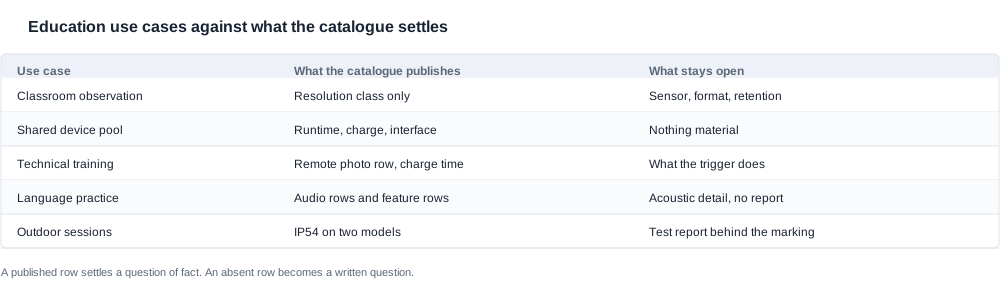
The first is classroom observation for teaching staff, where the requirement is a recording that a teacher can review and act on. The published rows settle the resolution class and nothing else, so this use case runs directly into the boundary described above. It is not disqualified; it is unclosed.
The second is a shared classroom device pool, where each learner takes a unit for a lesson block and returns it. The published rows handle this well, because the relevant constraints are runtime, charge duration and interface, and all three are published for every model in the range. Since twenty-six models publish a duration of two hours or less and the D17 and the ZH12 publish approximately one hour, an overnight window is not what limits a classroom pool. What limits it is the register and the handover routine, and both of those are procurement work rather than anything the catalogue can settle.
The third is technical training and fieldwork, where the requirement is hands-free documentation of a procedure. This is where the sport models earn their place in an education review, because the feature rows published for them concern remote control photography, which suits a task where the user's hands are occupied. The D17 and the ZH12 both publish that row, and both also publish the approximately one-hour charge duration that suits a deployment with short turnaround between sessions.
The fourth is language practice and comprehension work, where the requirement is audio that a group can hear and follow. The published rows are informative here, and they carry one trap worth naming. The surround-sound feature row appears on the D11, on the YK12, on the YKC02, on the D17 and on the ZH12, and it does not appear on the D12, which is the only audio model whose page carries no feature row at all. A buyer who assumes that two models with identical cell capacity, charge duration, runtime and interface also share their acoustic configuration will be wrong on that pair.
The children's models and where the boundary sits
The children's category covers three of the models in the range, and they are published with a feature set that has to be described precisely.
The A05 and the A06 publish the same rows as one another, and our internal product record notes that what separates the two of them is still to be confirmed. Each carries a 40 mAh cell, a runtime of roughly twenty hours, a charge duration of two hours or less, and magnetic charging. The feature rows published for them are a lens-based electronic element and a fogging unit, then correct posture and distance, then incorrect posture and distance, and last of all lens clarity and lens fogging.
Those are the catalogue's rows, and stating them as such is the whole of what can be said. They describe what the catalogue lists and nothing beyond it, and they do not establish any medical, therapeutic or eyesight-related outcome. No such claim is made anywhere in this article or on our product pages. The A07 differs: it publishes a 70 mAh cell, around twenty hours of runtime, the same two-hour-or-less ceiling, magnetic charging and a Bluetooth version of 5.4, and no feature rows whatsoever.
The distinction matters for an education buyer for two reasons. The first is that the internal product record we hold for the children's category carries no certification status at all, which means the question cannot be answered from a catalogue page and has to be put to us in writing. The second is that the child product compliance route exists precisely because buyers in this category have to document what a product is and is not before it goes near children, and a feature row describing posture and distance prompts is a different kind of thing from a clinical claim.
The IP rating question for outdoor and sport education
Two models in the range publish an IP54 marking, and both of them sit in the sport camera group: the V06 and the S7.
That is a narrow and useful fact. The V06 publishes a 260 mAh cell, a runtime band of five to eight hours, the two-hour-or-less charge ceiling, magnetic charging, an ergonomic design row, a detachable inner frame row and the IP54 marking, together with four published colours. The S7 publishes a 260 mAh cell, the same five-to-eight-hour band, the same charge ceiling, magnetic charging, an ergonomic design row, a detachable inner frame row and the IP54 marking.
For an education buyer running outdoor sessions, the IP54 marking on those two models is the relevant published row, and our internal product record attaches a caveat to it: the IP54 marking is a catalogue entry, and no accredited test report number sits behind it. That is exactly the kind of distinction that has to be settled before the marking appears in a procurement document, and the IP ratings note covers what the code means and what it does not.
Where an education review differs from a retail review
Four divergences that decide the procurement
The two reviews share a method, and they diverge in four places. Naming the divergences is what stops a buyer from carrying a retail conclusion into an education procurement.
The first divergence is the unit of acceptance. In retail, acceptance is judged on a sample and a customer who has the freedom to return it. In education, acceptance has to be judged across a fleet, because a school cannot inspect every unit and therefore needs a sampling plan that somebody in the institution is actually responsible for. The acceptance criteria sheet therefore needs a sampling rule attached to it, and that rule is a decision the institution makes.
The second divergence is the register. A retail channel has no register because the customer owns the device. An institution needs one from the first delivery, and the published rows determine what it can be populated with: serial number, model, cell configuration, charge duration, runtime band, charging interface, and the case state where one is published. The case field is the one that needs care, because the four published case states have to be held apart rather than collapsed into a yes or no.
The third divergence is the replacement path. A customer who loses a device replaces it personally. A school replaces it through a procurement process that has a lead time, and the lead time is a commercial term that is confirmed per enquiry rather than published. A buyer who has not asked how long a replacement takes will discover the answer at the worst possible moment, in the middle of a teaching term.
The fourth divergence is the data question, which does not exist in a retail deployment in the same form. A retail customer who uses a camera model is making a private decision. A school that issues camera models to staff or to learners is making a governance decision that the institution has to document, and the published record cannot document it for them: the catalogue publishes no storage or retention row for any camera model.
Where the education review lands
Having run those four divergences against the published rows, a review reaches a conclusion that is narrower than a recommendation and more useful than a feature tour. For a non-capture education use case, the audio and sport lines answer the requirement, and the published rows settle the constraints that matter: runtime, charge duration, charging interface, and the Bluetooth version. For a capture use case, the review reaches a boundary at the resolution class and cannot go further from published material, and the correct output is the written question list.
That conclusion is not a refusal. It is a statement of what the catalogue settles and what it does not, which is precisely what a buyer needs in order to write the specification and know which parts of it still need a supplier to fill them in.
How to approach a smart glasses project in either environment
A scoping sequence that works in both channels
The education and retail reviews share a method even where the answers differ, and the sequence below is the part that can be reused.
- Write down the operating constraint from site facts, before naming a model.
- Separate the capture requirement from the non-capture requirement, because they resolve against different model groups.
- Read the published rows for the eligible group and attach them to each candidate.
- Record every boundary as a written question, not as an assumption.
- Define the acceptance criteria for the delivered unit, per model.
- Then request the commercial schedule, which is confirmed per enquiry.

The sequence differs between the two channels at exactly one point, and it is the point that matters most for education. In retail, the acceptance criteria can be written against a single unit and a customer who has a choice. In education, the acceptance criteria have to be written against a fleet, because the unit that matters is the twentieth one, not the first, and because the institution has to be able to show that every unit in the register matched the specification it bought.
The questions to put to the supplier
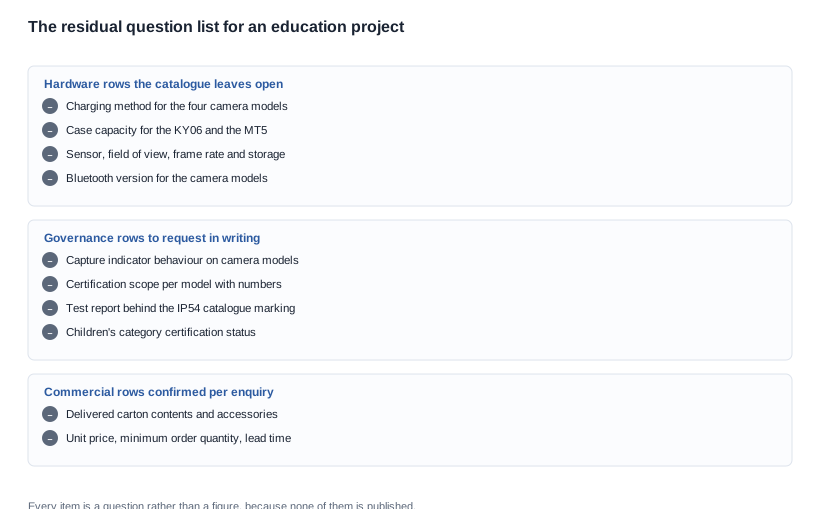
The residual list for an education project is short enough to be sent in one message, and every item on it is a question rather than a request for a figure we have not published:
- Which charging method applies to the MT6, the L1 Pro and the CY03, and the CY05?
- What is the case capacity for the KY06 and the MT5?
- Which of the two published L2 Utral case capacities goes with which published variant name?
- What sensor, field of view, frame rate and storage format do the camera models use?
- What is the capture indicator behaviour on the camera models?
- Which Bluetooth version applies to the camera models?
- What certification scope applies to each model, and which reference numbers can be checked?
- What does the delivered carton contain, and which accessories are quoted separately?
The last two are commercial rather than technical, and the sample order route is the practical way to close them before a full order is committed. The same applies to the remaining commercial terms in an education programme: the unit price behind the specified configuration, the minimum order quantity that applies to it, the production lead time the academic calendar has to absorb, and the warranty and returns terms for a defect measured against the acceptance criteria. None of these appear on this site, and each is settled per enquiry, because each one turns on the configuration, the quantity, the mix and the schedule as it stands. For an institution working to a term boundary, the lead time is the one that decides whether the procurement is realistic, and it is the one that should be asked for in writing earliest.
The boundary we will name
We do not publish a certification claim our catalogue does not carry, and we do not publish a capture specification the model pages do not contain. Where an education review reaches the boundary of the published record, the answer is that the specification has to come from written supplier documentation, and we will say which of the questions we can close from our own product records and which have to go to the factory.
For the category context behind these use cases, the retail and education solution page sets out where the two channels diverge, and the bluetooth audio glasses page covers the group that answers most non-capture education requirements. The children's models page sets out the three models published for that category, and the kids eye care note draws the boundary between the published feature rows and the claims that cannot be made from them.
Send the site facts, the capture requirement and the fleet size, and we will return the eligible models with their published rows, the boundary questions, and the acceptance criteria we would write against them.


