
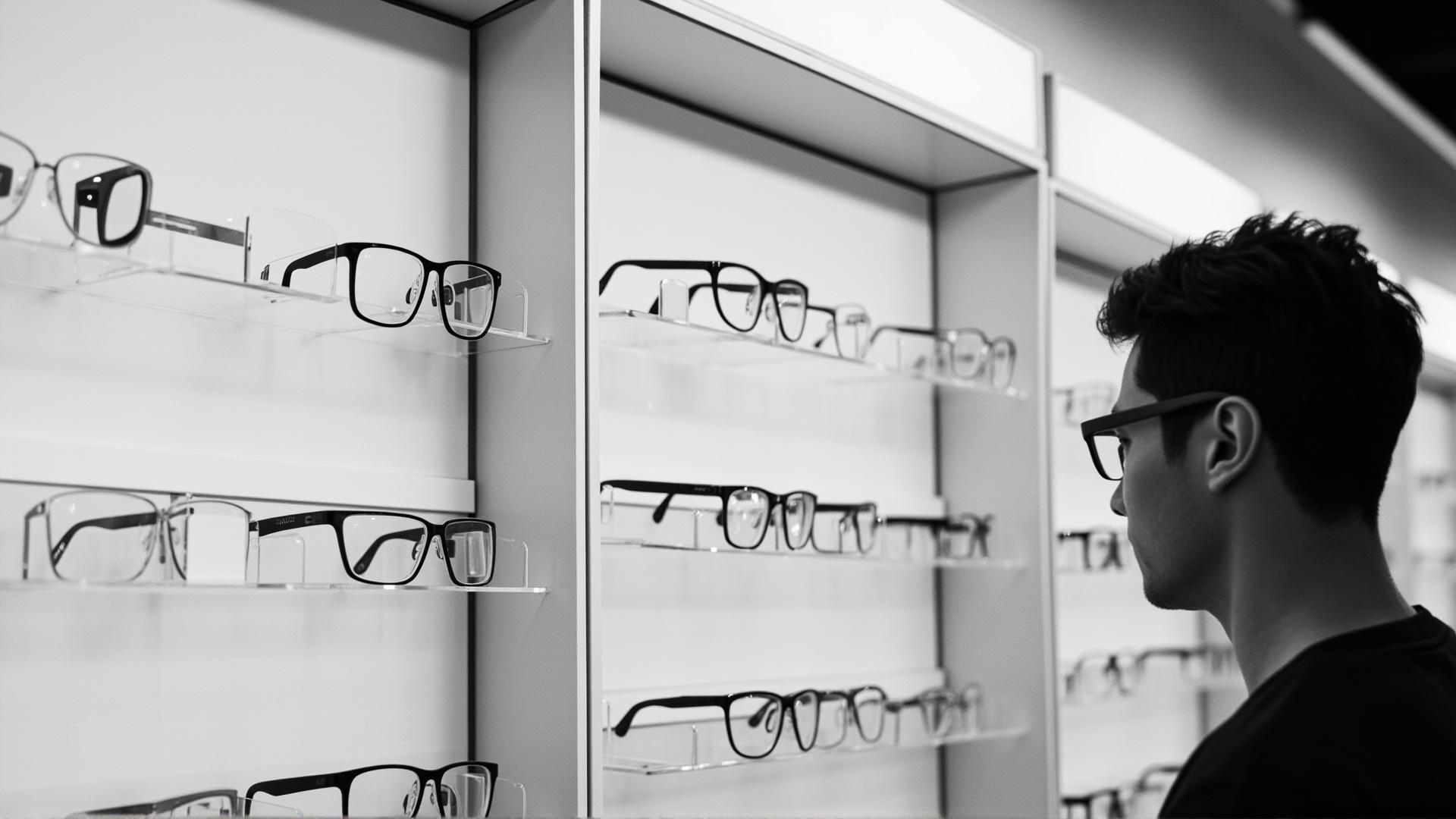
Privacy in this category is usually discussed as though it were a property of the device, and it is not. A camera that captures nothing creates no privacy exposure; a camera that captures continuously and stores the result on the device creates a substantial one, and the difference between those two outcomes is determined by configuration, by policy and by what the supplier has actually published. The device determines the possibility. The deployment determines the exposure.
That framing matters for a buyer because it tells you where to spend the diligence. Asking the supplier whether the product is private is unanswerable. Asking the supplier what the product captures, where it goes, how long it is kept and how it is deleted is answerable, and the answers are what a procurement file needs.
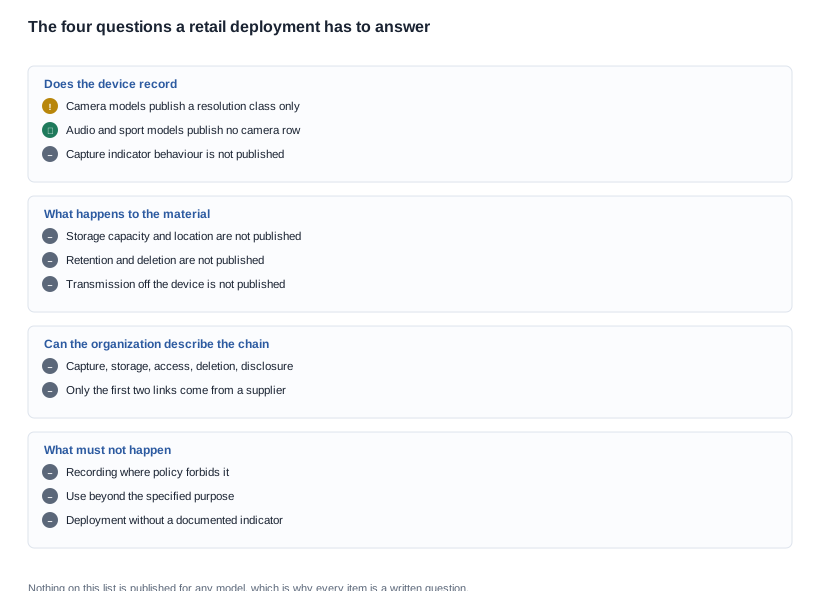
The conclusion the published record supports is narrow and worth stating at the outset. Our catalogue publishes a resolution class for the camera models and no storage, retention, indicator or transmission detail for any model. It publishes an indicator light and button control as feature rows for one entry without a model designation, and it publishes no indicator row for any of the camera models. Every privacy question that follows from that is therefore a question to the supplier rather than a fact to be read, and this article is about framing those questions so they can be answered in writing.
Smart glasses privacy: does the device record, and how is that shown
The published position on capture
The catalogue divides the range into models that publish a camera row and models that publish none, and the division is the first privacy decision a buyer makes.
The eleven camera models publish a resolution class: eight of them publish eight megapixel, and three publish thirteen megapixel, namely the S7 and the L2 Utral, and the L1 Pro. For none of them does the catalogue say anything about the sensor model, the field of view, the frame rate, the video format or the storage capacity, and it publishes no stabilisation figure or low-light performance either.
The audio models, the sport models and the three children's models publish no camera row at all. That makes them the straightforward choice for a deployment where capture is not required, and it is a distinction a buyer can make from the catalogue without asking anyone a question.
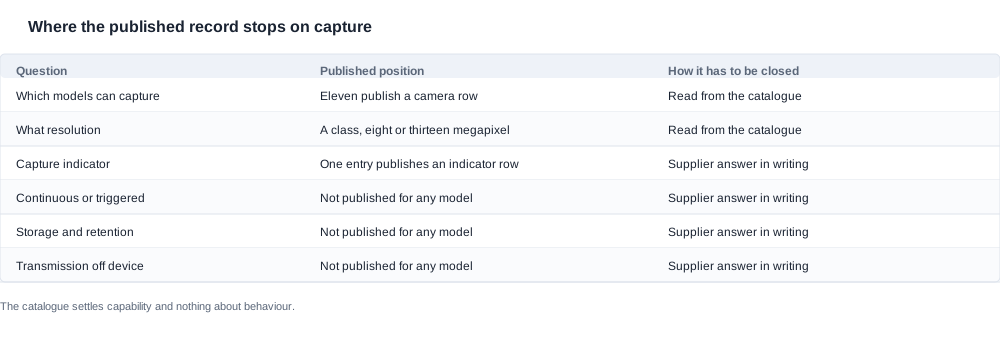
The relevant point for privacy is narrower than the spec sheet point. Whether a model has a camera or not settles the capability. It does not settle whether the camera is switched on, whether it records continuously or on trigger, whether audio is captured alongside, or whether the operator can tell. None of those four behaviours is published for any camera model.
The indicator question, and why it is a governance question
One entry in the range has a published indicator: the catalogue records an indicator light and button control as feature rows for the AR entry. It publishes no indicator row for the camera models.
In a retail deployment, an indicator is not a feature question, it is a governance question. The reason is that the deployment's own policy about recording customers, staff or the public depends on the organization being able to say what the device does and how that is communicated. If the behaviour of an indicator is not published, then the policy cannot reference it, and the organization ends up either relying on a verbal assurance or excluding camera models from customer-facing areas altogether.
The questions to ask are therefore about behaviour rather than existence: whether capture is indicated at the front and the rear, whether the indication is continuous or only while recording, whether it can be disabled, and whether the state of the indicator can be verified in a test. These are answerable in writing by a supplier, and they are worth answering before a pilot rather than during one.
Trigger, or always on
The second behaviour a policy depends on is whether capture is continuous or triggered, and the catalogue is silent on it for every camera model.
This silence has a direct operational consequence. A continuously recording device in a retail environment generates far more material than a triggered one, and the material has to be dealt with: it has to be stored somewhere, reviewed by somebody, and eventually deleted. A triggered device generates material tied to a specific task. The two require different retention policies, different review processes and different signage, and a buyer cannot choose the lighter of the two policies without knowing which behaviour the device has.
There is a related point about the models in the range that publish a remote-control photo row. The D17 and the ZH12 both publish one, which indicates a shutter that is triggered from elsewhere. That is a different capture pattern again, and it is worth asking how the triggering works and what happens to the material, particularly for the D17 and the ZH12 in a deployment where the unit is worn by a member of staff rather than held.
Question two: what happens to the data
Storage, retention and deletion are not published
No model in the range publishes a storage capacity, a storage location, a retention period or a deletion mechanism. The catalogue publishes the resolution class for the camera models and stops there.
That is a large gap, and it is the gap a retail buyer has to close in writing before deploying a camera model in a customer-facing area. The minimum set is short:
- Where is captured content stored, on the device or elsewhere?
- What is the storage capacity, and what happens when it is full?
- How is content retrieved, and by whom?
- What is the retention period, and what deletes it?
- Is deletion automatic, on schedule, or on request?
- Can content be deleted without returning the device?
The last question is the one that changes the practical operating cost. If content can only be deleted by returning or resetting the device, then the fleet needs a retrieval and reset routine, and that routine is an operational task with a labour cost attached. If deletion is per-item and remote, the operating cost is much lower. Both answers are legitimate; the difference has to be known before the deployment rather than after.
Whether capture leaves the device at all
The question that follows from storage is transmission, and it is the one with the strongest legal and reputational consequences in a retail setting.
If captured content stays on the device and is deleted by policy, the exposure is bounded by the device and the policy. If it is transmitted to an application, a server or a cloud service, then the deployment has created a data processing activity that triggers a set of obligations the organisation may not have anticipated, including the question of who the processor is and where the data is processed.
Our catalogue publishes no application, no platform, no transmission detail and no server component for any model, and nothing in our published material implies a shared platform of any kind. This means a buyer cannot answer the transmission question from published material at all, and it means the question has to go to the supplier with an expectation of a written answer.
The way to frame it is precisely. Asking whether the product has cloud features invites a general answer about features. Asking whether captured content is transmitted off the device, to whom, in what format, over what transport, and under what retention policy invites an answer a policy can be written against.

The chain a retail organization has to be able to describe
A privacy position in a retail deployment is a chain, and it breaks at the weakest link. The chain has five links, and each one needs an owner.
- Capture: what the device records, when, and how that is indicated.
- Storage: where the material sits, and for how long.
- Access: who can retrieve it, under what authority, and how that access is logged.
- Deletion: what removes it, on what trigger, and how that is verified.
- Disclosure: what happens when a subject asks whether material exists that concerns them.
For a deployment in an area where staff or the public are visible, each of those five links needs an answer that the organization can put in its own documentation. A supplier answer supplies the facts for the first two links; the third, fourth and fifth are the organization's own process, and they have to exist before the deployment rather than after a complaint.
The questions to put to the supplier are therefore about the first two links and about the mechanics that make the rest possible: whether the device supports an organisational retention configuration, whether content can be deleted selectively, whether access can be restricted per device or per account, and whether the answer is a statement about a specific model or about the product family.

Question three: audio capture, and the boundary that is easy to miss
The models with a speaker are also models with a microphone
The audio models publish surround-sound or spatial-sound feature rows on several entries, which means they carry speakers, and any device that plays audio into an environment also has a microphone to hear it.
The catalogue publishes no microphone specification for any model, and no audio capture behaviour. That is the same boundary the camera models present, arriving through a different door, and it is the one most often overlooked because the audio models are the obvious choice for a retail deployment that wants capture.
The relevant published distinctions are these. Among the eight audio models, the D11 publishes a surround-sound feature row, the YK12 publishes surround sound and a slim temple, the G07 publishes a slim frame with detachable temples and no acoustic descriptor at all, and the D12 publishes no feature row whatsoever. Among the sport models, the YKC02 publishes surround sound and a long battery life row, the D17 publishes a remote control photo row and a surround-sound row, and the ZH12 publishes a remote-photo row and a spatial surround-sound row.
The G07 and the YK12 are worth singling out, because they publish an identical set of five standard rows and are separated only by their feature rows. A buyer who has established a privacy position for one of them on the basis of the published rows alone has established it for both, which is a mistake in the opposite direction to the one usually made.
The acoustic boundary of an open-ear design
Where a model publishes a surround-sound or spatial-sound feature row, the device is designed to project audio into an environment rather than into the ear canal. Behind that design sits a limitation our internal product record makes explicit: no third-party measurement report sits behind the acoustic performance, and no parameter may be set against a competitor's until a physical competitor unit has been compared.
For a privacy review, the practical consequence is about what can be claimed rather than about what is captured. A deployment that needs to tell a customer what the device can be heard at distance cannot do so from a catalogue row, because the row is a feature name and the record carries no measurement behind it. The open-ear audio note covers what that design does and does not settle.
What to ask about audio
The audio-specific questions are narrower than the camera ones:
- Is audio captured, and if so is it captured alongside video or independently?
- Does capture include a microphone indicator, and what is its behaviour?
- Is there a published acoustic output figure, and what report supports it?
- At what distance is the device audible, and is that measured?
The third and fourth questions are the ones a retail organization will need for a signage or announcement decision, and they are the ones our published record cannot answer for any model.

Question four: what you must not do with recorded material
The limits are set outside the catalogue
Whatever the technical answer to the preceding questions turns out to be, the organisation's use of the material is governed by rules that have nothing to do with the device.
A retail organization that deploys a device capable of capture inherits obligations that follow from operating in a space where the public and its own staff are visible. The General Data Protection Regulation governs the processing, and the General Product Safety Regulation governs the product placed on the market; the GPSR route covers what a buyer needs to hold in place before a product is placed on the market in the European Union. A radio-equipped device is separately within the scope of the Radio Equipment Directive (EU) 2014/53/EU, and the EU compliance route sets out the framework.
What the organisation must not do is straightforward to state, and it is worth stating explicitly because it is the part that is most often left to individual judgement on the shop floor.
- It must not record in areas where recording is not lawful or not permitted by the organisation's own policy.
- It must not use captured material for a purpose that was not specified at the point of collection.
- It must not retain material beyond the published or agreed retention period.
- It must not deploy a camera model in a customer-facing area without the indicator behaviour documented.
- It must not treat the absence of a published specification as the absence of a duty.
How to evaluate a supplier's privacy answers
Once the answers arrive, they have to be judged rather than filed, and the criteria for judging them are short enough to apply in a single meeting.
The first criterion is specificity. An answer that describes a product family is not an answer for a specific model, and the eleven camera models differ from each other in their published rows, so the model has to be named in the answer. The second criterion is completeness against the five-link chain, which means an answer has to address capture, storage, access, deletion and disclosure rather than only the first two. The third criterion is testability, which means the organisation has to be able to verify the behaviour on a sample unit rather than take it on trust.
Those three criteria are what to ask for in a request for quotation, and they are also what to write into the acceptance criteria for a pilot. A privacy answer that cannot be tested on a sample cannot be evidenced later, and an evidence-free answer is worth very little to a buyer whose deployment has to withstand a challenge.
The red flags in this category are recognisable. The most common is an answer that describes a feature set rather than a behaviour, which is what happens when a supplier answers the question in terms of the catalogue. The second is a policy that only works if the operator behaves correctly at all times, with no technical support, which is a policy that will fail eventually. The third is a retention answer with no deletion mechanism attached to it, so in practice the material is simply kept indefinitely.
The trade-offs are worth stating before the deployment rather than during it. A deployment with capture capability and a documented indicator is more capable and more expensive to govern. A deployment confined to models that publish no camera row is easier to govern and cannot serve a task that requires capture. A pilot that runs with a smaller fleet and a full question list will produce better answers than a rollout that starts with the questions still open.
Cost the deployment as a whole rather than a single unit: the units, the storage and access arrangements if any are required, the review labour for captured material, the deletion administration, and the policy work to evidence the chain. Which model to carry comes down to a shortlist question, and that shortlist belongs on the published rows and the answered questions rather than on anyone's preference, and price is considered only afterwards.
A deployment decision framework
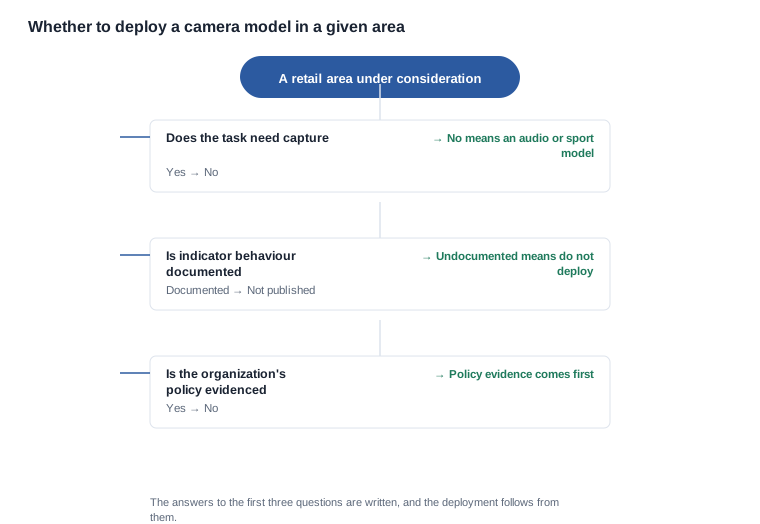
The practical decision a retail organization faces is whether to deploy a camera model at all in a given area, and the framework for it is short.
Deploy where the task requires capture and the indicator behaviour is documented and tested. Do not deploy where the task does not require capture, and use an audio or sport model instead, since those publish no camera row. Do not deploy in any area where the organization's own policy cannot be evidenced. And in every case, obtain the storage, retention, transmission and deletion answers in writing before the pilot rather than after it.
That last point is the one worth repeating, because it is where procurement timelines usually fail. The pilot is scheduled against a trading period, and the supplier's written answers on data handling arrive after the pilot because nobody asked for them at quotation stage. The questions on this page are the ones to attach to the request for quotation, so that the answers exist before the pilot does.
Where the privacy position stands
What we publish and what we will answer
We publish the specification rows the catalogue contains, and for the camera models that means a resolution class and nothing further about the imaging hardware. We publish no storage, retention, transmission or indicator behaviour for any model, and no platform description appears in our material that would imply one.
On privacy considerations for smart glasses in retail, our position is that the published record settles which models are capable of capture and settles very little beyond that, so the privacy position has to be built from written supplier answers and from the organization's own policy, and both need to exist before deployment rather than after. We will answer the questions in writing, and we will say plainly which of them are answered from our own product records and which have to be confirmed further.
For the wider compliance picture, the retail and education solution sets out the category background and the privacy-related route covers the boundary between this category and claims the products in it cannot make.
Send the areas you intend to deploy in and the task each area has to perform, and we will return the eligible model groups, their published rows, and the written question list to attach to your request for quotation.


