

Running is a gentle use case physically and a severe one electrically. A runner does not drop the product, does not sit on it, and rarely subjects it to a load — but a runner wears it through sweat, heat and rain three or four times a week for a year, and it lives in a pocket or on a desk the rest of the time. That pattern produces a specific set of long-term failures, and the honest position is that our catalogue describes almost none of them. It publishes capacity, charge time and rated use for every model, and the charging interface for twenty-four of the twenty-eight, and it does not publish cycle life, frame material, frame weight, support lifetime or lens performance over time.
The published rows for the running models are the baseline this degradation profile is measured against. The YKC02 publishes a 70 mAh cell in each temple, a charge time of two hours or less, about eight hours of rated use, magnetic charging, surround sound and long battery life. The D17 publishes a 115 mAh cell, a charge time of about one hour, about seven hours of rated use, Type-C charging, remote photo capture and surround sound. The ZH12 publishes a 100 mAh cell, a charge time of about one hour, about eight hours of rated use, Type-C charging, remote photo capture and stereo surround sound. The two camera models that carry a sport designation, the V06 at 8 MP and the S7 at 13 MP, publish a 260 mAh cell, a five-to-eight-hour rated band, magnetic charging, two hours or less of charge time, an ergonomic frame design, a removable inner frame and an IP54 marking.
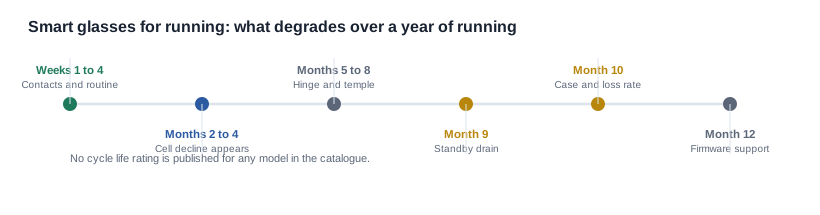
Smart glasses for running: what a twelve-month degradation profile has to cover
A degradation profile for this category has four components, and the useful thing about naming them separately is that each one has a different evidence status. The cell is the component every buyer plans around and the one the catalogue is silentest about. The frame and hinge are the silent second failure. Water and sweat are a chemistry problem rather than a wear problem. And the support lifetime is a commercial decision that has to be made before the first customer asks about it.
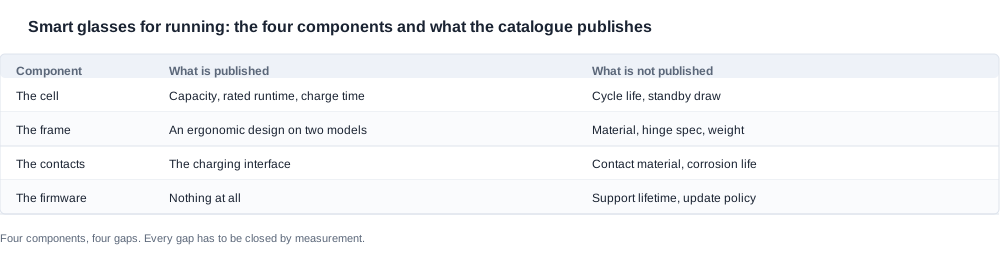
The profile has to be built per configuration, not per model, because the configurations do not age in the same way. A configuration that ships with a charging case gets used differently from one that ships with a cable: the device goes into the case rather than into a pocket, the contacts are exercised on every cycle rather than once a week, and the device is less likely to be left behind. A configuration that ships with a removable inner frame gets a part replaced rather than a whole product written off, which changes the returns profile completely. These are different products with different twelve-month stories, and the catalogue publishes the rows that describe the difference.
And the profile has to state its own gaps, because the gaps are what the warranty is actually written against. A profile that claims to cover the cell, the frame, the ingress position and the firmware lifetime, when the catalogue publishes a cycle life for none of them, is a profile a supplier's quality reviewer will reject. The honest profile names the gaps and attaches a measurement plan to each one — which is what the rest of this article does.
The cell is the component you plan around, and the plan is not published
Every model in the range publishes a rated-use figure and a capacity, and neither survives contact with the second year of use unchanged.
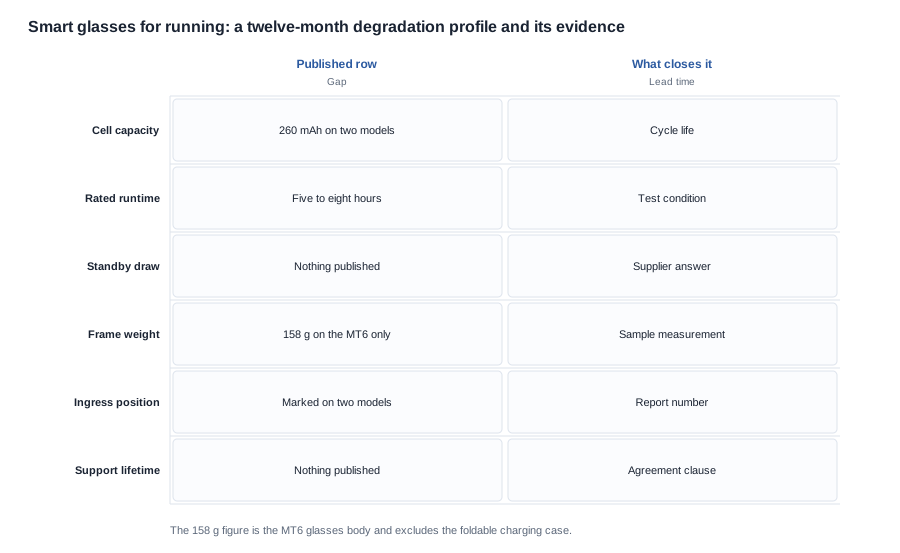
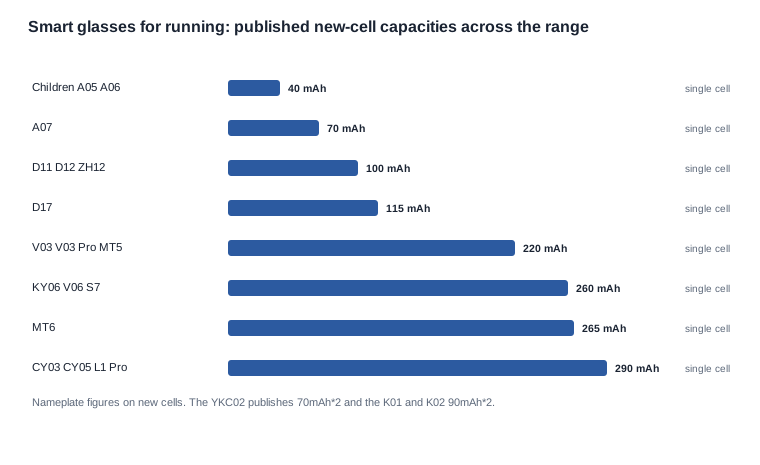
The published capacities span a wide range and are all new-cell figures. The running models publish 70 mAh in each temple on the YKC02, a single 115 mAh cell on the D17, a single 100 mAh cell on the ZH12 and a single 260 mAh cell on each of the two sport camera models. Across the wider camera tier the published values include 220 mAh on the V03 and the V03 Pro, and the MT5, 260 mAh on the KY06, 265 mAh on the MT6 and 290 mAh on the CY03 and the L2 Utral, and the L1 Pro and the CY05. These are nameplate figures on new cells, and no model states a cycle life, so no model tells a buyer when the published five-to-eight-hour band becomes four hours.
Two consequences follow, and both of them are commercial. First, a product page should quote the published figure and describe it as new-unit behaviour, which is both true and what every competitor's page means. Second, a channel built on repeat purchase or a subscription needs a replacement assumption, and the only honest way to get one is to run samples through a cycle test over several months rather than to ask a supplier for a number they also do not have.
A cycle test is cheaper than a warranty claim. The protocol is simple: charge and use a small number of units on a fixed pattern, record the elapsed runtime at fixed intervals, and plot the trend. The battery life page covers reading the published rated-use rows, and the shape of the curve tells a buyer more than any single number would — whether the decline is gradual, whether it steps at a particular cycle count, and whether the two-cell configurations hold up differently from the single-cell ones.
The configuration detail that matters for the plan is the case, not the cell. The five camera models that publish a case capacity — 1400 mAh on the CY05 and the L1 Pro, and the CY03, 900 or 1400 mAh as a configuration choice on the L2 Utral and 1200 mAh in the foldable case on the MT6 — support a second-session routine that a cable does not, and a second-session routine is a different usage pattern over a year. A programme that intends to sell a long-session product should test the long-session pattern, which means running the unit down and recharging it from the case rather than from a wall socket.
Standby draw is the row that decides a twelve-month plan and it is not published. A running device spends most of the day idle in a bag, and the drain between sessions is what determines whether one charge in the morning covers two sessions in the day. There is no standby figure for any model in the range, and it is a question worth putting in writing before the first order, because a channel that sells a two-session product without a standby figure is selling a promise it has not tested.
The frame and the hinge are the silent second failure
Frame material is not published for any model in the catalogue, and neither is the hinge specification, so hinge durability cannot be reasoned from a material or a figure.
On the weight question, the catalogue's single figure needs precise handling. The only published unit weight in the whole catalogue is 158 g for the MT6, and that figure is the MT6 glasses body — it includes the 265 mAh battery and the camera and it excludes the foldable charging case, whose own weight is not published. It is a whole-unit figure for a camera model rather than a frame weight, and it cannot be restated as a frame weight or borrowed as a running weight. The MT6 also carries an ergo-free published feature set that does not include a removable inner frame, so it is not a substitute for a running model on any published row.
Running accelerates hinge fatigue because sweat and body heat act on the joint continuously and the temple flexes on every stride. A pair that develops a loose temple in year one is a fit and returns problem, and it is entirely invisible in the catalogue. The two models that publish a removable inner frame, the V06 and the S7, are the two where a worn component can be replaced rather than the whole product being written off — which is the published answer to a problem the catalogue does not otherwise address.
The audio tier offers two structural features that change the year-two arithmetic. The G07 publishes ultra-slim detachable temples and the YK12 publishes slim detachable temples, and in both cases a detachable temple is a field-replaceable part rather than a scrapped frame. A programme whose year-two return profile is dominated by temple failures has a parts strategy available in two configurations, and a programme that has not ordered the spare part has already decided to write the product off instead.
A sampling programme is the only way to close this gap, and it is cheaper than a defect rate dispute. Run a small number of units through a simulated year: heat, sweat exposure, a transport cycle and a storage cycle, with the hinge and the temple checked at fixed intervals against a control unit. The sample evaluation page covers the request itself. Whatever the result, it converts an argument about a percentage into a measurement, and a measurement is what a supplier's quality function can act on.

Water, sweat and the charging contact across a season
Two models in the catalogue publish an IP54 marking, and both are camera models: the V06 and the S7. That marking appears in the catalogue with no supporting third-party report number, which means it is a claim we can relay but not one we can evidence for a buyer. The IP ratings page covers what the marking does and does not mean, and the two-model limit matters in a running context because it means the sport band carries no ingress position at all.
In a running context, sweat on the temple and the hinge for hours is a chemical exposure that an ingress rating does not characterise, and the charging interface is the part most likely to be affected. The published figures do not separate the two effects: IP54 addresses a dust level and a splash level, and it says nothing about a salt residue sitting on a contact for six hours. The cheap protection is procedural — do not charge a wet frame, and do not rinse the hinges — and neither cost anything or appears anywhere in a specification.
The charge symptom is the same in year one and year two, which makes it easy to misattribute. A device that charges intermittently after a session is reported as a flat battery, and the returns desk has no way to tell a corroded contact from a tired cell from a cable that is not the specified one. The protocol that prevents the confusion is documentation rather than hardware: the consumable in the insert, the instruction to dry the contacts, and a returns form that asks which of the three it was.
A seasonal cycle is the natural test, and a running year has four. Heat, cold, rain and a period of disuse are the four exposures a year actually contains, and they can be reproduced on a small sample of units in a much shorter period than a calendar year. A programme that runs one unit through four exposures and records the outcome has, in a fortnight, the evidence it would otherwise have to wait a year to collect.
What a replacement and support policy has to decide
Because the catalogue does not state a firmware support lifetime, a buyer has to put one in the agreement. Say how long firmware will be provided, what happens when it stops, and whether a unit that can no longer be updated is still supported. This is a commercial decision rather than a technical one, but it needs to exist in writing before the first customer asks, because the answer to a customer is much easier to give than to invent.
Then decide the replacement position deliberately, and decide it per configuration. Products with a case give a runner somewhere to keep the device, which reduces the loss rate more than any specification will. The catalogue records three case states rather than two: five camera models publish a capacity, two publish a case without a capacity, and four have no case row at all. The first state reduces loss; the third does not, and a runner whose unit has no published case row should budget for a replacement cycle the catalogue does not quantify, and the gap between them is a loss rate a buyer should expect to carry.
Three clauses do most of the work in a replacement policy. The first names the categories, so that a fault and a consumable issue are not treated the same way — a frame fault and a corroded charging contact are different problems with different remedies and different costs. The second sets the evidence requirement, so that a claim is assessed against something rather than argued. The third sets the period, so that the buyer's exposure is bounded and the supplier's is bounded.
A replacement policy that names the categories is also a returns-cost policy. Every return is a unit price, a freight cost and a customer relationship, and the categories are what let a programme compute which returns are structural and which are a configuration problem that can be fixed by changing the bill of materials. A programme that cannot separate them cannot reduce either.
Where the catalogue is silent, and what that means for a warranty clause
Concretely, we publish the new-cell figures because that is what the source contains, and we will not attach a cycle life, a durability claim or a support lifetime to a number we do not have. If a buyer needs those numbers for a warranty commitment, we will say that the source is silent rather than offer a typical industry value that would later be the buyer's problem.
What the catalogue publishes. The cell capacity, the charge-time ceiling, the rated runtime figure and the published feature list for every model, and the charging interface for twenty-four of the twenty-eight — the remote photo capture on the D17 and the ZH12, the removable inner frame on the V06 and the S7, the ergonomic frame design, the IP54 marking on those two camera models, the ultra-slim detachable temples on the G07, the slim detachable temples on the YK12, and the charging-case capacities where they are published. No touch row is published for any model, so a temple control surface is a question for the supplier rather than a line in that list.
What it does not publish, and will not be estimated. The cycle life rating, the frame material, the lens material, the coating, the hinge specification, the per-model frame weight, the field of view, the video specification, the operating temperature range, the runtime test condition, the standby draw, the firmware support lifetime and the per-model ingress report. It also carries a company-level export certification page whose content is images rather than text — eight appearance-design patents and two utility-model patents, ten certificates in all — and no per-model certification row. Unit prices, minimum order quantities, lead times and production capacity are confirmed per enquiry rather than published as fixed numbers.
And this is why a warranty clause written against the catalogue has to be a clause about evidence rather than about duration. A twelve-month term on a device whose cell life is not published is a term the buyer is underwriting alone. What the buyer can do instead is write the clause against the evidence: the categories, the proof required, the measurement programme that will produce the missing numbers, and the date at which the programme will revisit the term with real data. That clause is defensible in a negotiation with a supplier, and it is the one a quality reviewer can approve.
The practical request. If you need a degradation figure for a specific model and configuration, ask for the cycle life, the standby draw, the operating temperature range and the firmware support lifetime in writing, and attach a cycle-test protocol to the sample order so that the answer is produced rather than quoted.
How to verify the degradation story before you order
The questions to ask are short, and a supplier who answers all six in writing is a supplier whose quality function will not spend six weeks arguing about them.
- What is the rated cycle life for the cell in this configuration, and on what duty cycle was it measured? The catalogue publishes capacity and runtime but no cycle life for any model.
- What is the standby draw, and what does the device draw between sessions? A running device spends most of the day idle in a bag, and the answer decides whether one charge covers two sessions.
- What is the operating temperature range the configuration was qualified across? Nothing in the catalogue publishes it, and a running range covers summer heat and winter cold.
- How long will firmware be provided for this model, and what happens on the unit that can no longer be updated? The catalogue publishes nothing on this at all, which is why it has to be an agreement clause.
- What is the frame material and the hinge specification for this model? Neither is published, and hinge durability cannot be reasoned from a marketing description.
- What is the per-model unit weight, and does it include the battery, the camera and any case? The catalogue publishes a unit weight for one model only, and that figure covers the MT6 glasses body and excludes the foldable charging case.
The red flags are worth naming at this stage. A cycle life quoted without a duty cycle. A standby figure quoted as a percentage rather than as a current. A firmware lifetime quoted as "ongoing" without a date. A weight quoted for a model where the catalogue publishes none. Each one of these is a number that looks usable and cannot be used in a warranty clause, and each one is cheaper to catch in the quotation than in a claim.
Before you order, put the measurement plan on the same page as the agreement. A cycle test, a four-exposure seasonal cycle and a unit count are all things the buyer can specify and the supplier can agree to, and attaching them to the agreement means the data arrives with the first shipment instead of with the first complaint. A buyer who has decided which model to take, what to ask for and how to verify it has a shortlist that a quality reviewer can sign off, which is the only kind of shortlist that survives a volume change. Send us the model, the configuration, the expected annual volume and the warranty position you need to defend, and we will come back with what the source documents and what has to be measured instead. The published product data is at sport smart glasses, and the scenario entry point is smart glasses for running.
Related reading
- Reading the published rated-use figures — battery life
- What the IP54 marking covers — IP ratings
- Checking a sample before you commit — sample evaluation
Tell us the model, the expected annual volume and the warranty position you need and we will come back with what the source documents.


