
Running is the hardest everyday environment for wearable audio hardware, and it is also the one where a generic recommendation is most dangerous. A device that sits well in a showroom will bounce against the cheekbone at 12 kilometres an hour, a temple that grips the head will slip once the session starts, and a battery that survives a flight will not survive a long slow run. These are the model sets we would specify for a running channel, with the gaps stated rather than papered over, and with the criteria a buyer can apply without taking our word for it.
One fact governs the whole recommendation, and it is the fact buyers ask about most and the catalogue answers least: per-model frame weight is not published for any running model. The single published unit weight in the catalogue is 158 g for the MT6, and that figure is the MT6 glasses body — it includes the 265 mAh battery and the camera and it excludes the foldable charging case, whose own weight is not published. It is not a frame weight, and the MT6 is a camera model rather than a running model, so it cannot be borrowed as one. Every recommendation below therefore ends in a sample evaluation rather than in a model name.
Smart glasses for running: what to drop when the specification gap decides
The recommendation is a selection procedure, not a product list. In this category the published rows narrow the field decisively and the remaining choice is physical, so a recommendation that ends in a model name has skipped the part that matters. What follows is the procedure: the criteria in the order they bind, the three model sets, the gap each set leaves, the sample evaluation that closes it, and the request that turns a recommendation into a quotation.
The order of the criteria is the recommendation, and it is not the order a product page uses. A product page leads with the camera or the audio; a procurement decision starts with the task and ends with the weight. Five criteria bind in sequence: environmental awareness, water and sweat, movement, sizing, and mass. Three of the five are physical properties the catalogue does not publish, and one of them — mass — is the one that decides the purchase.
The commercial consequence of that ordering is worth stating at the top. A buyer who selects on the published rows alone will produce a shortlist that is arithmetically correct and commercially unreviewable, because the rows do not cover the three properties that generate the returns. The shortlist is therefore only valid once the sample evaluation has run, and a procurement schedule that assumes otherwise will find the evaluation happening after the artwork is approved, when it is cheapest not to change anything.
The five criteria, and the order they bind in
Environmental awareness comes first because it cannot be traded. A runner in a city needs to hear traffic, a bicycle, a dog and a training partner. Open-ear audio is the point of the category, and the consequence is that the device is audible to others, so a customer on a shared path is broadcasting. That is a commercial consideration rather than a technical one, and it belongs in front of a brand whose product page will be read by people running in cities. What the catalogue publishes for the audio and sport models is the Bluetooth version, the cell capacity, the charge-time ceiling, the rated runtime and, on some models, a surround sound feature. Leakage, driver size, frequency response and microphone pickup distance are not published for any model, so the degree to which traffic noise is audible has to be established by a sample rather than described in a quotation.
Water and sweat come second, and here the catalogue's position is narrow and useful. Exactly two models publish an ingress marking, and both are camera models: the V06 at 8 MP and the S7 at 13 MP, both on a 260 mAh cell with a five-to-eight-hour rated band, magnetic charging, two hours or less of charge time, an ergonomic frame design and a removable inner frame. No sport model and no audio model publishes an ingress marking. The marking covers a dust protection level and protection against splashing water; it is not immersion and it is not a shower rating, and no third-party test report number is published behind it. A buyer who needs an ingress position for a running range has two candidates, and a buyer who has been told that the whole running range is IP54 has been told something the catalogue does not say.
Movement is third, and it is where the published structure features do their commercial work. At running pace the temple and the camera housing move relative to the skull, and anything that shifts changes both the microphone geometry and the video stability. The two camera models publish an ergonomic frame design and a removable inner frame, and the second of those is a sizing system rather than a cosmetic feature: it lets one outer frame serve different nose shapes, which on a channel with a wide size range is a return-rate lever and a stock-holding decision before it is anything else. In the audio tier the corresponding published features are the ultra-slim detachable temples on the G07 and the slim detachable temples on the YK12, both of which turn a damaged temple into a replaced part rather than a scrapped product.
Sizing is fourth, and it is the criterion with the thinnest published evidence. Nothing in the published data addresses movement retention, because the field of view, the video specification and the stabilisation capability are all unpublished, and no fit or movement data is published for any model. A device that slides is a device that comes off, and the only way to settle it is a sample.
Mass is fifth in the list and first in practice. It is the criterion the published data cannot answer for any running model, and it is the first thing a customer notices and the last thing a buyer can research. Which is why the recommendation below ends with a test.
The model sets, and what each one leaves unanswered
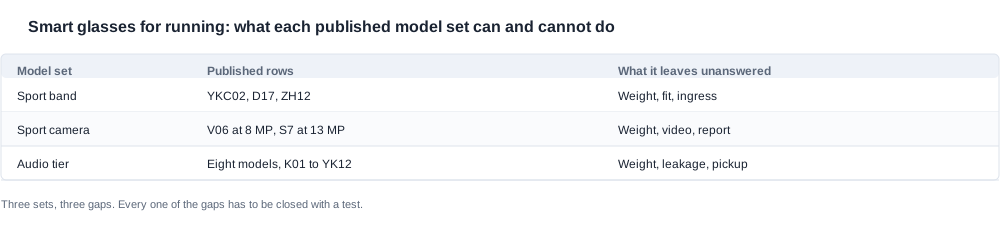
The catalogue publishes three named tiers a running channel actually chooses between, and each leaves a different gap.
| Model set | Published rows | What it leaves unanswered |
|---|---|---|
| Sport band | YKC02, D17, ZH12 | Mass, sizing, ingress position |
| Sport camera models | V06 at 8 MP, S7 at 13 MP | Mass, video spec, report number |
| Audio tier | Eight models, K01 to YK12 | Mass, leakage, pickup distance |
The sport band is three models with different architectures, not three variants of one. The YKC02 publishes Bluetooth 5.4, a 70 mAh cell in each temple, a charge time of two hours or less, about eight hours of rated use, magnetic charging, surround sound and long battery life. The D17 publishes Bluetooth 5.4, a 115 mAh cell, a charge time of about one hour, about seven hours of rated use, Type-C charging, remote photo capture and surround sound. The ZH12 publishes Bluetooth 5.4, a 100 mAh cell, a charge time of about one hour, about eight hours of rated use, Type-C charging, remote photo capture and stereo surround sound. The D17 and the ZH12 are the only two models in the entire catalogue that publish a charge time of about one hour — every other entry publishes two hours or less as a ceiling, which allows a charge time of exactly two hours and is not the same claim as under two hours.
The two camera models that carry a sport designation differ from the sport band in three published ways. They carry a camera, they carry an ingress marking, and they publish a removable inner frame. They also carry a 260 mAh cell and a five-to-eight-hour rated band rather than a single figure, which is a different shape of endurance claim. What they do not carry is a capture control: remote photo capture is published on the D17 and the ZH12 and on neither of the two camera models, so a channel that needs remote capture and a channel that needs a camera are specifying different products.
The audio tier is eight models and it is where the mass options live. The K01 and the K02 publish Bluetooth 5.3, a 90 mAh cell in each temple, a charge time of two hours or less, about eight hours of rated use and magnetic charging, and no model in the catalogue publishes a touch row. The D11 and the D12 publish Bluetooth 5.4, a 100 mAh cell, two hours or less, about seven hours of rated use and Type-C charging, with surround sound on the D11. The LC-105-1 and the LC-105-2 publish Bluetooth 5.4, a 55 mAh cell in each temple, two hours or less, about eight hours of rated use and magnetic charging. The G07 and the YK12 publish the same cell configuration at about six hours, with ultra-slim detachable temples on the G07 and surround sound with slim detachable temples on the YK12.
That last line is the one to read carefully before it goes into a comparison table. The 55 mAh-per-temple configuration is not one runtime figure. The LC-105 pair publishes about eight hours and the G07 and the YK12 publish about six hours, and the two six-hour models are exactly the two with the slim or detachable temple. A buyer who puts those four models on one row of a comparison table has invented a runtime that the catalogue does not publish for any of them, and that is the kind of error a due diligence reviewer finds in the second month.
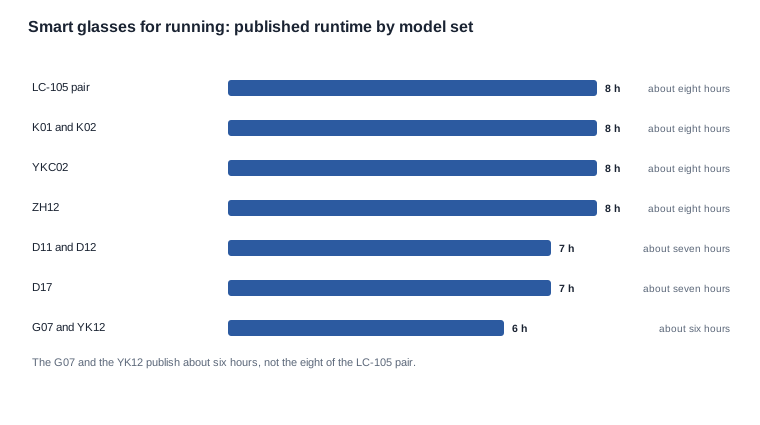
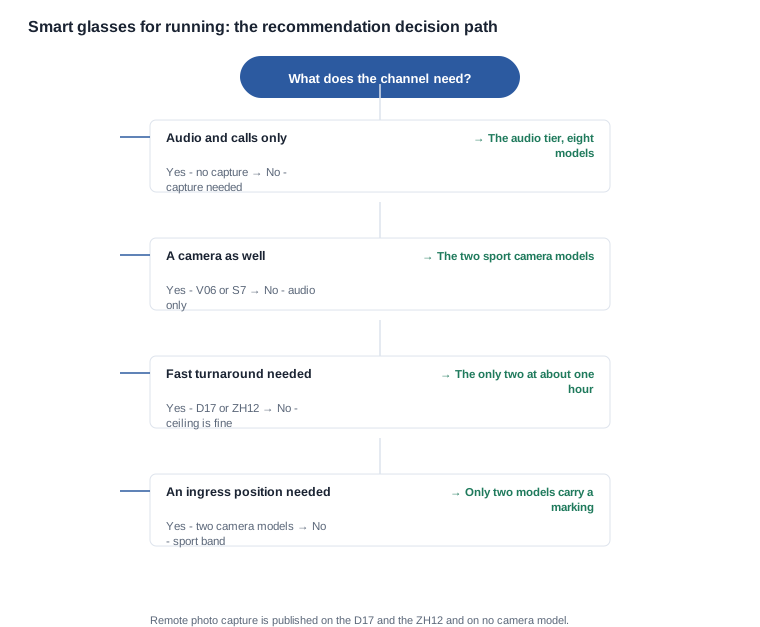
The specification per set, with the gap stated. For a channel that needs audio and calls and nothing else, the answer is the slim end of the audio tier — the G07 or the YK12 with their published detachable temples — accepting about six hours rather than eight, because the cell size in this category tracks the physical size of the device and the physical size is what a customer notices first. For a channel that also needs a camera, the two sport camera models are the only entries with an ingress marking and a removable inner frame, and the cost is the 260 mAh cell and the bulk that comes with it, plus the fact that the marking is a catalogue annotation with no published report behind it. For a channel that needs a fast turnaround between sessions, the D17 or the ZH12 are the only models that publish about one hour, on Type-C charging.
And the commercial qualification that belongs with every one of those specifications. No unit price, minimum order quantity, lead time, production capacity or landed cost is published for any model in this catalogue. All of them are confirmed per enquiry, against a configuration and a volume. A recommendation that names a model without naming the configuration is therefore a recommendation to a buyer who cannot yet compare it with a second supplier's quotation, and the criteria a buyer should evaluate a supplier against are the same criteria in every case: the unit price at a stated tier, the lead time against a stated configuration, the tooling or NRE line treated as separate and amortised across the intended volume, and a written warranty term with the return causes named.

The sample evaluation that decides the purchase
Ask for two or three units and run them for a week. Not a walk — a session at the pace, in the heat, with the sweat, on the route the channel actually sells into. Record five things, and write down what was observed rather than what was concluded.
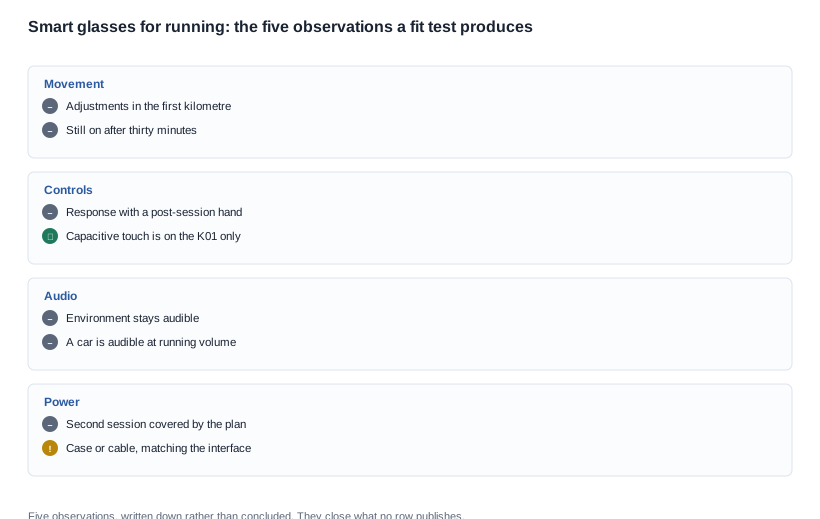
- Whether the device moves on the face at pace, counted as the number of adjustments in the first kilometre rather than as an impression. This is the cheapest indicator available and it predicts the month-two behaviour better than any published row.
- Whether the controls respond with a hand in its post-session state. No model in the catalogue publishes a touch row, so this observation cannot separate the audio tier from the sport band — neither band publishes a control surface to compare against, and the result is a build-specific test rather than a way of ranking two models.
- Whether the audio stays open to the environment rather than blocking it, and whether a car is audible at the volume the customer actually runs with.
- Whether the device is still on after thirty minutes, which is the honest proxy for whether it will be on at ten kilometres.
- Whether the second session is covered — that is, whether the charging plan for this configuration works with the case or the cable the customer will actually have.
Those five observations are worth more than any row in this article, because the specifications that decide them are the ones the source does not publish. They are also the observations that go into a sample order, which is what makes them usable commercially rather than merely informative. A sample order with the five observations written into the request is a document a quality reviewer can approve; a sample order described as "a running unit for evaluation" returns an opinion.
What we recommend, and what we will not pretend to know
We publish the per-model figures for the audio, sport and camera lines: cell capacities, charging interfaces, charge-time ceilings, the rated runtime figures, the Bluetooth version, the published charging-case capacities, the detachable inner frame where it applies, the remote photo capture where it applies, the colour options where the catalogue lists them, and the ingress marking on the two models that carry one. The catalogue publishes no touch row for any model, so a temple control surface is a question for the supplier rather than one of the figures in that list.
We mark as not published the frame weight of every model except the one whole-unit figure at 158 g — the MT6 glasses body, which includes its battery and camera and excludes its foldable charging case — along with the sensor part numbers, the field of view, the video resolution and frame rate, the stabilisation capability, the ingress test report numbers, the per-model certification numbers, the acoustic figures including leakage and driver size, the cycle life rating, the operating temperature range and the standby draw. We will not describe a model as wind-resistant, shake-proof or waterproof, because those are claims the material does not support.
And we will not quote a weight for a running model, however much it would simplify the recommendation. That is the one gap that would make this article easier and less useful, and filling it with a typical figure would move the cost of the gap onto the buyer at exactly the moment it matters most. The same applies to the other silent rows: the certification position, the runtime test condition and the cycle life rating are all things a buyer should write into a request rather than accept a plausible number for.
The request that turns a recommendation into a quotation
Send the models, the configurations, the quantities, the destination market, the channel and the price band, and we will tell you which of the published rows apply to each configuration, which claims each configuration can carry, what has to be settled in writing before a purchase order, and where the specification gaps sit.
What we will need back to make the recommendation specific. The session profile — typical length, weekly frequency, and whether the longest session is a weekend long run. Whether the device records at all, and if so whether the footage has a commercial use. The environment, including climate and whether the route is shared with traffic. The interface the customer already carries, because that decides whether a case is an accessory or an architecture. And the price band, which fixes the configuration mix before any specification discussion starts.
The questions to ask in the same message. Which configuration each quote covers and at which order tier. The unit price, the minimum order quantity, the lead time and the production capacity for that configuration, since none is published. Whether the charging case ships in the box and which capacity applies. The runtime figure with its test condition. The per-model certification file, and its lead time. And the warranty term with the return causes named. A supplier who answers all of these in one reply is a supplier whose file set will survive the first volume change.
And the two questions that decide the commercial terms rather than the specification. Whether the supplier will hold the configuration's bill of materials against a stated minimum order quantity, and whether a first run can be split across two deliveries against a staged payment. Both are legitimate to negotiate because both have more than one acceptable answer, and both of them become expensive to change once the artwork, the packaging and the freight file are committed. The parameters with a single correct answer — the cell configuration, the charging interface, the runtime figure, the ingress position — are not negotiation targets, and a buyer who spends the relationship negotiating them has misallocated the negotiation.
What we will not do is guess. We will not invent a frame weight, a certification number, a runtime condition, a unit price, a minimum order quantity or a lead time, and we will not present a catalogue marking as a tested rating. Where a question has no published answer, we will say which document would settle it, which party has to produce it, and what the risk is if the programme proceeds without it.
Where to go next. The published product data for the sport band and the camera tier is at sport smart glasses, the wider camera range is at AI camera glasses, and the published endurance figures are explained at battery life. For how the same rows work in a different environment, the field work selection guide covers the same decision from a different starting point, and the scenario entry point is smart glasses for running.
Related reading
- Camera and audio smart glasses range
- Sport smart glasses for outdoor and cycling use
- Choosing a model for field work
Send us the typical session length, the pace, the climate and the budget band, and we will narrow the catalogue to the two or three models that fit those constraints, and tell you which of the published gaps you will have to close with a test.


