Smart glasses for running are worth specifying carefully, because the case for the format and the case against it are both real, and they sit on different rows of the same specification sheet. A pair of running glasses earns its place by taking the phone out of the runner's hand, and it earns its place in the returns ledger by exactly the same mechanism: a device worn in sweat, at pace, for an hour, is being asked to do things that no desk comparison ever tested. This assessment works from the rows the catalogue publishes — cell capacities, charge times, rated runtimes, charging interfaces, structural features — and it is explicit about the rows it does not publish.
The short form of the argument. The advantages that survive contact with a second supplier quotation are hands-free capture, a serviceable inner frame on the two sport camera models, a splash-and-dust marking on those same two models, and a one-hour top-up on the two sport models that publish it. The disadvantages that survive the same scrutiny are an unpublished unit weight for every running candidate, an ingress marking with no test report behind it, a rated runtime with no test condition attached to it, an unpublished field of view, and a charging interface that puts exposed contacts next to a sweaty temple on five of the seven candidates. Neither list is decisive on its own. What makes a decision is knowing which list the buyer's own channel is sensitive to, and that is a procurement question before it is a product question.
Smart glasses for running: the case a buyer has to close before price
The reader here is a brand buyer, a channel buyer, or a product manager who has been handed a running programme and a budget. The decision is not which unit is nicer. It is which two or three models enter a quotation, what the accessory and packaging configuration around them is, and which written confirmations have to be on file before a purchase order is signed. The specific fear behind that decision is a category failure rather than a technical one: a first shipment that sells, followed by a wave of returns whose stated reasons describe capabilities the documentation never claimed, because the listing was written by somebody who filled the gaps with reasonable-sounding guesses.
The candidate list is short and it is not the whole range. The catalogue carries twenty-eight models across audio, sport and camera families. For a running channel, seven of them survive a first filter: the V06 and the S7, which are the sport camera models and the only two units in the catalogue that carry the IP54 marking; the YKC02, the D17 and the ZH12, which are the sport models; and the K01 and the D11, which are audio models a running brand would consider if the product being sold is sound rather than footage. The remaining models are excluded for reasons a buyer can state in one line each, and stating them is cheaper than comparing across all twenty-eight.
| Model | Published support | Published gap |
|---|---|---|
| V06 | 8 MP camera, IP54 marking, detachable inner frame, 260 mAh | Frame weight, field of view, ingress report |
| S7 | 13 MP camera, IP54 marking, detachable inner frame, 260 mAh | Frame weight, field of view, ingress report |
| YKC02 | About 8 h rated use, 70 mAh x 2 cells, Bluetooth 5.4 | Frame weight, retention parts, microphone spec |
| D17 | About 1 h Type-C charge, remote shutter, 115 mAh | Frame weight, retention parts, microphone spec |
| ZH12 | About 1 h Type-C charge, remote shutter, about 8 h | Frame weight, retention parts, microphone spec |
| K01 | About 8 h rated use, Bluetooth 5.3, no touch row published | Frame weight, retention parts, microphone spec |
| D11 | Type-C, about 7 h rated use, 100 mAh | Frame weight, retention parts, microphone spec |
Reading the table above as a procurement artefact rather than a spec sheet. The middle column is what a supplier has already committed to in writing; it is the set of facts a listing can safely be built from. The right column is the set of facts that a listing will get wrong if nobody asks, and every one of those six entries recurs across the whole catalogue rather than being a defect of a particular model. A buyer who treats the right-hand column as the question list — and who refuses to let the listing be written until each row has a written answer — has already done most of the work that a running programme needs, before a single quotation is compared.
What the comparison is actually costing today. When two quotations for running glasses arrive, they are usually compared on unit price and lead time, because those are the two numbers that fit on one line of a spreadsheet. The comparison that actually decides the programme is longer and slower: which models are being offered, whether the case configuration is the same on both sides, whether the ingress claim is the same on both sides, and whether the quoted unit price is the unit price that lands. A buyer who shortlists on price first will discover the differences in those four items afterwards, usually in the form of a variation order.

What the catalogue settles before any comparison begins
Several things in a running programme are settled before the first supplier approaches you, because they are properties of the product rather than properties of a vendor. The first is the split between a capture product and an audio product. A brand selling footage and a brand selling sound are running two different SKUs, two different accessory lists, two different return profiles and two different certification routes, and a single product page trying to serve both will underperform on both. The camera models in the catalogue carry a resolution class — eight megapixels on the V06, and thirteen on the S7, which is also the higher-resolution of the two sport camera models. The audio models are a separate set of eight units, and the sport models are three.
The charge-time ceiling is the most consequential published number, and it is easy to misread. Every model in the catalogue publishes a charge time. Twenty-six of the twenty-eight publish it as two hours or less, which is a ceiling rather than a typical figure — a unit that takes exactly two hours satisfies it, and a buyer who treats the row as an average has no idea what the slow case looks like. The two exceptions are the D17 and the ZH12, which publish about one hour, and both charge over Type-C. That distinction has direct consequences for a running programme, because a two-hour ceiling does not fit between a training session and a shower in a way that a one-hour figure does.
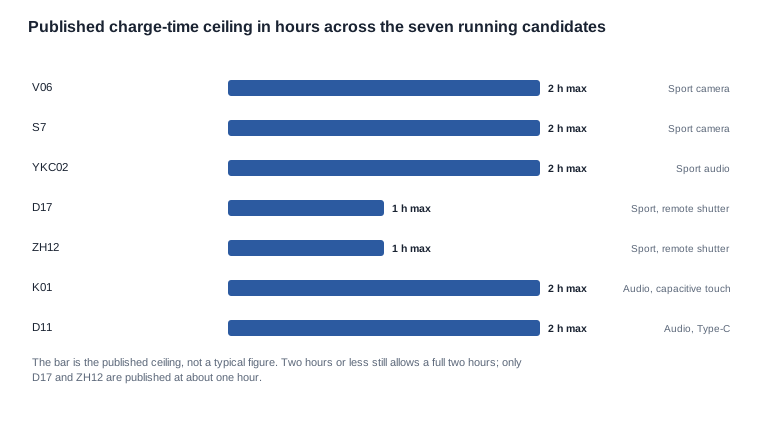
What the bar chart does and does not say. Each bar is the published ceiling expressed in hours, so five of the seven candidates sit at two hours and two of them sit at about one hour. The chart does not say that a unit reaches full charge in two hours, because the catalogue does not say that. There is no published start-of-charge state and no published end-of-charge criterion, which means the row cannot be used to calculate how many sessions a single unit can cover, how long a charging station must be booked, or how many spare units a club needs to keep in rotation. It is a ceiling on one session's turnaround, and a buyer who wants a session count has to ask for the missing half of the figure in writing.
Two catalogue facts that quietly shape the accessory plan. The charging method splits the range into three groups rather than two: seventeen models publish magnetic charging, seven publish Type-C, and four publish no charging-method row at all. Among the seven running candidates, four are magnetic and three are Type-C. That matters because a magnetic unit needs its contacts exposed to be charged at all, and a case becomes part of the charging architecture rather than an optional accessory. It also means that the spare-cable strategy which works for a Type-C product does not work for a magnetic one, so the two families cannot share a kit.
And the single weight figure in the entire catalogue. The MT6 is published at 158 grams, and that figure is the weight of the glasses body including its battery and its camera, excluding the foldable charging case whose capacity is published at 1200 mAh. It is the only weight anywhere in the range, and it belongs to a camera model rather than a running model, so it cannot be used as a proxy for any of the seven candidates above. Frame weight for the running candidates is unpublished, and we will not substitute the MT6 figure for it.
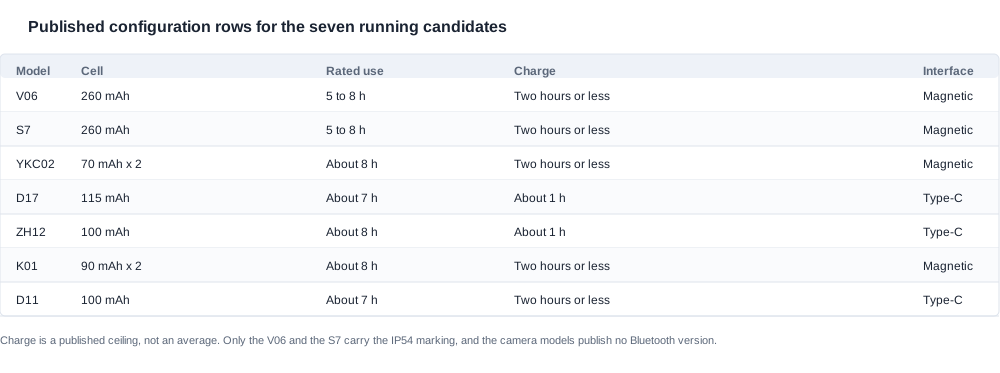
Reading the published configuration rows as a sourcing document. The table above is the seven-candidate list reduced to the rows that can be quoted, inspected and compared against a second supplier. Every entry in the charge column is a ceiling rather than an average, every entry in the rated-use column carries no test condition, and the interface column is the one that quietly decides the accessory plan. A buyer who takes this table into a supplier meeting is asking about five cells per model and thirty-five answers in total, which is a short meeting and a shortlist.
The advantages that survive a second supplier quotation
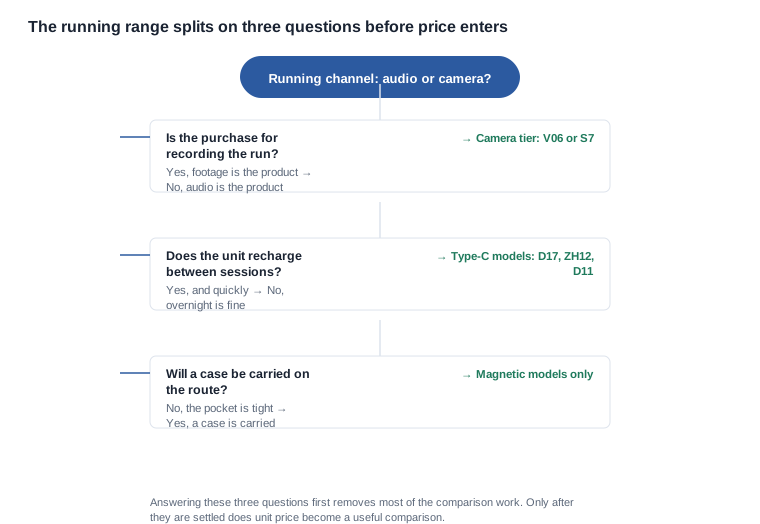
The decision tree above is the part of the assessment that a buyer can execute in a meeting. Three questions, in this order, remove most of the twenty-eight models and most of the comparison work. They matter commercially because a wrong answer is not a small error: a buyer who answers "footage" and receives an audio model has not saved a few dollars on unit price, they have built a packaging, an accessory list and a marketing plan for the wrong product and will discover it at the point of listing approval.
Hands-free capture is not a convenience feature, it is the reason the format exists. A runner cannot hold a device and run properly, so a camera that must be gripped produces footage nobody shoots and a product nobody reorders. The catalogue's answer to this is structural: the V06 and the S7 publish a detachable inner frame, which turns the part of the unit that touches skin into a replaceable item rather than a scrapped product. A buyer should ask what a replacement inner frame costs, whether it is orderable separately, and whether the replacement is a separate purchase from the warranty claim. Those three answers decide whether the frame architecture is a serviceability advantage or a spare-parts line that never sells.
The IP54 marking on two models is a genuine differentiator in this scenario, and it is narrow. Water splashing against the enclosure and a dust protection level are what the second digit covers. The marking appears on the V06 and the S7 and on no other model in the catalogue. That narrowness is an advantage for a buyer because it is a checkable attribute rather than a marketing adjective, and it is a risk for the same reason: the marking is printed in the catalogue and no test report behind it is published. The ingress protection rating page sets out exactly what the second digit does and does not cover, and the correct commercial treatment is to describe the marking as a catalogue attribute and never to extend it into a waterproof claim.
A one-hour top-up on the D17 and the ZH12 changes the shape of a training day. These two models publish about an hour of charging over Type-C, and both publish remote shutter control. For a running programme sold on recorded routes, the combination is worth more than it looks: the one-hour figure means a unit can be charged in a club changing room between sessions, and the remote shutter means the runner does not have to reach for the device mid-stride, which removes both the framing problem and the movement that destabilises the fit.
Runtime covers the sessions a running programme actually runs. The sport models publish rated use of about seven hours on the D17, about eight hours on the ZH12 and about eight hours on the YKC02, and the sport camera models publish a five-to-eight-hour band on the V06 and the S7. No published rated-runtime figure in the catalogue carries a test condition, so none of these numbers can be converted into "will it survive a 90-minute run" without a condition attached. What they do establish is that no candidate in this list is published as short-runtime, which removes runtime from the list of disqualifiers and puts it on the list of things to verify. The battery life page covers why that distinction matters.
The disadvantages that survive a second supplier quotation
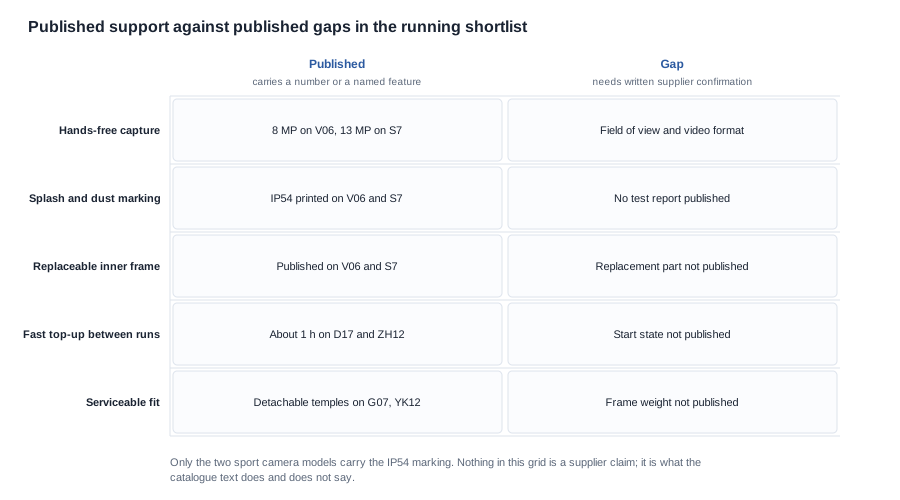
The grid above is the other half of the same seven candidates. Every cell in the right-hand column is a genuine gap in the published record rather than a weakness of the design, and the pattern across the five rows is what a buyer should take into a supplier meeting.
Weight is unpublished for every running candidate, and it is the most commercially expensive gap in this category. The complaint that decides a running-channel return is pressure at the nose bridge after forty minutes. We publish no frame weight, no fit data and no temple specification for the sport models or the sport camera models, so a buyer cannot answer the question "will this sit comfortably for an hour" from any document. We will not estimate it, and we will not quote the MT6 figure as a proxy for a different product class. The correct response is a sample unit, worn for a long run by somebody whose head shape is representative of the channel, because no amount of reading replaces that test.
The rated runtime has no test condition, and the difference matters commercially. A figure of about eight hours measured with the camera idle and the same figure measured with the camera recording are not the same claim, and the catalogue does not say which one it is publishing. For a buyer who is building a rotation plan — how many units a club needs, how often a unit goes back to a charging point — the missing condition is the difference between a two-unit rotation and a five-unit rotation, which is a direct line to the order quantity.
The field of view is unpublished, so framing cannot be judged from a specification. This is survivable for stills and not survivable for moving footage, because a narrow field of view on a subject in motion crops badly and cannot be predicted from a resolution figure. The remedy is a short sample-recording protocol run at running pace rather than at walking pace, recorded on the unit that will actually ship. The video format, the frame rate and the storage path are likewise unpublished for the camera models, and all three belong in the same sample request.
Magnetic charging and sweat are a poor combination, and it is a routine rather than a defect. Four of the seven candidates charge magnetically, which means exposed contacts meeting a damp temple at the end of every session. Salt crystallising in a contact produces an intermittent charge that reads as a fault and is cleared in thirty seconds with a dry cloth. That is the largest preventable return category in the application, which is why it belongs in the box insert and in the listing rather than in a support article.
Open-ear audio reduces ambient awareness, and it is a design property rather than a defect. The audio family is an open-ear architecture, so the ear stays unobstructed and traffic, a pace partner and a car remain audible. That is the strongest argument for the format in a road-running channel and simultaneously the reason a buyer selling audio to a trail-running audience has to state the trade-off plainly rather than presenting the device as an upgrade. The bluetooth audio glasses range covers the architecture, and the channel context sits under smart glasses for running.
And the certification route is a question rather than an answer. The catalogue lists a company-level export certification page whose content is images rather than text, and the written catalogue carries no CE, FCC or RoHS reference. There is no per-model certification row anywhere. A buyer who is asked to confirm a compliance claim for a running product is therefore buying a written document from a supplier, not reading it out of a catalogue, and that document should be a condition of the purchase order rather than a follow-up.
Negotiating the gaps rather than the catalogue
The gaps above are cheap to close at the quotation stage and expensive to close later. That is the central commercial point of this assessment, and it is where the negotiation actually happens: not on unit price, but on which rows are answered in writing, on what schedule, and on what happens to a shipment if an answer turns out to be wrong.
The six questions that should appear in the first request for quotation.
- Which units in the running candidate list are being quoted, and at which tier and quantity?
- What the unit weight is for each quoted model, in grams, measured with the battery fitted?
- Does a test report exist behind the IP54 marking on the V06 and the S7, and which laboratory issued it?
- What the rated runtime is measured under, per model, and what the cycle-life rating is?
- What the ingress position is for any quoted model that does not carry the marking?
- Which written compliance documents exist for the quoted configuration and destination market?
A supplier who answers all six in a single reply has told you something about how that supplier will handle the programme; a supplier who answers none has told you something more useful. A supplier who answers three and declines the rest has told you which three answers you will be chasing for the life of the contract.
The four clauses that convert an answer into a commitment. The conformity clause should require that the delivered configuration matches the specification that was quoted, row by row, with the model designation treated as part of the specification rather than as a label. The documentation clause should require the compliance documents and the test reports to be delivered before shipment rather than on request, so that a missing document stops a delivery instead of creating a dispute after one. The acceptance clause should allow for an inspection against the written specification on arrival, including the weight and the runtime condition. And the remedy clause should state what happens if a delivered unit does not conform, because a remedy clause that is silent defaults to a dispute rather than to a credit.
The accessory configuration is a negotiation line, not a detail. Because five of the seven candidates charge magnetically, the charging case sits inside the charging architecture for those units rather than beside it, and whether the case is in the box or sold separately changes the price point, the freight weight and the number of lithium cells that have to be declared in the transport file. Two published case configurations exist for a running-adjacent camera model — a 900 mAh and a 1400 mAh choice on the L2 Utral, and a 1200 mAh foldable case on the MT6 — and each configuration changes the artwork, the freight weight and the transit file. The battery transport documentation is the gate that gets asked for at a border rather than in a quotation, and it is worth settling at the quotation stage.
A worked example, stated as a scenario rather than a client project. Take a running brand listing two models under a single brand for a club channel and a retail channel. The buyer answers the three questions from the decision tree first: the product is a capture product, the unit must recharge between sessions, and no case will be carried on the route. That answers to the camera tier with a Type-C interface, and among the published candidates it points at the S7 and the V06 for capture, both of which charge magnetically — which forces the case question to be reopened, because a magnetic interface is exactly the configuration where a carried case becomes part of the charging architecture. The buyer then asks for the written weight of both models, the test report behind the IP54 marking, and the runtime condition, and the programme proceeds on whichever units come back with complete answers. This is a hypothetical scenario, not a client project; no customer names, volumes or outcomes are implied.
Where our published position stops, and what happens next
The advantages above are published facts about specific configurations and the disadvantages above are published gaps, and neither list has been padded with industry averages to make the assessment read more evenly. We publish the resolution class, the cell capacities, the charging interfaces, the structural features, the rated runtimes and the charge times that the catalogue names — the detachable inner frame on the V06 and the S7, the remote shutter on the D17 and the ZH12, the absence of any published touch row — the colour counts, and the IP54 marking on the two models that carry it.
What we do not publish and will not estimate: frame weight for the running candidates, the field of view, the video format, the frame rate, the storage path, the runtime test condition, the cycle-life rating, the microphone specification, the Bluetooth version for the camera models, or any per-model certification row. The single weight figure in the range belongs to the MT6 glasses body, excluding its foldable charging case. The export certification page in the catalogue is image-based and the catalogue text contains no CE, FCC or RoHS reference, so we will not present any of those as ours to claim. A buyer who needs any of the above in writing should ask, and the honest answer will be either the document or a clear statement that it does not exist yet.
What to send us. Send the capture-versus-audio answer, the session length, the quantity band, the destination market and the channel, and we will return the seven candidates ranked against those five inputs, the published rows that apply to each, the rows that would have to be closed in writing before a purchase order, and the accessory configuration we would put in the quotation. If the running programme is closer to a road-cycling programme than a running one, the retention questions are different enough that the cycling application is the better starting page. And if the programme is a sound programme rather than a capture programme, the bluetooth audio glasses range narrows the eight audio models to the two or three that make sense for a moving customer.
Tell us whether the running programme sells footage or sound, and we will return the shortlist, the rows that apply to each candidate, and the questions to put in the first request for quotation.