

Smart glasses for security: a deployment template, and why the order of its blocks matters
Most deployment templates fail at the same place, and it is not the detail. They are filled in as a form — every field completed, every box ticked — and the document that comes out contains no decisions at all, only fields. The reason is structural, and it is fixable by changing the order of the blocks rather than by adding fields. A security deployment template should run in four blocks, and each block's answers should constrain the next block's options: the constraint sheet decides which group can serve the job, the group decides the shortlist, the shortlist decides the questions, and the questions decide the base design. Fill the blocks in that order and the template produces decisions. Fill them in the order that feels natural — models first, because the models are the interesting part — and it produces a purchase order for something nobody has established is needed.
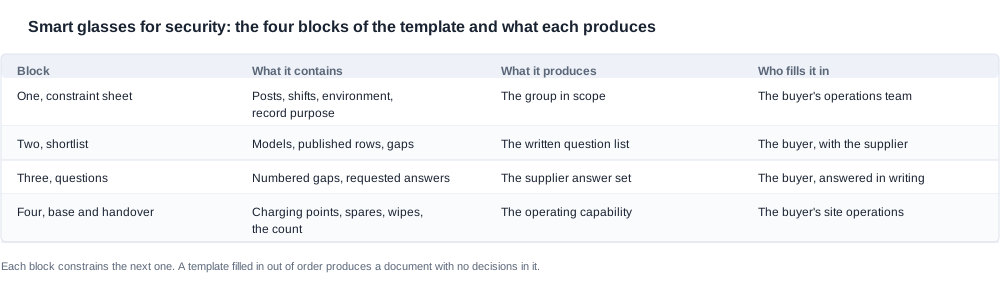
What this template is and is not. It is a working document for a buyer, structured so that each block answers a procurement question and each answer narrows the next. It is not a proposal, not a requirement specification and not a tender document — those are written after the template has produced its decisions, and they are written much faster once the decisions exist. It is also not a form. The difference between a form and a template is that a form can be completed without thinking, and a template cannot be completed without answering the questions it asks.
The four blocks, and the decision each one produces.
| Block | What it contains | What it produces | Who fills it in |
|---|---|---|---|
| One, constraint sheet | Posts, shifts, environment, record purpose | The group in scope | The buyer's operations team |
| Two, shortlist | Models, published rows, gaps | The written question list | The buyer, with the supplier |
| Three, questions | Numbered gaps, requested answers | The supplier answer set | The buyer, answered in writing |
| Four, base and handover | Charging points, spares, wipes, the count | The operating capability | The buyer's site operations |
Who fills this in. The operations team fills block one, because only they know what happens at the post. The buyer fills blocks two and three with the supplier's involvement. The site operations team fills block four, because the base design is theirs to run. A template that assigns all four blocks to the purchasing department produces a document that describes a device rather than a deployment, and that document will not survive the first shift.

Block one, the constraint sheet
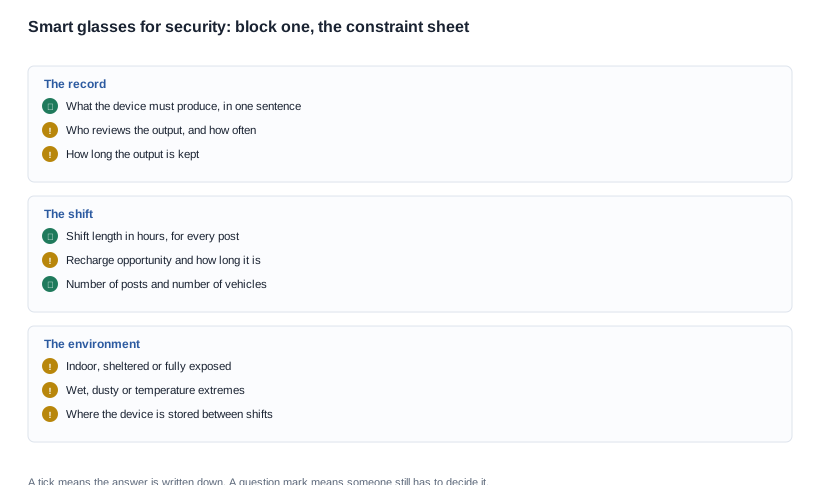
Block one is eleven questions and no products in it at all. That is deliberate: the constraint sheet is the part of the template that cannot be influenced by what is available, and it is the part that a buyer most often skips because it feels unproductive. It is the opposite of unproductive. It is the block that eliminates whole groups of models before a single quotation is requested, and in this catalogue that elimination is unusually large — three groups, of eleven camera models, eight audio models and three sport models, and the record purpose alone decides between them.
The record question, which comes first because everything else follows it
The first line of block one is a single sentence: what the device must produce. If the deliverable is an image, the camera group is in scope, and the sport group is in scope only where its published remote photo control is acceptable — which the D17 and the ZH12 offer and the YKC02 does not. If the deliverable is voice contact, the audio group is in scope, and the camera group is not, because no audio model publishes an image row. Two further lines follow: who reviews the output and how often, and how long the output is kept. The second of those two lines is usually the reason a deployment fails, because it is the line that the storage question has to satisfy, and the storage question is not published for any model in the range.
The shift questions, which convert a runtime figure into a requirement
Shift length per post, in hours, is the second input. The published run times in this catalogue are five to eight hours on the V03 and the V06, and the S7 and the V03 Pro, six to eight hours on the KY06 and the MT5, about seven hours on the CY03 and the MT6, and the L2 Utral and the L1 Pro, and the CY05, and between about six and about eight hours across the eight audio models — with the G07 and the YK12 publishing the shorter figure in their own 55 mAh by two tier. A shift length turns those figures into a pass or a fail, and a fail here is not a purchasing problem, it is a design problem: the answer is a spare pool, a second model or a shorter shift at that post.
The third input is the recharge opportunity and how long it is. This is where the charge-time row becomes a scheduling constraint rather than a specification detail. Twenty-six of the twenty-eight catalogue entries publish a ceiling of two hours or less, and only the D17 and the ZH12 publish about one hour, so a short break narrows the field to those two models unless a spare pool absorbs the difference. The published rows are at battery life and the charging plan is at charging solutions.
The environment questions, which decide whether the shortlist can be short
Indoor, sheltered or fully exposed is the first environment question, and it is the one that produces the most surprising result in this catalogue. An IP54 marking appears on two models only — the V06 and the S7 — and on no other product in the range. So a fully exposed post does not narrow a shortlist of eleven camera models to eleven candidates; it narrows it to two, or it commits the buyer to writing to the supplier about ingress for every other model on the list. Whether that write-up is worth doing is a cost decision, and it is cheaper to make it before the shortlist is fixed than after. The digit reading is at IP ratings.
The second environment question is about wet, dust and temperature, and here the catalogue publishes nothing at all — no operating temperature range, no thermal behaviour, no cycle life rating. The template records the site's condition and sends it as a question; it does not assume an answer. The third question is where the device is stored between shifts, which is not a cosmetic detail: a device stored in a hot vehicle overnight is a device that will arrive at the issue point with a contaminated contact and no charge, and that failure is reported as a fault.
The output of block one
At the end of block one the buyer holds a group, a shift requirement, a recharge interval, an exposure statement and a record purpose. That is enough to write block two and not enough to order anything — which is exactly the condition a template should be in at the end of its first block.
Block two, the shortlist block
Block two is a table with one row per candidate model and four columns: the model, the published row that justifies it, the gap on that row, and the number of the question that closes the gap. The fourth column is what makes the block useful. A shortlist without it is a feature comparison; a shortlist with it is a request for information, already structured, and the supplier can answer it in one reply.

Filling the four columns without inventing anything
The published column is copied from the catalogue and nothing else is permitted in it. For the camera group that means the resolution class — 8 MP on eight models and 13 MP on three — the cell capacity, the charge time, the rated run time, the charging interface, the charging-case capacity where it is published, and the IP54 marking on the V06 and the S7. For the audio group it means the Bluetooth version — 5.3 on the K01 and the K02 and 5.4 on the other six — the cell architecture, the charge time, the run time, the interface, and the published structural features. For the sport group it means the YKC02, the D17 and the ZH12 with their cell architectures, their charge times and their feature rows. The gap column holds only what the catalogue does not publish for that specific model, and the rule that keeps this column honest is simple: a gap is only a gap if it is a row that exists for other models and not for this one, or a behaviour the catalogue describes nowhere at all.
The four questions that appear in almost every row
Almost every candidate row in this category carries the same four gaps, and a buyer who recognises them can stop looking for them individually. The storage capacity, the overwrite behaviour and the notification before the limit. The runtime test condition and the standby draw. The field of view, the video output format, the low-light behaviour and the capture latency. And the per-model certification scope for the destination market. A fifth gap appears on some rows only: the charging interface, which is absent entirely for CY03 and CY05, and the MT6 and the L1 Pro, and the charging-case status, which the catalogue publishes for five camera models, publishes as a case with no capacity for two more, does not address for three, and states as absent for the V03 Pro.
The output of block two
A shortlist with numbered questions attached. Nothing has been sent yet, and the buyer's next action is a single document rather than a conversation.

Block three, the supplier question block
Block three is the questions themselves, and its discipline is that each question is numbered, each asks for a specific answer, and each is written so that a yes-or-no answer is a failure of the answer. "Please confirm the device is IP54" is a question that can be answered wrongly. "For the model named above, state the ingress marking and the scope it covers, including whether it covers immersion" is a question that cannot.
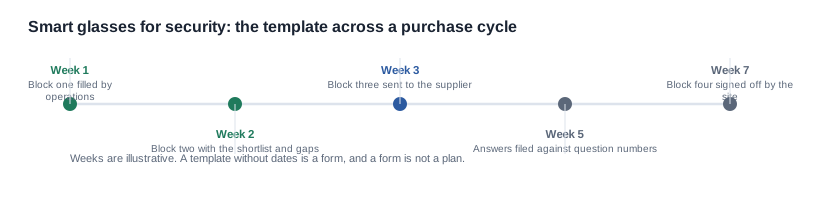
What the block contains and what it produces
Three sections. The behavioural questions, which cover the storage and overwrite behaviour, the notification before the limit, the capture and transfer route, the capture latency, and what the device does when it is issued without a case. The documentary questions, which cover the per-model certification scope for the destination market, the battery transport file for the exact configuration, the model designation and configuration table, and the runtime test condition. And the commercial questions, which cover the consumable quantity per device per week, the restock interval, the incoming inspection criteria, the return path, and the lead time for the configuration and the quantity.
The output is the supplier's answer set, filed against the question numbers. That filing is the point of the whole template: a year later, when a specific question is raised — why did the device overwrite, was the charge time measured at the site's temperature, what was the agreed inspection standard — the answer is retrievable in one step instead of being reconstructed from memory and forwarded emails.
The answer set is a document, not a conversation
Two disciplines make the difference. First, every answer is attached to its question number, so a partial answer is visible as a partial answer rather than as a silence. Second, an answer that contradicts a published row is flagged, not silently accepted. A supplier who states a charge time outside the published ceiling has changed the product or made an error, and both of those are worth knowing before the order. The commercial side of the same document is at contract terms, and the certification scope question is at the certification checklist.
The output of block three
A document that can be handed to finance, to the site, and to the supplier as the single source of truth for the configuration. The budget consequence of the answer set is the subject of budget considerations, because the answers change what the deployment costs and not only what it does.
Block four, the base design and the day-two block
The last block is the one most templates stop before, and it is the one that determines whether the first week works. It has four parts, and all four are things the supplier cannot decide.
The charging design. One charging point per location for each interface in the deployment, plus one spare. The interface row decides what that is: a dock for a magnetic model, which is an installed asset with its own capital line, and a cable for a Type C model, which is a consumable replaced at the base. Four camera models have no interface row published, which means the base design for those models cannot start until the answer arrives.
The spare pool. Sized against the shift length, the published run time and the number of posts — not against the fleet size. The published rows are the first two inputs; the third is the buyer's. The wipe rate. Per device per week, with the item specified, because the lens material and the coating are not published and the instruction has to be restrictive. The count. The issue and return log, which is the only way the loss rate becomes a number rather than a budget variance.
The one thing a template cannot fix. No block of this document decides whether the deployment is a good idea. A template decides whether the deployment is specified properly, and the decision before that — whether a camera group, an audio group or nothing at all is the right answer for this site — belongs to the buyer's own business case, with its own cost model and its own alternatives. That decision is made before block one, and it should be revisited if block one turns out to constrain the site harder than expected. What the template guarantees is that when the decision is made, it is made against a written set of constraints rather than against a preferred product.
The day-two questions, and why they belong in the template rather than in a meeting
Three questions arrive in week one of the deployment, and all three are answerable at the template stage. Does the footage go somewhere the site controls? The answer depends on the storage and transfer answers from block three, and if the answer is no, the site has a policy problem that is cheaper to solve before the shipment than after it. Who is allowed to review the recording? A legal and operational question that block one's record purpose has to anticipate. What replaces a unit that fails mid-shift? The spare pool, sized in this block, which is why the pool belongs here and not in the operations manual.
The output of block four
A signed block, with a named owner per line and a date per line. At that point the template has become a deployment record: four blocks, every gap either closed by a published row or by a written answer, a base design that matches the interface, and a handover that the site can run without supervision.
The limit we place on filling in a template
We can supply the published rows that fill the second column of block two, and we can answer the questions in block three about the products we make. We cannot fill in block one, because only the site knows its posts, its shifts and its exposure. We cannot fill in block four, because a charging point, a spare pool and a handover are properties of a site and not of a product. And we will not fill a template with figures the catalogue does not publish, because a template with invented rows is worse than an empty one: it moves the invention upstream, where it is much harder to detect.
The rows we publish, and which block two may carry, are the resolution class per camera model, the cell capacity and cell count, the charge time as a ceiling of two hours or less with about one hour published for the D17 and the ZH12, the rated run times, the charging interface per model including the four camera models whose interface row is absent, the charging-case capacity and case status per model, the IP54 marking on the V06 and the S7 as a catalogue attribute, the Bluetooth version on the audio models, the group composition of eleven camera models, eight audio models and three sport models, and the published structural features.
What we will not put in any block: a field of view, a video output format, a low-light figure, a stabilisation figure, a storage capacity, an overwrite behaviour, a capture latency, a standby draw, a runtime test condition, a thermal limit, an operating temperature range, a cycle life rating, a frame or lens material, a coating, a hinge specification, a unit weight for any model other than the MT6 glasses body at 158 g, or a per-model certification scope. We will not write that a device is tested to IP54, because no test report is published behind that marking, and we make no medical, hearing-aid or corrective-lens claim for any product.
What we will do is fill in blocks two and three with you. Send the completed block one — the posts, the shifts, the environment, the record purpose and the target market — and we will return the group that can serve it, the models inside that group with their published rows, the numbered question list, and the base design those answers imply. The scenario entry point is smart glasses for security, and the model-selection logic that sits behind block one is at how to choose the right model for field work.
Related reading
- The scenario's starting point — smart glasses for security
- The product lines — AI camera glasses and Bluetooth audio glasses
- The commercial consequences — budget considerations
- How to choose between them — how to choose the right model for field work
Send the completed block one, and we will return block two, block three and the base design.


