

Security is the one application where a wrong assumption is not an inconvenience but a liability, and where the assumptions buyers make are almost always about categories of product rather than about hardware. Nobody in this channel buys a device without a requirement. Most buy the wrong class of device against a real requirement.
Six decisions cause most of that, and none of them is a hardware fault. They are a category decision, a shift-length decision, a sample-approval decision, a marketing-position decision, a market-splitting decision, and a contract-content decision. Each of them can be closed before a purchase order, and each of them is cheaper to close early.
Smart glasses for security: the six decisions, and who owns each of them
The reader is a brand buyer, a channel buyer or a solution integrator assembling a body-worn device programme for an operator. The decision in front of them is not whether the hardware records — that the published specification settles — but whether the programme survives contact with a shift pattern, a site rule, a border and a legal review. The fear behind that decision is not a defect rate. It is a programme that is halted after deployment because the evidence cannot be defended, or because the specification was written for a job the product class does not do.
All six mistakes share one root cause. Each is a decision that was deferred because it looked like somebody else's problem. The category question belongs to the buyer. The shift length belongs to operations. The sample comparison belongs to quality. The marketing position belongs to the brand. The market split belongs to regulatory. And the charging rotation and the consent model belong to the contract. Deferring them does not remove them; it removes the buyer's control over them.
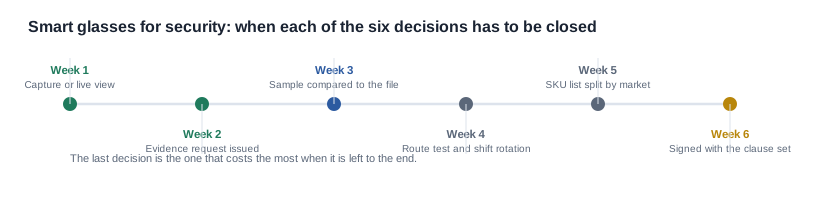
The practical consequence is that a security procurement checklist is really a list of owners. If a line on the checklist has no named owner, it will not be closed, and the programme will discover the gap at the moment it is least affordable. That is also why the order of the six matters. The category question comes first because a wrong answer to it makes the other five irrelevant, and the contract question comes last because it is the only one that can be reopened at any point without unwinding the deployment.
Mistake one: buying the category before deciding the job
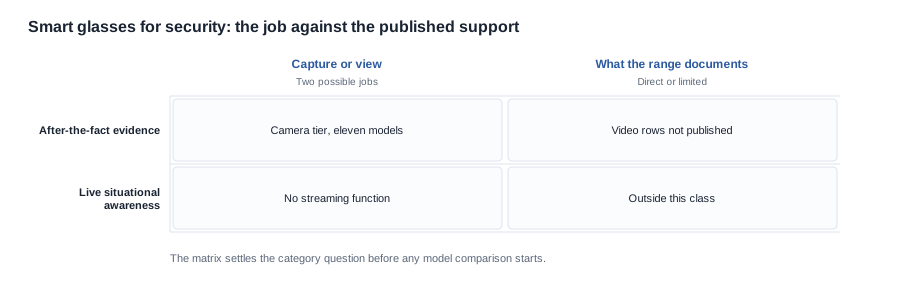
There are two jobs in this application and they need different products. One is evidence capture — a device that records, is removed at the end of the shift and is reviewed later. The other is live viewing — a device that streams to a control room as the situation happens. These are not two feature levels of the same device. They are different device classes with different costs, different power budgets, different regulatory questions and different evidence handling.
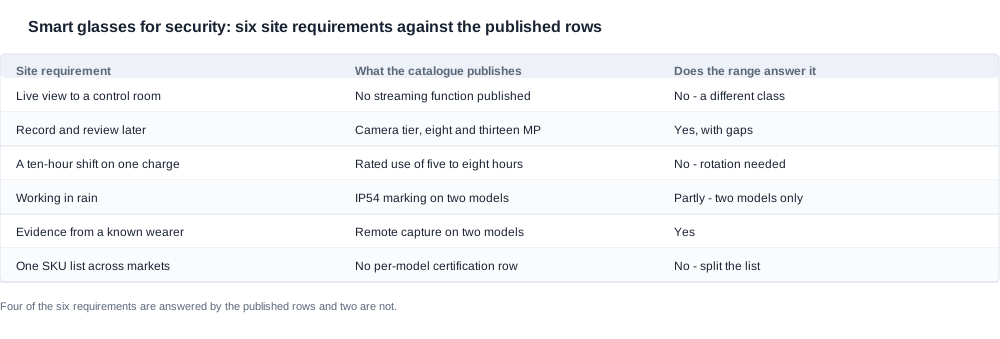
Everything published about this range describes Bluetooth connectivity, with V5.3 published on two audio models and V5.4 across most of the rest. There is no published Wi-Fi, no published streaming function, no published control-room integration and no published live-view protocol. If the requirement is live situational awareness, this product class does not satisfy it, and the honest answer is that a different product class does. A buyer who discovers this in week six has already built a business case on a capability the specification does not contain.
The remedy is a decision in week one, written down in one sentence: this device records, and the recording is reviewed after the shift. Once that sentence exists, the comparison narrows to the camera tier and the question becomes which camera tier — eight megapixels on eight models, or thirteen megapixels on three. The model coverage is on the AI camera glasses page, and the scenario background sits under smart glasses for security.
A useful discipline for this decision is to write the requirement before the shortlist. If the sentence above cannot be written without an and that joins recording to live viewing, the programme is a live-view programme and this category is the wrong place to start. The second discipline is to write what the programme will not do. A security device that does not do live viewing, does not publish low-light performance and does not publish storage behaviour is still a legitimate purchase for a route where the shift ends with a recording that is reviewed at a desk — and it is a bad purchase for a control room that needs to respond in the moment. Naming the excluded use early is cheaper than discovering it at the pilot.
Mistake two: deploying on a rated hour and an ingress marking you have not tested
The rated-use figures in this range are published, and they are shorter than a security shift. The camera models publish a band that runs from five to eight hours — the V03 and the V03 Pro, and the S7 and the V06 publish five to eight hours, the KY06 and the MT5 publish six to eight hours, and the L1 Pro and the CY05, and the L2 Utral and the MT6, and the CY03 publish roughly seven hours. The audio models publish roughly six to eight hours, and the sport models publish roughly seven to eight hours. A security shift is commonly ten to twelve.
That gap is not a defect. It is the honest limit of a small device, and it is made worse by a second omission: no runtime figure in the range carries a published test condition. There is no row that states the volume level, the clip length, the ambient temperature or the duty cycle behind any of those numbers, so a rating cannot be converted into a shift. The measurement method and the published rows are at how battery runtime is measured.
The ingress marking is a separate problem. IP54 appears on exactly two models, the V06 and the S7, and it covers a dust protection level and protection against splashing water. It does not cover immersion, it does not cover a sustained downpour, and no test report behind the marking is published for either model. Every other model in the range carries no ingress rating at all. The detail is on ingress protection ratings.
The operational consequence has to be written into the budget rather than discovered on a wet Tuesday. Two things follow. First, a charging rotation: with a rated use of five to eight hours and a shift of ten to twelve, the programme needs either more units per shift position or a charging point in the middle of the shift, and both are line items that do not appear on a product quotation. Second, a route test: the operator has to walk the actual route in the actual weather with the actual configuration, because the marking covers splashing water and not a route. If the operator will not run that test, the risk has to be accepted in writing by somebody whose name is on the programme — and that is a different decision from the one a buyer makes.
There is a third, quieter version of the same mistake: the programme assumes the shift starts with a full charge and nobody owns the charge. Because the catalogue publishes a charge time for every model — a ceiling of two hours or less on twenty-six of them, and roughly one hour on the D17 and the ZH12 — the recharge is possible, but no published figure states the starting level or the level that counts as finished. A rotation therefore cannot be built from the catalogue alone. It has to be built from a measured recharge on the buyer's own cable and dock, which is a five-minute test on a sample unit and the cheapest piece of due diligence in the whole programme.

Mistake three: approving packaging and workmanship against a sample
A sample may come from a pilot batch rather than from production. Firmware revision, component lot, lens tint batch and packaging print run can all differ from the goods that arrive. The acceptable answers to the question is this sample representative of production are a clear yes, this is production-representative or a clear no, and here is what differs. The full procedure is at sample evaluation.
What is not acceptable is approving artwork, colour and box contents against an evaluation unit and discovering the difference on the pallet. In a security programme that difference has a second cost: the artwork usually carries the operator's name and the site's identification, so a print-run difference is not a cosmetic issue but a labelling issue, and labelling issues on body-worn equipment are handled as procurement exceptions rather than as quality notes.
There is a sharper version of the same mistake, and it is the one this catalogue makes hardest to close. The sample proves what the sample does. It cannot prove what a production unit will do in low light, because low-light performance is not published for any model in the range. It cannot prove how the unit behaves after four hours of recording, because the runtime test condition is not published. It cannot prove what happens to a stored clip after the next shift, because storage and overwrite behaviour is not published for the camera models either. A night patrol is the case where several of these gaps are the whole decision, and a sample review that produces a confident answer to them is a sample review that has overreached.
The defensible sample review therefore produces three answers rather than one: what the sample demonstrably does, what the published rows state, and what remains untested. The third column is the one that should travel into the agreement, because it is the list of things nobody has verified and everybody has assumed. A buyer who insists that the sample review leave that column empty will get it filled with adjectives instead, which is the same risk with less information in it.
Mistakes four and five: marketing positions and multi-market fleets
Words create exposure in this application, and the two that create the most are covert and discreet. Neither is a published feature of any model in this range — the catalogue publishes no covert row, no concealment row and no discrete-form factor specification — and both describe a behaviour that is governed by rules the manufacturer cannot resolve. Recording rules vary by jurisdiction, by site and by subject, and signage, notification and consent obligations sit with the operator. No manufacturer can settle them and no supplier should be asked to.
The defensible positioning for this category is evidence capture by an identified operator. That is what the hardware actually does, it survives a legal review without needing an opinion to explain it, and it is the only positioning that does not require a claim about concealment. The commercial test of a positioning is simple: if a listing cannot explain itself in a sentence without using a word that a regulator might want to examine, the word should come out. That test also has a second use. The same sentence should survive translation into every market on the SKU list, because a position that has to be re-argued in each market is a position that will eventually be mis-stated in one of them.
That is where the fifth mistake begins. A programme covering multiple countries inherits the strictest requirement. That is usually the worst of both outcomes: the product does not meet the loosest market's expectation of value, because it has been specified to the strictest market's compliance work, and it still carries the strictest market's cost. The alternative is to split the SKU list by market, which is more work at the start and considerably less work at the border and in the review queue.
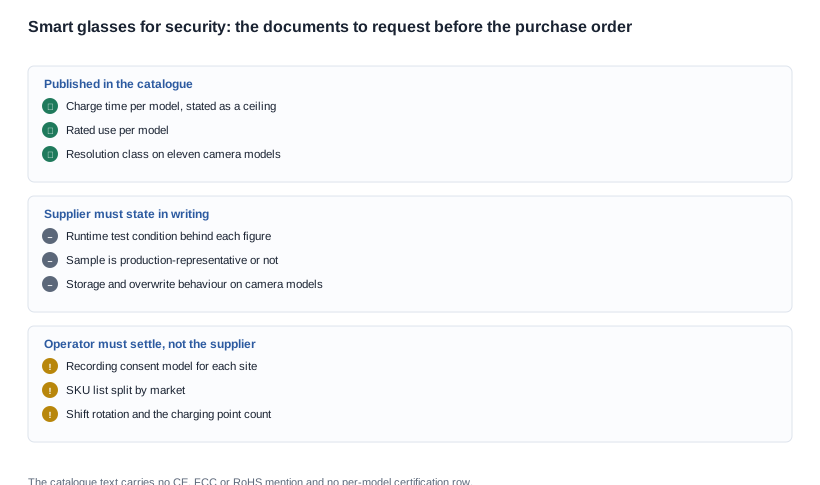
Splitting is only possible if the conformity position is per model and in writing, and that is exactly what the catalogue does not provide. The catalogue carries a company-level export certification page whose content is images rather than text, and the catalogue text contains no reference to CE, FCC or RoHS anywhere. There is no per-model certification row on any model, and no record of a pending per-model confirmation. So a buyer cannot split a SKU list from the catalogue; a buyer has to request the conformity file for each configuration in each market, and treat the absence of a published row as a document to be asked for rather than as a clearance to be assumed.
The requirement hierarchy for a multi-market programme is worth stating once, because it is the same in every market even though the names differ. Radio equipment falls under the Radio Equipment Directive (EU) 2014/53/EU; electromagnetic compatibility under the EMC Directive (EU) 2014/32/EU; transport of lithium cells under the UN 38.3 test summary and the applicable battery transport requirements; general product safety under the General Product Safety Regulation (EU) 2023/988 for consumer-facing sales. Every one of those is a question about a specific model in a specific configuration, and every one of them has to be answered by a document rather than by a company-level statement. The radio and conformity documentation practice is at certification checklist.
Mistake six, the failure patterns, and what we will not claim
The sixth mistake is the one still open when the programme is already running, and it converts a technical gap into a financial one. Two items belong in the agreement, and neither of them is about the device.
The first is the charging rotation, with numbers attached. Rated use of five to eight hours against a ten-to-twelve-hour shift is a staffing or equipment decision, and the arithmetic has to be written down: units per position, charging points per site, and the interface, because a magnetic configuration needs a dock at every point and a Type-C configuration needs a cable. The catalogue publishes the charging interface for twenty-four of the twenty-eight models; the MT6 and the CY03, and the L1 Pro and the CY05 have no published charging interface row at all, only a published charging case capacity, so those four are a specific question to ask before a rotation is designed around them.
The second is the recording and consent model, which belongs to the operator and not to the supplier. The agreement should state who notifies whom, who retains the recording, how long it is retained, how it is handed to a third party and what happens to it at the end of the shift. None of that is a product specification, and a supplier that volunteers an opinion on it is a supplier that has not understood the programme.
What to put in the agreement, therefore, is a short list: the model designation and its configuration, the conformity file for that model in each market on the SKU list, the runtime test condition, the charging interface, the charging case state, and the incoming inspection criteria against which the first shipment is accepted. Everything else belongs in a schedule the operator signs. The clause language sits at contract terms, and the commercial structure of a first order sits at pricing.
The failure patterns repeat, and each one is cheaper to prevent than to pay for. A programme specified on a rated hour with no rotation behind it: the symptom is a device handed over at a shift change that has been flat since the middle of the shift; the root cause is a rating read as a shift length; the prevention is the arithmetic in the agreement. A programme deployed on a wet route with no ingress evidence: the symptom is a cluster of failures in one weather week; the root cause is a marking read as a guarantee; the prevention is the route test. A programme that approved artwork against an evaluation unit: the symptom is a print-run difference discovered at receiving; the root cause is a sample treated as a production unit; the prevention is the production-representative statement. A programme sold on a positioning the documentation cannot carry: the symptom is a listing takedown or a complaint from a site; the root cause is a marketing word with no published feature behind it; the prevention is the one-sentence test.
Our position, stated plainly. We will tell you what this product class can and cannot do before you buy it, even when the answer costs us the order. We can answer the cell capacity, the charge time and the rated use for every model in the range, the charging interface for twenty-four of the twenty-eight, the Bluetooth version for the fourteen models that publish one, the resolution class for the eleven camera models, the charging case position in all four of its states, and the IP54 marking on the two models that carry it, stated as a catalogue attribute.
We cannot answer the frame weight beyond the single published figure of 158 g for the MT6, which is the glasses body including its cell and camera and excluding the foldable charging case; nor the field of view, nor night and low-light performance, nor the storage and overwrite behaviour, nor the runtime test condition, nor the evidence behind the ingress markings we print. We will not state that any product in our range is tested to IP54, because no test report is published behind that marking, and we will not extend it to the models that carry no rating. We will not describe a model as covert, and we will not convert a published charge ceiling of two hours or less into a shorter window, because those are different claims.
What we will do with your programme. Send the shift pattern, the route conditions, the markets on the SKU list, whether the job is recording or live viewing, and the volume split between pilot and full deployment. We will return the model shortlist with the published rows attached, the list of documents that have to be closed in writing before a purchase order, and the claims a listing can carry without overreaching. The charge rows are at battery life, the comparison method is at how to choose smart glasses for security, and the scenario entry point is smart glasses for security.
Related reading
- The opening point of the scenario — smart glasses for security
- The family behind this model — AI camera glasses
- The rows in the catalogue — battery life and IP ratings
- The sample procedure — sample evaluation
Tell us your shift pattern, route conditions and whether you need live viewing or after-the-fact evidence, and we will tell you before you order whether this class of device fits.


