
A sports or cycling brand planning a smart glasses range runs into a specific problem very early: the catalogue publishes an energy row for each model, but those rows are written in the language of a data sheet, not the language of a training session, a race stage, or a weekend ride. A brand that reads "about 8 hours" as a promise of a full day of use, and then ships that promise onto a retail listing, is committing to a claim that the published figure was never written to support.
This article is about how to read the published energy rows correctly, how to turn them into a session plan that you can defend in your own product documentation, and what to ask the supplier when the published row is not specific enough to close the question on its own.
Smart glasses battery: the published energy rows
The first thing to establish is exactly what is published, and what is not. Across the models that matter for sports and cycling use, the catalogue publishes a battery capacity, a runtime figure, and a charging method. It does not publish a measured runtime under a specific load, a standby figure, a cycle life, a charge time, or a weight for anything except one model.
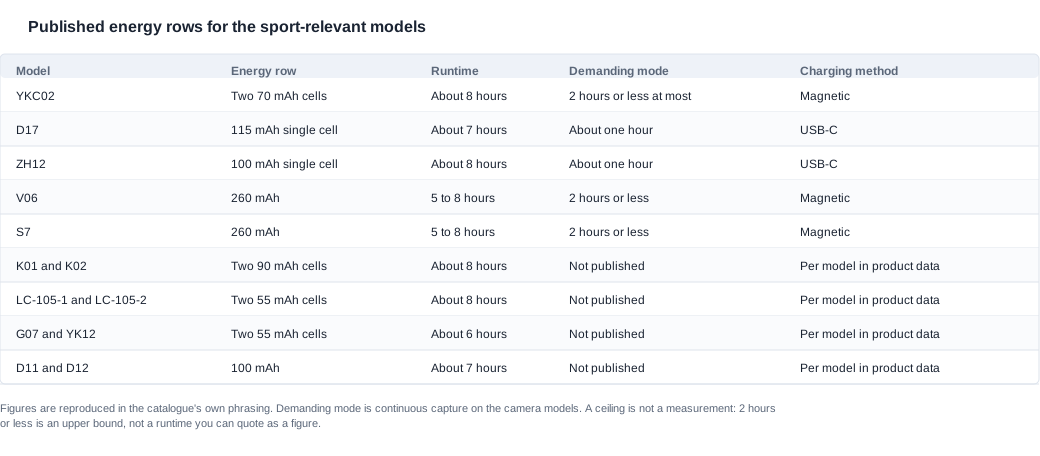
Here is the published set, model by model. These are the only figures available, and they are reproduced in the catalogue's own phrasing.
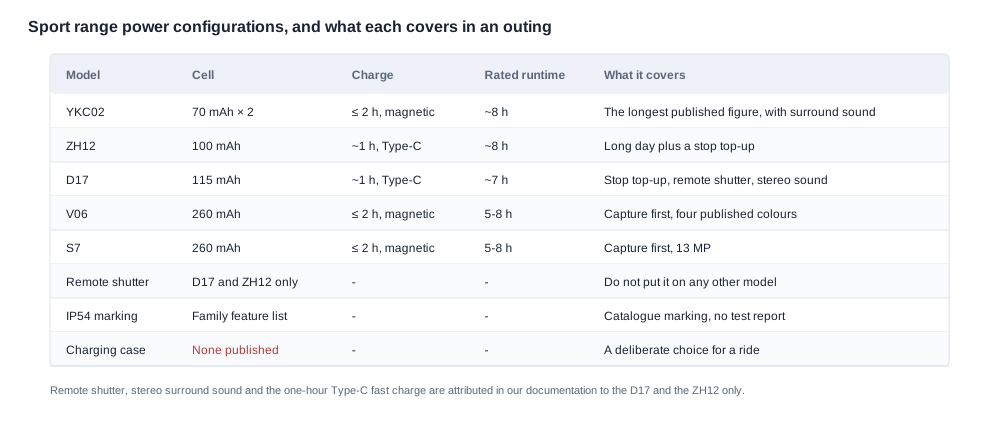
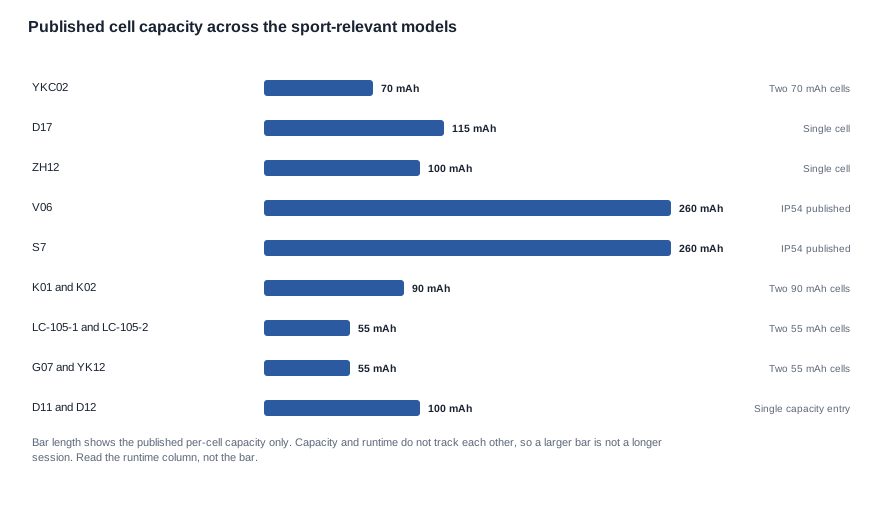
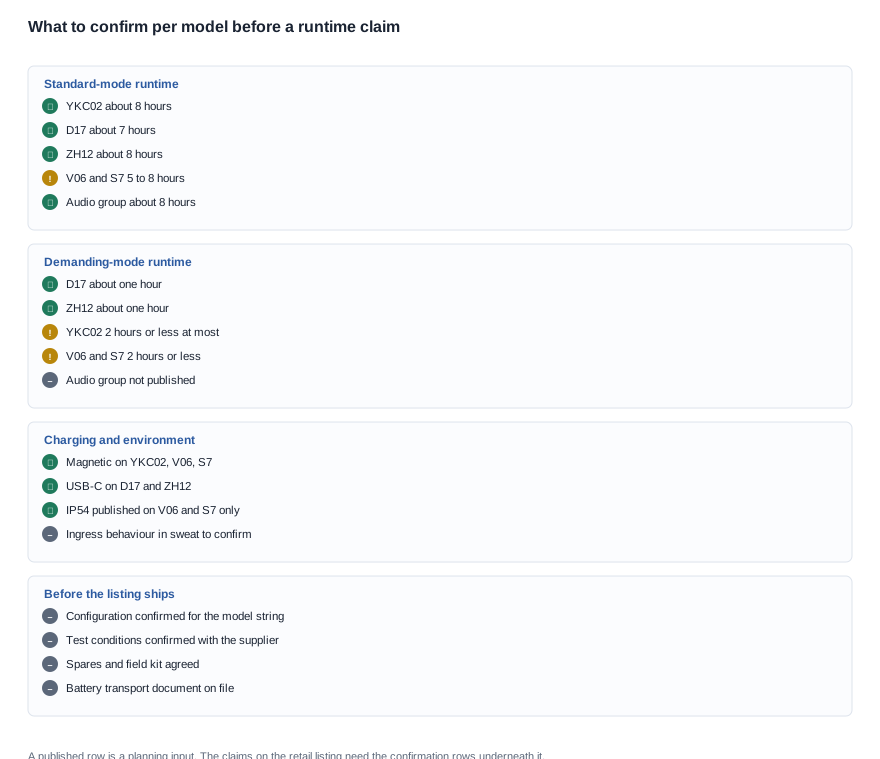
- YKC02 — 70 mAh × 2 cells, about 8 hours, 2 hours or less at most, magnetic charging.
- D17 — 115 mAh single cell, about 7 hours, about one hour, USB-C charging.
- ZH12 — 100 mAh single cell, about 8 hours, about one hour, USB-C charging.
- V06 — 260 mAh, 5 to 8 hours, 2 hours or less, magnetic charging, 8 MP camera.
- S7 — 260 mAh, 5 to 8 hours, 2 hours or less, magnetic charging, 13 MP camera.
- K01 / K02 — audio group, 90 mAh × 2, about 8 hours.
- LC-105-1 / LC-105-2 — audio group, 55 mAh × 2, about 8 hours.
- G07 / YK12 — audio group, 55 mAh × 2, about 6 hours.
- D11 / D12 — 100 mAh, about 7 hours.
Two columns in that list carry a different kind of weight, and they are easy to misread. The second column is the energy row. The third column is the sport-relevant one: how long the device keeps working at its higher-demand setting, stated as a ceiling rather than as a measurement.
The way that third column is phrased is not consistent across the range, and that inconsistency is the single most important fact in this article. For YKC02, V06 and S7, the catalogue states "2 hours or less at most". For D17 and ZH12, the catalogue states "about one hour". For the audio group models, no third figure is published at all.
That difference matters for two reasons. First, "2 hours or less" is a ceiling. It tells you that the figure will not exceed two hours. It does not tell you that the figure is two hours, and it certainly does not tell you whether a specific configuration reaches one hour or reaches two. If your brand's marketing copy says "two hours of continuous recording", it has promoted a ceiling into a floor, and it has done so from a phrase that explicitly refuses to say what the actual number is.
Second, "about one hour" on D17 and ZH12 is the only point in the whole published set where the catalogue gives a duration for the demanding mode as a figure rather than as a bound. So if a brand wants a defensible "one hour" claim on a sport model, the published material supports it on D17 and ZH12 and on nothing else. Everything else in the sport-relevant set is bounded above at 2 hours or less.
There is a third observation that only shows up once the two columns are read together, and it has an immediate commercial consequence. Capacity and runtime do not track each other. D17 publishes the largest single-cell capacity in the sport set at 115 mAh, and it publishes the shortest standard-mode runtime of the single-cell models at "about 7 hours", against "about 8 hours" for ZH12 at 100 mAh. YKC02 publishes 70 mAh × 2 and an "about 8 hours" figure. The camera models publish the largest capacities in the whole catalogue at 260 mAh and publish a runtime range of "5 to 8 hours" rather than a single figure. The practical implication is that a brand cannot compute a runtime from a capacity, and a brand cannot rank models by capacity and expect the ranking to match the runtime ranking. Both numbers must be read from the published row for the specific model.
Note also what is absent from the V06 and S7 rows. These are the two camera models in the range that carry an IP54 marking. The IP54 marking tells you something about ingress — limited protection against dust and water spray — and it does not tell you anything at all about how long the battery lasts in sweat or rain, or whether the sealing changes the thermal behaviour of the cell under load. A brand that reads IP54 as a weather warranty for a long outdoor session is reading a different claim into the marking than the marking makes. More detail on how to read ingress markings is in the IP ratings guide, and the model-level picture sits in the battery life reference.
One drafting rule follows from all of this, and we will state it plainly so it can be reused. When the catalogue publishes a ceiling rather than a figure, we will write the ceiling in the brand's copy rather than a number we inferred from it. We will also keep the two published columns separate in every internal table, because collapsing "about 8 hours" and "2 hours or less" into a single "runtime" column in a spreadsheet is exactly how a brand ends up quoting a mixed figure it cannot defend.
What a runtime range means for a session plan
The second published column varies in form too, and the variation has direct operational consequences for a brand designing a range.
Some models publish a single figure with a qualifier: "about 8 hours" for YKC02, D17's "about 7 hours", ZH12's "about 8 hours", the 90 mAh and 55 mAh audio pairs at "about 8 hours", G07 and YK12 at "about 6 hours", D11 and D12 at "about 7 hours".
Two models publish a range instead: V06 and S7 at "5 to 8 hours". A range is a materially different kind of statement from a figure, and the practical consequence is that a range cannot be used to plan a session boundary. It is a spread across conditions the catalogue does not enumerate. If a rider's session plan depends on the device being alive at a specific point, a range means that point is somewhere inside the spread, not at a known position in it.
Here is how we will treat this in our own planning, and why. When the catalogue publishes a range, we will not convert the upper end of the range into a session length. We will treat the lower end as the planning number for any session where the device has to be on continuously and the outcome matters, and we will treat the upper end as the number that a buyer might observe on a good day. In practice, that means a V06 or an S7 is planned as a session-length device on the "5 hours" figure, not the "8 hours" figure, and the retail copy is written to say what the range says.
The sport-relevant runtime column changes the picture again. The second column tells you how long the device lasts in its normal listening or standard mode. The third column tells you how long it lasts at the demanding setting — for the camera models, that means continuous capture. A cycling brand whose product story is about recording a ride is working against the third column, not the second.
So the honest way to think about a session plan for a sport model is to split the session into segments by mode. A brand can reasonably expect a continuous "about 8 hours" style figure for standard operation, and should plan the demanding mode as a window bounded by the published ceiling. Whether that window is 2 hours or 1 hour determines whether the ride is one continuous recording or several.
The published set supports a clean tiering that a brand can use as a starting point, and we will state it plainly because the reasoning matters more than the conclusion:
- For a continuous capture requirement, only D17 and ZH12 publish a duration rather than a ceiling. If the brand needs a specific hour figure for a listing, those two models are where the published material supports it.
- For a standard-mode endurance requirement, the audio-group pairs and YKC02 at "about 8 hours" are the models whose published figure supports a full-session claim.
- For camera capture in a range programme, V06 and S7 at "5 to 8 hours" for standard and "2 hours or less" at most for continuous capture define the envelope that the packaging has to live inside.
- For audio-led use where capture is incidental, the published ceiling and duration columns of the audio group do not apply at all, because the catalogue does not publish a demanding-mode figure for those models. A brand should not infer one from the capacity.
A two-cell model changes the accessory story in a way that is easy to miss. YKC02 runs 70 mAh × 2, and the audio pairs run on 90 mAh × 2 or 55 mAh × 2. Two cells mean two failure points and two charge states, but they also mean a spares conversation. A brand can legitimately build a spare-cell or spare-charger line into its accessory plan around the two-cell models, because the architecture makes it coherent. A brand should not assume the same for D17, ZH12, D11, D12 or the camera models, all of which are published as single-cell or single-capacity entries with no second cell listed.
On the spares question specifically, we will make one commitment here: we will not publish a spare cell as a catalogue item, because none is published as such. What we will do is describe the architecture that makes spares practical for a two-cell model and tell you to ask the supplier directly what spares are actually available for the exact model string you are ordering.
There is a further operational point that only applies to the two-cell models, and it affects the spare line rather than the runtime claim. With two cells in series the usable energy is shared across both, and a partially exhausted cell pair is not interchangeable with a fresh pair in the way a single cell is. If the brand is going to offer a spare, the spare has to be sold as a pair or as a matched set, and the packaging needs to say so. This is exactly the kind of detail that is cheap to settle while the requirements are being frozen and expensive to settle after the packaging is printed and the purchase order is placed.
The broader point for a session plan is that the published energy row is a planning input, not a listing input. A brand that plans a season of rides against "about 8 hours" and then publishes "8 hours" has quietly converted a qualified figure into an unqualified one. "About" is doing real work in that sentence. It is the qualifier that the published material gives you, and it is the qualifier your listing should carry.

What the charging method changes in the field
The charging method is published per model, and it is the most operationally visible difference between two otherwise comparable sport models.
Magnetic charging appears on YKC02, V06 and S7. USB-C appears on D17 and ZH12. Across the whole catalogue the split is 17 models on magnetic, 7 on Type C, and 4 where the charging method is not published at all — L1 Pro and MT6, and CY03 and CY05. That last group is a useful reminder that a gap in the data is itself a data point: for those four, the brand cannot write a field-kit instruction from the catalogue at all.
Magnetic charging changes the in-field kit in three specific ways. It is faster to put on and take off in a dark or gloved context than a connector, because there is no alignment step. It tends to leave the port area clean, which matters when the device is worn in an environment where grit is present. And in practice, the cable and the contact are two separate items, so a field kit built around magnetic charging is a kit with a dedicated cable as a spare, not a kit with a universal USB cable.
USB-C changes the kit in the opposite direction: it is a standard connector that a rider, a team staff member or a shop is far more likely to already own, and it means the spare item in the accessory box can be a generic cable. But it also means a connector that goes into a port, and port wear plus sweat plus grit is a real concern that a brand should raise with the supplier rather than assume away.
For a brand assembling a field kit, the trade-off is straightforward and worth making explicitly. Magnetic charging buys you a faster turnaround at the pit or the roadside; USB-C buys you a commoner spare. Neither is free: magnetic ties the brand to a specific cable, and USB-C ties the brand to the durability of a port that a buyer will abuse. In both cases the spare line, the packaging decision and the charging instruction on the retail listing have to follow the model, not the other way around.
The catalogue publishes the charging method per model and also publishes it as a field in the product data, which is where a brand's own configurator and product pages should source it rather than from a marketing page. The charging options article sets out how the charging method is presented across the range and why a brand should treat it as a configuration input rather than a model assumption. The rule is straightforward: when the charging method is not published for a model, the brand does not publish it either. Where it is published, the brand's accessory line, its packaging and its retail copy all follow the same model string.
There is a related documentation point that most brand-side teams discover late. A device shipping a lithium cell moves under battery transport rules, and the paperwork for that movement is part of the product file rather than a logistics afterthought. That file is opened at the requirements stage, before the model is frozen, because the cell configuration is what determines it. If the brand changes the cell supplier or the cell format after the file is open, the document set has to be reopened. More on how configuration changes propagate is in the certification support article, and the platform view is in the OEM and ODM customization overview.
One more point on the physical environment, since it is the reason a sport brand buys smart glasses at all. The IP54 marking is published on V06 and S7 only, and on no other model in the catalogue. It tells you about dust ingress and water spray. It does not tell you about immersion, about pressure, about salt water, or about how the marking changes if the enclosure or the interface changes. For any model outside V06 and S7, the brand has no published ingress marking to work from, and the honest position is that the ingress behaviour of a sweat-exposed unit in heavy rain is a question to put to the supplier in writing.
There is a related gap that a brand should treat as a question rather than an assumption, and it sits squarely in the sport use case: whether sweat and water exposure interact with the charging interface. A model that is charged at a pit stop after a wet session is a different proposition from one that is charged in a dry tent, and the catalogue does not publish anything that would let a brand decide the question. The safe engineering assumption for a brand is that the charging interface is not to be exposed to liquid, and that the field-kit instruction should say so.
There is a practical trade-off here that the brand has to price rather than avoid, and we will describe it as it actually sits. A magnetic-charged model is easier to top up quickly between sessions, which reduces the risk that a rider simply leaves the device dead in a bag at the start of a stage; a USB-C model is easier to support with a generic spare cable that any shop can hold. If your distribution model is a team shop or a club kit list, where the same cable type is likely already present, USB-C is the lower-friction option. If your distribution model is direct-to-consumer with a packaged accessory bundle, magnetic charging gives you a spares line and a packaging story that USB-C does not. Neither option is free, and the packaging decision, the spares decision and the instruction sheet all have to be made for one model string at a time.
Questions to ask before committing a runtime figure
The purpose of all of the above is to let you write a runtime claim on a retail listing that you can defend if a customer asks, and that your own product file can support. These are the questions we would want answered before any of these models appears on a packaging panel or a product page.
The published figure itself. For every model in your range, ask the supplier to confirm in writing which of the published figures applies to your exact configuration: the standard-mode runtime and the demanding-mode runtime. Ask which of the two phrasings the supplier considers a measured figure and which is a ceiling. If the answer is that the demanding-mode figure is 2 hours or less at most, ask what the supplier can confirm as a conservative working figure for your configuration, and ask for that confirmation in a form you can file.
The test conditions behind the figure. Ask what the runtime figure was measured under, because the catalogue does not publish the load, the volume level, the screen state, the recording resolution, the ambient temperature, or the connection state. Two "about 8 hours" figures from different models are not comparable until you know what was running. If the supplier cannot give you the conditions, your listing should be written against the figure alone and not compared against anything.
The spares. Ask which models have a spare cell or a spare charging dock available as a separate orderable item, and ask for the spares list per model string. For the two-cell models, ask whether the two cells are interchangeable or whether they must be matched as a set, since that determines whether the spares line is two items or one.
The charging kit. Ask what ships in the box for your configuration: the cable, the dock, or both, and whether the magnetic contact and the cable are orderable separately. Ask whether the retail packaging should carry a spare cable, and ask what the supplier's recommendation is for the field kit given the charging method.
The battery transport file. Ask for the transport documentation that applies to the exact cell configuration and the exact destination markets you intend to ship to, and ask who in your organisation holds it. Ask what triggers a re-issue of that file, because a change to the cell, the enclosure, or the shipping configuration is the kind of change that does.
The ingress marking. For V06 and S7, ask what the IP54 marking does and does not cover in the supplier's own words, and ask whether sweat exposure over an extended session at the demanding mode has been characterised. For every other model in your range, ask directly whether an ingress marking exists and whether it can be published.
The model string on the shipping unit. Ask what the model string is on the unit, the box and the manual for your configuration, and ask that the string be identical across all three. This is the point where the compliance file connects to the runtime claim: the document you hold describes a specific model string, and the unit that carries your listing has to be that string. Ask the supplier to confirm that the certification evidence on file for that model string covers the cell configuration you are quoting, because a runtime figure and a document in the same file only reinforce each other when both describe the same unit.
The samples. Ask for samples of the exact configuration you intend to order, and run them in your own real conditions — a long ride, a hot car, a wet session — before you commit. A sample tells you what the supplier's figures feel like in your own hands; it does not replace the figure, and the figure does not replace the sample. If the supplier offers to adjust the configuration to improve the runtime, ask for the change in writing, because a configuration change moves the model out of the published row and onto a new one that has to be documented separately.
The commercial terms. Ask for a quotation against a defined pilot order, and ask what the MOQ is for the model, what the lead time looks like, and which incoterms the supplier is set up to quote. Ask what tooling is required for your configuration and whether it is a one-off or a repeatable charge. Ask about packaging options, the warranty position on the cell, and what happens to the warranty if the model string changes. If a volume break matters to your plan, that is what to negotiate — but negotiate the volume terms separately from the specification terms, so that a change to the cell or the enclosure does not silently reset the commercial terms you already agreed.
That last cluster is deliberately separated from the technical questions above. The technical answers determine what you can write on the box. The commercial answers determine whether you can order enough units to find out whether the technical answers hold. A pilot order is the cheapest way to convert the second into evidence for the first: it produces units that carry the model string, run in your own conditions, and let you test the listing copy before the print run of the retail packaging.
The framing that makes these questions usable is a single habit: treat every published runtime figure as something that has to be attached to a specific configuration before it reaches a customer. We will work that way on our side — we will not issue a runtime figure for a configuration we have not confirmed, and we will not issue a figure for a model string whose document set does not match the unit in the box. If you want to structure the same conversation with your own supplier, the phrasing to use is "what to ask the supplier", and the items above are written in that form deliberately: each one is answerable in writing, and each answer becomes a line in your own file rather than a recollection of a meeting.
The final discipline is simple, and it is the one that keeps a brand out of trouble with its own customers: publish the runtime in the catalogue's own phrasing. Write "about 8 hours", "5 to 8 hours", "2 hours or less", "about one hour". Do not write "up to 8 hours" as a marketing construction, do not convert a range into a single number, and do not convert a ceiling into a floor. A listing that says "2 hours or less of continuous capture" is defensible in a way that a listing saying "two hours of continuous capture" is not, because the second one asserts a measurement the published material does not contain.
The model range, the energy rows and the sport-relevant figures for all of the models discussed here are set out in the sport smart glasses overview. If you are at the stage where the model shortlist is not yet frozen, the battery life reference is the fastest way to see which published rows correspond to which models before you start asking about quotations and samples.


