

Charging and runtime are the same question for this product, and a buyer who treats them as two separate lines in a specification will end up with a plan that works on paper and fails on a Saturday afternoon. The published record is short: a 260 milliampere-hour cell, an endurance figure given as a five-to-eight-hour band, and a charge ceiling of two hours, with magnetic charging. Nothing is published about the lead, about a case, or about what happens to the product in the hours between charges.
The reason the record is thin is also the reason the subject matters. Magnetic charging is not a convenience detail for this model; it is the point at which the product, the accessory chain, the packaging and the operating plan meet each other. A buyer choosing a charging arrangement is choosing a stock policy, a carton, a spares position and a customer instruction, and the choice has to be made in that order rather than the other way round.
This article works through the three field situations in which a device like this gets charged, what each one demands of the interface, the charging-case row that the catalogue does not list for this model, and the accessory questions that have to be closed before a first order is placed.
V06 smart glasses charging options: the magnetic interface this model publishes
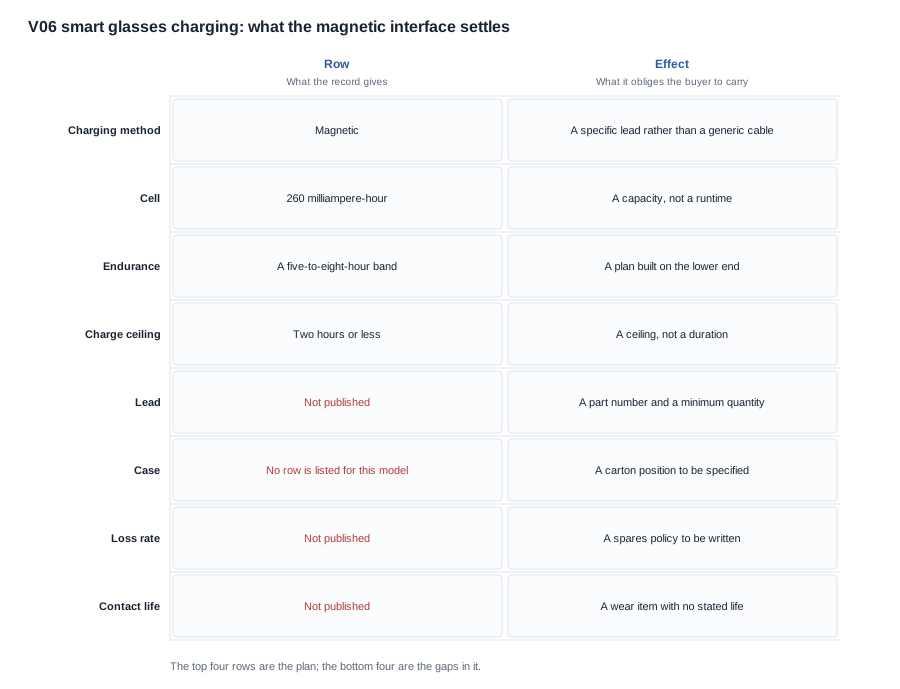
The published method is magnetic, and that single word decides several things at once. It decides that the product is charged by placing it on a contact rather than by inserting a connector. It decides that the charging item in the carton is a specific part with a part number, a lead time and a minimum quantity, rather than a generic cable that the customer can substitute. And it decides that the contact itself is a wear item, because a metal-to-metal interface that is mated repeatedly is a place where the fit can change.
None of that is a criticism of the method. A contact that has no insertion step is faster to use and harder to damage by insertion, and for a product that is put down and picked up repeatedly in the course of a working day that is a genuine advantage. The point is that the buyer inherits the accessory chain, and the size of that chain is a commercial fact that has to be in the plan.
The published rows that bear on the arrangement are these: a 260 milliampere-hour cell, an endurance figure of five to eight hours, and a charge ceiling of two hours. Each of them does a different job in the plan, and each of them has a limit that the plan has to respect.
The cell figure sets the size of the energy reserve. It is the only published figure about capacity, and it is a capacity rather than a runtime, so it cannot be turned into hours without a condition, and no condition is published for this model.
The endurance band is the figure the operating plan is built on, and it is a range rather than a point. A range of five to eight hours is useful and it is also awkward, because a plan built on the top of the range is a plan built on the least conservative reading of the record. The honest use of a band is as the planning envelope: the lower end is what a day has to be built around, and the upper end is what a good day looks like. A buyer who publishes the upper end of an unpublished band as a customer-facing figure has converted a range into a promise.
The charge ceiling of two hours is the number that constrains the interruption, and like the endurance figure it is a ceiling rather than a measurement. What a buyer can say with confidence is that a charge takes no more than two hours. What a buyer cannot say is that it takes two hours, and the difference decides whether a break of a given length is useful.
Put the three together and the charging arrangement for this model is not a single decision. It is a decision about the interface, a decision about the accessory chain, and a decision about the interval between charges, and the third is the one that decides whether the first two were worth the money.

Three field situations, and what each one asks of the charger
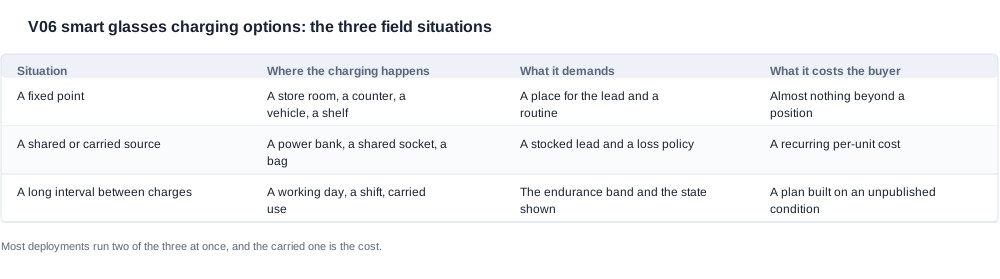
The arrangements that work are few, and they are distinguished by where the charging happens and how long the device goes between charges. Naming them is more useful than describing a method, because each one puts a different set of demands on the interface and a different set of costs on the buyer.
Situation one: the unit is charged at a fixed point. A store room, a counter, a vehicle, a charging shelf in a workshop, a desk that belongs to one person. The device goes back to the same contact every time, the lead stays where it is, and the charging session is part of a routine that already exists. This is the arrangement in which a magnetic contact is most convenient, because the device is placed and forgotten, and the lead never has to be carried. What it demands of the buyer is very little: a position for the contact, a place to keep the lead, and an instruction that says the device goes back to it. What it does demand is a discipline, because a fixed charging point that is not enforced produces a device that arrives at the next shift part-charged, and the resulting complaint is never phrased as a charging complaint.
Situation two: the unit is charged from a shared or carried source. A power bank, a socket in a shared space, a lead carried in a bag, a vehicle's own outlet. Here the lead becomes a carried item, and everything that follows from a carried item follows here: it can be left behind, it can be borrowed, it can be damaged, and it is a proprietary part, because the catalogue publishes magnetic charging and a generic cable will not seat on a contact. The demand on the buyer is a stock and loss policy, and the demand on the instruction set is a charging procedure that works with a lead rather than with a wall.
Situation three: the unit goes a long time between charges. A full working day, a shift, a period in which the device is carried rather than used. This is the situation in which the endurance band does the work, and it is the situation in which the cost of the published record is highest, because a band of five to eight hours cannot be turned into an operating plan without a condition and without knowing how the product presents its own charge state. A buyer who has to support this situation has two things to establish that are not published: the reference condition behind the band, and what the device shows about its own state. Both are questions for the supplier, and both should be asked before the arrangement is put in front of a customer.
The three situations can coexist in one deployment, and most will. A business that sells to a shop floor and to a field team has a fixed point for one and a carried lead for the other, and the cost model is the sum of both. The practical consequence for a buyer is that the accessory chain has to be specified for the worst case rather than the average one, because the carried lead is the one that gets lost and the fixed point is the one that gets left behind.


The charging-case row the catalogue does not list
The catalogue lists no charging-case row at all for the V03, the V06 or the S7, and that sentence is worth reading carefully in both directions. It records that the catalogue does not carry a line for a case on these models. It does not record that the product has no case, and it does not record that the product has one. Those are three different positions, and a buyer who collapses them into the middle one will make a decision on the basis of a fact nobody established.
What this means practically is that the carton contents for this model are a question, not a line on a specification. If a case is supplied, it is a second physical object in the box, and it has a volume, a weight and a freight effect, and it may itself carry a cell, in which case the transport requirements follow the case as well as the product. If no case is supplied, the product is charged over a magnetic contact, and the lead in the box is the only thing that makes the device usable on arrival, so the lead cannot be treated as an optional inclusion either. Either way, something has to be in the box, and the specification has to say what.
The risk of getting this wrong is asymmetric, which is why it is worth spelling out. A carton that promises a case and does not contain one produces a complaint and a return. A carton that contains a case nobody promised produces a freight cost, a volume surprise and a customer who does not know what the extra object is for. The second failure is quieter and is the one that is more expensive over a year of shipments.
There is a second consequence, and it is the one that is often missed. If a case is supplied, it becomes an accessory with its own part reference, its own minimum order quantity and its own place in the spare-parts position. If it is not, and the product is charged over a magnetic contact, then the lead is the only charging item and it carries that burden alone. In both cases there is a stocked item that the buyer has to plan for, and the difference is one of identity rather than of quantity.
The question to put to the supplier is therefore precise rather than general. What is in the carton for this model, item by item, with a part reference and a quantity for each; whether any of those items contains a cell; and whether the case position applies to all four published colours or to some of them. Those three questions close the gap, and the absence of a catalogue line is not a reason to leave them open.

Accessory questions to settle before the first order
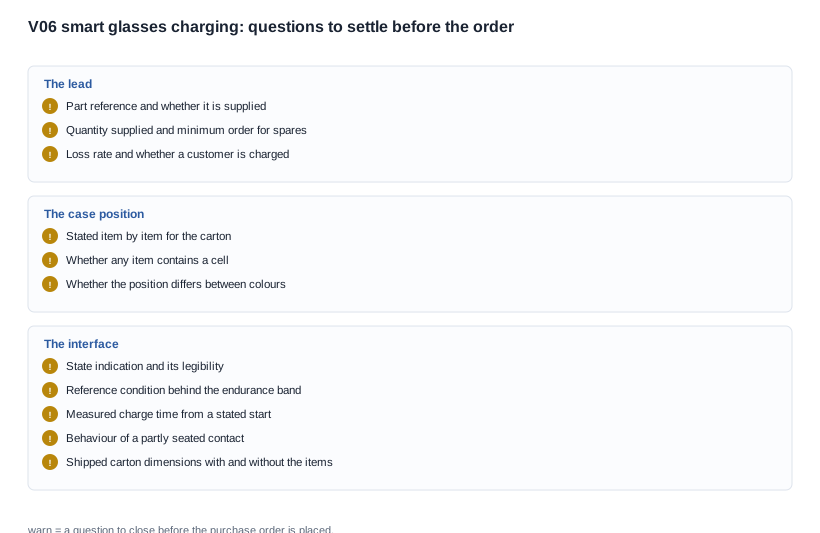
The questions below are the ones that have to be answered before a purchase order is placed, in the order they tend to be forgotten, which is roughly the reverse of how they bite.
- The charging lead. Its part reference, whether it is supplied with the product, how many are supplied, and the minimum order quantity for spares. A magnetic contact needs a specific lead, and a lead that is not specified is a lead that will not arrive.
- The loss rate. What proportion of units come back with a missing or damaged lead, whether the lead is supplied in the retail carton, and whether a customer who has lost it is charged or given one.
- The case position. Whether a case is supplied, and if it is, its part reference, its capacity, whether it contains a cell, and whether the position differs between colours.
- The state indication. What the product shows about its own charge, and whether that indication is legible in the conditions it will be used in.
- The reference condition behind the five-to-eight-hour band, and whether the same condition applies across the colour range and the removable inner frame configurations.
- The measured charge time from a stated starting state, and how it behaves when the product is left on the contact after it has finished charging.
- The contact itself. What the interface is made of, what happens to a product that is placed on it slightly askew, and how the contact is expected to behave over repeated use.
- The packaging consequence. The shipped carton dimensions with and without the lead and any case, because the freight follows the carton.
- The instruction content. What the instructions say about charging, in which languages, and from which controlled source they are produced.
- The commercial terms for each of the above, since every one of them is a minimum quantity somewhere.
There is a shortlist of arrangements that can be worked through in order, and it is worth setting out because the choice is not between methods but between combinations. The first question is whether the device is charged at a place the business controls, because a controlled point removes the carried lead from the equation entirely and removes the loss rate with it. The second is whether the device is ever out of reach of a charger for longer than the lower end of the published band, because that is the point at which the band stops being a planning envelope and becomes the constraint on the whole deployment. The third is whether the device is expected to be handed between people, because that is where a shared accessory becomes a hygiene question and where the loss rate stops being an operational detail.
Those three questions produce a shortlist of no more than three arrangements, and for each of them the ten questions above resolve into a different subset. An arrangement with a controlled charging point needs the lead reference, the contact behaviour and the instruction content. An arrangement with a carried lead needs all of those plus the loss rate and the spares position. An arrangement with long intervals needs the reference condition behind the band and the state indication before anything else, because without them the arrangement cannot be specified at all.
The trade-off is worth naming explicitly, because it is the one that gets decided by default. A controlled charging point costs space and a routine. A carried lead costs stock and loss. A long interval costs a condition that has to be established. A business that takes the cheapest of the three in isolation — a controlled point without a routine, a carried lead without a spares policy — ends up with the most expensive arrangement in practice, because the gap is filled by support and by returns.
Two of these deserve a note. The seventh is the one that is usually asked too late: a contact that seats imperfectly charges more slowly, and a product that is charged more slowly than the published ceiling is a product that does not meet its published figure, so the contact is not an accessory detail but part of the specification. The tenth is the one that decides the programme: the binding constraint on a launch is normally the largest of the minimum quantities across the device, the lead, the case if there is one, and the artwork, and a buyer who has only asked about the first of them has a programme that cannot be reordered at the volume it was planned for.
Before you order, the red flags to look for in a supplier's reply are worth listing, because they are consistent across this kind of product and they are easy to miss in a reply that is otherwise helpful. A lead described without a part number is a lead that cannot be reordered. A case position given as "one is included" without stating whether it holds a cell is a transport question left open. An endurance figure given as eight hours without a condition is the published band being converted into a promise. A charge time given as two hours rather than as a ceiling is the same error in the opposite direction. And a loss rate given as "very low" is a number that will be discovered in the service budget.
The way to close all ten is a single accessory file attached to the purchase order, with a status against each line, rather than a sequence of separate requests that arrive in different weeks and do not reconcile with one another. A file with a status column also does something a request does not: it shows at a glance which of the gaps are still open when a delivery date is being discussed.
Our own position on this model is that the published charging arrangement is a magnetic method, a cell of 260 milliampere-hour, an endurance band of five to eight hours and a two-hour charge ceiling, and that none of the accessory detail around those four figures is published — no lead reference, no case line, no loss rate, no measured charge time and no condition behind the band. We will not quote a typical charging accessory, a typical case or a typical contact life as though they described this product, and we will not state that the product has no case, because the catalogue is silent rather than negative on that point. What we can do is set out the three field situations, the accessory questions that close them, and the sequence in which those questions have to be answered for the arrangement to be the one a customer can actually use.
If the charging arrangement for this model is being planned, the deployment pattern, the number of units in service, whether the lead is supplied in the carton and whether a case is part of the offer are the four inputs that determine the accessory position, and we will work through them into a stocking plan and a question list from them, with the total cost of the arrangement separated from the device itself.


