

Certification impact is the question a brand asks too late: it comes up in the week before a file set is closed, when somebody proposes a lens change or a firmware behaviour, and by then the schedule has already absorbed the plan. The answer is that most customisations touch nothing in the technical file, and the ones that appear most cosmetic are frequently the ones most likely to change the technical description of the product. The work is not in deciding which customisations are risky. It is in establishing the boundary before anyone proposes a change.
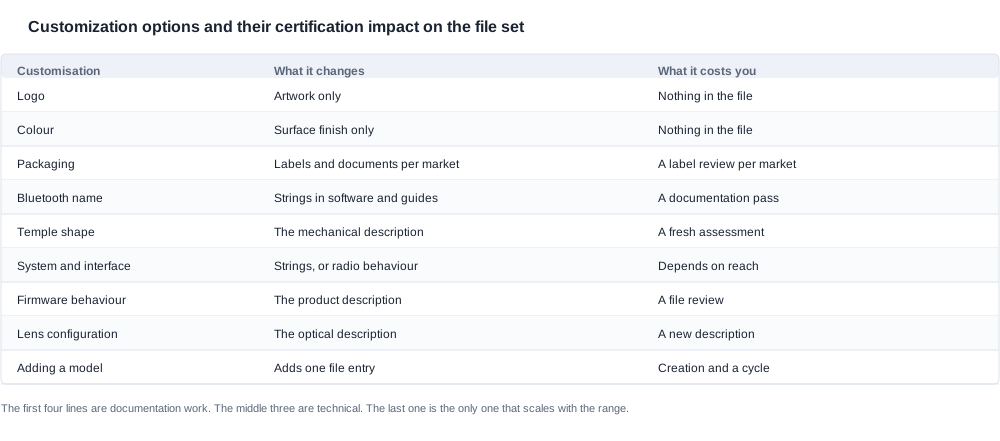
Customization options certification impact: what changes nothing
A logo, a colour and a packaging treatment are the three customisations a buyer thinks about first, and all three leave the technical description of the product alone. The radio is the radio, the electronics are the electronics, the model designation does not change, and the technical file that describes the product is unaffected.
The test for each is the same and it is worth stating explicitly: does the change alter anything a laboratory measures? Surface finish does not, artwork does not, and a label does not. That test is crude, it is fast, and it removes most proposed changes from the certification conversation in about ten seconds — which is the point, because the conversation is expensive in schedule terms and cheap in decision terms.
It is worth saying what happens when a buyer assumes wrongly in the other direction. A change treated as technical when it is documentation costs schedule for nothing, and the cost is not recovered later because the schedule has already been spent. The asymmetry is worth remembering: over-classifying is expensive and visible, while under-classifying is cheap and silent until an inspector finds it. Programmes tend to drift towards the second only when nobody owns the list.
The packaging is not quite so simple. The marks and the documents that travel inside the box are part of what has to be right per destination market, so a packaging change is commercially neutral and administratively live at the same time. It does not reopen the product file; it does reopen the label review.
One more belongs in this group: a change to the printed quick-start guide, the language set inside the software, or the model name as it appears in the interface. All three are documentation work with no file consequence, and all three are frequently grouped with technical changes by the person proposing them.
There is one more consideration in this group that matters more than the others. A change which alters nothing measurable still alters what the market-facing documentation says, and the documentation is usually the last thing updated and the first thing audited. The technical file stays closed; the label, the manual and the listing drift out of alignment, and the drift is discovered by an inspector rather than by the factory.
A Bluetooth name change belongs in this group too, and it surprises people. The name shown during re-connection is a software string rather than part of the radio description, so changing it does not alter what the file set asserts about the product. What it does change is the documentation, the quick-start guide and the support material that names the device.
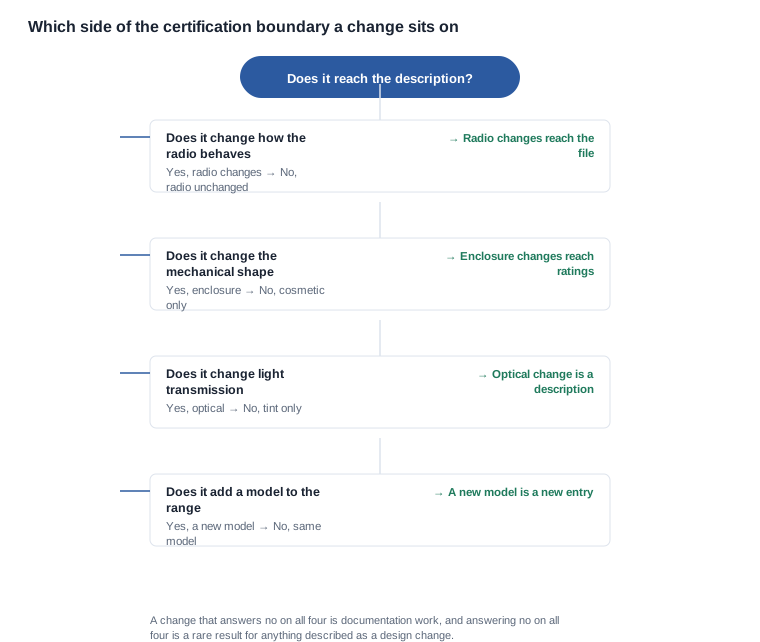

What needs a conversation before it is quoted
Note that the cost here is rarely the assessment itself. The cost is the schedule around it — the drawing freeze, the tooling, the artwork that carries the dimension, and the marketing material that shows the profile. That is why this group is raised at quotation time even when the technical answer turns out to be that nothing is required.
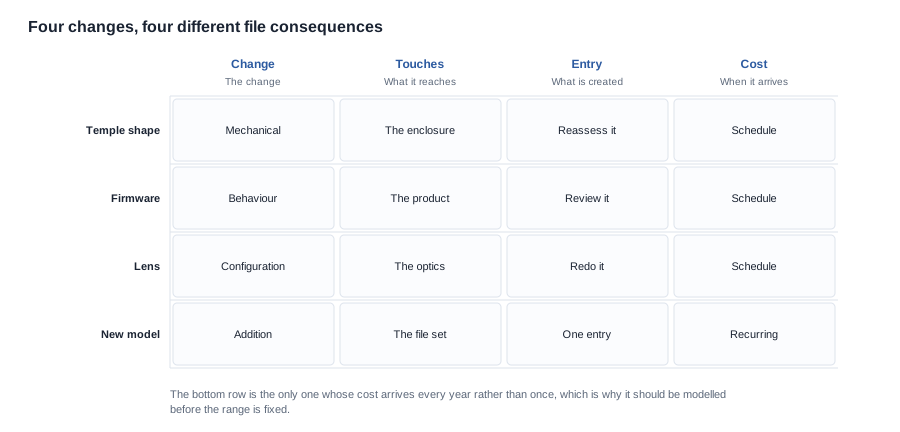
A temple shape change. This alters the mechanical description of the product, and a mechanical description is part of what the technical file records. Where a rating has been established on the enclosure — the IP54 marking on our sport models is a catalogue marking with no test report number behind it — a change to the enclosure is a change to the thing the rating was about. The same logic applies to any change that reduces a clearance or moves an opening, because both are the kind of thing an ingress rating was established on. It may require nothing to be redone and it may require a fresh assessment, and the only way to know which is to raise it before the design is frozen.
A system and interface change. The question is narrow and worth asking directly: does the change reach behaviour that the technical file describes? Changing menus, on-screen strings and the application does not, because the radio is unaffected. Changing something that alters how the radio behaves does, and that is a different conversation with a different cost attached to it.
The reason this group is the expensive one is that the answer depends on a technical file the buyer will probably never read. What the file asserts about behaviour is written once, at a level of abstraction that assumes no further change, and any change that reaches inside that abstraction has to be checked against it by somebody who built the product.
A firmware behaviour change. This is the one with the widest range, and it is the one most often waved through. A firmware change is only a firmware change if it leaves the radio and radio-adjacent behaviour alone. A change to the wake word, the capture logic or the assistant workflow sits inside the product description and can move what the file set asserts.
A fifth belongs here and is easy to miss because it arrives as a supplier suggestion rather than a buyer request: a revised battery or a revised radio module sourced for cost reasons. Neither is a cosmetic substitution, and a substitution made after the file is closed is exactly the situation the file was supposed to prevent.
The general pattern is worth stating once: the certification consequence tracks how close a change comes to something a laboratory measures. Everything at arm's length from that — artwork, finish, label, string — is documentation. Everything at the far end — enclosure, radio, optics, power source — is technical. The difficult cases are the ones in between, and they are difficult precisely because somebody has to consult a file written by someone else.
A lens configuration change. For a camera product this is a camera change. The V03 Pro publishes a photochromic lens configuration alongside its 8 MP camera, and the optical description of the product has genuinely changed with it. A lens that alters light transmission is not a cosmetic variant, however it appears in a product page.

Step four is the one that catches people out. Adding a model feels administrative from the outside, because nothing about the hardware changes; from inside the file it is a new entry with its own maintenance cycle. A brand that treats it as an administrative step will discover the obligation at the first review rather than at the quotation.

The change that is always a new file entry
One further point on adding models: the obligation is not only to create the entry but to keep the models distinguishable. Where two entries in the same file are described in near-identical terms, a declaration can cover both only if the descriptions match, and near-identical descriptions are where the mismatch appears. Distinct model designations, distinct names on the rating plate and distinct entries in the file are three cheap decisions that remove an expensive ambiguity.
Adding a model is the change most often underestimated, because it feels like a configuration rather than a new product. A file set is a set of models, and every model added to the range is an entry that has to be created, held and kept current. A brand that plans a range of six models from one platform has created six entries, and the documentation work scales with the range rather than with the platform.
That is the part most buyers do not model. The platform is a single exercise; the range is a recurring one. The incremental cost of the second model is lower than the first and higher than zero, and the incremental cost of the sixth is higher than the second because it crosses whatever threshold a market applies to product variants.
The threshold is worth naming explicitly. In several regimes the unit that matters is the distinct model or the distinct configuration as listed in the file, and a variant that shares a housing but differs in firmware or optics is counted separately from the base. A range built from one platform is therefore not one entry; it is one entry per combination that the file has to describe, and the combinations multiply faster than the models do.
There is a practical consequence worth stating. Where the range is planned before the first quotation rather than after it, the number of entries is a decision. Where it is planned after, the number of entries is an accumulation, and the accumulation is usually larger than the decision would have been.
The obligation also has an owner. In a small factory the file set is frequently maintained by the same engineer who built the product, which means the maintenance capability leaves when that person does. A programme that depends on one engineer for both the product and its documentation has a single point of failure that no contract currently addresses, and asking about it during due diligence costs nothing.
The related point is the periodic obligation. The file set for a model is not a one-time exercise; it has to be maintained, and in several regimes it has to be reviewed on a cycle. A brand that adds two models a year and does not plan for the maintenance is creating a recurring cost that was never in the quotation.
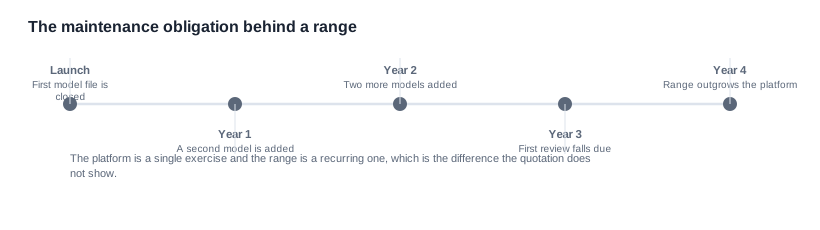
The year-four line is the one that changes a buyer's mind. At that point the platform has been carried for longer than the original quotation assumed, the range has grown, and the cost of keeping the file current is a known quantity rather than a risk. A programme that reaches year four without having modelled it discovers the cost exactly when it has the least ability to change the range.

The questions to ask, and in what order
Ask the certification question at the same time as the price question, and get the answer in the same form — per customisation, rather than as a general reassurance.
- Which of these change the technical description of the product?
- Which of these create a new entry in the file set?
- Which of these are purely commercial?
- Which of these change the documentation but not the file?
- What is the maintenance obligation per entry, and on what cycle?
- Who confirms the answer in writing before a quotation is issued?
- What happens to a model whose file entry falls out of date with the product?
- Which markets does the answer apply to, and which are still open?
Questions seven and eight are the ones that convert a classification into a programme. The first asks what recovery looks like, and the second makes explicit that a file set is jurisdiction-specific rather than global — which is true of every regime that issues model-specific documentation.
The first four produce a list you can hold. The fifth is the one that determines whether the range is affordable over three years. The sixth is the one that prevents the entire exercise being repeated, because an answer given verbally is an answer you will ask for again at the next quotation.
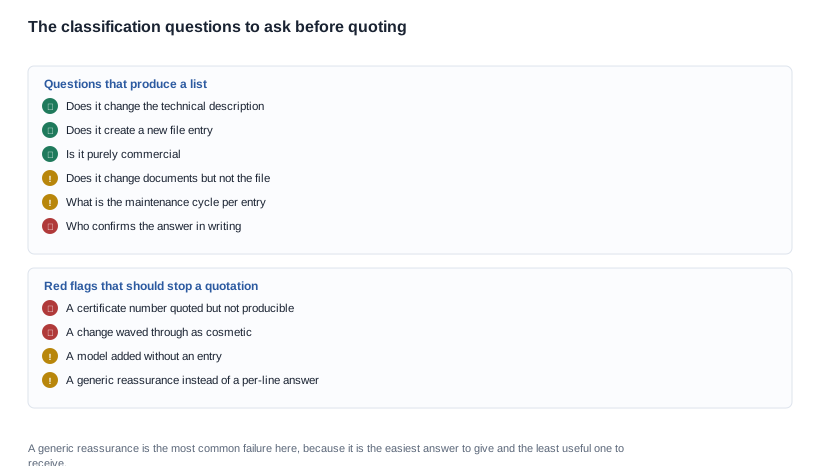
Keep the classification list where the people who propose changes can reach it. A list held by the person who negotiated it will be consulted once, and the second proposal will arrive with the same question again. A list held with the artwork files, the firmware register and the purchase order is consulted automatically.
One practical format works better than a spreadsheet for this: a single page, one line per customisation, four columns. It fits on a screen, it survives being forwarded, and it can be attached to a purchase order without anyone needing a tool to open it. Anything more elaborate tends to live in a system that only one person knows how to use, which is the same single point of failure described above in a different form.
Where a change arrives that is not on the list, treat that as a signal about the boundary itself rather than about the particular change in front of you. Three unlisted changes in a quarter means the boundary was drawn in the wrong place, and redrawing it costs an afternoon. Continuing to answer unlisted changes individually costs considerably more.
The second habit matters more than the first: a change proposed after the file is closed is not the same problem as a change proposed before it, even when the change itself is small. The difference is entirely in the schedule, and the schedule is where the money is.
For a buyer negotiating with more than one supplier, the classification list is also a comparison tool. Two quotations that describe the same customisation differently are not comparable, and the usual reason is that one party treated the change as cosmetic while the other treated it as technical. Agreeing the classification before comparing prices removes the most common source of a false price gap.
Where a change is genuinely cosmetic, the way to keep it that way is to state what "cosmetic" means in the agreement. A named list of surfaces, materials and artwork positions — agreed once — turns an open-ended question into a check anyone can run in a minute. Without it, every future request becomes a fresh argument rather than a lookup.
A short closing note on scope. Everything above concerns the product as configured, not the product as assembled by a third party downstream. A buyer who adds a local power supply, a local radio module or a local enclosure after the file is closed has created a new product that the file does not describe, and that product is the buyer's to certify rather than the factory's. The boundary is worth writing into the agreement so the question never has to be argued later.
None of this requires a consultant or a laboratory. It requires that somebody owns the list, that it is consulted before a change is accepted rather than after it is built, and that the answer is written down in a form the next person can use without asking.
A second discipline pays for itself more quietly: keep a dated log of every classification decision, with the reason and the person who made it. Six months later the reason is the only thing that survives, because the change will have been implemented, the quotation closed, and the original requester gone.
What we can confirm today, and what stays pending
We publish the customisation lines our catalogue lists, and we publish the certification position as it stands rather than as a reassurance. Our catalogue states no CE, FCC or RoHS text, carries no per-model certification row and evidences no FCC certification, and no model-specific certificate number is published for any model. We will not print a certificate number we cannot quote, and we will not tell a buyer that a change is certification-neutral without knowing what the change does to the technical description.
The question to ask a supplier is therefore narrow and can be asked in a sentence: can you produce this document, for this model, on request, today? A yes with a document attached is the only answer that changes anything, and it is worth asking before signature rather than during an audit where the answer has no value.
The same applies to the declaration documents themselves. A brand that receives a document without the model it covers, or with a model scope broader than the models it actually ships, has received something worse than nothing, because it has recorded a file it cannot produce on request.
That distinction is not caution for its own sake. A certificate number printed by a supplier who cannot produce it on request transfers the entire regulatory exposure to the brand, because the brand is the party named on the market-facing documentation. A model-specific number marked pending is inconvenient for a short period and defensible for the length of the programme.
If a line cannot be classified at all — and that is a legitimate outcome — the right response is to mark it open and name what would close it. An open line with a named closure is a manageable item. An open line that has been quietly assumed safe is not, because it will be carried through production on the assumption that somebody checked.
In practice the exercise runs in one pass and takes an afternoon. You send the customisation list, we return the same list with a classification against each line and a note on anything we cannot yet answer. Where a line is marked pending, it is marked against the specific figure rather than against the whole programme, so the open item stays visible and small.
What we can do is take your list of proposed customisations and tell you, for each one, whether it touches the technical description in our understanding, and which questions remain open until the company confirms the file set. The full customisation menu is under customization options, the checklist form is in customization options checklist, and the verification side is under certification verification checklist.
Related reading
- What the documentation has to cover: oem ready platform export documentation.
- The compliance side of the same decision: oem ready platform certification coverage.
- What the other customisations change commercially: customization options cost factors.
Send us the customisation list and we will mark each line as commercial, mechanical, technical, or a new file entry.


