

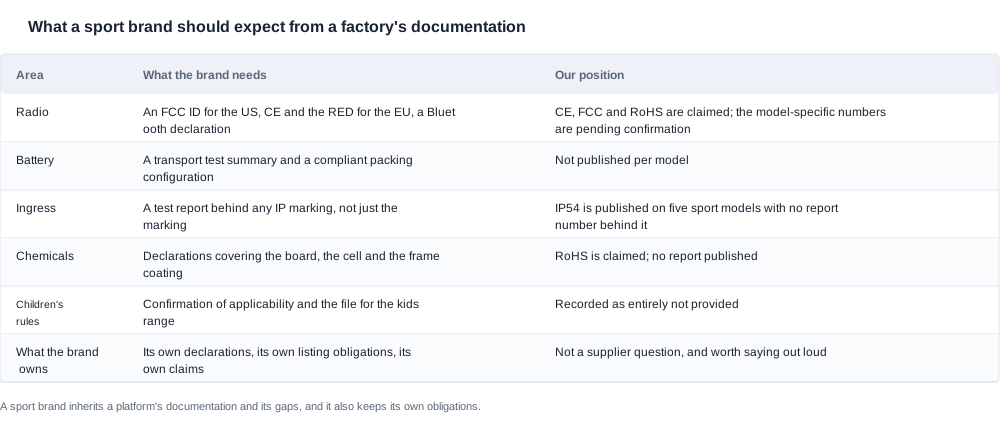
Certification support is one of those line items that sits in a quotation between a sample fee and a tooling charge, and it is frequently bought on the assumption that the supplier is selling paperwork. The assumption is half right, and the wrong half is the expensive one: a supplier is selling a document set that matches the model that will actually ship, and the work is in making the second half true.
This article is about what a certification-support engagement covers at document level, what the buyer ends up holding at the end of it, and how to write the request so that what arrives is usable in your own file.
Nothing in this article asserts a certification status for any specific model. Per-model certification status is not published, and any supplier who hands you a compliance claim without a document reference is asking you to take their word for a regulatory matter.
Smart glasses certification support: what it delivers
The clearest way to describe the deliverable is as a set of documents, each of which has to correspond to a specific model configuration, at a specific version, for specific destination markets. It is not advice. A consultant's opinion is worth what the market pays for it; a document set that your own logistics team, your own importer and your own retail compliance team can each use without calling the supplier is worth considerably more, because it transfers the burden of proof from the brand to the file.
A useful way to break the deliverable down is into four layers, which is how we will describe it here.
- The declaration itself. The document that the brand or its legal entity signs and that carries the obligations. This is the only layer that carries legal weight for the person who signs it.
- The reports behind the declaration. The third-party or internal test documents that the declaration references. They are what makes the declaration credible, and they are what a buyer, a retailer or an inspector will ask to see.
- The test evidence. The raw records behind the reports: the measured values, the photographs, the configuration notes, the sample identifiers that tie a test result back to a physical unit.
- The technical description. The document that the reports refer to. It describes the model, its configuration, its components and its variants, and it is the document that makes a report mean something, because a report that references a technical description you do not hold is a report you cannot use.
The thing a buyer is really purchasing is the connection between those four layers. A declaration without reports is an assertion. Reports without test evidence cannot be traced back to a unit. Test evidence without a technical description is a set of numbers with no product attached. This is where we will be precise about our own position: we will describe a certification-support engagement as producing a traceable chain, and we will say plainly when a layer is missing rather than letting a partial file pass as a complete one.
Two structural facts about the catalogue matter for this discussion, and both of them are about what is not in it.
First, per-model certification status is not published for any model in the range. This is a deliberate absence, not an oversight, and it is the right absence. A catalogue that publishes a compliance mark next to a product image is making a claim that has to be maintained per configuration, per market and per revision, and it will drift the first time a component changes. The absence means the brand must obtain the evidence for itself, which is slower but correct.
Second, the one certification-adjacent item that is published is a patent portfolio, and it is published in a way that demonstrates exactly why a patent portfolio is not a market-access document. The catalogue export page is an image page showing ten patent certificates — eight design patents and two utility models. It carries no per-model rows, no marking, no market reference and no expiry information tied to a model. A design patent protects how something looks; a utility model protects a mechanism. Neither is a statement that the product may lawfully be placed on a market. The distinction matters because brands occasionally see a page of certificates and read it as regulatory assurance. It is not.
A useful test for any document a supplier shows you: could this document, on its own, be used by an inspector or a market surveillance authority to establish that the unit in the box is the unit the document describes? If the answer is no, the document is a supporting artefact and you should treat it as such.

The model string is the document
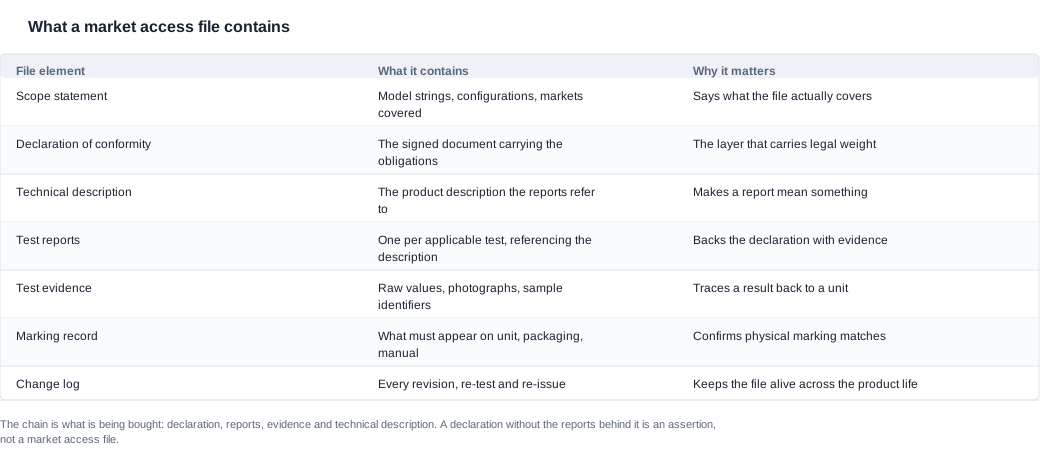
The single most common failure mode in a brand-side compliance file is a mismatch between the model identifier on the paperwork and the model identifier on the unit that ships. It happens quietly, because each side of the mismatch is individually correct: the report is valid, the unit is valid, but they are not valid for each other.
That is why the model string is treated as the document. The string on the shipping unit is the thing that has to match, because it is the only identifier that is physically present in the box. A brand-side product manager who writes "the certification" into a project plan is usually thinking of a single global approval that covers the range. The reality is more specific, and the granularity is what the file has to be organised around.
There is a difference between a family-level and a model-level declaration of conformity, and the difference determines how much of your range is covered by one document.
A family-level declaration covers a group of models that the issuing body or the supplier has determined to be equivalent for the purposes of that declaration. Its advantage is administrative economy: one document, one file, one review cycle for a set of SKUs. Its risk is that the equivalence is a judgement, and the judgement holds only for as long as the configurations in the family stay equivalent. A change to one member's configuration can break the group's cover for the whole family, not just for the member that changed.
A model-level declaration covers one model string against one technical description. It requires more document management, but each document has one subject, and the set of documents maps one-to-one onto the SKUs you actually sell.
The practical consequence for a brand planning a range: the number of documents in your file is a function of how many model strings you actually ship, not how many families you think you have. If your range is three sport models plus two audio models plus one camera model, you should expect a file organised around six model strings, and you should expect the supplier to tell you which of those six can share a family-level declaration and which cannot. That grouping is itself a deliverable, and it is a deliverable worth asking for explicitly, because it is the difference between one review cycle and six.
There is a trade-off between the two approaches that is worth naming, because brands sometimes pick one by default and regret it later. The family-level route is cheaper to administer and more fragile under change; the model-level route costs more document management and gives you a clean one-to-one map between SKU and file. The trade-off is administrative cost against change resilience, and the choice should follow how much you expect the range to move after the file is closed, not how convenient the supplier's paperwork looks in the first meeting. Our own working practice, and what we will advise on, is to ask for the model-level map as the baseline structure, and to treat any family-level grouping as an optimisation that has to be justified in writing.
The second dimension that makes the model string the document is configuration. The same model string can exist in several configurations — a lens variant, a strap, a colourway, an interface, an accessory bundle. The technical description behind the reports states which configuration the reports were run on. If your retail listing sells a configuration that differs from the tested one in a way that matters, the document set no longer supports the listing, even though the model string is identical.
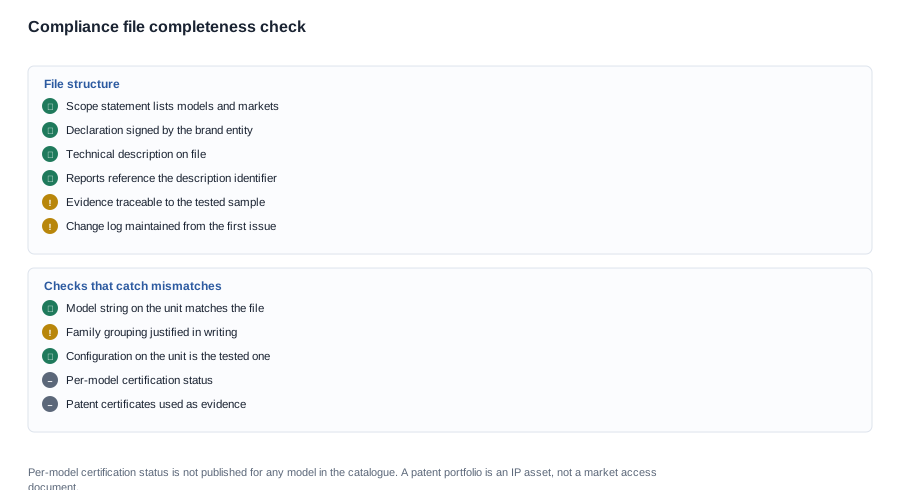
This is where the requirement that the claims be frozen at the requirements gate connects directly to what a report can support. The development framework this supplier works to runs through six gates in order: requirements frozen, feasibility reviewed, engineering and tooling, samples built and verified, compliance file closed, pilot run before mass production. A stage is finished when it produces a document, not when a date arrives.
The requirements gate is where the claims get frozen. It is the point where the brand states, in writing, what the product is and what it will be sold as: which markets, which claims appear on the packaging and the retail listing, which model strings are in scope, which configurations are in scope. That frozen statement is the input to the technical description that the reports will be written against. If the claim set is not frozen there, the reports are written against an assumption, and every report has to be revisited when the assumption turns out to be wrong.
So the order matters and it is not negotiable in practice: freeze the claims, then let the reports be written against the frozen claims. A brand that wants to change a claim after the compliance file has closed is not asking for a new report; it is asking for the file to be reopened, and the supplier is entitled to quote that as new work.

What a market access file contains
Assembled per model string and per destination market, a complete file has a recognisable shape. The order below is the order we will work to, and it is the order a brand should ask a supplier to present it in.
- The scope statement. Which model strings, which configurations, which destination markets this file covers. If it does not state the scope at the top, it is not a file, it is a folder.
- The declaration of conformity. The signed document that carries the obligations for the brand or its legal entity, with the model strings and the applicable rules listed against it.
- The technical description. The product description the reports refer to, including the configuration detail, the component list and the variants covered.
- The test reports. One per applicable test, each referencing the technical description by identifier and revision, each traceable to the sample that was tested.
- The test evidence. The raw measured values, the photographs and the sample identifiers that support the reports.
- The labelling and marking record. What markings must physically appear on the unit, the packaging and the manual, and confirmation that they do.
- The change log. Every revision of the technical description, every re-test, every re-issue, with the reason.
That last one is the item most brands discover they do not have, and it is the item that determines whether the file survives the life of the product. A file without a change log is a snapshot. A file with one is a running record that tells you, at any point, whether the unit in the warehouse is still covered.
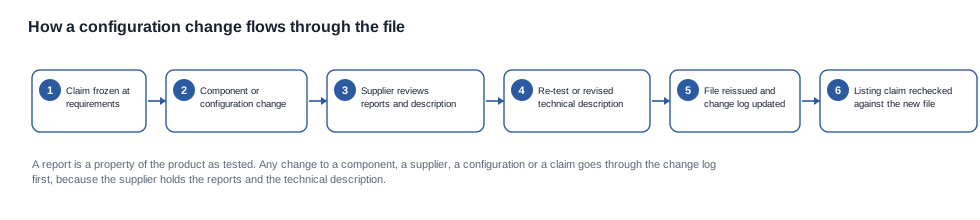
Why a configuration change invalidates a report is worth stating as plainly as possible, because it is counter-intuitive to buyers who think of a report as a property of the product. A report is a property of the product as tested. Change anything that could affect the outcome — the radio, the antenna, the enclosure material, the power source, the firmware behaviour that affects the electromagnetic characteristics, the supplier of a safety-relevant component — and the report is describing a unit that no longer exists in your inventory. The declaration does not fail because of a technical reason; it fails because the document's subject has changed while the document did not.
The practical rule that follows is simple enough to write on an internal process document: any change to a component, a supplier, a configuration or a claim goes through the change log first, and the file determines whether a re-test or a new technical description revision is required. The supplier should be the one making that determination, because they hold the reports and the technical description.
On keeping an evidence pack per model and per market, the practical advice is to organise the archive so that the file can be handed to someone who has never seen the project. That means: one folder per model string, one sub-folder per market, the declaration at the top of the model folder, the technical description and the reports beneath it, and the change log at the top level of the model folder rather than buried at the end of the sequence. A brand that has to reconstruct which report applies to which SKU during a retailer audit should not have to open a spreadsheet to do it.
Certification evidence that lives in one shared drive, named by project rather than by model, is the failure pattern to avoid. It works perfectly until the range grows, at which point nobody can say which document applies to the unit that is actually in the warehouse. The pack is cheap to set up correctly at the start and expensive to reconstruct later, and the structure described above is also the structure a brand's own insurer or market surveillance authority will expect to see. Where spares and accessory items share a model string with the main product, keep the certification evidence for the main product in its own folder and record separately which accessory items are covered by the same documents, so that a spare sold as a standalone item does not inherit claims it was never tested for.
One structural point belongs here rather than earlier, because it is the sort of thing that gets misread as regulatory: the patent certificates on the export page are a portfolio asset, and they belong in a brand's own IP and design-risk file. They do not belong in the market-access file, and they should never be offered as a substitute for a report. Keep them separate.
Questions to ask a supplier about certification scope
The purpose of a scope conversation is to establish, before the purchase order is raised, exactly which documents will be handed over and in what form. These are the questions we would put to any supplier, including ourselves.
The deliverable itself. Ask what documents are included in the certification-support scope, and ask for a document list rather than a summary. Ask in what form the documents are handed over, whether they are issued to the brand's own legal entity or held by the supplier, and whether the brand can store and re-issue them.
The model coverage. Ask which model strings the scope covers, and ask the supplier to state which of those can be grouped under a family-level declaration and which require a model-level one. Ask to see the grouping rationale, because it is the part that tells you what happens to your file when one model in the group changes.
The configuration coverage. Ask exactly which configurations of each model string the reports were run on, and ask for the technical description that identifies them. If your retail listing will sell a configuration that is not on that list, ask what is required to bring it into scope.
The market coverage. Ask which destination markets the scope covers and which are excluded. Ask what the supplier can and cannot do for a market that is not in the current scope, and ask what the lead-time implication is for adding one.
The samples. Ask how many samples are consumed by testing and whether the returned or retained units are returned to the brand. Ask whether the samples tested are production-representative or pre-production, because that determines whether the file describes the unit you will ship.
The claims. Ask which claims the file supports. A claim on a retail listing, a claim on a package, and a claim in marketing material are not automatically the same claim, and the file may support some and not others. This is the point where the frozen claims from the requirements gate come back into the conversation: if the claim set was not written down, the supplier cannot tell you which claims are covered.
The triggers. Ask what changes require a re-test, a new report, or a revised technical description. Ask how the supplier notifies the brand of a change in a component or a sub-supplier. This is the question most likely to be answered well by a supplier with a real quality system and badly by one without.
The commercial terms. Ask for a quotation that separates certification support from tooling and from samples, so that the cost of adding a market or a model is visible on its own. Ask what the MOQ and lead time look like for the compliance file itself, which incoterms apply to the documentation handover, and whether the sample cost is refundable against a pilot order or a subsequent purchase order. Ask what the supplier's position is on the warranty if a unit is later found not to be covered by the file — that conversation is far easier before the relationship starts than after the first shipment. If the per-market scope is going to be expensive to extend, negotiate the scope and the price of the first block of markets separately from the price of any later addition, so that adding a market is a decision with its own number attached rather than a change to a fixed fee.
The framing that makes these questions useful is the same in both kinds of engagement: every question here is written in the form of what to ask the supplier, and every answer should land in your file as something you can file rather than something you remember. We will keep the document list, the model-string map and the market scope as three separate outputs, because a supplier who returns one merged report cannot answer the next question you need to ask without going back to the beginning.
The final point is the one that decides how all of the above lands. Certification support is worth the most when it is treated as a delivery with a document list and a model-by-model scope, and worth the least when it is treated as a compliance checkbox that someone ticks. We will be direct about how we will handle it on our side: we will tell you which layer of the document set exists for your configuration and which does not, we will tell you when a request falls outside the published scope, and we will not present a portfolio asset as a market-access document.
The wider framework, including where this work sits between the requirements freeze and the pilot order, is set out in the certification impact article, and the documentation side of the platform is covered in the OEM-ready platforms and export documentation. If you want a checklist to work through with your supplier before raising the purchase order, the procurement certification checklist is the starting point, and the wider sports and cycling brands solution covers how the range-level decisions feed into it.


