

Most sports and cycling brands arrive at an OEM conversation with the same three questions wearing different clothes: can you build this, can you build it again the same way, and what happens when something goes wrong in the channel? The answers are rarely found in a product page. They are found in the documents a supplier is willing to put its name on, and in the sequence in which those documents appear.
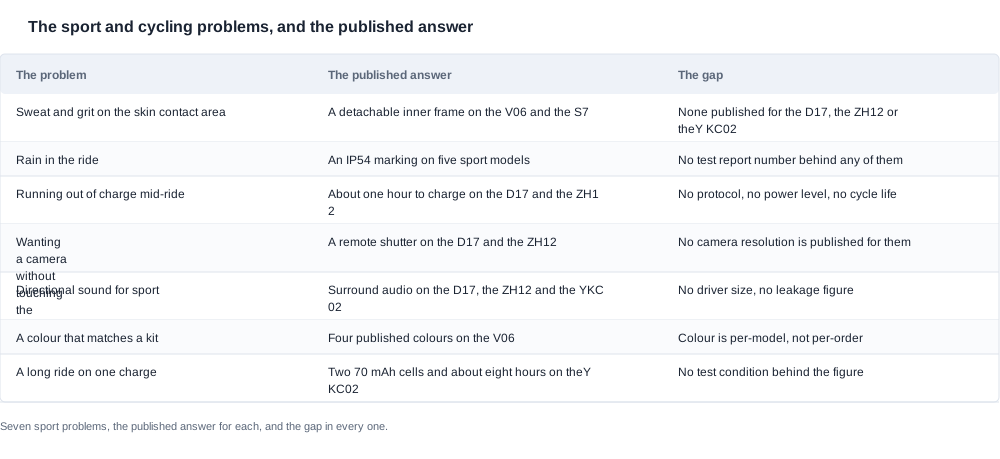
This article describes how our development programme for sports and cycling ranges is structured, what we are accountable for at each step, where the responsibility line sits with your team, and how you can test whether a supplier's process is real or decorative. It is written for the product manager or channel buyer who will eventually sign a purchase order and live with the result.
The short version: a supplier programme is a chain of gates, and each gate closes by producing a document rather than by passing a date. If a supplier cannot tell you which document closes which gate, they are not running a process. If they can, you have something you can audit, and you can hold the supplier to it when a pilot run behaves differently from a bench sample.
Smart glasses programme: what we are accountable for
Our programme runs through six gates, in a fixed order. The order matters more than the individual steps, because each gate consumes the output of the one before it. A stage is finished when it produces a document, not when a date arrives on a plan. We will refuse to advance to the next gate on the basis of verbal confidence alone, because verbal confidence is exactly what cannot be presented to a compliance reviewer, a retail buyer, or an insurer.
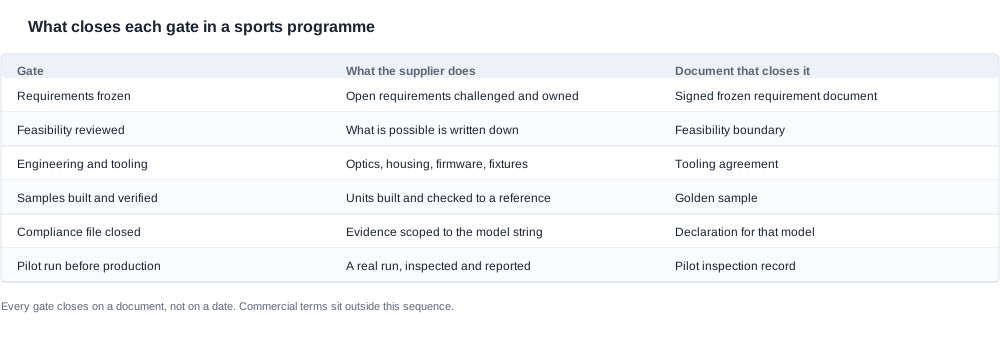
The six gates, and what we owe you at each:
-
Requirements frozen. Before any engineering conversation is productive, the requirement set has to be written down and agreed. Our accountability here is to interrogate it. We will challenge an open requirement by asking what a customer will be able to tell the difference between, and we will mark clearly which requirements are fixed, which are parameterised, and which are genuinely open. The output is a frozen requirement document that both sides have signed. If a requirement is still open at this gate, it is recorded as open, with an owner, rather than quietly absorbed into the build and discovered later. What we do not own at this gate is the market decision behind the requirement. Which feature set justifies which retail price, which claim goes on the pack, and which segment you are targeting are yours to decide.
-
Feasibility reviewed. With the requirements frozen, we assess whether each one can be met, and at what cost in engineering, tooling and risk. The output is a feasibility boundary: a written statement of what we can do, what we cannot do with the current platform or the current component supply, what would need to change, and what the constraints are. This document is deliberately a boundary and not a promise, because the honest answer at this stage is usually a set of conditions rather than a yes. Where we believe a requirement is not achievable in the form written, we will say so in writing at this gate, which is the cheapest moment for you to change it. A requirement that is quietly reinterpreted in engineering, because nobody wanted to reopen the conversation, is the single most expensive way for a programme to lose control of its own specification.
-
Engineering and tooling. Here the programme becomes physical. We own the engineering work and the tooling work: lens geometry, housing, the electronics, the firmware behaviour, the assembly process, and the fixtures and jigs that make a repeat build repeatable. We will classify every requested change as engineering work or as a commercial change, and we will tell you which is which in writing before it is executed. A change that alters the physical form of the product or its measurable behaviour is engineering. A change to the name on the box, the colourway designation, the packaging artwork or the channel naming is commercial, and we will handle it as such.
-
Samples built and verified. Samples are built to the frozen requirements and to the agreed golden sample definition, and then they are verified against it. The output is a golden sample: one unit, agreed and signed by both sides, that becomes the reference against which every later build is judged. This is the single most useful document in the whole programme, because it converts a subjective argument about whether a unit is acceptable into a comparison against a physical reference. We will record what was checked and what the result was, and we will tell you which checks were run and which were not, rather than presenting an incomplete verification as a complete one. We will also record the checks that failed on the first sample, because a verification record in which every item passes on the first attempt tells you very little about the process that produced it.
-
Compliance file closed. The output here is a declaration scoped to the model string: the specific model identifier, against the specific regulation, with the supporting documentation attached and the scope of the claim stated in words that can be read by someone who did not attend the meeting. We will tell you plainly which regime applies to which model and what evidence exists. Where a certification route is open to us and evidence exists, we will name it; where it is not established for a model, we will say that it is not established. We will not transfer a claim from one model string to another, because a declaration that is scoped to the wrong model string is worse than no declaration at all. Certification evidence is discussed separately in smart glasses certification support.
-
Pilot run before mass production. The final gate runs a pilot order rather than a production run. The output is a pilot inspection record: what the line actually produced, what was inspected, what the defect observations were, and what was done about them. A pilot run exists to find the things that only appear when a process runs more than once in a row — fixture wear, station drift, operator variation, and the small tolerances that look fine on a single hand-built unit and do not survive a real run. We will report pilot findings in our own words, including the findings that are inconvenient, and we will tell you which of them were resolved before the mass-production release and which were accepted as known conditions with a monitoring plan.
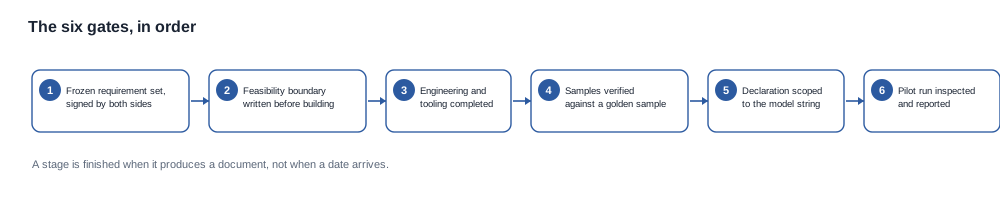
A note on what the gates deliberately do not do. They do not contain a commercial gate, and they do not contain a production release gate that the supplier can pass on the buyer's signature alone. That is intentional. A process that mixes commercial negotiation with technical verification tends to compress the verification until it becomes a formality, and a process that lets the buyer release mass production without a supplier-owned inspection record tends to hide the pilot findings until they arrive in a returns figure.
Where the boundary sits with the buyer
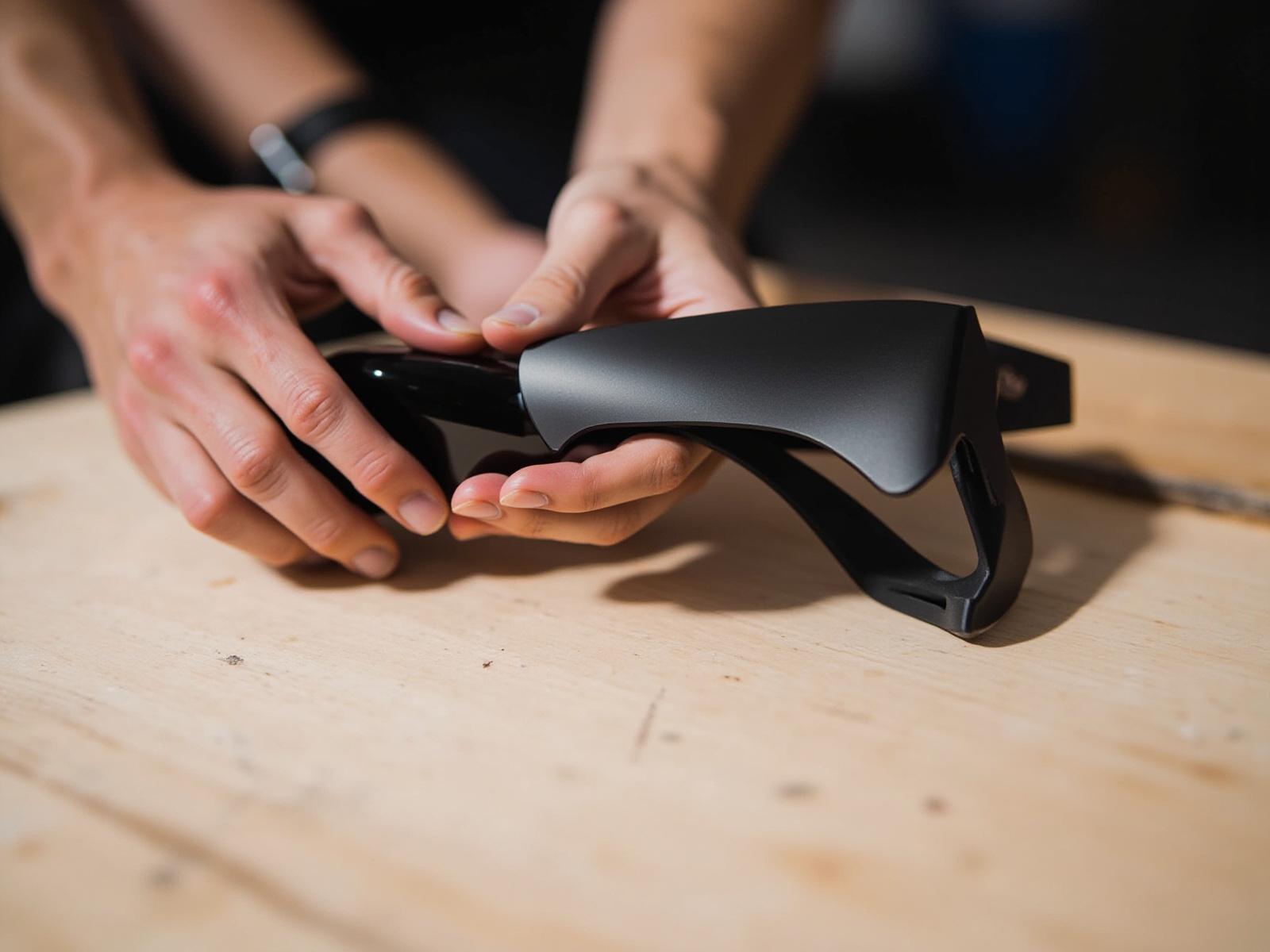
A supplier programme fails most often not through technical incompetence but through unallocated ownership. Two parties each assume the other is handling the claim wording, the packaging artwork, the certification route, or the channel inventory plan, and the gap surfaces after tooling is cut. We prefer to fix that by writing the boundary down, at the feasibility gate, while the change is still cheap.
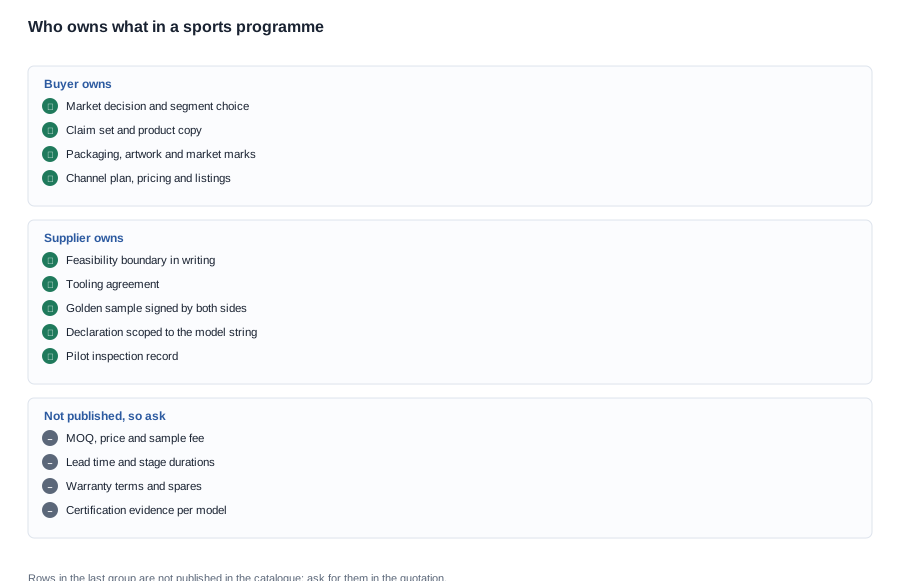
On our side of the line, we answer in writing:
- A feasibility boundary — what is achievable, what is not, and what would have to change.
- A tooling agreement — what tooling we are cutting, what it produces, what it is for, and what happens to it if the programme stops.
- A golden sample — the signed physical reference for build acceptance.
- A declaration scoped to the model string — evidence for the specific model identifier, with the scope stated in words.
- A pilot inspection record — what the run produced and what was found.
On your side of the line, you own:
- The market decision. Which customer, which price architecture, which channel, which geography. This drives everything upstream and it cannot be delegated to a factory, because a factory does not carry the margin or the channel risk.
- The claim set. What the product is permitted to say on the pack, on the product page and in the listing. We can tell you what evidence supports which claim; the decision to make the claim is yours, and so is the risk of making one that the evidence does not carry.
- The packaging. Artwork, copy, regulatory marks that depend on your market, barcodes, and the physical pack structure. Packaging is also where the first physical proof of the range lives, so it is worth deciding early what it has to communicate.
- The channel plan. How the range is priced, listed, promoted and supported in retail and online channels, including which units become demo stock and which become aftersales replacements.
The practical test of a well-drawn boundary is simple: at any point, you should be able to ask "who owns this?" and get an answer that names a document. If the answer is "we both do", that is an unallocated risk, and it should be recorded as one rather than left to surface later.
A note on quantities, terms and timing, because these are the questions buyers most often raise first. Catalogue-level capacity figures, indicative lead times, stage durations, prices, MOQ, sample fees and warranty terms are not published by us as fixed numbers, because for an OEM programme they are functions of a configuration and a volume that do not exist until the brief is fixed. We will not invent a figure to fill the gap in a proposal, and we will not publish a number in a brochure that we cannot honour in a purchase order. What we will do is state the assumptions a figure depends on, and we will put those assumptions in the quotation in the form of what to ask the supplier before you compare two quotes. Incoterms, negotiable terms and lead time assumptions belong in the quotation with their conditions attached, and any attempt to compare two suppliers on a number that has had its conditions stripped out is a comparison of the wrong thing.
Where a buyer wants a single number and we give a set of conditions, the trade-off is deliberate. A fast quote built on a guessed configuration is a cheap document and an expensive programme, because the rework lands after tooling. A conditional quote is slower to produce and far cheaper to act on. If you need the single number earlier than the conditions can be established, the honest route is to narrow the configuration until the conditions collapse into a number, not to have us widen the assumptions.

How engineering judgement shows up in practice
Most of the daily work in a sports or cycling programme is deciding whether a change is engineering. It sounds like a small administrative question, but it decides cost, timing, and whether the programme needs to go back through a gate. A lens geometry change is engineering work. A firmware behaviour change is engineering work. A naming or packaging change is commercial.
The distinction is worth spelling out, because in practice the boundary is drawn by what the change physically or measurably does to the product, not by who asked for it.
A lens geometry change alters the optical path. It changes the housing tooling, it changes the seal arrangement, it changes how the frame sits on a face and therefore how it sits on a head under movement, and it changes what the camera actually sees. That is engineering, and it is handled as engineering: we assess it, we quote it, we build it, we re-verify the affected checks, and we update the golden sample. If a cycling brand asks for a wider field of view because riders want to see their blind spot without turning their head, that is not a cosmetic request and it is not treated as one. It is also not free, and a supplier who quotes it as a firmware setting rather than an optical change is buying you a defect.
A firmware behaviour change alters what the device does, even though the plastic is identical. A change to how a recording is triggered, how a control responds, how the device behaves after a fall, or how a file is named and stored is engineering work, because it changes the user-visible behaviour that the golden sample certified. It also carries a specific risk in sport: firmware behaviour under motion, under rain, and with gloves on is not the same problem as firmware behaviour at a desk. We will tell you which behaviours we have verified in which conditions, and where verification is partial, we will say that rather than implying a general claim. An honest "verified for this condition, not verified for that one" is a more useful sentence than a broad assurance, because it tells your product manager exactly what to put in the product page and what to leave out.
A naming or packaging change alters what the product is called and how it is presented. Renaming a model string, adding a colourway designation, changing the artwork on the box, adjusting the product name that appears in listings, or altering the brand mark does not touch the optical path, the electronics, or the firmware. It is commercial work. We will handle it through the commercial channel, confirm it in writing, and it does not consume an engineering cycle.
The practical reason to classify carefully is that the classification determines who owns the risk. Engineering work reopens the golden sample and the verification record. Commercial work does not. If a change is misclassified as commercial when it is engineering, the product ships with a behaviour that was never verified against the agreed reference, and the mismatch is discovered by a customer rather than by the process. The reverse mistake is wasteful in its own way: a packaging rename routed through engineering consumes a cycle, delays the artwork release, and makes the programme look slower than it is.
A related habit matters as much as the classification: we will report a named blocker early. A supplier who tells you in writing that a requirement cannot be met as specified, with the reason and the alternatives, is a better partner than one who stays quiet and lets the programme run to a surprise. Silence is not risk management. It is risk deferral, and it always costs more, because by the time a blocked requirement surfaces it is usually already embedded in tooling, in artwork, or in a channel listing that is difficult to retract. The cheapest moment to hear "this cannot work as written" is at the feasibility gate, where the only thing at risk is the requirement document.
After the programme ships
Shipping is not the end of the relationship for a sports or cycling range; it is the point at which the real usage conditions start, and those conditions are the ones that a bench verification cannot fully predict. What support looks like after a programme ships is therefore part of what you are buying, and it should be discussed before the purchase order rather than after the first field complaint.
Four elements are worth confirming in writing:
- Spares. What is held as spare stock for the programme, how replacement units are made available to your channel, and what the process is for a defect discovered in the field rather than on the bench. Spare parts, like everything else commercial, carry terms, and those terms should sit next to the technical commitments rather than in a separate commercial conversation.
- Firmware fixes. How a defect found in the field reaches engineering, who decides the priority of the fix, and what your visibility is when a fix is released. For a sports range where the marketing claim and the user expectation are tied to a behaviour, a firmware fix that changes behaviour is a commercial event as well as an engineering one, and the listing copy may need to change with it.
- Replacement parts. Which parts are individually replaceable — battery, charging case, strap, temple, mount — and which are not, because a unit that can only be replaced whole has a very different field economics from one that can be repaired in a channel. Mounting arrangements matter especially for cycling, where the unit is carried on a helmet or a bar mount and the mechanical interface is part of the product.
- The support channel. Who receives a support request, through what route, and what response is committed to. A support route that only exists as a named individual is a risk; a support route that is a documented channel with a defined escalation path is an asset.
Warranty terms are part of this conversation. We do not publish a fixed warranty statement for a catalogue range, because the meaningful warranty for an OEM programme is a function of the volume, the channel and the agreed quality target, and a generic number detached from those conditions is not a commitment — it is decoration. We will negotiate warranty terms explicitly, in writing, against the quality target established at the pilot gate, and we will show you how the two are linked. A warranty that ignores the pilot findings is a warranty that prices risk into a price rather than into a process.
For a first programme in this category, the range decisions usually sit alongside these questions. Our sport smart glasses collection covers the models that carry the sport position, and the sports and cycling brands solution page sets out how the ranges are grouped. Conditions of use still need their own review: the sports and outdoor weather considerations piece covers what happens to these devices when they are used where they were not designed to be used, and that review should happen before the requirement set is frozen rather than after.
The purpose of describing all of this is not to present it, but to make it testable. Any supplier can describe a disciplined process. A few can show you the documents from the one before last. These questions are designed to separate the two.
- Which document closes the feasibility gate, and will you send it for a programme we have not started? If the answer is a brochure, you are looking at marketing. If the answer is a format with a boundary structure — what we can, what we cannot, what changes it — the process exists. Ask to see one with the client name removed.
- What is the golden sample in your process, and who signs it? A golden sample that only our quality manager sees is a reference unit, not a golden sample. A golden sample carries both signatures, and it is what makes an acceptance argument resolvable.
- Show us a pilot inspection record from a previous programme. The content matters more than the branding. It should show what was inspected, what was found, and what changed afterwards. A record with only passes in it is not credible.
- How do you classify a firmware behaviour change versus a packaging change, and where is that written? The answer should name a rule and a document. If the answer is a conversation, the classification will be renegotiated whenever it is inconvenient.
- What will the compliance file contain, and against which model string is it scoped? The scoping question is the important one. A declaration that is not tied to a specific model string is not evidence for the model you intend to ship.
- What happens if we stop after the pilot run? Tooling ownership, spare parts, and what can be reused all become relevant. A supplier who has not thought about the exit has probably not thought about the entry.
- Who is the named support contact, and what is the channel? Ask for the channel, not only the person.
We will answer all seven of these with a document or a direct reference to one, on a programme of comparable scale. We will also tell you the things that are not published and what to ask the supplier to supply instead, because a buyer who knows the difference between a withheld number and an unavailable number negotiates better. That distinction runs through this whole article: published rows such as cell capacity, runtime, charging method and ingress rating can be compared directly between suppliers, while the commercial terms that decide whether the programme works are the ones you have to ask for, in writing, as part of the quotation.
That is the whole of what we offer here. Not a claim that every programme runs without trouble, but a programme in which every stage ends in a document you can hold, every boundary is written down, and every hard question has a named answer. The smart glasses certification support article covers the evidence side in more detail, and the sports and cycling brands solution page brings the model and programme questions together.


