

The remote shutter is the feature that makes a sport camera product feel like a sport product, and it is also the least finished object in the published documentation for smart glasses. Two models in the sport range publish it — the D17 and the ZH12 — and the sport family's customisation list includes the remote control itself. No pairing behaviour, no range, no charging method, no ingress status and no dimensions are published for it.
Integrating a remote is not a branding task. It is a product decision about who holds the thing, and it has to be made before the packaging is designed rather than after the artwork is approved.
Smart glasses remote control starts from the published rows
Everything about the remote integration has to be built upwards from what the catalogue actually publishes, and the published rows are narrower than most buyers expect.
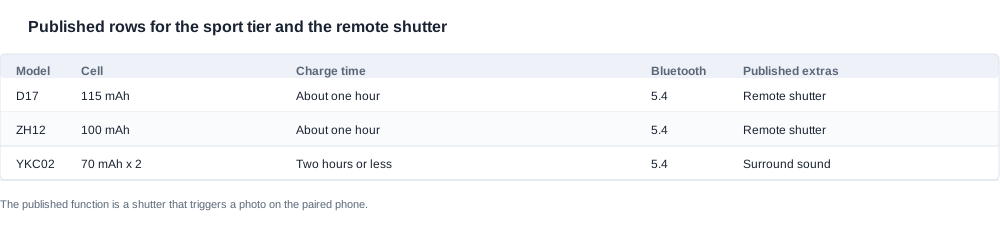
The two configurations that publish a remote shutter are the D17 and the ZH12. Between them they publish Bluetooth 5.4, Type-C charging, a charge time of roughly one hour, a remote shutter, and stereo surround sound, with the D17 running a 115 mAh cell and a runtime of roughly seven hours and the ZH12 running a 100 mAh cell and a runtime of roughly eight hours. The third model in the sport tier, the YKC02, publishes Bluetooth 5.4, two magnetic charging, a charge time of two hours or less, 70 mAh cells, a runtime of roughly eight hours and surround sound — and no remote shutter.
The published function of the remote is specific and worth repeating exactly: it is a shutter that triggers a photo on the paired phone. That is not a camera button on the frame. The camera sits in the glasses, the shutter sits on the remote, and the resulting file appears on the phone. A brand that markets the remote as a camera button is describing a different product, and the customer who expects the frame to capture when they press it will conclude that the product does not work.
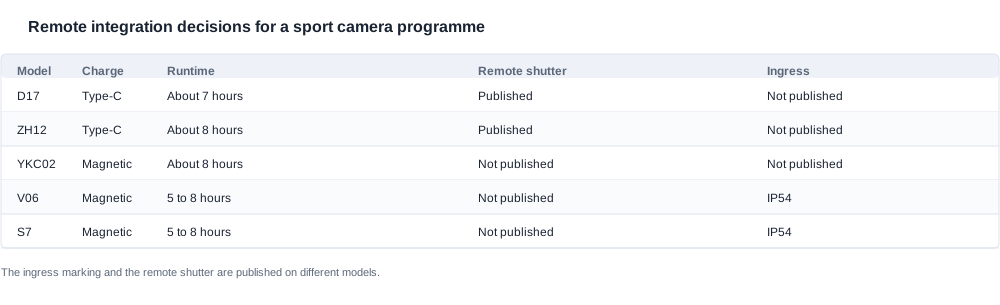
One observation about the range is worth stating early, because it changes what a brand can safely say on a product page. The ingress marking and the remote shutter are published on completely different models. IP54 is published for the V06 and the S7, and neither of those publishes a remote shutter. The remote shutter is published for the D17 and the ZH12, and neither of those publishes an ingress marking. A page that says "IP54 with remote shutter" describes a combination that no published row supports.
It is worth being precise about what "published" means in this context, because the word is doing a lot of work in a remote integration. It means the catalogue carries a row stating that a remote shutter exists for that configuration. It does not mean the catalogue describes how the remote pairs, what radio it uses, how it is powered, how far it reaches, or how it is protected. The published remote shutter is a function statement, and every integration question a brand has to answer sits in the space the statement leaves open.
The surrounding range sharpens the point further. The V06 and the S7 sit in the camera group rather than the sport tier, and they publish the ingress marking and the detachable inner frame but not the remote shutter, while the D17 and the ZH12 publish the remote shutter and the fast Type-C charge time but not the ingress marking. A brand that wants a remote and an ingress marking in the same configuration is asking for a combination that no published row supports, and the honest answer is that the two have to be qualified separately or the product page has to describe only what exists.
Smart glasses integration decisions a brand settles before artwork
Three decisions sit upstream of the packaging, and each of them has to be taken before the artwork is approved rather than after it is printed.
One: is the remote bundled, or is it a catalogue line? A bundled remote needs a home in the box, and a moulded pocket in the insert is the difference between a customer who uses it and a customer who loses it in the first week. A separate catalogue line needs its own stock position, its own packaging, its own minimum order quantity and its own spare-parts plan. The two routes also have very different commercial shapes: a bundled accessory carries its cost inside the unit price and hides inside the carton, while a catalogue line exposes it as a separate purchase and puts it on the distributor's shelf.
Two: does the remote carry the brand? A branded remote is a visible piece of the brand in the customer's hand, and it is small enough to ship as a spare without a freight discussion. It also means the remote artwork has to be approved alongside the frame and the box, because a customer holding a branded remote and a branded frame expects them to be the same product. The published customisation list for the sport family includes colour, frame shape, lens configuration, packaging and the remote control itself, so the surface is real — but the customisation scope, the artwork route and the minimum quantity are not published, and those three answers determine whether a branded remote is a realistic plan or an aspiration.
Three: what happens to the pairing when the customer's phone changes? A customer who switches phones has to re-pair, and how that works determines whether the product keeps working or ends up in a drawer. This is a product decision about the firmware and the application rather than a packaging one, and it belongs in the same conversation as the camera application itself. It also belongs in the instruction leaflet, because the leaflet is what the customer reads at the moment the product stops working.
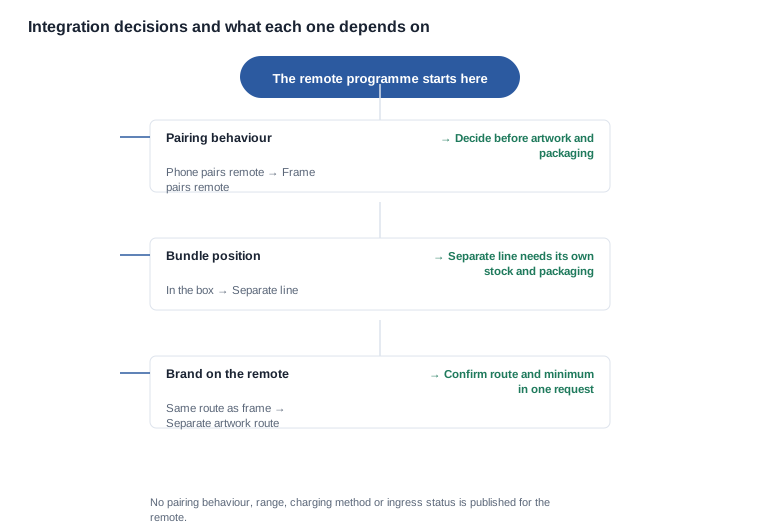
The three decisions share a common failure mode: they are all made late. A brand that decides the pairing behaviour after the packaging tool is cut will either change the box or ship a leaflet that describes something the firmware does not do. A brand that decides the branding after the artwork is approved will pay for a second artwork route. The sequencing is simple and it is worth stating plainly — the pairing behaviour first, then the bundle decision, then the artwork, then the packaging, then the leaflet.
Before any of the three is taken, the shortlist criteria are worth writing down, because the accessory is exactly the part of a programme that gets decided by whoever is loudest rather than by whoever specified it. Four criteria carry most of the weight: the customer can reach the remote without touching the frame, the pairing survives a frame reset, the remote is recoverable when it is lost, and the artwork route is compatible with the lead time the programme is built on. A decision that fails any one of those four is not a saving; it is a support cost moved to the wrong quarter.
Smart glasses remote control as a support cost
The remote is often planned as a feature and experienced as a support obligation, and the gap between those two is where the cost sits.
The customer-facing sequence has five steps, and each of them is a point where a brand either has an answer or has a support contact.
- The customer unboxes the frame, the charging accessory and the remote. If the remote has no home in the box, it is a loose object from the first minute and it will be found in a pocket long after the customer stopped looking for it.
- The customer powers the frame and the phone up, and the phone finds the frame. This is ordinary Bluetooth pairing, and the published Bluetooth version for both remote-equipped models is 5.4.
- The customer pairs the remote. This is the step that is not published, and it is the step the instructions have to describe. If the remote pairs to the phone directly, the customer does it once and it survives a frame reset. If it pairs through the frame, a frame reset breaks it, and the customer will describe that as the product being broken.
- The customer raises the remote and takes a shot. The frame captures and the file lands on the phone. This is the moment the remote earns its place, and it is also the moment a customer forms a permanent impression of the whole product.
- At some point the remote is lost, the battery dies, or the phone changes. Each of those is a support contact unless the brand has decided in advance what happens.
That fifth step is where a brand can either pay once or pay repeatedly. A replacement remote sold as a catalogue line with a stated price, a pairing reset instruction and a short support script cost almost nothing to decide and are expensive to improvise under pressure. Where the remote is bundled and no replacement route exists, the customer who loses it in month three has a product they cannot fully use, and the refund conversation is more expensive than the remote ever was.
Support cost is measurable, and it is worth measuring because the numbers are usually kinder than the brand expects. Two figures are enough: the share of support contacts that name the remote, and the average number of contacts per remote-related case. A brand that has not sold enough units for either figure to be stable can still measure them on a pilot, and the direction of travel is visible long before the absolute numbers are. The measurement criteria should be fixed before the pilot rather than chosen afterwards, otherwise the definition of a remote-related contact will drift to suit whichever answer the team prefers.

The claim discipline applies to the accessory as strictly as it applies to the frame. A customer who has been told the glasses carry an ingress marking will assume the remote carries it too, because the remote is the object they hold in a sweaty hand at the exact moment they are least able to deal with a problem. No ingress status is published for the remote, and we will not estimate one. The remote control options piece works through the accessory question in full, and our IP rating guidance covers what a marking does and does not mean — in particular, that a marking on one object in the box says nothing about another object in the same box.
Smart glasses customisation scope around the remote
The published customisation surface for the sport family is colour, frame shape, lens configuration, packaging and the remote control itself. The camera family's published list adds logo, system and interface, the Bluetooth device name and firmware. That is the entire published scope, and a brand planning a private-label sport programme is working inside it rather than alongside it.
What that scope does not tell you is the part that decides the schedule. The artwork route for the remote is not published, and neither is the minimum quantity, the tooling treatment for a small moulded part, the lead-time contribution, or whether a remote can carry a different artwork treatment from the frame at all. A remote is a small moulded object with its own cavity, and a small cavity behaves differently from a frame in a tool: it is more sensitive to surface finish, more sensitive to tolerance, and more likely to carry a visible mark or a draft mismatch. Any of those effects shows up on the object the customer holds most often, and none of them can be judged from a specification.
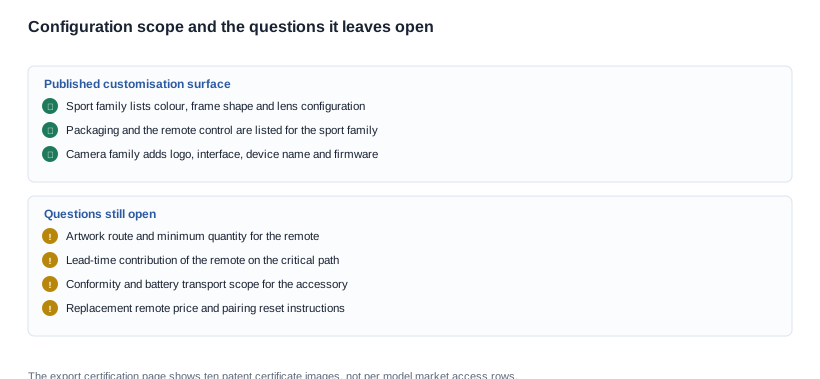
The checklist itself is short, and it is worth keeping it short, because an accessory question list that runs to two pages gets answered selectively. Five lines cover it in practice: the pairing behaviour, the radio and battery arrangement, the charging method, the ingress status if any, and the replacement route. Each of the five is a question to a supplier, each has a document that could answer it, and each is either closed before the artwork is approved or carried forward as a known open item on the programme file. The alternative — leaving them open and hoping the sample reveals them — costs a tooling cycle each time one of them turns out to be a constraint.
Four questions close that gap, and they are worth asking in one request because each one constrains the others.
- What artwork route does the remote take, and is it the same route as the frame or a separate tool?
- What is the minimum quantity for a customised remote, and does it differ from the frame minimum?
- What is the lead-time contribution of the remote against the frame, and does it sit on the same critical path?
- Is the remote configurable in colour to match the frame, and how many colour combinations are supported in one programme?
The third of those is the one that moves dates. A programme where the remote sits on the critical path and the frame does not is a programme where a single accessory delays the whole shipment, and it is invisible until the artwork is routed.
The trade-off between a branded remote and a plain one is the one most brands get wrong. Branding raises the unit cost and the tooling cost, adds an artwork approval cycle and puts a small moulded part on the critical path; it buys brand visibility in the one place where the customer is holding something and not looking at anything else. The honest way to weigh it is against the accessory itself rather than against the frame, because the frame's branding is already funded by the frame. If the remote is bundled, the branded option has to beat the cost of the plain remote plus the support cost of a lost accessory, and on most sport programmes it does, because the remote is the object that ends up in the hand.
Smart glasses remote control inside the order programme
Where the remote sits in the programme matters because of what it is. A remote with a radio and a battery is a separate item with its own conformity documentation and its own battery transport scope. A brand that puts a branded remote in the box is creating a second product to document, and the questions about which documents apply to it are worth settling before the artwork is approved rather than after the first shipment is held.
That question is sharper than it sounds, because the published catalogue does not answer it. The catalogue body mentions CE, FCC, RoHS, RED and EN 18031 nowhere, there is no per-model certification row anywhere in the range, and the export certification material is a picture page carrying ten patent certificate images — eight design patents and two utility models. That material describes intellectual property, not market access for a radio accessory. A brand that needs a conformity file for a remote in the box needs it requested explicitly, per configuration and per destination market.
The programme sequence that follows from this is straightforward.
- Fix the published configuration. The D17 or the ZH12, and what is bundled with it.
- Request the remote evidence in the same request as the product evidence — pairing behaviour, radio version, battery arrangement, charging method, ingress status if any, dimensions and weight, and the replacement route.
- Take a sample of the complete configuration, remote included in the box, and exercise the whole sequence on it. A sample without the accessory tells you nothing about the accessory, which is the usual reason a remote integration surprises a brand.
- Agree the conformity and transport scope for the accessory as a separate item, and put the answer in the quotation rather than in a verbal assurance.
- Fix the artwork route and the packaging pocket together, so that neither is designed against an assumption about the other.
- Agree the spare-parts and support position — replacement price, pairing reset instructions and the support script — before the first order ships.
A pilot order is the stage where most of this gets tested for real, and it is worth defining what it has to contain rather than accepting a generic first shipment. The pilot should carry the complete retail configuration, remote included and in the box, at a volume large enough to reach the distributor who will handle it. It should use the production packaging rather than a sample box, because the packaging pocket is one of the things being tested. It should travel with the packaging artwork, the packing list, the accessory in the carton, and the accessory in the shipping documentation. Where those lists disagree, the customer finds out first, and the brand will hear about it through a returns email rather than through a pilot report.
Unit price, minimum order quantity, lead time, sample fee and warranty are not published on this site; they are confirmed per enquiry and belong in the quotation alongside the accessory terms, because a remote that pushes a unit from a cable build to a case build changes the freight profile of every unit that ships.
The due diligence on an accessory this thinly specified is short, and it is not optional. Four items belong in the request: the pairing behaviour, the radio and battery arrangement, the conformity and battery transport position for the accessory as a separate item, and the replacement route with its pricing. Three of the four are commercial or regulatory rather than technical, and they are the three that most often arrive too late to be changed cheaply. A shortlist of configurations for a remote-equipped programme is short in practice — the D17 and the ZH12 are the only rows that publish the function — so the due diligence effort belongs on closing those specifications rather than on widening the shortlist.
The remote is the most valuable and least specified object in the sport range, and a brand which treats it as an accessory will get a support problem rather than a feature. We will not publish a pairing behaviour, a range, a charging method, an ingress status or a price, because none of them is published, and we will not present an ingress marking as covering the remote. We also will not extend the remote shutter to any model whose own row does not publish it — the D17 and the ZH12 only, and a listing that says otherwise describes a product the customer will not receive.
Tell us the models, the volume, the target markets and whether the remote is a bundled accessory or a catalogue line, and we will come back with what is published and what we can close for you. The family sits on our sport smart glasses range page, and the wider sequencing of a private-label programme is covered in OEM-ready platforms and lead time.
One closing point about how we work. Where a specification does not exist yet, we would rather tell a brand that it does not exist and name what would be needed to produce it than describe it loosely in a quotation, because a remote that arrives without a pairing instruction and without a conformity position is a liability that sits on the accessory line rather than on the frame line, where it is much harder to see.
One last artefact deserves a mention, because it is the cheapest thing in the programme and the most often skipped. The leaflet and the carton label are the only places where the pairing sequence, the replacement route and the exclusions are written for a customer who has no other source of instruction. A single printed page that shows the three-step pairing, names the replacement part and states what the product is not rated for removes a large share of the support contacts that a remote programme generates, and it does so before the first unit ships.
Related reading
- The accessory, in detail — remote control options
- How a product's protection claim is written — IP ratings
- How a private-label programme is sequenced — lead time
Tell us the models, the volume and whether the remote is bundled or a catalogue line, and we will come back with what is published.


