

OEM ready platforms make the lead time look simpler than it is, because the platform is already built and the buyer assumes the remaining wait is a formality. It is not. A lead time on a private-label programme is four clocks running at once — production, preparation, transport and receiving — and the number that matters to a buyer is the sum, measured to arrival rather than to factory completion. None of these four clocks is published on this platform, which is precisely why a buyer who quotes a lead time from a conversation is planning against a number that was never committed by anyone.
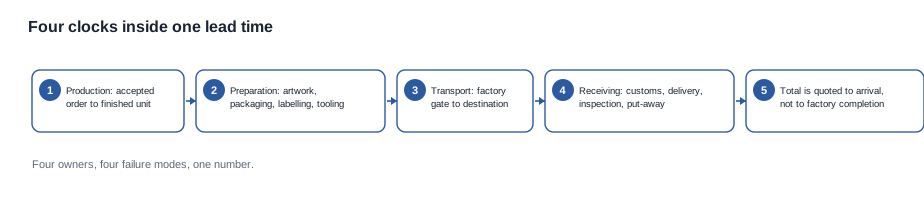
The practical consequence is that lead time is not a property of the factory. It is a property of a specific configuration moving along a specific route into a specific destination. Change any one of those three and the number changes, which is why a single figure quoted once is nearly useless as a planning input.
OEM ready platforms and the four clocks inside one lead time
Take the four clocks apart and each one has a different owner, a different failure mode and a different question to ask. Treating them as one number is the single most common cause of a launch that arrives late with no party at fault.
Production. The time in the factory from an accepted purchase order to a finished unit. It depends on the queue, on the configuration, on whether artwork is approved, and on whether the build is a standard platform build or a private-label run with its own preparation. It is the only clock a supplier can see directly, which is why it is the one most often quoted — and the least useful to a buyer.
Preparation. The work that sits between a production slot and an orderable unit: custom artwork, packaging, assembly of the private-label elements, labelling and any configuration-specific tooling. This clock is frequently invisible because it is scheduled separately from production, and it is the one most damaged by late artwork approval.
Transport. From the factory gate to the destination. Varies enormously by mode, lane and season, and it is the clock with the least predictability and the most external variables: sailing schedules, air freight capacity, transhipment, congestion at the destination port.
Receiving. Customs clearance, delivery to the warehouse, inspection and put-away. It is routinely omitted from quoted lead times, and it is the one a buyer controls most directly — because it depends on the documentation arriving complete.
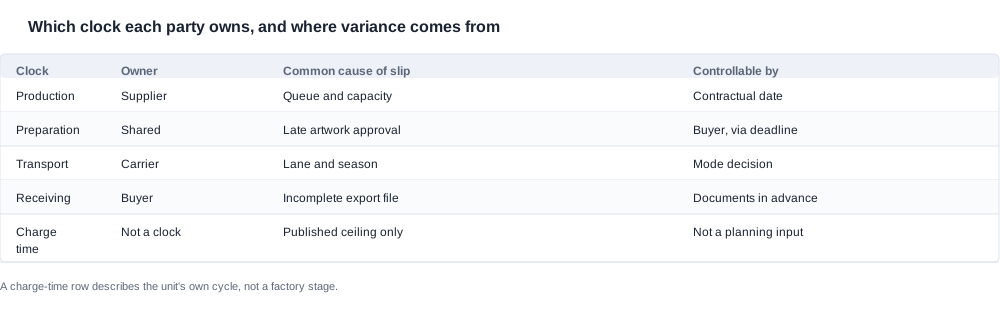
Which clock causes which complaint
When a launch runs late, the diagnosis matters more than the apology. A delay in production is a capacity problem. A delay in preparation is an approval problem, and the remedy is a contractual deadline rather than goodwill. A delay in transport is a routing problem, and the remedy is usually a mode decision taken earlier. A delay in receiving is a documentation problem, and the remedy is an export file that was built before the goods left the factory rather than after they arrived.
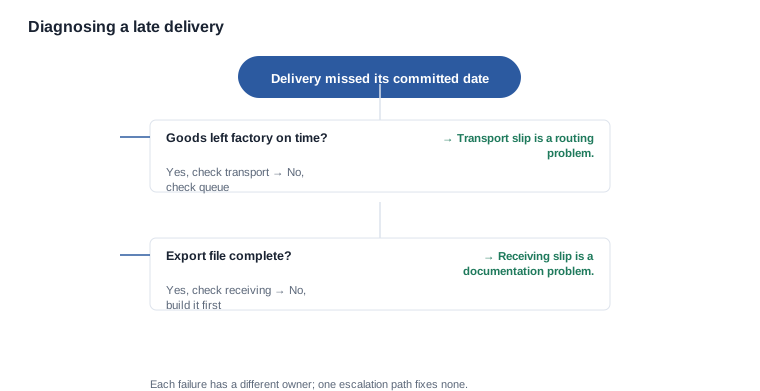
Because each failure has a different owner, a single escalation path will not fix them. A buyer who sends one complaint email to a supplier about a late shipment is asking a factory to fix a customs problem.
The number that should be quoted
The quotable number is days from accepted purchase order to arrival at a named place, on a named lane and shipping mode, for a named configuration and quantity. Ask for the components separately as well, because a total without components is a number you cannot re-plan when one of them slips.
Where a supplier offers only production time, the honest response is to ask for it explicitly as production time rather than to accept it as the lead time. A production duration of a few days converted into a launch date is a planning error that will surface at the worst possible moment.
Separating production duration from the days you actually wait
The distinction between factory time and total time is the one that matters most, and it is where quotations most often blur. Both numbers are real; using the wrong one is the error.
What the catalogue does tell you is relevant to production, even though it does not tell you the duration. Every model in the range publishes a charge time — twenty-six of the twenty-eight entries publish two hours or less as a ceiling, and the D17 and the ZH12 publish roughly one hour. That figure describes the charging operation inside the unit's own cycle. It is emphatically not a production duration, not a case turnaround figure, and not a statement about how long any manufacturing step takes.
Why the charge-time ceiling gets misquoted
The distinction between "two hours or less" and "under two hours" is a real one. The first permits exactly two hours; the second does not. When a buyer copies a charge-time row into a specification document or a listing and converts it into a claim about interruption time in a shift, the ceiling becomes a measured value and the document becomes wrong. This matters commercially as well as technically, because a specification that misstates a published figure is a specification a supplier can legitimately decline to meet.
Write the ceiling as a ceiling. Carry the wording rather than a paraphrase, and never present it as a measured interruption window, a charging time for a specific battery state, or a figure that a charger has been verified to achieve.
What is genuinely open about production
Production duration, queue position, capacity allocation and peak-season loading are all unpublished here, and all of them are ordinary questions to ask in writing. A buyer asking for them is not asking for a trade secret; a supplier that declines to give a range is telling you something useful about how much variance to plan for.
Three questions make the answer usable. Does the quoted duration apply to a standard platform build or to a private-label run. Does it hold across the year or does a peak-season component apply. And what must be approved by when for the clock to start.
A configuration change restarts the clock
This is the clause most often missing from an agreement and the one that hurts most in practice. The clock does not merely continue when the configuration changes; in most factories it restarts, because the unit is no longer the unit the slot was reserved for.
The approval gate
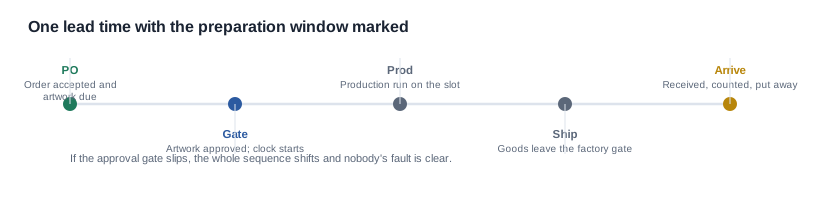
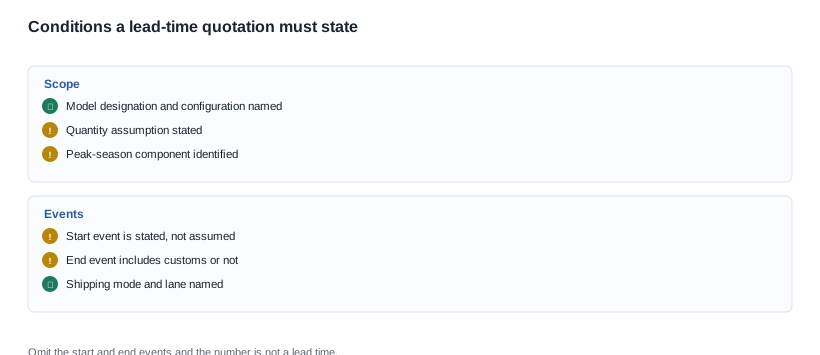
The most common restart is not a technical change at all. It is late artwork. A purchase order that is accepted does not always start production, because the build waits for the packaging and labelling to be approved. If that approval is not contractually dated, the buyer owns the delay by default — and will often be quoted a revised date as though it were the supplier's own slippage.
Two clauses remove the ambiguity. The first ties the production start to a stated artwork approval date, so that any slippage has a cause that can be attributed. The second specifies what happens if the artwork arrives after that date, including whether the slot is held at a different price or released.
Configuration changes that genuinely restart production
Beyond artwork, some changes are structural. Whether a colourway can ride on an existing production run or needs its own is a question with a real cost difference, and on this range it is sharpened by the fact that only two camera models publish colour rows at all — the V03 Pro and the V06. For every other model, the colour list is something you obtain from the supplier, and with it the answer to whether an added colourway needs a separate run.
Ask explicitly: which changes to a configuration can be made without restarting the production clock, and which cannot. Get the answer as a list attached to the agreement, because it determines how flexible your range plan can be when demand shifts.
The naming ambiguity is a scheduling risk too
The L2 Utral illustrates a related point. Its page carries two names printed side by-side, Utral and Pro Max, and a charging-case row reading 900/1400mAh without stating which capacity belongs to which name. If the case configuration is not fixed on the purchase order, the factory is preparing against an ambiguous specification, and every clarification cycle is time that nobody has accounted for in the plan.
Fixing the designation before the order is a scheduling action, not only a documentation one. A purchase order that names the model, the variant and the case configuration unambiguously is the shortest route to a start date you can rely on.

What a quotation must state for the number to mean anything
A lead time is quotable only if the quotation states the conditions attached to it. The minimum set is short, and every item on it is ordinary.
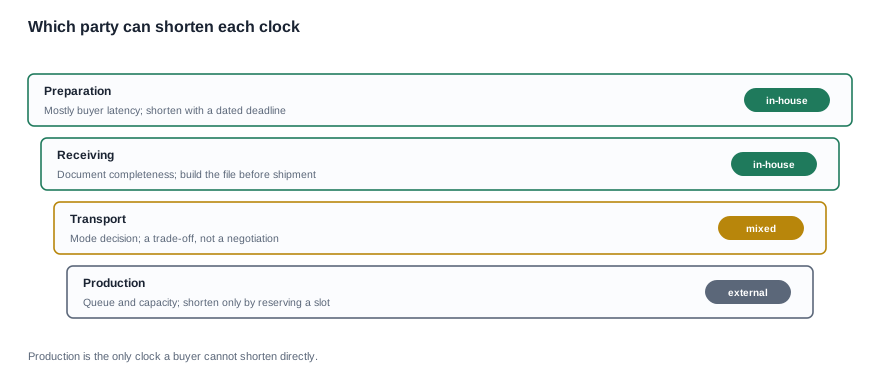
- The model designation and configuration the duration applies to.
- The quantity the duration assumes.
- The start event — accepted purchase order, or artwork approval, whichever is later.
- The end event — arrival at the named destination, and whether that includes customs clearance.
- The shipping mode and the lane.
- Whether the duration is fixed or subject to a peak-season component.
- The artwork approval deadline that must be met to hold the slot.
A quotation that omits items three and four is the most common problem, because it is exactly those two that determine whether the number is a lead time or a production duration wearing a lead-time label.
Why the quantity assumption belongs in the quotation
A lead time is not a constant across quantities. A first order of a private-label configuration includes preparation that a repeat order does not, so the first lead time is systematically longer than later ones. Quoting a single duration without naming the quantity assumption produces a plan that is wrong on the first order — which is the only order where the launch date actually matters to the buyer.
The useful way to handle this is to ask for two numbers from the start: the duration for a first private-label configuration, and the duration for a repeat of the same configuration. The gap between them is a direct measure of the preparation cost, and it is useful in a negotiation even when the absolute figures are not published.

What the buyer can compress and what it cannot
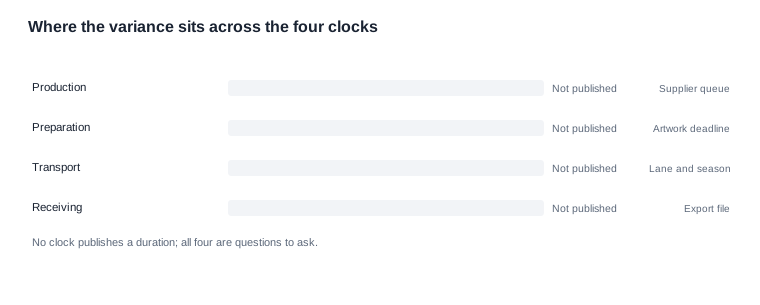
Having taken the four clocks apart, the useful question is which of them the buyer can actually shorten. Three can be compressed by planning; one cannot be compressed at all and has to be managed instead. Knowing which is which is what separates a lead time that can be negotiated from one that can only be tolerated.
Preparation is the most compressible clock. Almost all of its length is the buyer's own approval latency rather than factory work. A buyer who dates the artwork milestone in the agreement, freezes artwork earlier, and accepts a proof round rather than an open-ended one will find this clock shorter without paying anything extra. The mechanism is a deadline rather than a demand: you are not asking for a faster build, you are asking for the queue behind the build to start sooner.
Receiving is compressible if the documents are built early. The customs clock is dominated by whether the export file is complete when the goods arrive. A file built after arrival adds days that have nothing to do with the supplier. Building the export document set before shipment moves the work out of the critical path entirely, and it is the one of the four clocks where a buyer's own preparation pays off most directly.
Transport is compressible by mode, not by negotiation. Air freight is faster and costs more; sea freight is slower and cheaper. That is a commercial trade-off, not a factory performance issue, and it is best decided at the planning stage against a launch date that is actually fixed rather than discovered late.
Production is the hardest to compress, and pretending otherwise causes damage. It depends on the queue and on capacity allocation, neither of which a buyer controls directly. The only reliable way to shorten it is to reserve capacity against a firm schedule well before the required date, which converts an open queue into a booked slot. That is a commercial commitment, and it should be priced as one rather than requested as a favour.
A planning rule that survives contact with a factory
The rule that holds up in practice is simple: put the approval deadline in the past and keep the delivery date in the future, and reverse the emphasis only when the launch date is genuinely fixed. A buyer with a flexible launch date should optimize for approval speed, because the factory will optimize for the queue anyway. A buyer with a fixed launch date — a trade show, a retail season, a contractual delivery — should reserve capacity early instead, and accept that the premium is the price of certainty.
That distinction is worth writing into the plan explicitly, because it determines which of the two trade-offs you are making. In one case you are buying optionality; in the other you are buying a reserved slot. Neither is wrong, and conflating them is what produces a plan that is simultaneously too slow and too expensive.
What to ask, in one message
Before committing, ask for these in writing against the named model and configuration, so that the answer is attached to the order rather than to the conversation:
- The lead time from accepted purchase order to arrival at the named destination.
- Whether customs clearance is inside that number or outside it.
- The duration for a first private-label configuration, and for a repeat of the same configuration.
- Which configuration changes avoid restarting the production clock.
- The artwork approval deadline required to hold the production slot.
- What happens if that deadline is missed.
- Whether a peak-season component applies and how it is notified.
- Whether capacity can be reserved against a fixed delivery date.
- The notice period to change a delivery date after the order is accepted.
- The remedy if a committed date is missed.
These are ordinary questions. A supplier who answers all ten has given you a plan you can build against; a supplier who answers three has told you that the remaining seven are the risk you will carry. We will not quote a duration we cannot hold to, and we will not produce an availability window beyond what production status supports — a range-wide figure that turns out to be wrong on the model you chose is worse than an open question, because a plan built on it fails at exactly the wrong moment.
Negotiating the lead time as a contractual term
Once the number is stated with its conditions, it becomes negotiable in a way a vague duration never is. The negotiation is not really about shaving days; it is about who carries which variance.
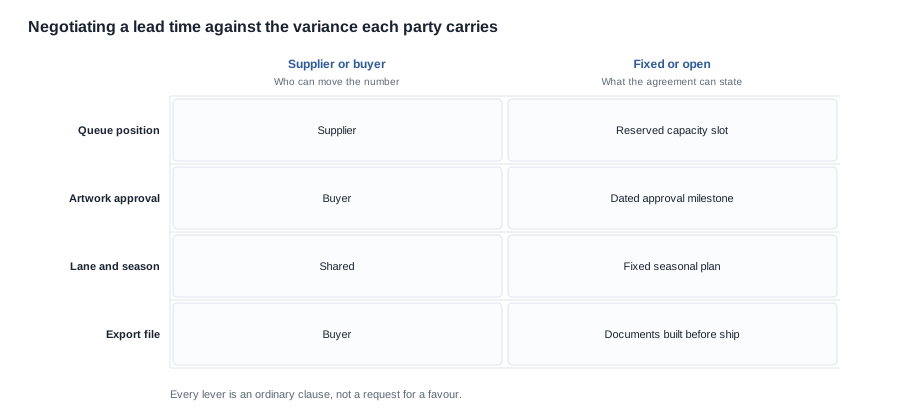
Three moves are usually available. The first is to shorten the preparation clock, which is largely within the buyer's control and is achieved by dating the approval milestones rather than by paying more. The second is to fix the production clock for a configuration, which is achieved by reserving capacity against a firm schedule rather than against an open one. The third is to shorten the receiving clock, which is achieved by having the export documentation built before the goods ship rather than after they arrive — the same document set discussed in the export documentation piece for this platform.
A fourth move is honest and often underrated: reduce the variance you have agreed to carry. If the lane is seasonal, agree a seasonal plan rather than a fixed date. If the configuration is likely to change, agree a change procedure rather than a date that will move anyway.
Payment terms against a delivery risk
There is a close relationship between the lead time and the payment terms, and the two should be negotiated together. A large deposit paid far ahead of delivery transfers delivery risk to the buyer without reducing the chance of delay. A milestone structure tied to events — a deposit, a payment against approved artwork, a balance against shipment readiness — keeps the buyer's exposure proportionate to how far the goods have actually progressed, and it makes the artwork approval milestone a contractual event rather than a courtesy.
This is an ordinary commercial term and it belongs in the contract. It does not require the supplier to offer anything unusual; it requires the buyer to ask for the milestones to be named and tied to events rather than to calendar dates.
The question set to send before you commit
If there is room for one message before the purchase order, these are the questions to ask, in writing, against the named model and configuration:
- The lead time in days from accepted purchase order to arrival at the named destination.
- Whether that figure includes customs clearance or ends at the port or factory gate.
- The duration for a first private-label configuration, and for a repeat of the same configuration.
- Which changes to the configuration can be made without restarting the production clock.
- The artwork approval deadline that must be met to hold the production slot.
- What happens if that deadline is missed, and whether the slot is held or released.
- Whether a peak-season component applies, how it is identified, and how it is notified.
- The components separately — production, preparation, transport — if the supplier will state them.
- The notice period required to change a delivery date after the purchase order is accepted.
- The remedy if the delivery date is missed: replacement, credit, or a stated schedule.
None of these ten is published on this platform, and all ten are ordinary commercial terms that a serious supplier can answer. We will not quote a lead time we cannot hold to, and we will not quote an availability window for a model beyond what production status actually supports — a range-wide figure that turns out to be wrong on the model you chose is worse than an open question, because a plan built on it fails at the worst point in the launch.
Related reading
- Where the number comes from — inventory planning that survives
- The terms that change with the quantity — minimum order quantity for private label
- The documents that shorten the receiving clock — the export documentation set to ship
- Carton and freight decisions — logistics planning for a multi-part box


