
Sport smart glasses remote control is the most under-specified accessory in this range, and the reason is structural rather than accidental. Two models in the sport group publish a remote shutter, the group's customisation list includes the remote itself, and our documentation publishes nothing beyond that single fact — no link target, no range, no charging method, no ingress status, no dimensions and no weight. A brand that puts that object in the box is making a promise about an accessory nobody has described, and the buyer who signs the purchase order is the one who carries it.
This article sets out what the catalogue actually supports for a remote shutter, why a remote is a separate procurement decision rather than a feature line, the three ways to handle one in the parcel and what each costs, and the questions to ask before the deposit leaves. It is written for importers, brand owners and distributors who already know they want an AI camera glasses programme. The wider buying sequence for the group is covered in the sport smart glasses buying guide, and this piece picks up where a purchase order is being drafted.
Sport smart glasses remote control: what is published and what is not
Start with the published facts, because the failure mode in this category is a listing that describes a product the customer never receives. In our documentation the remote shutter is attributed to the D17 and the ZH12. The YKC02 publishes surround sound and long endurance without a remote. The V06 and the S7 publish a camera and no remote. That attribution is the single most common error in sport-range comparison material, and getting it wrong produces a channel listing that a buyer will discover at the returns counter.
The documented function is a shutter: it triggers a photo on the paired phone. That is the whole of the published behaviour, and it is a genuinely good function for the use case. A rider who wants a frame without taking a hand off the bar gets it.
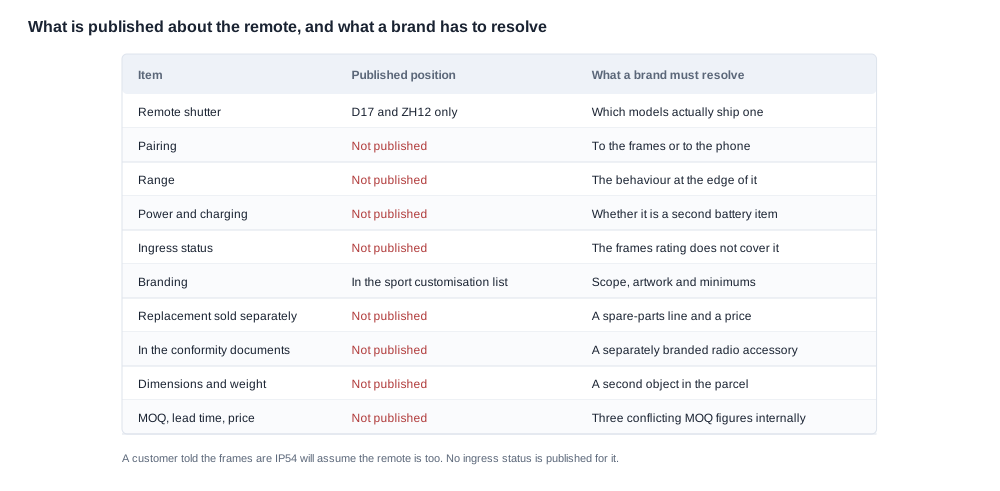
Everything else about the remote is unpublished. Whether it links to the frames or to the phone directly, how that link is made, what its usable range is, how it is powered, whether it carries its own cell, whether it can be charged separately, what ingress status it has, what it weighs, and whether it can be branded as part of a private-label programme beyond the fact that the group's customisation list includes it. The customisation list is the only evidence that a branded remote is possible, and that is a thinner basis than a written scope.
The published rows for the frames themselves are worth keeping separate from all of this, because buyers routinely borrow a frame figure and attach it to the accessory. The sport group publishes cell configuration, a 6~8 hour runtime band, charge time, charging method and Bluetooth V5.4 — YKC02 and ZH12 on two 70 mAh cells with magnetic charging and a 2 hour or less ceiling, D17 on a single 115 mAh cell with USB-C and about 1 hour. None of those five figures describes the remote, and none of them may be presented as if it did. The single weight figure printed anywhere in the range is 158 g for the MT6 glasses body, excluding its folding 1200 mAh case, and that model is not in this group.
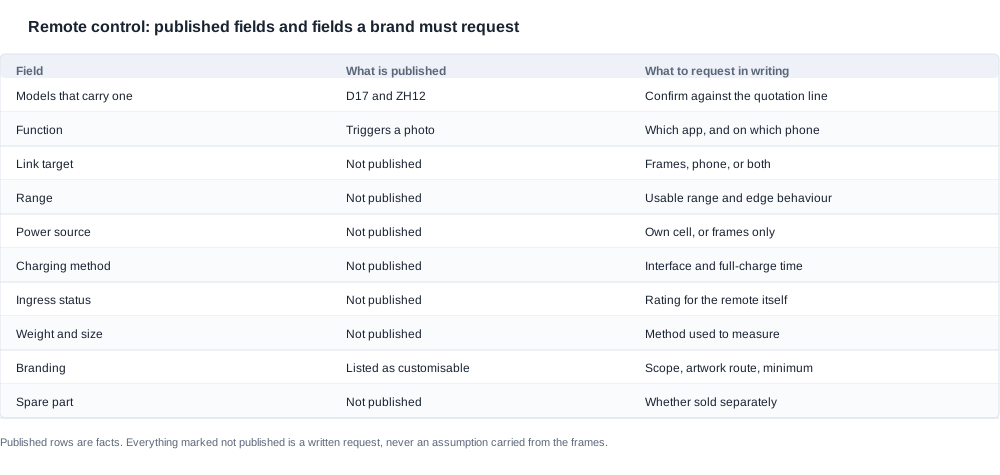
The useful discipline here is to sort the open fields into two piles before anything is ordered, because the two piles are handled by different people on different timetables. One pile is everything the supplier can answer in a single written reply: the link target, the range, the power source, the charging method, the ingress status, the weight, the branding scope and the commercial terms. That pile belongs in a structured question list sent with the request for quotation, because it is exactly the list that tells a supplier what to go and ask its own factory. The other pile is everything that requires the factory to produce evidence rather than an opinion: the conformity documentation covering the remote, the cell format and its transport treatment, and any ingress figure. That pile takes longer, it needs to be requested early, and a supplier who cannot source it is telling you something important about the programme before you have paid a deposit.
One correction is worth stating plainly, because it appears in older sport-range material. The IP54 marking in this catalogue belongs to the V06 and the S7. It does not belong to the D17, the ZH12 or the YKC02, and it certainly does not extend to a remote. A buyer who has written "IP54" into a product listing for a sport model with a remote has made two claims the documentation does not support. The general method for closing that gap is set out in how to test before ordering IP rating smart glasses, and the family-level position is in V06 certification status.
Why a remote is a separate procurement decision
Three things separate the remote from the frame, and each carries a cost.
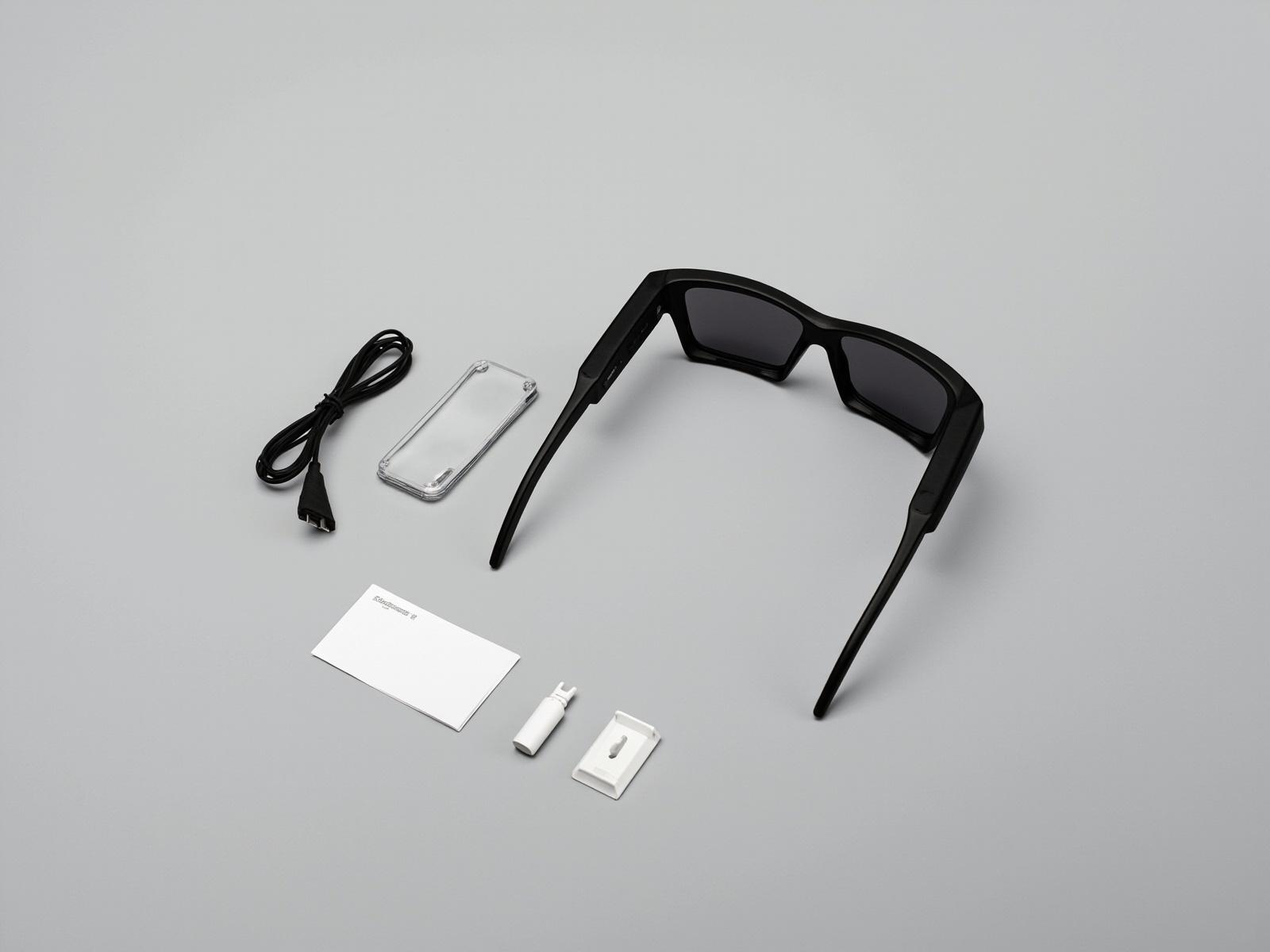
It is a second object in the parcel. A remote is small enough to disappear inside packaging, and it is an object the customer has to remember to bring. A product whose remote sits at the bottom of a jacket pocket is a product the customer stops using within a week, and the complaint arrives as "the camera does not work" rather than "I lost the remote". The support script has to handle both, which means the spare-parts question has to be answered before the first bulk order rather than after the first complaint.
It may be a second battery. If the remote is powered, it is a separate item with its own transport documentation, and the battery paperwork for the consignment has to cover it. That is routine work, and it is the kind of thing discovered at the freight forwarder when nobody planned for it. A buyer who asks whether the remote carries its own cell, and what cell format it uses, has avoided a delay that costs far more than the question.
The protection claim leaks. This is the one that catches brands out. If a listing says the frames are IP54, a customer will reasonably assume every object in the box is IP54. No ingress status is published for the remote, and we will not estimate one. A brand that publishes a protection claim on the frames and ships an unprotected remote has created a complaint it will pay for. What an IP rating does and does not cover is set out in our IP rating guidance.
There is a fourth consideration that is easy to miss because it is not about hardware at all: the remote changes the bill of materials. A cable, a dock, a moulded insert and a spare part all become items that appear in the unit cost, the carton dimensions, the freight calculation and the compliance file. A buyer who prices the frames and treats the remote as free has mispriced the shipment.

The same logic applies to the technical file. A separately branded accessory with its own radio is a different document from the frame it ships with, and a conformity assessment written only for the frame does not automatically cover it. Ask whether the remote is inside the scope of the technical file the supplier will hand over, and get the answer in writing.
A fifth consequence is quieter and shows up in the warranty terms. If the remote is bundled, the warranty a brand offers has to cover an accessory it has never described, and most warranty templates are written assuming a single product with a single failure mode. A shutter that stops firing after two months is not the same event as a frame that stops charging, and the remedy differs: the first is a spare part, the second is a replacement. Before you commit, ask how the warranty applies to the remote specifically, whether the replacement part is available for the length of the warranty period, and what the lead time on that replacement part is. A warranty period that is generous on paper and unusable in practice is worse than a shorter one that works, because the customer experience sets the brand's reputation long before the warranty terms do.
Three ways to handle the remote in the parcel
The trade-off is not really about the remote at all. It is about who absorbs the cost when the object goes missing.
Ship it loose, as a named accessory. The lowest cost and the most control, because the customer chooses whether to use it. The risk is the one above: it disappears and the product is blamed. The mitigation is a line in the instructions, a named part in the support script, and a spare-parts route with a stated lead time.
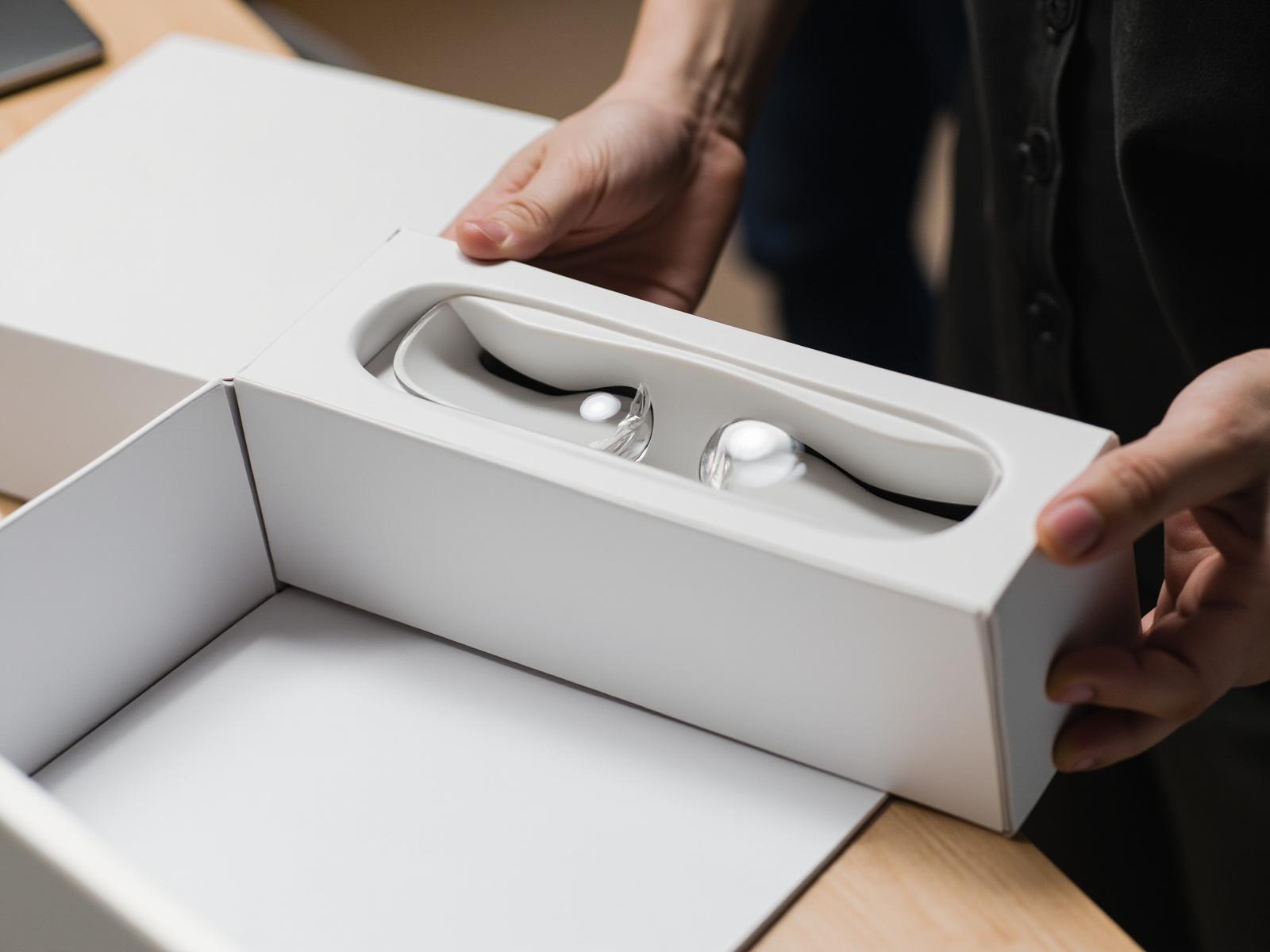
Integrate it into the packaging so it cannot be lost. A moulded pocket in the insert costs more in tooling and removes the failure mode almost entirely. This is the option most brands should take for a model whose whole story depends on the remote. It is a packaging decision rather than a product decision, which is why it belongs alongside the rest of the packaging work in logo and packaging. The tooling cost is real and it belongs in the quotation as a separate line, because it is a one-time charge amortised across the programme and a buyer who discovers it later has no leverage.
Do not ship a remote at all, and select a model that does not have one. The V06, the S7 and the YKC02 publish a camera or a sound claim and no remote. If the remote is not part of the story, the model without one is the simpler product for your customer, the parcel is simpler to pack, and the support script loses a whole failure mode. This is a legitimate outcome of the evaluation and it should not be treated as settling for less.
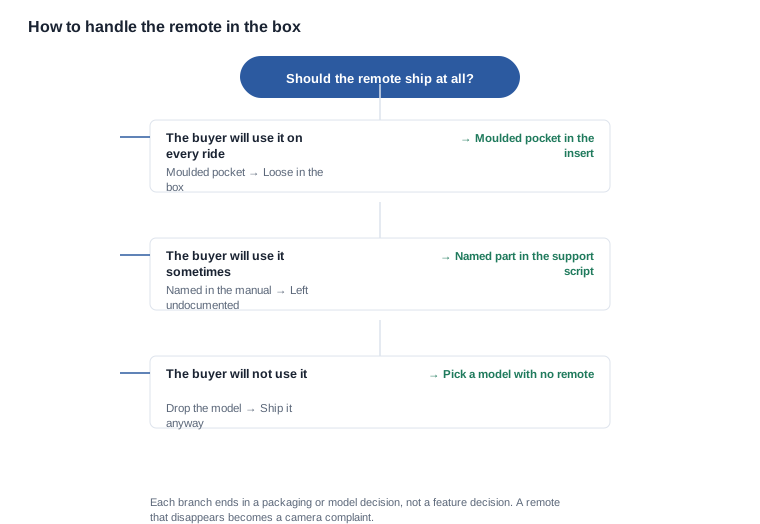
A fourth route exists for some programmes: a remote offered as a separate SKU rather than a bundled item. It removes the accessory from the base shipment entirely and moves the decision to the customer, who then owns it. The cost is that the customer has to discover that it exists, which means the product page, the manual and the packaging all have to carry it, and the unit price of the base model looks better than the experience will be. For a channel that sells on a single comparison table, that is often the wrong call; for a channel with an accessories upsell path, it is often the right one.
Whichever route a brand takes, the negotiation position is the same: the packaging decision, the accessory scope and the compliance scope should all be settled in the purchase order and the technical file before the deposit is paid, because all three are cheaper to change on paper than in tooling.
There is a practical way to run that negotiation. Ask for the moulded-insert option and the loose option to be priced separately in the quotation, with the tooling charge shown as its own line and its ownership stated explicitly. A supplier who quotes one price with the tooling buried inside it has given you nothing to negotiate with; a supplier who shows the tooling as a separate one-time charge has shown you exactly what changes if you drop the accessory. That single line of arithmetic usually settles the decision faster than any argument about user behaviour, because it converts a product opinion into a number both sides can check.
The same technique works on the accessory scope. Ask for a quotation with the remote included and one without it, at the same volume. The delta is the true cost of the feature, and it is a far more useful input to the decision than a unit price quoted with the remote bundled in.

The questions to ask before the remote enters the purchase order
These are the questions to ask, in the order that saves the most rework if the answers are refused.
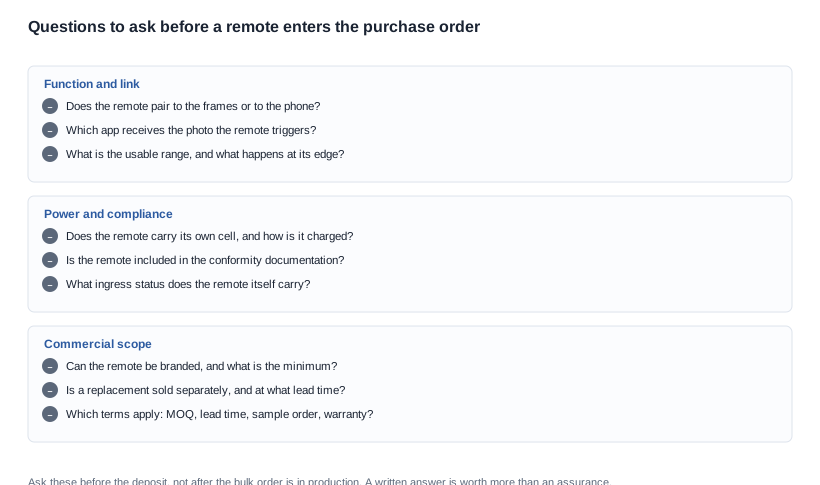
- Does the remote link to the frames or to the phone? And how is that link shown to someone who has just opened the box? If the answer is a gesture that is not in the manual, ask for the manual page.
- What is the usable range, and what happens at its edge? A shutter that fires from a different part of the course is a defect report, and the buyer should know the boundary before the customer finds it.
- How is the remote powered, and does it carry its own cell? If it does, what cell format is it, and does the transport documentation cover it?
- How is it charged, and how long does a full charge take? If the answer is "the frames charge it", ask what happens when the frames are flat.
- What ingress status does the remote itself carry? Not the frames' position — the remote's own.
- Is the remote inside the scope of the conformity documentation and the technical file? If it is not, ask what the separate document is called and when it will exist.
- Can the remote be branded, and what are the minimums? The customisation list includes it; the scope, the artwork route and the minimum are not published.
- What is the unit cost of the remote, and is it inside the quoted unit price or added to it?
- Is a replacement sold separately, at what price, and at what lead time? This is a spare-parts line, and it is priced on the back of a question a buyer should ask.
- Which commercial terms apply to it — MOQ, lead time, sample order cost, warranty period, payment terms, deposit percentage, incoterms and shipment method?
How to evaluate the answers is a separate step from asking them. A written answer that says "this remote has no ingress rating" is worth more than a vague assurance, because it can be checked against the delivered unit. A supplier who declines to answer a question at all has told you something about how the relationship will run, and that is due diligence information in itself. The broader method is in oem ready platforms export documentation.
The one question that is worth raising in the sample order rather than in the bulk order is the link behaviour. Almost every other field on this list is a documentation matter that can be settled in writing, but the link behaviour is the one field a buyer genuinely cannot verify without the object in their hands. Order the sample, hold it, and try the sequence a customer would try: open the box, follow the manual, make the link, fire a shot, find the photo. Any step that needs verbal instruction is a manual defect, and manual defects are cheap to fix before a programme launches and expensive to fix after one.
Two red flags are worth naming specifically. The first is a supplier who quotes a remote range without stating the condition under which it was measured, because a range figure without a protocol is a number a buyer cannot test. The second is a supplier who answers the accessory questions before the frame questions, which usually means the accessory specification is less settled than the conversation implies.
Where our documentation stops
The remote is a good feature and a poorly documented object, and a brand should not put one in the box until the questions above are answered in writing. The feature is not in doubt; the accessory around it is.
We will not extend any ingress marking to a remote, we will not publish a link behaviour, a range or a battery arrangement we do not hold, and we will not attribute a remote to a model whose published row does not carry one. We will also not publish a weight, a dimension, a MOQ, a lead time, a price, a warranty term or a certification status for the remote, because none of those are printed in the range and a figure we cannot source would be worse than an open question.
What we can do is close those fields. Tell us the sport, the channel, the volume and the target market and we will come back with which models in this group publish a remote, which do not, and what the factory can provide on the open fields before the deposit. The group is listed on our sport smart glasses range page, and the feature attribution across the family is covered in sport smart glasses common questions.
One thing we will do without being asked is tell you when a field is not worth chasing. If a programme is sold as a single-SKU bundle with no accessories line and no channel that sells spare parts, then the range figure, the spare-parts price and the branding minimum for the remote are all low-value questions, and spending negotiation capital on them costs you attention you will want elsewhere. The fields that are always worth chasing are the ones a customer can check: whether the remote is in the parcel, whether the link works as the manual says, and whether the photo arrives. Everything else in this article is about protecting those three.
The honest summary is narrow and it is the same summary this catalogue gives for every other open field in the range. A remote shutter is published for the D17 and the ZH12. Everything else about it is a written request, made before the purchase order, and written into the contract so that it can be enforced afterwards. That is not a weakness in the product. It is an accurate description of where a product-row catalogue ends and a supplier relationship begins.


