

Conclusion first: smart glasses for sports and cycling brands weight optimization is a budget exercise, not a materials exercise. The budget is set long before a material is chosen. A cycling product has to carry a cell, a protection circuit, a radio, sometimes a camera module and sometimes an acoustic assembly, and it has to carry all of it inside a section thin enough to stay on a rider's head for an hour or more. Every gram removed has to come out of one of four places — cell, electronics, structure, accessory — and each of those four places has a different consequence when it is emptied. A brand that treats this as "make the frame thinner" ends up with a product that fails at the temple hinge rather than with a lighter product.
The figure a cycling brand is usually shown first is a weight number, and our catalogue carries exactly one. The MT6 glasses body is published at 158 g, and that figure covers the body including its 265 mAh cell and its camera while excluding the foldable charging case, whose 1200 mAh capacity is published separately and whose own mass is not. Nothing else in the range carries a weight row. That is useful as a statement of what our documentation contains, and it cannot be scaled up or down to the sport and cycling models a buyer would actually place in a range.
Who is making the decision, and what they are defending
A brand owner is setting the specification for a product that will sit on a shelf next to lightweight helmets and sunglasses, and the weight figure is the first comparison the shopper makes.
A procurement manager is building the request that goes to a supplier, and the mass budget is the part of that request most likely to come back with "not published" attached.
A channel buyer is pricing the unit into a range, and the mass affects the parcel, the freight class and the retailer's own stock handling. The sports and cycling brands solution page sets out where that range sits.
The three positions rarely agree on what "light" means, which is why the budget has to be written down before the models are chosen rather than negotiated afterwards.
Smart glasses weight optimization starts with the mass budget
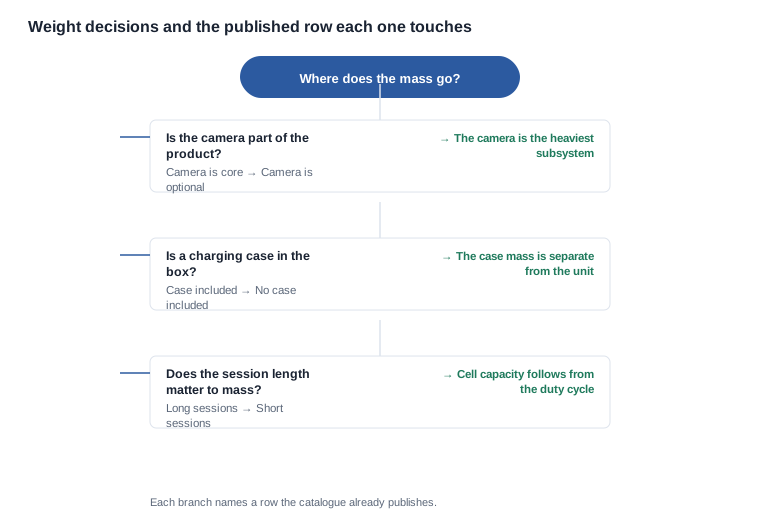
A mass budget is a single number with four deductions against it, and the discipline is that each deduction has to be justified by something other than preference. In a cycling programme the budget is usually framed as the total the unit may weigh in its shipping configuration, and the four deductions are then taken against it in a fixed order, because the order determines what the buyer actually ends up with.
The four subsystems and the order they are emptied in
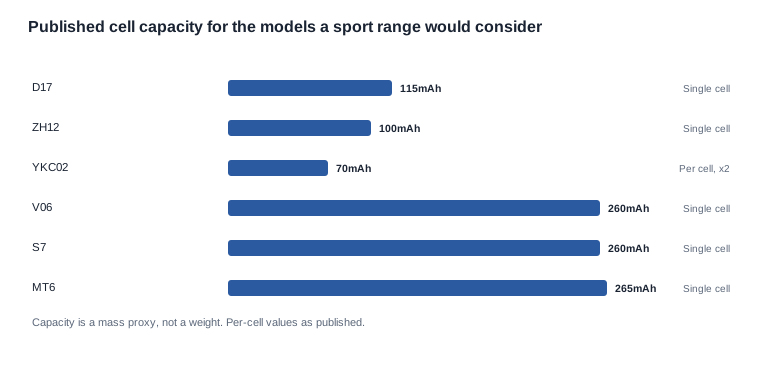
Cell. The largest single subsystem and the one a buyer influences most directly, because the published cell capacity in our range runs from 40 mAh in the two children's models up to 290 mAh in four camera models, and the relationship between capacity and mass is strong enough that the cell row is the closest thing the catalogue offers to a weight proxy. It remains a proxy and not a weight, which is the distinction worth holding on to throughout the evaluation.
Electronics. The control board, the protection circuit, the radio and, in the models that carry a camera, the imaging module. Our documentation publishes no component weights and no board description for any model, so this subsystem is entirely a request to the supplier rather than a line a buyer can read and compare.
Structure. The frame and temple sections. This is where a naive weight programme does damage, because the obvious move is to reduce section thickness and the result is a frame that flexes under the mass it already carries, at exactly the point where a rider is applying force to it with one hand.
Accessory. The charging case and the cable. This mass never reaches the rider's head, but it sits in the customer's pocket, it dominates the parcel, and in a configuration where the case ships in the box it is a second lithium cell travelling on every consignment.
The one published weight, and why it does not transfer
The 158 g figure belongs to a camera model with a foldable case, and that combination is the reason it cannot serve as a reference point for an audio-led cycling range. The body includes a 265 mAh cell and a camera module, which is a different subsystem mix from a model carrying two smaller cells and no imaging hardware at all. Subtracting an assumed camera mass from a published body mass would be inventing a number, and the result would be exactly the kind of derived figure that later appears on a product page as though it had been published.
There is also a scope point that is easy to lose in a long request. The catalogue publishes the weight of the glasses body. It does not publish a frame-only weight for any model in the range, and it does not publish the weight of the MT6 case. A supplier who answers "how heavy is the frame?" with "158 g" has answered a different question to the one that was asked, and that correction has to be made at the request stage rather than discovered at the artwork stage.
The criteria a weight budget is judged against
Three criteria decide whether a mass budget is worth setting, and they are worth writing down because each one disqualifies a different kind of programme. Is the mass on the head? A rider compares the unit against a pair of sunglasses and against a helmet, so the head-borne figure is the one that has to be small. Is the mass in the parcel? A freight and packaging figure is a different constraint and a different lever, because it is dominated by the accessory rather than by the unit. Is the mass on the warranty? A lighter frame is not automatically a stronger frame, and a mass programme that takes the grams out of the temple section is making a durability trade without saying so.
The evaluation that follows a brand's own environment description should end with a shortlist, and the shortlist should be scored against those three criteria rather than against a single number. A brand that cannot state which of the three criteria dominates is not yet ready to shortlist, because the models that win on head-borne mass and the models that win on parcel mass are not the same models.
What the catalogue publishes about mass, and what stays blank
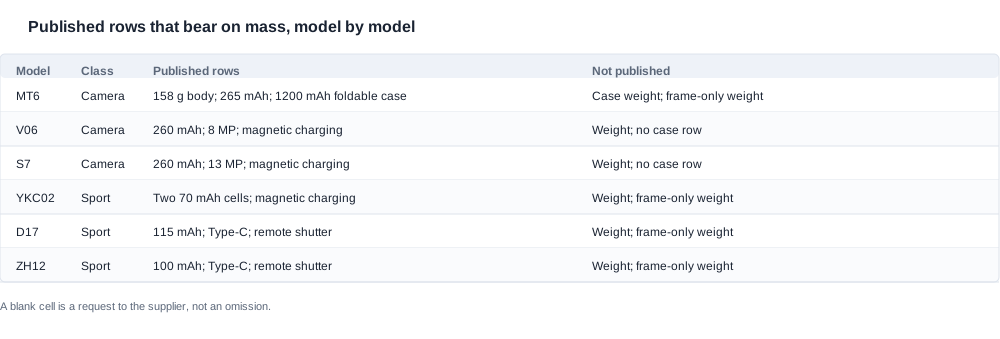
Sourcing decisions in this category move faster when the buyer can see, in one place, exactly which rows exist and which are empty. The table below is that inventory for the models that come up in sport and cycling conversations, and the right-hand column is the commercially interesting one: every entry in it is a row that has to be requested in writing.
| Model | Class | Published rows that bear on mass | Not published for this model |
|---|---|---|---|
| MT6 | Camera | 158 g body; 265 mAh cell; 1200 mAh foldable case | Case weight; frame-only weight |
| V06 | Camera | 260 mAh cell; 8 MP; magnetic charging | Weight; no case row |
| S7 | Camera | 260 mAh cell; 13 MP; magnetic charging | Weight; no case row |
| YKC02 | Sport | Two 70 mAh cells; magnetic charging | Weight; frame-only weight |
| D17 | Sport | 115 mAh cell; Type-C; remote shutter | Weight; frame-only weight |
| ZH12 | Sport | 100 mAh cell; Type-C; remote shutter | Weight; frame-only weight |
The cell row is the closest thing to a weight row
Capacity figures are published for every model in the range, and they are published in the catalogue's own form — the cell value and the cell count, for example 55 mAh × 2 rather than a combined number. Reading a cell figure as a mass proxy is defensible for relative comparison inside a programme. It is not defensible as a specification, because cell chemistry, packaging and the protection circuit all move mass in ways a capacity figure does not describe.
The two-cell configurations deserve separate attention, because there the mass is distributed rather than concentrated. Three configurations in the catalogue split the cell count across both temples: the YKC02 at two 70 mAh cells, the LC-105 pair together with the G07 and the YK12 at two 55 mAh cells, and the K01 together with the K02 at two 90 mAh cells. Two cells spread across both temples change the balance of the unit as well as its total mass, which is a design property rather than a weight property, and one that a cycling brand should raise separately from the budget.
The accessory row is a mass the buyer also carries
Case capacities are published in three places across the range: 1400 mAh on the CY03, the CY05 and the L1 Pro; 900 mAh and 1400 mAh on the L2 Utral; and 1200 mAh on the foldable MT6 case. The KY06 and the MT5 carry a case with no capacity published, and the S7, the V03 and the V06, and the V03 Pro have no case row at all in the catalogue, so a weight-optimisation brief has to treat the case as an unquantified variable for those four rather than as an absent item. Those four different states are four different answers to the question "is there a second lithium cell in this parcel", and the difference between "no row" and "published without" is the difference between asking a supplier and assuming.
The questions to ask before a model is selected
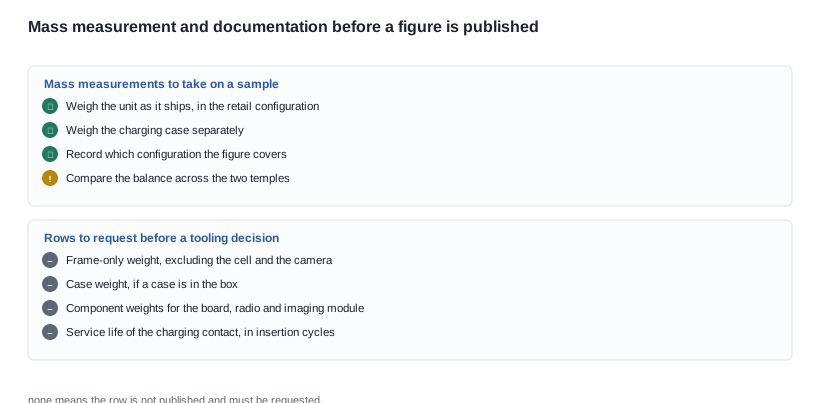
The rows that are not published become questions, and the questions are worth writing down as a set rather than raising one at a time. What is the frame-only weight, excluding the cell and the camera? What is the weight of the case that ships in the box? What are the component weights for the board, the radio and the imaging module? Which configuration does any published weight apply to? What is the service life of the charging contact, expressed in insertion cycles? Those five questions are the difference between a mass programme and a mass opinion, and a due diligence checklist that omits them will quietly inherit whatever the supplier volunteers.
Grams a cycling brand can remove, and grams it cannot
The removals that work and the removals that fail are separated by one test: does the change alter a row the catalogue publishes? If it does not, the change is free. If it does, the change is a business decision with an owner, not an engineering preference.
Removals that leave the published specification intact
Thinning the temple section away from the electronics channel, tightening the hinge hardware, shortening the cable, dropping a moulded accessory and removing a cosmetic element are the moves that reduce mass without touching any row a buyer will later quote. The charging case is the most obvious one in this category, because a case shipped separately can be made a lighter accessory, or a different accessory, or an accessory at a different price point, and none of those choices changes the cell capacity, the charge time or the runtime of the unit itself.
The colour decisions sit in the same group. The V06 is published with four colourways and the V03 Pro with three, and a colour is a coating and a plastic, so it is a mass lever a brand can pull at specification stage rather than at sample stage. There is a trade-off here worth stating rather than assuming, because a darker coating usually adds a layer and a lighter one usually does not, but neither the coating stack nor the coating's mass is published for any model.
Removals that change what the product is
Reducing cell capacity changes the runtime row, and the runtime row is the one a shopper reads. Moving from the 260 mAh cell in the V06 and the S7 down to a smaller cell moves the published five-to-eight-hour range with it, and the buyer has to decide whether the shorter runtime is acceptable before tooling is committed rather than after a sample arrives.
Removing the camera is the larger decision and the one that saves the most mass. The eleven camera models in the range include the V06 and the S7, which share an electrical platform and differ only in resolution, and the sensor, field of view, frame rate and storage behaviour behind the eight- and thirteen-megapixel classes are not published for either. A brand that removes the imaging module is building a different product with a different compliance and privacy position, and the mass saving is one line inside that larger change.
Removing the remote shutter is a smaller change with a real trade-off: the D17 and the ZH12 are the only models that publish one, and it is also the feature that lets a rider capture without touching the temple during a ride.

Establishing a weight figure you can put on a product page
A weight claim is a published commitment, and the discipline that protects a brand is that the figure is measured, scoped and repeatable. In this category the number usually arrives from a supplier as a single unqualified figure in grams, and the risk is that it is a prototype figure, a figure for a different configuration, or a figure that includes an accessory. Three actions close most of that risk.
Three measurements to take on a sample
Measure the unit as it ships, in its retail configuration, with the case in the box if a case is in the box. Weigh the case separately. And measure a production-intent sample rather than an engineering sample, because the two diverge in ways that are invisible on a specification sheet: the cell supplier changes, the housing material changes, and the accessory set is the item most often revised last.
Reconciling a supplier figure against your own
Where a supplier provides a weight and you have measured one, the difference is data rather than a dispute, and it is worth spending a question on it. The common causes are configuration drift, an engineering sample, and a unit measured without the cell fully seated. Ask which configuration the figure covers and ask whether the figure includes the case. Neither answer is in the catalogue, and both answers materially change whether the figure can be published at all.
The red flags in a weight quotation
Three patterns in a weight quotation are worth stopping on. A figure delivered without a configuration is the first, because a weight without a configuration is not a number. A figure that is conspicuously lower than the rest of the supplier's range is the second, and it usually means the cell or the camera has been left out of the count. A figure that is delivered only for the highest-specification variant, with no answer for the configuration actually being ordered, is the third. None of these is proof of anything, and all three are worth one question before the order is placed.

Where a weight-optimised programme lands commercially
The commercial argument for treating mass seriously is not the shopper's comparison on a shelf. It is freight, packaging and the accessory set, and it compounds across a volume that is the buyer's responsibility.

Freight, packaging and the accessory set
Every gram on the unit is a gram the parcel carries, and in a programme where the unit ships with a case, the parcel weight is dominated by the accessory rather than by the glasses. This is why the case decision belongs inside the mass budget rather than inside a packaging discussion, and why the published case capacities — 900, 1200 and 1400 mAh depending on the model — are the first thing to read when a buyer is trying to move mass out of the carton.
The compliance and logistics consequences follow from the same choice. Every unit that ships with a case carries a second cell, which alters the declared contents and the packing instruction requirements, changes the transport classification, and alters the service kit a distributor has to hold in stock. A programme that optimises the unit's mass and ignores the case has moved the mass rather than removed it, and the total cost of the shipment says so.
Warranty, service and the cost of a return
A lighter unit is not automatically a more durable unit, and the two programmes are frequently confused with each other. A mass reduction concentrated in the temple section tends to surface later as a hinge or a flex complaint, which is a warranty event rather than a specification event. The service life of a charging contact, expressed in insertion cycles, is not published for any model in the range, and it is a more commercially useful number than the unit mass, because it drives the spare-parts stocking decision in the channel.
The materials and ergonomics reference covers the structural side of the same question, and the durability engineering article covers the interfaces whose service life interacts with any decision to remove mass from the temple.
The commercial lines a weight budget still has to cover
- Price and the tiers attached to it — the part of a quotation a buyer can move.
- The accessory and mounting set — order quantities of their own, separate from the unit.
- Packaging, and how a consignment is split — the specification and the delivery pattern.
- Settlement — released once inspection is passed.
- Cover — the period, plus the response time written inside it.
- Returns for an outdoor channel — the policy that applies.
- Terms for a first small order.
- Certification and tooling — outside negotiation, because the amount charged and the schedule it takes follow the testing body, and tooling is normally spread over a first order while certification is billed once for each family the factory holds. A quotation that names only one of the two should be read as pricing only one of the two.
We publish the mass rows exactly as the catalogue states them and we do not reconstruct a weight figure from a cell capacity. A single published weight exists in the range, on the MT6 glasses body at 158 g, and it excludes the foldable case; it describes that one model and is not offered as a figure for models it does not describe.
The first three steps of a weight programme
- Write the mass budget down — the total the unit may carry in its shipping configuration, and the four deductions you intend to take against it.
- Send the unpublished rows in one request: frame-only weight, case weight, component weights, the configuration any published weight applies to, and the service life of the charging interface in insertion cycles.
- Weigh production-intent samples in the retail configuration, reconcile any supplier figure against your own, and publish only what you measured.
The sport smart glasses weight comparison sets the weight-relevant rows across the models a cycling brand would shortlist, and that comparison is the natural next document once step one is complete. Smart glasses for sports and cycling brands weight optimization is decided by the budget and the request, and the only mass figure available from the catalogue today is the MT6 body at 158 g.


