

Buyers arrive at this page with one number in mind. They want a table that puts the sport smart glasses group side by side and shows which one is lighter. A weight comparison is the easiest kind of product comparison to understand: heavier feels like a problem, lighter feels like a feature, and the buyer can rank three or four products in a minute. That is exactly why the request is hard to satisfy honestly.
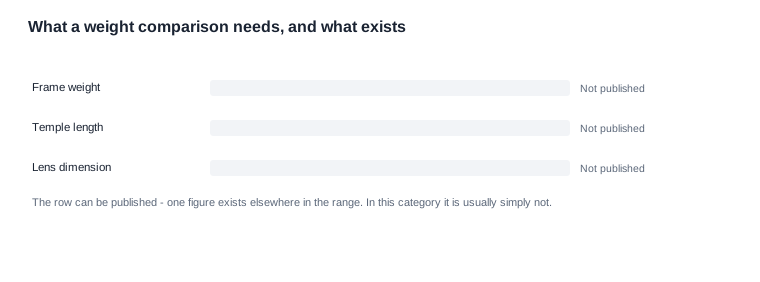
The reason is not that the data is hard to find. The reason is that the data does not exist. Of the three products in the sport group — YKC02, D17 and ZH12 — none of them has a published weight in the catalogue we work from. There is no figure to rank. No amount of careful analysis turns an unstated number into a stated one, and a comparison table with three empty cells is worse than no table, because it looks like an answer and quietly fails to be one.
This page therefore does something slightly unusual for a product selection guide. It explains what the sport group publishes, what it does not, what the only published weight in the wider range actually measures, and how a buyer who genuinely needs a weight comparison can build one from sample measurements that are recorded against a purchase order. Our position is simple and we will not move off it: we will not publish a weight the catalogue does not state, so a buyer who needs to compare the sport group on weight should commission a sample measurement and record it against the order.
If you have arrived here from a search for a number, the short answer is in the first section. If you have arrived because you have a real sourcing problem to solve, the three later sections give you the measurement and contracting method.
What the sport group publishes, and what it does not
Start with what is actually on the record for the three sport products. The catalogue lists them as YKC02, D17 and ZH12. For each one, the published rows cover the electrical and structural basics that a catalogue of this kind carries for every product: the battery cell and its capacity, the endurance figure, the charging time and the charging method, and the Bluetooth position where one is stated at all. There is also a product name, and for some entries a configuration note.
What the catalogue does not contain for any of the three is a weight. Not a weight range, not an approximate weight, not a weight for a related housing or strap. The field is simply absent. That absence is consistent across all three, which means it is not a case of one product being measured and two being overlooked.
This matters because a weight comparison is only meaningful when the three compared products were measured the same way. A number that exists for one product and is missing for two does not support ranking. It supports a much narrower claim, which is that one product has a known figure and the other two have not been disclosed. Publishing that narrow claim clearly is more useful to a procurement team than publishing a ranking built from estimates.
The same logic applies to a second field that buyers in this category ask about constantly: ingress protection. The catalogue carries an IP rating for exactly two models in the range, V06 and S7. The sport group does not appear among them. For YKC02, D17 and ZH12, the correct entry in a comparison sheet is that the rating is not published. It is not permissible to infer an IP rating from the word "sport", from the product naming, or from the fact that a product is described for outdoor use. A rating that is not on the record is not a rating the buyer can rely on, and relying on it is how a product arrives in a market where the certification obligation is real and the evidence is not.
That distinction between "the catalogue does not state it" and "the product does not have it" is the backbone of this whole page. We do not know that the sport group lacks a weight measurement internally. We know that the published catalogue does not carry one. When we make a statement on this site, it is a statement about what is published, and we do not extend it into a statement about what exists internally at a supplier or factory. That is a deliberate boundary, not a technicality, and it is the same boundary that applies to certification, compliance and every other claim below.
It is worth being blunt about the commercial dimension too. A weight comparison is a differentiation tool. A brand that can say "our sport glasses are 28 grams" has an advantage over a brand that says nothing. Because our catalogue does not carry sport group weights, we cannot make that comparison, and we would rather say so than fill the gap with a plausible number. A fabricated weight is not a small error. It becomes a product page claim, then a quotation, then a sample expectation, and eventually a dispute with a customer who weighed the goods. The catalogue gap is annoying; the dispute is expensive.
The published facts for the sport group, kept strictly to what is on the record, look like this. The empty weight column is the point of the table, not a formatting failure.
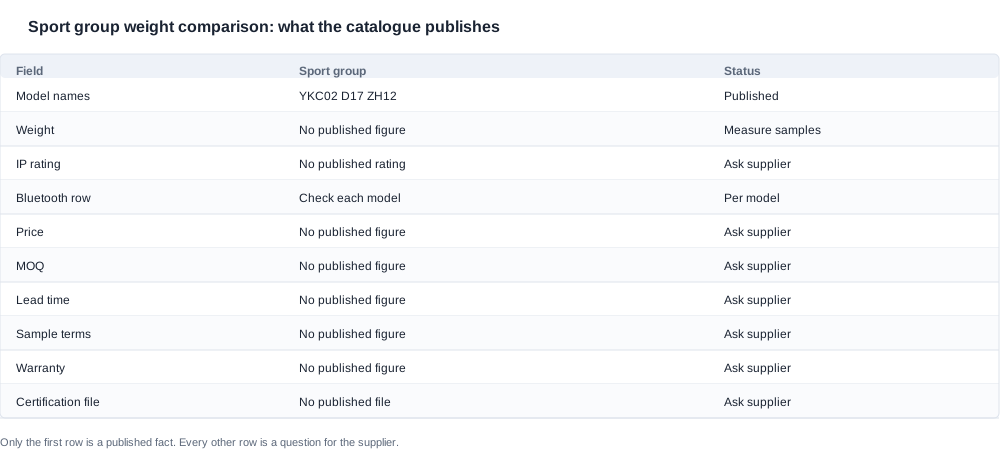
Note what is not in that table either. There is no price, no minimum order quantity, no lead time, no sample policy, no warranty term, no production capacity, and no certification or compliance record for these three products. Every one of those is a legitimate thing for a buyer to ask a supplier, and every one of them is something you should get in writing before you order. But none of them is published, so none of them belongs in a comparison sheet presented as product fact. The honest comparison sheet has one column of facts and a second column headed "to be confirmed with the supplier".
If your procurement model needs numbers in every cell before it will move, this category will frustrate you, and it is better to know that now than at the sample stage. The sections below give you a way to convert those empty cells into measured, contracted values.
The one published weight in the range, and why it cannot close this gap
There is one weight figure in the wider published range, and it belongs to MT6. The published weight is 158 g, and it is the weight of the glasses body. It explicitly excludes the 1200 mAh folding case, which is a separate item that the buyer adds when the use case requires it.
It is tempting to look at that number and treat it as a general sense of scale for the category: roughly one hundred and fifty grams for a pair of glasses in this family. And in a loose sense that is reasonable. It is also exactly the kind of reasoning that produces a bad comparison table, so let us set out precisely why it does not work here.
First, MT6 is not a sport group product. The sport group is YKC02, D17 and ZH12. A weight from a different model in the same catalogue is a data point about that model, not about the group being compared. Using it as a proxy means the comparison table is really comparing one product's published weight against three absent values, with the absent values silently filled by an assumption.
Second, the 158 g figure is a body weight that excludes the folding case. For a product bought as a complete kit, the number a buyer actually cares about is the shipped, carried weight. For MT6 that total is the 158 g body plus the case, and the case carries a 1200 mAh cell, so it is not a light accessory in the way a pouch is. For the sport products, if a case or a battery accessory is part of the configuration, the same distinction applies: body weight and shipped weight are two different numbers, and a comparison sheet that mixes them is wrong even when every figure in it is real.
Third, and this is the practical point, category averages do not answer a purchasing question. A buyer is not deciding whether the sport group is "light for smart glasses". The buyer is deciding between YKC02, D17 and ZH12, possibly against a competitor line the buyer already knows. The decision is a ranking among the three, and a number from a fourth product contributes nothing to it. It is background colour at best.
So what does MT6's 158 g actually buy you? Two useful things, neither of which is the comparison you came for. It gives you a rough sense of what a pair of glasses in this catalogue physically feels like, which helps you sanity-check any weight a supplier quotes you later: if a supplier tells you the sport product is 120 g, is that plausible? If a supplier quotes 260 g, is that a different category of device entirely? And it gives you a template for the question to ask. You now know exactly which measurement the catalogue publishes when it publishes one: the glasses body, excluding a removable case. When you ask a supplier for the sport group weights, you can ask for the same thing, the same way, and the answers will be comparable.
That is the honest use of the one number we have. It is a calibration reference and a wording template, not a substitute ranking. We would rather hand you that than hand you a table with three invented values in it.
There is one more thing worth saying about the direction of the argument, because it is a common pattern in this category and it produces bad buying decisions. The temptation is to treat missing data as a negative signal: no published weight means heavy, means heavy means bad, means we should rule the product out. That inference is not supported. Silence in a catalogue is a disclosure choice, not a performance measurement. A supplier who has not published a weight may simply have not been asked, may publish on request, or may hold the figure in a document that the web catalogue does not surface. None of those possibilities tells you anything about how the product feels.
Stated plainly so it can be quoted back to us: we will not publish a weight the catalogue does not state, so a buyer who needs to compare the sport group on weight should commission a sample measurement and record it against the order. If a supplier provides a weight for a sport product, and it is documented and consistent, we will publish it in due course, with the measurement method stated alongside it. Until then the field stays empty, and an empty field that is honestly labelled is more valuable to a serious procurement team than a filled field that might be wrong.

Building a weight comparison sheet from sample measurements
If the catalogue will not give you the comparison, the sample room can. This is the part of the process that actually produces a usable weight comparison for the sport group, and it is more mechanical than most buyers expect. The hard part is not weighing glasses. The hard part is making sure that the three numbers you end up with were produced under the same conditions, by the same procedure, on the same kind of sample.
Start with scope. Decide before you order what you are measuring and what you are not. There are at least four distinct weights that get confused with each other in this category, and a comparison sheet must pick one of them, not drift between them. The first is the bare product: the glasses as they ship, without case, without accessories, without packaging. The second is the packaged weight: the product plus its retail box and inserts, which is what a logistics team and a courier need. The third is the carried weight, which adds any case, battery pack or charging dock that is part of the configuration the buyer intends to sell. The fourth is the worn weight, which is the distribution of mass across the frame and temples and cannot be derived from a total.
For most buyers making a product selection, the bare product weight is the right comparison, because it is what appears on the product page and what a customer compares against another product they can also hold. The carried weight is the right comparison if you are building a kit or a bundle. Either is fine, but a sheet that mixes them is not a sheet at all. Decide once, write it at the top of the sheet, and keep every later entry consistent with it.
Then define the sample configuration. Weight varies with configuration, and the sport group is configured in more than one way. Agree with the supplier in advance, before the sample order, which configuration each sample represents: the standard battery configuration, the version with the largest capacity cell, the version with the case if one is offered, the accessory kit that ships in the box. If you order a sample in one configuration and later compare it against a bulk order in another, the weight comparison you produced is invalid, and you will not notice until the first shipment lands.
This is where the sample order becomes a specification event rather than a demonstration event. Write down, in the sample order, the exact configuration, the exact accessories included, and the exact documentation you want with the samples. Ask for a technical file or product file that states the weight if one exists internally. Most suppliers have a spec sheet or a dimension and weight drawing that simply was never published to the web; the request is routine, and the answer often exists. If it does not exist internally, then the measurement you take yourself becomes the only weight of record, which is why it must be taken carefully and recorded.
Method matters more than precision. Use the same scale for all three products, calibrated or at least consistent, and record the unit and the resolution. Weigh the bare product, and remove everything that is not part of the product definition: no case, no strap, no protective film, no cardboard insert, no packaging. If a product ships with a strap, weigh the product with the strap and then weigh the strap separately, so you can report both numbers rather than an argument about which one is "the" weight. Weigh more than one unit of the same model if you can afford the samples, and record the spread. A repeated measurement that lands within a tight band is a figure you can put in front of a customer; a single reading on a single unit is an observation.
Record the measurement with its method attached, every time. A weight figure without a method is a rumour. Write it in the form: model, configuration, measured weight in grams, tolerance or spread across units, scale used, date, and who measured. That format survives being forwarded to a colleague, quoted in a quotation request, and compared against the bulk order later. It also survives a conversation with a customer who asks how you got the number, which is the whole point of doing it properly.
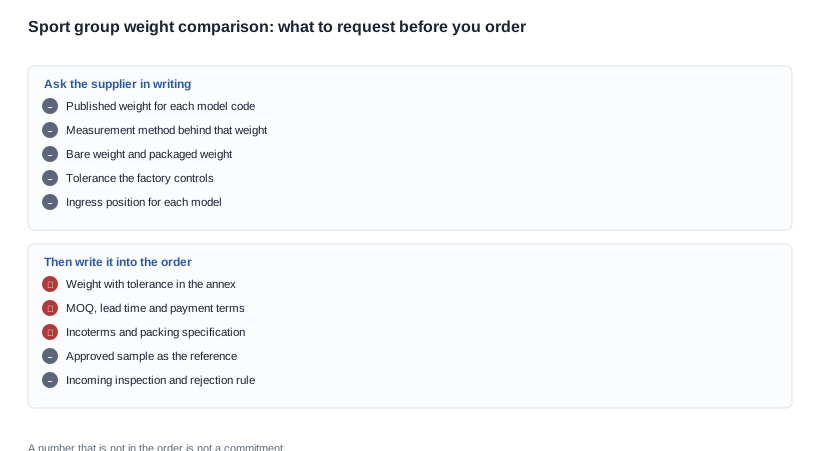
The questions below are the ones to ask, in the order we would ask them. Each needs a named owner and a written answer rather than a verbal assurance.
- The published weight for each model code. Ask the supplier's product contact for YKC02, D17 and ZH12 separately, and get the answer in the quotation reply itself.
- The method behind any figure offered. Ask what the number includes, and ask for a one-line method statement you can paste into your own specification sheet.
- The internal technical file. Ask whether a specification sheet or a weight drawing exists, and request the current version as a document you can file.
- Two weights, not one. Ask for the bare product weight and the packaged weight in the same reply, so the logistics file and the product page each use the right one.
- The tolerance the factory controls. Ask what spread the production line holds between units, and get it stated as a range for the purchase order.
- The verification point. Ask which quality control step checks the weight and against which approved sample, so the check continues after the sample is gone.
- The commercial terms for that configuration. Ask for the minimum order quantity, the lead time, the payment terms and the deposit in the same written reply, so the technical answer and the commercial answer describe the same build.
One more practical point about the sample stage: the sample order is where you discover the questions that the catalogue could never answer. Handling quality, whether the charging port is accessible with the case on, whether the fit holds during movement, whether the finish matches a photograph, whether the box is a plain or printed retail box. Weight is the number you planned to get, but the sample is also the only moment when you can check whether the whole configuration is what you assumed, and the weight you record is only trustworthy if the configuration around it was verified at the same time.
If you are building a private label version, the same sample carries more weight, in both senses. A private label project adds your own branding, your own packaging, your own accessory kit, and possibly your own tooling for moulded parts. Each of those changes the weight of what ships. Measure the sample as the supplier ships it, then measure again after your branding and packaging are applied, because the number that matters commercially is the number on your shelf, not the number on the supplier's bench.

Putting the measured figures into the purchase order
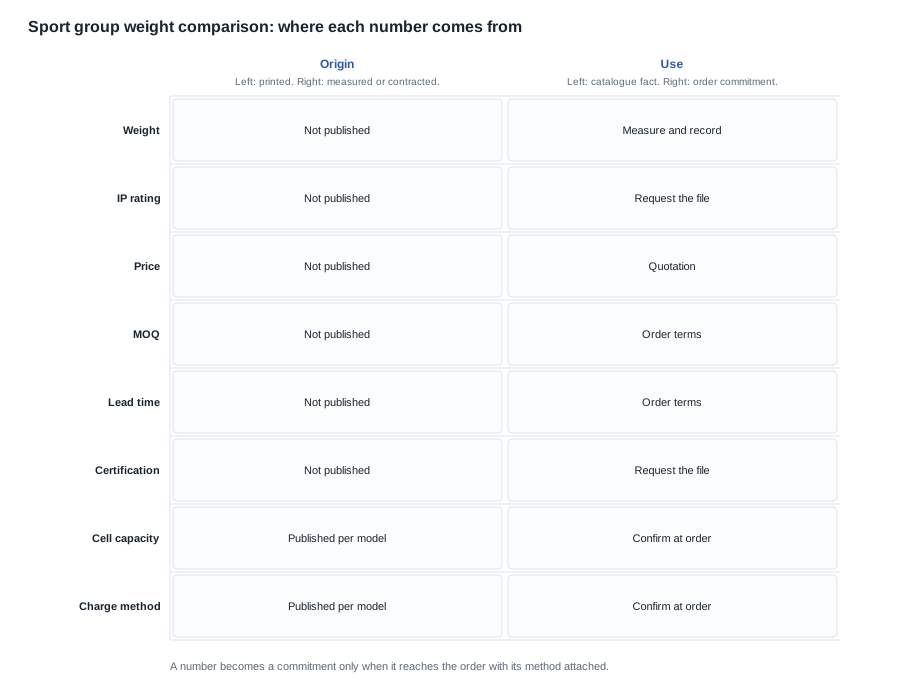
A measured weight is useful; a contracted weight is safe. The step that turns your sample measurement into something you can rely on is the one where the figure enters the purchase order, or the specification annex attached to it, and both parties sign the same number with the same method attached.
Before you order, put the measurement method into the documentation, not just the result. The order annex should state the weight, the configuration the weight applies to, the tolerance the supplier will accept, and the method that defines a passing measurement. A weight of "about 60 g" is a starting point for a conversation. A weight of "60 g ± 3 g, measured on the bare product as shipped, excluding case, strap, packaging and accessories, verified on a scale reading 0.1 g" is a specification that can be enforced. That distinction is the single most valuable thing you can carry out of the sample room, and it is worth more to you than any extra decimal place.
Then treat the weight as one line among the other commercial terms that a purchase order for this kind of product actually needs, because those terms are the ones that determine whether the number you measured survives into production. There is the minimum order quantity, which changes your per-unit economics and can change the configuration you are buying. There is the lead time, which determines whether your launch date is a plan or a hope. There is the bulk order pricing, which is where a private label project is usually won or lost. There are the payment terms and the deposit, which determine how much cash you have tied up. There are the incoterms, which decide who carries the risk in transit and where responsibility passes. There is the shipment arrangement and the packing specification, and a packing specification is where the packaged weight gets locked down if the logistics team cares about it. There is the warranty term and what it covers. There is the tooling arrangement, including whether tooling is exclusive and what happens to it at the end of the run. And there is the quality control process, including who inspects, against what sample, and what happens when a batch misses the agreed weight.
The point of listing them here is not to imply that any of them is published for the sport group. None of them is. This is the list of what you should have in the document that follows your sample, and what you should ask the supplier to fill in. Where the catalogue is silent, the purchase order is where the fact is created. A buyer's leverage in a supplier negotiation is not strongest when a catalogue has already fixed the numbers; it is strongest when it has not, and the supplier knows that a well-prepared order annex is what will convert the gaps into commitments.
Use the gaps as negotiating material, carefully. A blank MOQ line and a blank lead time line are not reasons to walk away; they are reasons to ask. Ask for a quotation against the specification you built, and ask the supplier to fill the fields that the catalogue left open, including the weight and its tolerance. A quotation that comes back with the weight written into it is a much better starting point than one with only prices in it. If a supplier declines to state a weight or a tolerance, that is itself information about how the product is controlled at the factory, and it belongs in your due diligence record.
Where the weight cannot be contracted as a fixed number, contract the method and the acceptance rule instead. "Weight verified against the approved sample at incoming inspection" is enforceable even when no numeric tolerance is agreed. Define who measures, on what equipment, at what point in the process, and what happens on a miss: rework, replacement, or a price concession. A documented non-conformance path is what keeps a missed weight from becoming a surprise at your customer's warehouse.
Keep the whole chain on paper, because each of these terms has a natural expiry. The sample order has one configuration. The purchase order has another, if the configuration was not frozen. The technical file is a version, and the version matters. The declaration and compliance records that a buyer asks for belong to the specific product and the specific configuration that was tested. A weight measured in January is not a weight confirmed in October unless the file says so. Ask for the technical file that travels with the shipment, and make the file version a line in the order.
One final caution specific to this category. Sport products get described with language that invites inference: endurance for outdoor use, durability language, water or dust resistance language, and the word "sport" in the name. None of that language is a measurement. When you build the comparison sheet, keep a separate column for what is published, a column for what you measured, and a column for what is contracted. Mixing published facts and measured facts in one column is how a sample reading, taken on one unit in one configuration, ends up presented to a customer as a published product specification. Keep the three apart, label them, and the sheet stays defensible.
That is the whole method. The catalogue gives you the row structure, the power and charging figures that are on the record for YKC02, D17 and ZH12, and one calibration reference in the MT6 weight. It does not give you the ranking you want. The sample room gives you the numbers. The purchase order turns them into commitments, and the criteria you use to evaluate the answers are the questions to ask before you order.
A final word on what to ask, in the order we would ask it. What is the published weight of this product in this configuration, and what is the method? Is there an internal technical file or specification sheet that states it? What is the minimum order quantity for that configuration? What is the lead time from order to shipment, and what are the payment terms and the deposit? What is the incoterms basis for the quotation, and how is the bulk order packed? What is the warranty term and what does it exclude? What is the quality control procedure for the specification, and what is the non-conformance process? What does the compliance and certification file for this exact configuration contain, and which documents will be provided with the shipment? And if a declared weight changes between the sample and the production run, what triggers a notification to us? Those questions are what to ask before you order, and the answers are what turn this comparison from a spreadsheet into a sourcing decision.
If you want the physical product before you measure it, the sample request is the first conversation to have. Sample order requests, configuration questions and the quotation discussion all begin in the same place, and you can start that from the procurement and sample request page for this category: /procurement/samples. If you want to see the sport group itself, with the published electrical and charging figures for YKC02, D17 and ZH12, it is here: Sport Smart Glasses. And if you are also looking at a lighter-communication product for a complementary programme rather than a sport build, the Bluetooth Audio Glasses line is a separate category with its own published rows; it is a different question from a sport weight comparison, and we keep the two apart.
The honest summary is short. The sport group does not publish weights, so no comparison table exists. The one published weight in the range, 158 g for the MT6 glasses body excluding the 1200 mAh folding case, is a reference point and a wording template, not a substitute ranking. If the comparison matters to your decision, it comes from samples, measured the same way across all three models, recorded with method, and written into the purchase order with a tolerance and an acceptance rule. We will not publish a weight the catalogue does not state, so a buyer who needs to compare the sport group on weight should commission a sample measurement and record it against the order.


