
The smart glasses for sports and outdoor cycling use case is where a category either earns its place or gets returned. A cyclist has no free hand, faces constant airflow across the front of the frame, sweats for the whole session, and needs the product to survive a season of road spray. That combination rules out most general-purpose audio glasses no matter how they are described in a review, and it is also the combination that most often exposes a specification sheet as incomplete rather than as decisive.
What our catalogue publishes for the models that come up in this conversation is specific in places and silent in others. The V06 and the S7 carry an ingress marking, an ergonomic design line and a removable inner frame; the D17 and the ZH12 publish a remote shutter, a surround-sound line and the only charge times in the range published as better than the ceiling, at roughly one hour. What the catalogue does not publish, for any model a rider would consider, is the frame weight, the wind-noise figure, the microphone specification, the ingress test report number or the operating temperature range. This page sets out what is published, what is not, and how to turn the published rows into a decision a brand can defend.
Who is making the call, and what they are defending
A sports brand is deciding whether a smart glasses line belongs in a cycling range at all, and the answer usually depends on the ride rather than on the product.
A channel buyer is comparing a small number of candidate configurations against a shelf of helmets, eyewear and lighting, and is looking for the single figure that decides the comparison.
A procurement manager is turning the marketing brief into a request, and needs to know which rows will arrive published and which will arrive blank.
Smart glasses for cycling: the environment decides the specification
A cycling environment is a set of exposures, and each one attacks a different part of the product. Writing them down is what turns "would our riders use this" into a specification that can be sent to a supplier.
Persistent airflow across the front of the frame. At speed the wind noise reaching the ear is the loudest sound in the environment, and it sits in exactly the band where a microphone picks up speech. Our catalogue publishes no wind-noise figure, no microphone specification and no leakage measurement for any model, so the acoustic behaviour of any candidate is an evidence question rather than a specification question. A buyer who needs a claim about call quality on a descent cannot support it from our documentation.
Sweat that does not dry. A rider's head is a warm, wet environment for the whole session, and it is concentrated at the temples where the electronics, the charging contact and the control surface usually sit. The same exposure that makes a magnetic charging contact unreliable is the one that makes a physical control preferable, and the D17 and the ZH12 are the only models in the range that publish a remote shutter for exactly that reason.
Road spray and standing water. The ingress question for a cycling product is not a splash and not an immersion; it is a jet of dirty water off a wheel at speed, and that is the exposure a rating has to address. The V06 and the S7 are the only models in the whole catalogue carrying an ingress marking, and it reads IP54. That second digit refers to water thrown from any direction, and it says nothing about a pressure jet, and no third-party test report number is published for either model.
Vibration. Continuous low-level vibration attacks solder joints and connectors in a way that discrete impact does not. No model in the range publishes a vibration rating or an impact rating, so this is a sample test rather than a row.
One-handed operation. A rider donning and doffing in the dark at a trailhead operates the product with a cold hand and no free hand, which is a control-design constraint rather than a specification row.
The criteria a cycling decision is judged against
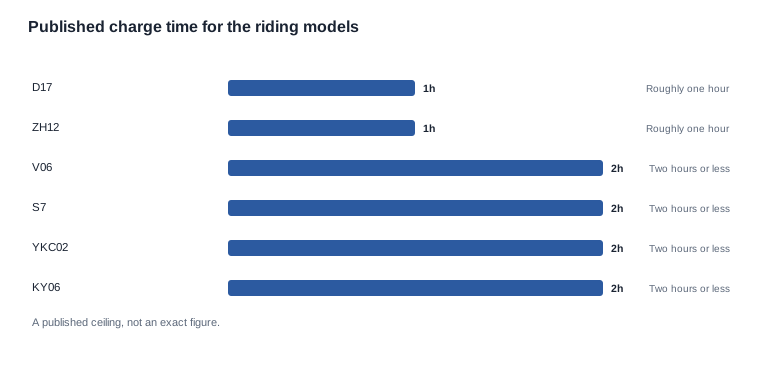
Five criteria decide this category, and each one eliminates a different set of candidates. Does the product stay on the head? The published weight data is thin: one model in the entire catalogue carries a weight row, and it is not a cycling candidate. Is the sound usable at speed? No model publishes a wind-noise figure, so this is a sample test and a customer-experience question. Does the product survive the session? The ingress marking covers splashing only, and the V06 and the S7 are the two models that carry it. Can the rider capture without handling the frame? The remote shutter on the D17 and the ZH12 answers this and nothing else does. Is there a charging opportunity during the ride? This is where the published charge times matter, because the D17 and the ZH12 are the only models whose figure is published as roughly one hour rather than as two hours or less.
The assessment ends in a shortlist, and every entry carries a written reason for being on it; there is no single recommended model here. A category with this many unpublished rows cannot support a recommendation; it can support a documented decision, and the documentation is what protects the buyer when a channel returns a unit.
Before any two models are compared, the shortlist criteria have to be written in a form that two suppliers would read the same way. "Comfortable" and "lightweight" fail that test, because each word means something different to a supplier and to a rider, whereas "a published runtime figure of at least six hours" and "a frame weight below a stated limit, measured in the retail configuration" can be compared without interpretation. The criteria that survive that test are the ones worth putting into a request, and everything else is an opinion.
The models a rider would consider, and what each one publishes
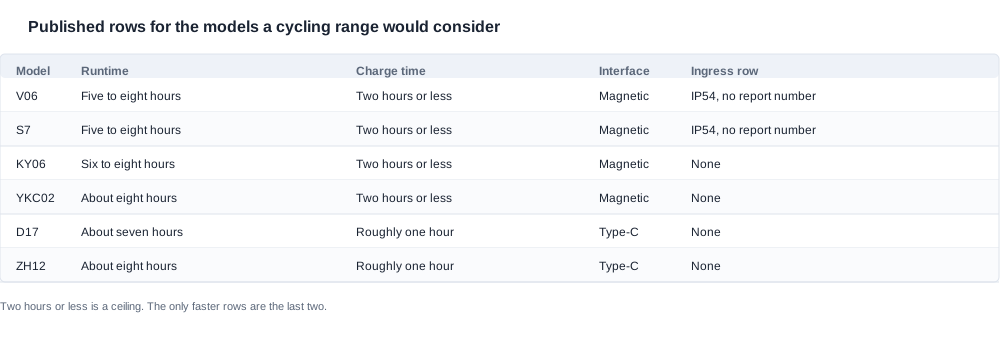
The published rows for the models relevant to a cycling range are set out below. The right-hand column is the part that shapes the request, because each gap becomes a question that has to be answered before the product can be listed.
| Model | Interface | Runtime | Charge time | Published ingress row |
|---|---|---|---|---|
| V06 | Magnetic | Five to eight hours | Two hours or less | IP54 marking, no report number |
| S7 | Magnetic | Five to eight hours | Two hours or less | IP54 marking, no report number |
| KY06 | Magnetic | Six to eight hours | Two hours or less | None |
| YKC02 | Magnetic | About eight hours | Two hours or less | None |
| D17 | Type-C | About seven hours | Roughly one hour | None |
| ZH12 | Type-C | About eight hours | Roughly one hour | None |
What the two camera models contribute
The V06 and the S7 sit on one platform electrically, and the published difference between them is the resolution class — eight against thirteen megapixels. Both carry a removable inner frame and the ergonomic design line, and the V06 adds four colourways to that list. For a cycling brand, the camera contribution is capture from the rider's point of view, which is a content proposition rather than a navigation one, and the removable inner frame is an adjustment feature rather than a retention feature.
Both also carry the only ingress marking in the range, and both therefore carry the only evidence obligation. The marking is a catalogue annotation with no test report number behind it, which means a channel that prints a water-resistance claim on the box is relying on a statement the catalogue makes and the supplier has not substantiated. That is a legitimate position for a brand to take if it is willing to own the claim, and it is a poor position for a brand that intends to defend it.
What the sport models contribute
The YKC02 is a sport model with two 70 mAh cells, a published runtime of about eight hours and a surround-sound line. The D17 and the ZH12 are sport models with a remote shutter, a surround-sound line, and the only two charge times in the range published as roughly one hour. The D17 states a 115 mAh cell and about seven hours; the ZH12 states 100 mAh and about eight hours.
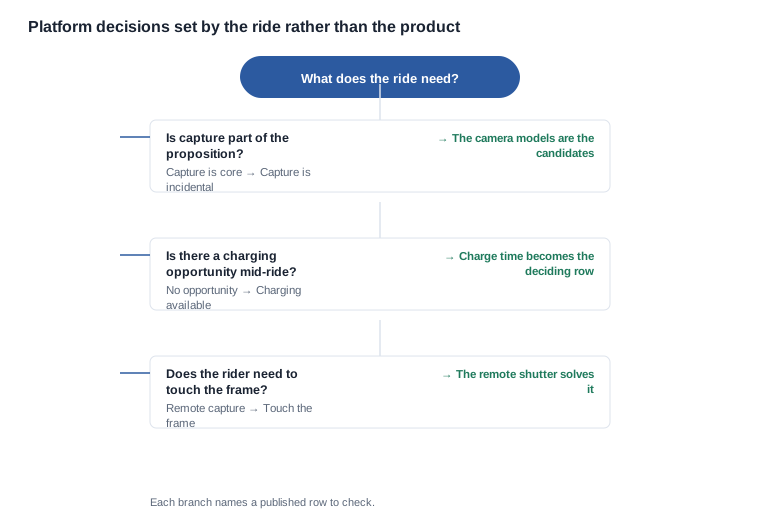
The remote shutter is the feature a cycling brief usually asks about first, and it is also the feature whose behaviour is described nowhere: its range, its pairing behaviour, whether it works with a gloved hand and how it behaves in rain are all unpublished. If remote capture is central to the product concept, it belongs in the sample test list rather than in the specification, and the pairing question in particular is one that a supplier answer and a field trial will settle in different ways.
Matching a platform to a riding pattern
The published rows support three distinct products for a cycling channel, and choosing between them is a question about the ride rather than about the product.
Capture-led rides
Where the proposition is content from the rider's view, the camera models are the relevant candidates, and the decision inside them is an imaging and pipeline decision rather than an electrical one. The V06 and the S7 publish the same cell capacity, the same charge-time ceiling and the same runtime band, so the pixel class is the only published difference between them. No sensor model, viewing angle, capture rate, file format, stabilisation behaviour or storage capacity is published for either, and a brand whose editing pipeline has a fixed format requirement cannot proceed on resolution alone.
A procurement team should assess this against one question before comparing two pixel classes: does the editing pipeline accept the output at all? Until the sensor model, the frame rate and the video format are known, the resolution class is an input to that decision rather than the decision itself, and choosing between eight and thirteen megapixels on any other basis is a purchase of a number rather than of a result.
Guidance-led rides
Where the proposition is navigation prompts and communication, the audio models are the relevant candidates, and the published charge times become the deciding row. A rider between charging opportunities values the roughly one hour rows on the D17 and the ZH12 over the two-hour ceiling elsewhere, and both of those models use Type-C, which means one cable type covers a mixed range.
Mixed sessions
Where the rider captures occasionally and navigates often, the two-hour ceiling models are adequate provided the session has a charging opportunity at one end, and the decision becomes the case rather than the unit. Case positions differ across the range: the S7 and the V03 Pro, and the V03 and the V06 have no case row published at all, and the camera models with published capacities carry 900 mAh, 1200 mAh or 1400 mAh depending on the model, and a rider planning a kit for one of the four has to settle the case question before the kit is priced.

Testing a cycling configuration before it reaches a channel listing
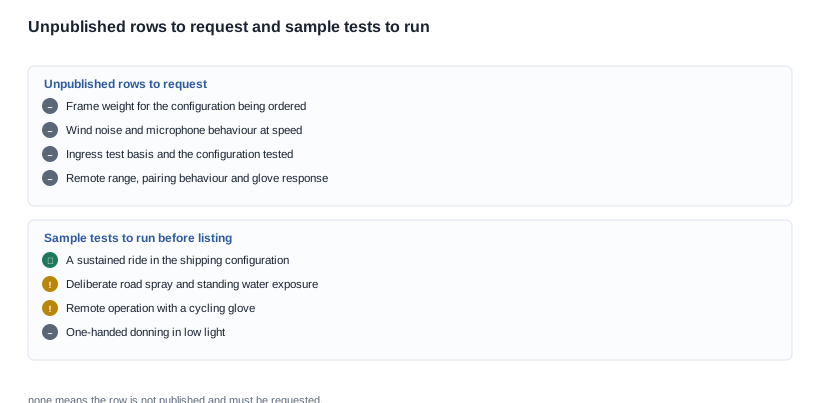
Three sample tests carry most of the value, and each of them maps to an unpublished row rather than to a published one.
The sustained-ride test. A ride of two to three hours with the product in its shipping configuration, with the capture pattern the channel will produce and with the unit charged immediately beforehand. The published five-to-eight-hour range is not under pressure in this test; what is under pressure is the acoustic behaviour at speed, which no published row addresses. Record what the rider can hear and what a microphone picks up.
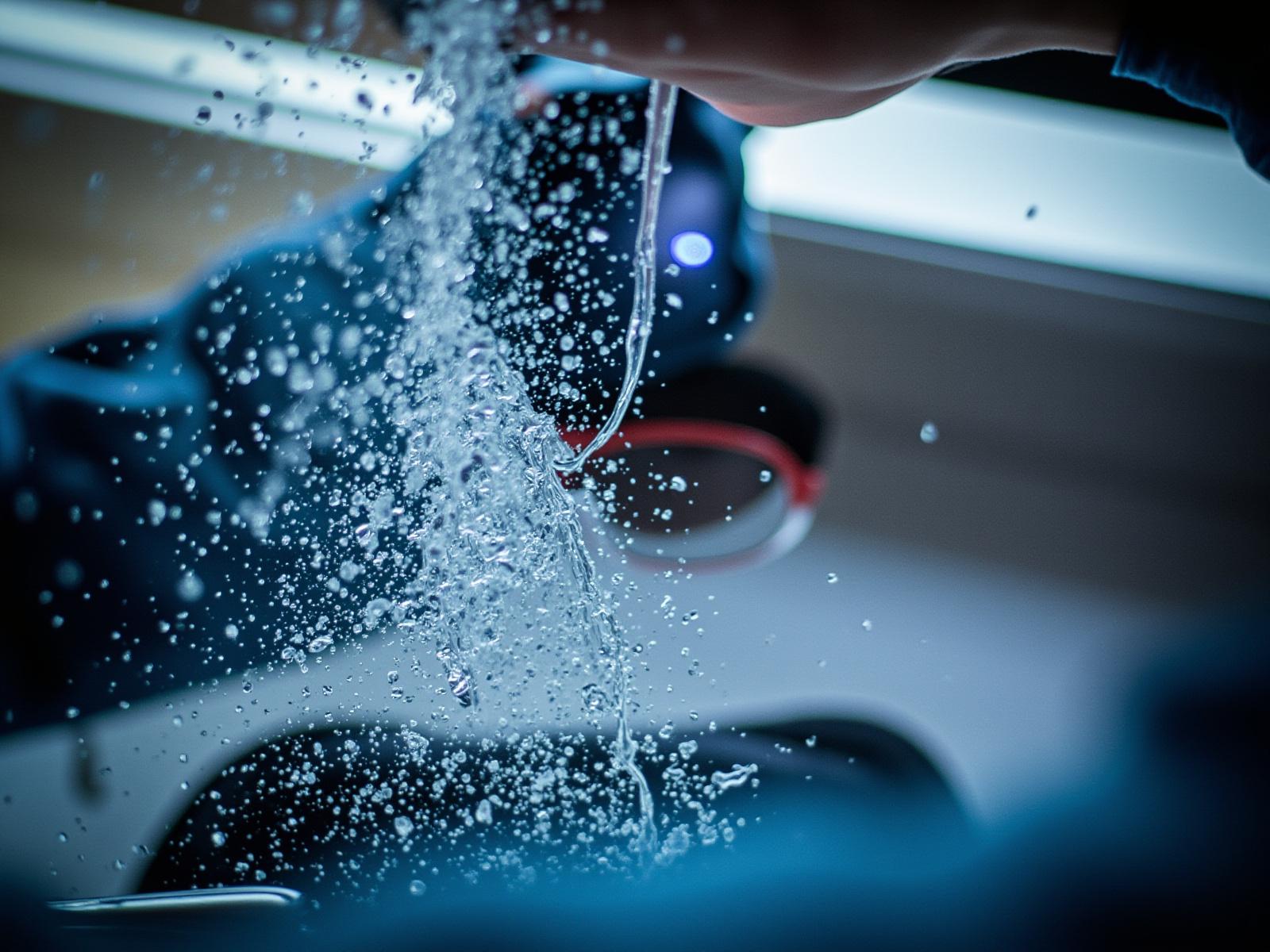
The wet-condition test. Deliberate exposure to road spray and to standing water, with the charging contact inspected afterwards. This is the test that tells a brand whether the ingress marking on the V06 and the S7 is a meaningful statement in the real environment or a marking that describes a laboratory condition, and it is the cheapest way to find out before a launch rather than after it.
The gloved-hand test. Remote shutter operation with a cycling glove, and one-handed donning in low light. The remote is published on the D17 and the ZH12 and its behaviour is published nowhere, so this is a specification question that only a sample can answer.
The privacy test. A camera product in a cycling channel films other people from a moving position, and no model in the range publishes a recording indicator, a storage limit or a file handling rule for the recorded material. A brand that plans to list capture in this channel should establish what the device does with a recording and what the rider is shown, because the answer determines the listing wording and the instructions a channel partner has to give.
What a cycling range costs to source and support
A cycling range is expensive in ways that are not visible in a unit price, and the item most often missed is the acoustic evidence. A brand that lists a camera product in a cycling channel inherits a privacy conversation, because the device films other people from a moving position, and that conversation is settled by wording rather than by engineering.
The procurement view of the same decision
The commercial reading of a cycling range is usually the second conversation rather than the first, and it is the one that decides whether the first decision survives contact with a supplier's quotation. Four items in that document are worth reading closely, and each one has either a published row or an absent row behind it.
The unit price and the volume tiers. A quotation that offers tiers without stating the configuration each tier applies to is not comparable between suppliers. Ask for the tier table to name the cell configuration, the case position and the packaging, because those three determine what is inside the carton.
The minimum order quantity for the accessory set. The remote shutter on the D17 and the ZH12 and the mounting hardware are separate items with their own order quantities, and a brand that has budgeted the glasses but not the accessory can find itself unable to supply a complete product at a sensible volume.
The warranty period and its stated response. The relevant question is not the length of the period but what the supplier commits to within it, and whether the response covers the charging contact, which is the component most exposed to the conditions the product is sold into.
The lead time and what it is measured against. A production lead time quoted without the order quantity, the packaging state and the inspection schedule is a number that will move. Ask for it in the form the buyer will be held to, and read the payment nodes against inspection at the same time.
The supply chain question that sits underneath all four is the same one: which of the unpublished rows does the supplier actually control? A supplier willing to sign the ingress report and the temperature rating has taken on a different risk from one that is not, and that difference shows up in the terms long before it shows up in the product.
The three things to settle before a sample order is placed are straightforward. First, the configuration the quotation covers, because a price without a configuration cannot be compared against a competing one. Second, the documentation set — the ingress basis, the temperature rating, the runtime condition — because those determine whether the product can be listed in a channel at all. Third, the accessory set and its order quantities, because a product that cannot be assembled from stocked parts is not a complete product.
The rows that decide the commercial shape
There is one trade-off in this category worth stating explicitly rather than leaving to the reader. The models with the shortest published charge time are the two Type-C models in the sport class, and the models carrying an ingress marking are the two camera models, and those two groups do not overlap. A brand that wants both a fast charge between segments and a published splash resistance is choosing between product families rather than between two configurations of one product, and the total cost of that choice is a different accessory set, a different packaging specification and a different certification scope.
How to choose between the candidates therefore comes down to which criterion dominates, and that answer belongs to the channel rather than to the specification sheet. A brand selling to riders who value the remote and the fast charge is buying a different product from one selling to riders who value the ingress marking, and the total cost of each includes a different service kit, a different packaging specification and a different return profile.
Whether the product ships with a case decides what goes in the box, how the consignment is classified for freight and what the shipping paperwork has to say, because the case puts a second cell into every unit. Whether it ships with a remote decides the accessory set and the number of items a distributor has to stock. Whether the ingress marking is printed decides the number of returns the channel will generate, because a splash rating presented next to the word waterproof is the most reliable way to create one.
The lines a cycling range negotiates on the way in
- Unit price and the volume tiers — negotiable, provided the configuration is named.
- The mounting hardware and the accessories — each with its own order quantity, and each a separate design conversation.
- Carton and consignment — the packaging specification and how the delivery is broken up.
- Payment — payable once the inspection clears.
- Cover — the period it runs for and the reply it commits to.
- Returns for a cycling channel — how a returned unit is handled.
- The opening order itself — the minimum quantity and the split of the first shipment.
- Certification and tooling — not negotiable: the testing body determines the amount and the schedule, the factory normally spreads tooling across an initial batch, and the certification charge is made once for each family the factory holds. A quoted line that mentions only tooling has still left certification unpriced.
We publish the cycling-relevant rows exactly as the catalogue states them and we do not restate the marking the V06 and the S7 carry as a rain or immersion claim. Where the catalogue is silent on acoustic behaviour, frame weight and test report numbers, we leave the row empty rather than filling it, and the empty rows are the questions a sample has to answer.
The first three steps for a cycling programme
- Write the ride profile down — the typical session length, the terrain, the charging opportunity at each end, and whether capture is part of the proposition.
- Put every open row into a single request: frame weight, wind-noise and microphone behaviour, the ingress test basis, the remote's range and pairing behaviour, and the runtime under the stated duty pattern.
- Run the three sample tests — sustained ride, deliberate wet exposure, and gloved remote operation — and record the results before the listing copy is written.
The smart glasses charging considerations page covers the interface question in more depth, and the open-ear buying mistakes article covers the acoustic claims that are commonly made without evidence. Smart glasses for sports and outdoor cycling use case is settled by the ride profile and the sample, not by the catalogue rows alone.


