

Most smart glasses charging smart glasses advanced considerations lists stop at cable type, which is the cheapest decision on this page. The expensive decisions happen after the design is frozen: how the charging case is treated as a product, what you ship in the box, how thick the cable is, and what happens when the goods sit in a hot container. None of these appear on a datasheet and all of them turn up in your cost or in your return rate.
One point needs stating at the top, because it changes what this article is about. Every one of the twenty-eight entries in our catalogue publishes a charge time — two hours or less on twenty-six of them, and about one hour on the D17 and the ZH12. The gap is not a missing number. The gap is that the published figure carries no starting state of charge and no completion criterion, so it cannot be turned into the length of an interruption during a shift, and it is not the recharge time of a charging case at all.
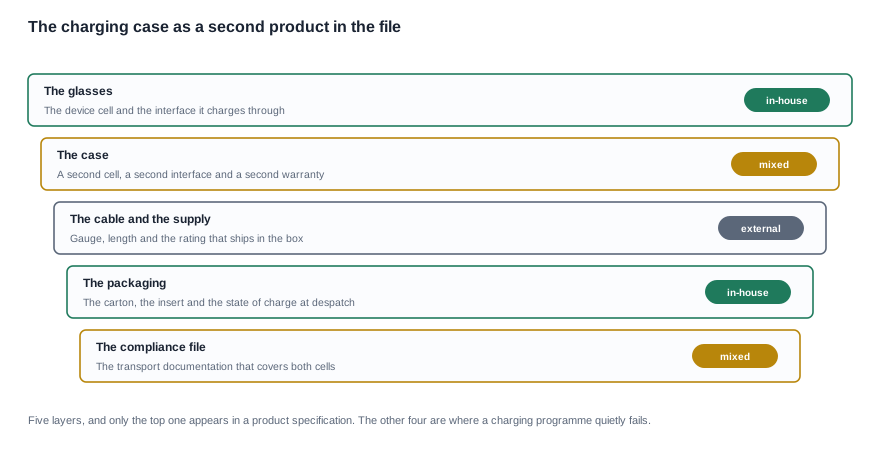
Smart glasses charging: the case is a second product to document
Where a case is supplied, it contains a second cell. That single fact drags in several obligations that buyers routinely discover after the first shipment rather than before the first order.
Seven camera platforms in our range ship a charging case. Five of them publish its capacity: the CY05 and the CY03, and the L1 Pro — each at 1400 mAh, the L2 Utral at 900 or 1400 mAh depending on configuration, and the MT6 at a foldable 1200 mAh. The KY06 and the MT5 are described with a charging case but publish no capacity for it. That last point is the one to act on first, because a case with no published capacity cannot be priced, cannot be declared for transport, and cannot be described on a packing list.
What the case adds to the bill of materials and the file
Add a case to a shipment and four separate things start happening that would not otherwise happen. There is a second battery in the consignment, and a second set of transport documentation that has to cover it. There is a second charging interface with its own contact set, its own degradation behaviour and its own failure mode. There is a second warranty term, because a case is a different object from the device it charges, and a customer who has a problem with the case and a customer who has a problem with the glasses are two different conversations. And there is a second failure return, because a case returned without its device, or a device returned without its case, is not a complete return and cannot be diagnosed.
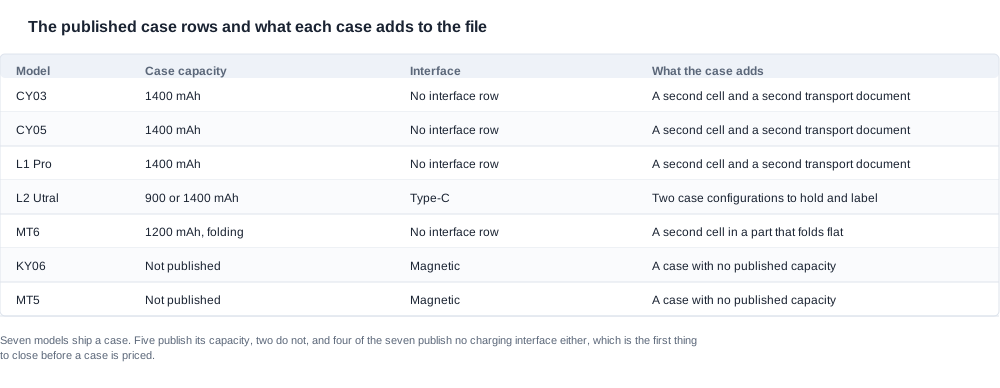
The distinction that catches most buyers out is between the case as a packaged accessory and the case as a second product. As an accessory it is a line in the packing list. As a second product it has a model designation, a cell declaration, a warranty, a failure rate and a returns route, and the cost of treating it as an accessory is that each of those is discovered individually and late.

What ships in the box decides the return rate
The contents of the box are a specification decision, and it is one that is usually made by omission rather than by design. Three items are in scope: the cable, the supply, and the instructions.
The cable is the cheapest of the three and the one that generates the most confusing complaints. A long, thin cable has more resistance than a short, thick one, so the same device charges at different rates depending on which cable it is given, and the customer who receives a slow charge concludes that the product is faulty. Nothing on a datasheet says which cable shipped, so the complaint arrives attributed to the product and is handled as a product fault rather than as a packaging decision.
The supply is a second-order decision with a first-order consequence. A unit rated for a certain input current will charge more slowly from a weaker source, and again there is no visible symptom other than a long charge time. Whether a supply is included at all, and if it is, what it is rated at and which markets it is legal in, is a decision that has to be made per market rather than per product.
The instructions decide what the customer does when the charge does not behave as expected. An instruction set that states the charge time, the interface and the expected behaviour is worth more than a longer one, because every question it pre-empts is a support contact that does not have to be handled.
The cable and the supply are two different decisions
They are usually bundled in the conversation and they should not be, because they have different owners and different failure modes.
The cable belongs to the hardware decision: the interface on the device fixes it, and the gauge and length follow from the cell capacity and the charge time the buyer wants to publish. The supply belongs to the market decision: it is tied to the destination, to what is legal there, to what the customer already owns, and to whether the device is being sold as a standalone product or as part of a kit.
Where a device is sold without a supply, which is a normal choice for a brand with an existing accessory ecosystem, the cable question becomes more important rather than less, because the customer is now supplying the mains side themselves and the only thing you control is what is in the box on the device side.
One further box decision is often overlooked and has a direct effect on the return rate: whether the cable that ships is the cable the published charge time was measured with. A buyer who quotes two hours or less and ships a thin cable is making a claim about a configuration that was never measured, and the customer will experience it as the device charging more slowly than the page says. A short note in the packing list stating the gauge and the length of the supplied cable costs nothing and removes the most common source of the complaint. whether a printed quick-start card is included in the buyer's language. A card that states the interface, the published charge time and what to do when the device does not charge will absorb a surprising share of the support traffic, and it costs almost nothing to print.
Transport, storage and the dead unit problem
Goods do not arrive at the customer directly from the production line. They sit in a container, they sit in a warehouse, and they sit in a returns centre, and every one of those holds cells at a temperature that is not ideal and for a time nobody planned.
The published charge time does not help here, because it says nothing about the state of charge at which the goods are despatched. A unit filled to capacity and then held for three weeks in a container is a unit with a different risk profile from one filled to half, and the risk is concentrated in the cells that are least able to absorb it — which in this range means the smallest ones, the 40 mAh cells on the A05 and the A06 and the 55 mAh pair on the LC-105-1 and the LC-105-2.
The decisions this creates are commercial rather than technical. What state of charge do the goods ship at? A deliberate answer is free and a default answer is not, because the default is usually full, and full is the worst case for storage. How long may the goods be held before despatch? A stated limit creates a disposal decision that can be planned for. Who carries the risk between the factory and the customer? Incoterms decide this, and it is worth checking that the term chosen matches the storage and transport decisions actually being made.
There is a fourth storage question that is often the most expensive to answer badly. How long can a unit sit in a returns centre before somebody decides what to do with it? A returned device that is never charged will discharge, and a device that has discharged deeply is a device whose condition is unknown and whose warranty claim is unresolvable. A returns process that charges the device on receipt produces a diagnosis; a returns process that does not produces a dispute.
The practical answer is a short written instruction that says what happens to a returned device and a returned case on arrival: how long they may wait, whether they are charged, and who records the state. That instruction costs a paragraph, sits inside the after-sales process, and prevents the most common cause of a warranty argument, which is a device that arrived flat and was assumed to have arrived faulty.
None of this is visible on a product page and all of it appears in a freight query. The freight forwarder will ask for the cell declaration for every cell in the consignment, including the one inside the case, and the answer has to exist before the goods are packed rather than after they are on a vessel.

Magnetic contact degradation over the product life
Seventeen of the twenty-eight entries in our catalogue charge magnetically, seven charge over Type-C — the V03 Pro, the L2 Utral, the D11, the D12, the D17, the ZH12 and the bone conduction model — and four, the L1 Pro and the MT6, and the CY03 and the CY05, publish a case capacity but no charging interface at all. The magnetic majority is not an accident of the range; it is the arrangement that removes the cable from the box, and it is the arrangement that most rewards attention to the contact itself.
A magnetic charging interface is a consumable in a way that a Type-C port is not, and the difference is not the number of cycles but the kind of failure. A Type-C port fails by becoming intermittent at a known point in its life, and the failure is usually understood as a port problem. A magnetic contact fails by degrading the contact surface, and the degradation is gradual: the contact resistance rises, the charge time lengthens, and the customer experiences it as the product getting worse rather than as the product breaking.
The decisions that follow are cheap to take and expensive to skip. How many rated charge cycles does the contact support? That number belongs on a datasheet and we do not publish one, because the manufacturer has not given it to us. What contact maintenance is expected, and what happens if it is not done? This is the single most common cause of a magnetic contact degrading early, and it is also the single most common cause of a claim being rejected. Is the contact gold-plated? It is the standard answer in this category, and it is a question worth asking because the answer tells you how the degradation behaves.
The commercial point is that a contact which degrades slowly produces a complaint that cannot be diagnosed and a return that cannot be attributed. The customer says the battery is worse than it was. The factory says the battery is new. Neither is wrong, and without a contact specification nobody can say which is true.
What to ask a supplier about charging, and in what order
Eight questions close most of the charging questions in this category, and they are worth writing down before you order rather than after the first shipment.
- What state of charge does the published figure assume, and what point counts as a finished charge? Without both, the figure cannot be reproduced or turned into an interruption time.
- What is the case's own recharge time, measured the same way? For a platform where the case is the primary charging path, this is the number that matters and it is not published for any model in our range.
- What is the rated cycle life of the charging contact, and how is it verified? A number without a method cannot be used in an acceptance criterion.
- What cable ships in the box — the gauge, the length and the connector? All three, because any one of them on its own will not reproduce the charge behaviour.
- What input current does the device accept, and what does the charge time assume as its source? This is the question that turns two published charge times into a comparison.
- What is the safe charging temperature range, and what happens outside it? Relevant to the container, to the vehicle and to the returns centre.
- What is the state of charge the goods are despatched at? A shipping instruction, not a catalogue row, and one that belongs in the order.
- What happens to a device and a case that are returned separately? The returns route has to name both, because a case returned alone cannot be diagnosed.
The order of the questions matters less than the fact that they are asked in writing and answered with conditions. A supplier who answers all eight with figures has a charging programme, and a supplier who answers them with adjectives has a product that will generate the complaints the questions were designed to prevent.

The measurements to take on the first samples
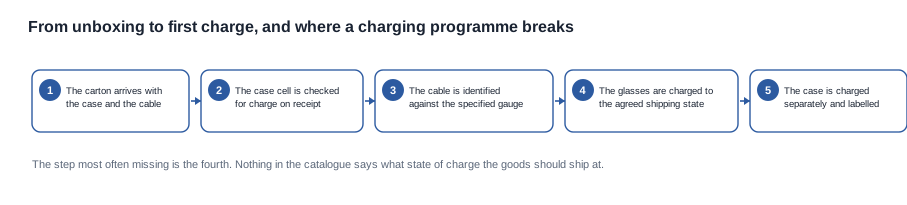
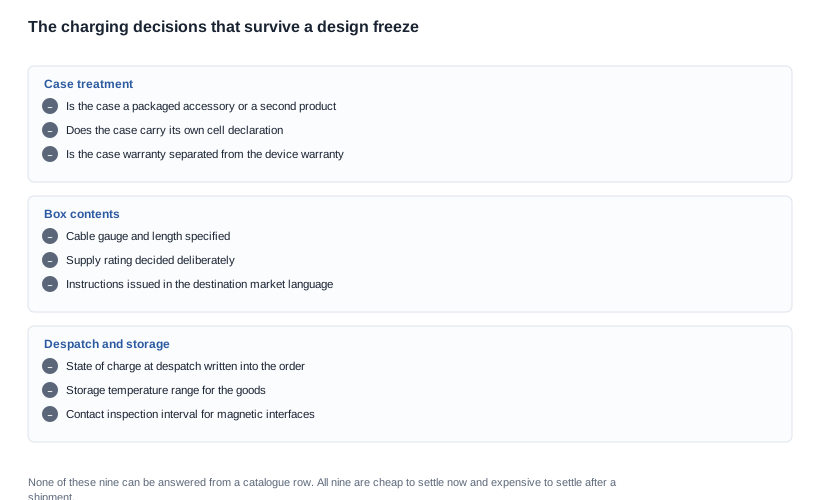
The checklist above is the set of decisions that survive a design freeze, and none of them can be answered from a catalogue row. That is the reason they are worth writing down before the order rather than during the review.
The measurements that come with them are specific and cheap. Charge from a stated low state, to a stated point, with the cable that ships. Without all three, the published figure cannot be reproduced, and a figure that cannot be reproduced cannot be put into an acceptance criterion. Measure the case separately, from the same low state, with the same method, because the case's own recharge time is not published for any model in the range and it is the number a buyer actually needs when planning a rotation between two devices and one case.
Cycle a contact and measure the change in charge time. A contact tested at cycle one and at cycle two hundred tells the buyer something that no datasheet will, and it takes a fixture and a bench rather than a laboratory.
The acceptance criteria should be written as a method rather than as a result, and the method for charging has four fixed elements: the starting state, the source, the cable and the completion point. A criterion with three of those four is a criterion that can be argued with, and a criterion with all four is one that can be repeated by an inspector who has never met the factory.
And measure the thermal behaviour during a charge, because the charge time of the two hours or less published across most of the range is a figure that nobody has stated at a temperature, and a charge that takes two hours at twenty-five degrees may take longer in a container or in a vehicle.
The total cost of a charging decision is worth putting on one sheet before the order, because most of it is invisible in the unit price. The cost of the case as a second product, the packaging that has to hold it, the second cell declaration, the freight weight it adds, the separate warranty and the separate return path. For a platform where the case is the primary charging path, all six of those items exist because of a charging decision, and all six of them are larger than the difference between two unit prices.
The same is true of the interface. Magnetic charging removes a cable from the box and adds a consumable to the product life; Type-C keeps the box simpler and puts the consumable in the customer's hands, which is a cost the buyer does not carry and a support question the customer does. Neither is better in the abstract, and the decision is worth making explicitly rather than inheriting from whichever module was cheapest.
The charging rows we publish and the ones we cannot
We publish the charging interface, the case capacity where we hold them and the charge time, and we publish the cell capacity and the runtime for every model. We do not publish case recharge times, contact cycle life, cable gauge, input current, charging efficiency, the nominal cell voltage, the safe charging temperature or the shipping state of charge, because those are not in our published material. We would rather flag the gap than let you discover it from a customer email.
There is one more thing worth being explicit about, because it is the difference between a usable figure and an unusable one. The published charge time has no starting state and no completion criterion. Two hours or less does not say from what percentage, and it does not say at what point the charge is judged finished. On most of the range this is a modest gap. On a platform where the case is the primary charging path, it is a larger one, because the device's charge time and the case's charge time are different numbers and only the first of them is published.
Related reading
- The freight-document question that catches people out: does the charging case need its own report.
- Fault patterns in the field: smart glasses charging problems and fixes.
- Why the interface decision is a commercial one: smart glasses charging smart glasses why it matters.
Send us the model, the box contents you plan and the destination markets, and we will tell you which of these obligations apply to you.


