

Most open ear audio glasses smart glasses buying mistakes to avoid lists come from reviewers who have tested one product on a desk. This one comes from the places where the products actually differ from each other, which is where purchasing errors happen. None of these are exotic. All of them are expensive once they reach a listing page.
Seven errors, and the first five of them are made while the shortlist is still being built — which means they are made cheaply, and corrected cheaply, provided somebody notices them in time.
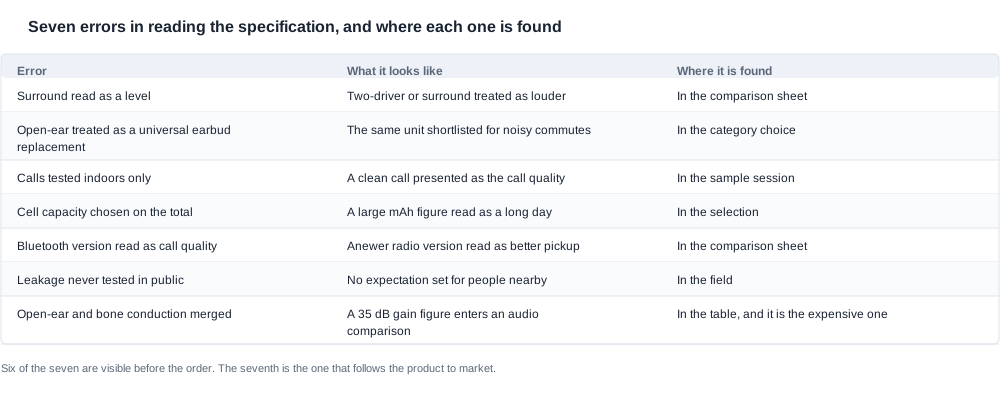
Open ear audio glasses: five shortlist errors
A shortlist is a document, and it is usually assembled by copying rows from supplier quotations and supplier websites into a spreadsheet. Every one of the five errors below is a mistake in how a row gets copied, or in what gets inferred from a row that was copied correctly.
Mistake one: reading a surround claim as a volume figure
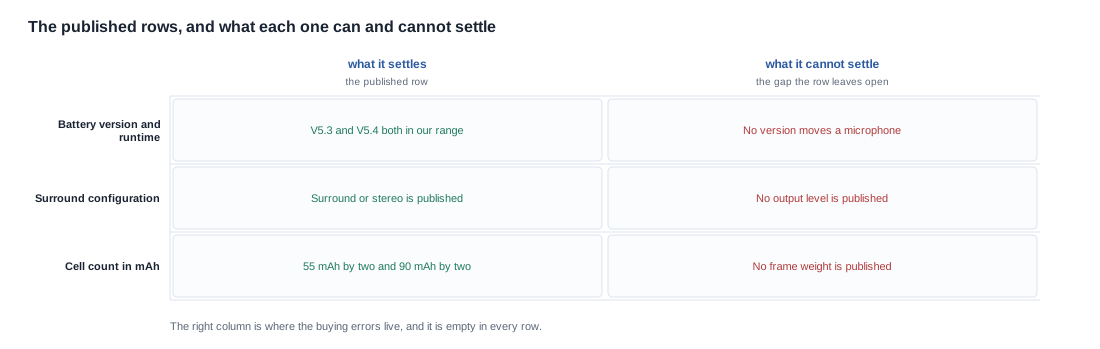
Our catalogue describes several models as carrying a surround or stereo configuration — the D11 publishes surround, the YK12 and the YKC02 publish surround sound, the D17 publishes surround sound and the ZH12 publishes stereo surround. Buyers consistently read that as "louder" and it does not mean that.
Driver count and driver output are independent. A two-driver configuration can be quieter than a single well-matched one, and a configuration descriptor tells you nothing about the maximum level. If volume is the requirement, ask for an output figure. Ours is not published for any model in this family, and we will not quote a figure from the industry for a product we have not measured.
The practical symptom of this error is a shortlist that ranks models by how many ways their audio is described, and a listing copy that says the product is powerful because the supplier's page used the word. When the customer turns it up in a street and it is not louder than the alternative, the return reason will be recorded as "not loud enough" and nothing in the file will explain why.
Mistake two: treating open-ear as a replacement for earbuds everywhere
Open-ear audio wins where ambient awareness matters: walking, cycling, working in a room where you need to hear a colleague. It loses where masking is severe — aircraft cabins, construction sites, a moving car with the window down.
No amount of volume closes that gap, because the problem is masking rather than insufficiency. Masking is the situation where the noise floor sits above the level of the signal you are trying to hear, and raising the signal only works until it reaches the noise floor. An in-ear product solves the problem by physically blocking the noise floor; an open-ear product cannot, because its entire acoustic argument depends on not blocking it.
The commercial consequence is a shortlist that has been assembled around one product because it is the fashionable category, when the correct shortlist for the channel might be entirely different. Decide which environments your customer is actually in before you decide the category, and treat the environment list as part of the product requirement rather than as marketing context. The loudness question in this family is treated separately in is it loud enough for calls.
Mapping the environments explicitly is the cheapest way to catch this error, because the mistake usually comes from a channel decision made somewhere else — by a retailer who wanted the fashionable category, or by a brand that assumed its customer was in an open environment.
| Environment | What open-ear does | The risk in this environment |
|---|---|---|
| Walking outdoors, traffic nearby | Keeps the wearer's awareness of traffic and people | Background noise raises the volume the wearer sets |
| Quiet office, open plan | Works well; the wearer's own voice does not mask the far end | Presence of colleagues constrains the volume ceiling |
| Café or restaurant | Adequate for calls at moderate volume | Noise level raises the volume and with it the leakage |
| Moving vehicle, closed window | Usable, and awareness of traffic is preserved | Cabin noise is a moderate masking problem |
| Aircraft cabin | Marginal; the cabin noise floor is high | Masking dominates and volume does not fix it |
| Construction or industrial site | Not recommended for any audio proposition | The noise floor is far above what the format can address |
Two things fall out of the table. The environments that open-ear genuinely owns are the ones where the customer wants to hear the world, and the ones where it fails are the ones where the customer wants to escape it. A channel that sells to commuters in a city and a channel that sells to site workers are not buying the same product, and a shortlist that mixes them is a shortlist that will disappoint one of the two.
There is also a second-order point about volume ceilings in the middle of the table, and it is the reason leakage and comfort have to be considered together. In any environment with other people in it, the wearer's volume is set socially rather than technically — they turn it up to the level they can hear, and then it is audible to the people beside them. The ceiling is not the amplifier; it is the room.
Mistake three: testing calls indoors only
An open-ear microphone has to separate the wearer's voice from whatever is around them. Indoors that is easy. Outdoors with moving air it is not, and wind noise rejection has to work without the wearer doing anything.
Test on a street, in wind, while walking. If the unit fails there and your customers take calls outdoors — and they do — you have found your return rate, and you found it in the field rather than in the sample session where it cost nothing to find.
The specific reason indoor testing is so misleading is that the two failures are different in kind. Indoors the microphone has to reject a low, steady background. Outdoors it has to reject a high, transient, moving one. A device that handles the first and not the second will pass a quiet office test every time and fail in the environment that matters. The measurement method for this is in how to measure smart glasses microphone quality.
Mistake four: choosing on cell capacity and inheriting the mass
Some of our audio models state two 55 mAh cells, one states two 70 mAh cells, one states two 90 mAh cells, and the single-cell models publish 100 mAh and 115 mAh. A buyer who reads the mAh figure as the differentiator will pick the largest total number on the sheet, and that is where this error becomes expensive.
Two cells in the temples do two things at once: they add runtime and they add weight to the ends of the frame. A frame carrying mass at the temples feels different from one carrying it centrally, and the difference is worth wearing both for a full day before you commit.
Weights are not published for our audio range, and in the whole catalogue exactly one model publishes a weight at all — a camera model, not an audio one. So this comparison has to be done physically, on units, with wearers. It is also the comparison most likely to be skipped, because a spreadsheet comparison of two mAh columns is quicker than a fitting session, and the spreadsheet will not tell you anything about the temples.
The published arrangements make the point sharper than the total figures do. The single-cell models in this family publish 100 mAh on the AR glasses, the D11, the D12 and the ZH12, and 115 mAh on the D17. The two-cell models publish 55 mAh by two on the G07 and the YK12, and the LC-105-1 and the LC-105-2, 70 mAh by two on the YKC02, and 90 mAh by two on the K01 and the K02. Read as totals, the single-cell models look competitive. Read as frames, they are a different product from the two-cell ones: a single cell can be placed near the bridge, and two cells have to sit at the ends of the temples where there is room for them.
That is why the question to put to a supplier is not "how much capacity" but "where do the cells sit, and what is the mass at each temple". It is also why the two-cell models in this family publish the longer runtimes — the LC-105-1 and the LC-105-2, the YKC02 and the K02, and the K01 all publish roughly eight hours — while the single-cell models publish seven or eight hours with a single cell of similar or greater total capacity. The difference is that the two-cell arrangement buys its runtime with two housings and two contact interfaces rather than one, and the buyer is paying for that in mass distribution rather than in milliseconds.
Mistake five: reading a Bluetooth version as a call-quality proxy
V5.3 and V5.4 both appear in our range — V5.3 on the K01 and the K02, V5.4 across the rest of the family. The version number describes a radio generation. Its effect on a call runs through power consumption and codec availability, not through microphone quality.
A V5.4 product with a poor pickup chain still sounds poor on a call. Use the version for battery and lifecycle decisions and the microphone test for voice decisions. Putting a radio generation into a call-quality column of a shortlist spreadsheet is the most common single error in this family, because the version is the only published number that appears anywhere near the word "call" in a supplier's document.
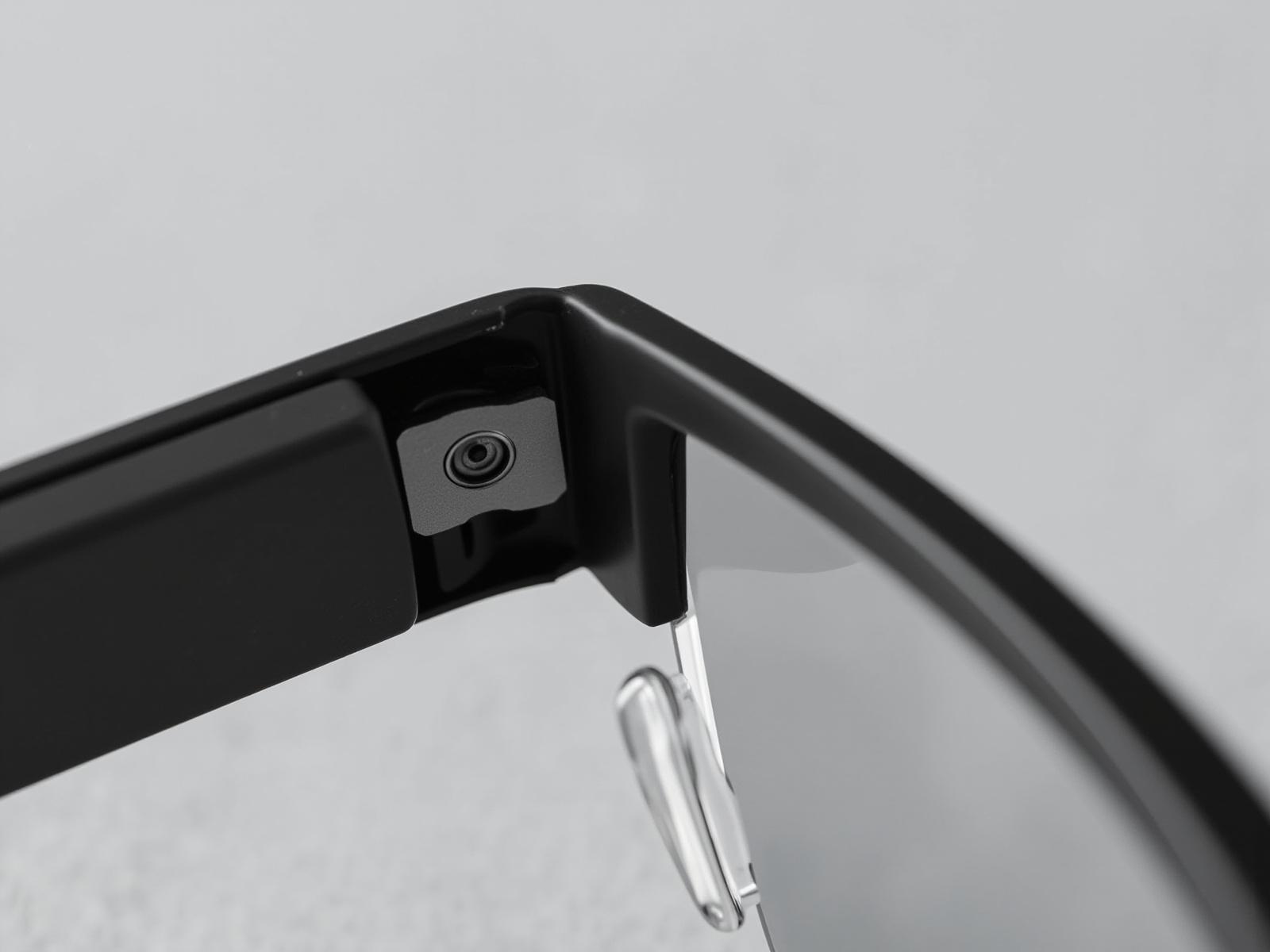
The expectation error that only appears in public
Mistake six: testing leakage only in a quiet room
Open-ear audio is audible to the people around you, and the level rises as the wearer pushes the volume to overcome noise. The combination that actually happens is a noisy environment, the volume turned up, and a stranger sitting beside the wearer.
If that combination was never observed on the sample, then the behaviour your customer will report is genuinely new information to you. Test the combination on the sample, in a street, at the volume you would set to overcome it, with a second person beside the wearer, and record what was heard.
If the answer is that anyone nearby can hear the audio clearly, that belongs in the listing copy, because the alternative is a disappointed customer and a public review. The field failure patterns for this family are set out in open ear audio glasses problems and fixes.
The reason this mistake belongs in the shortlist section rather than later is a practical one: leakage cannot be measured on a bench at all. It is a property of the product in a social setting, which means the only place to observe it is a sample session that is designed to include the observation. A sample session that does not include it will not produce the number by accident, and the number will not be available after the order either.
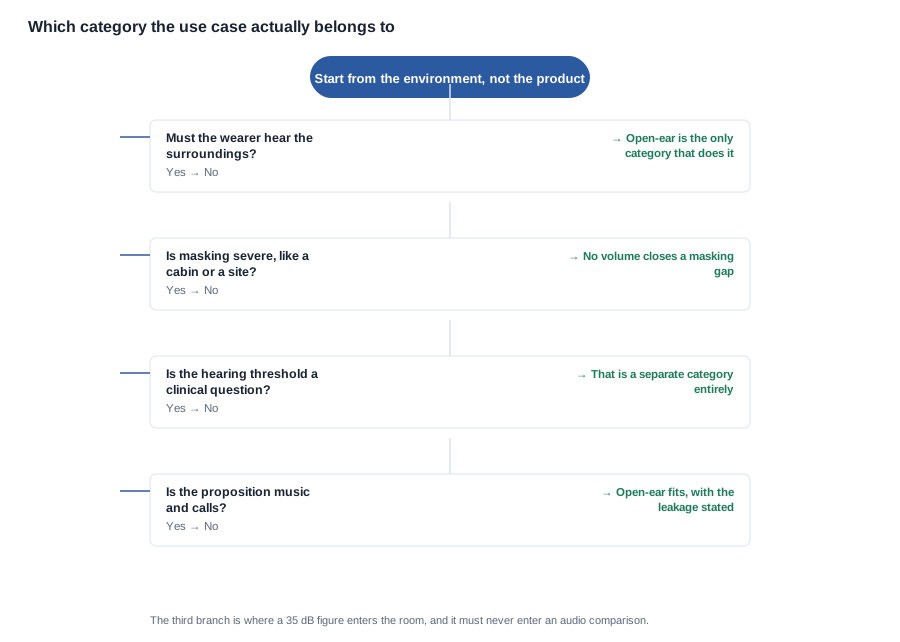
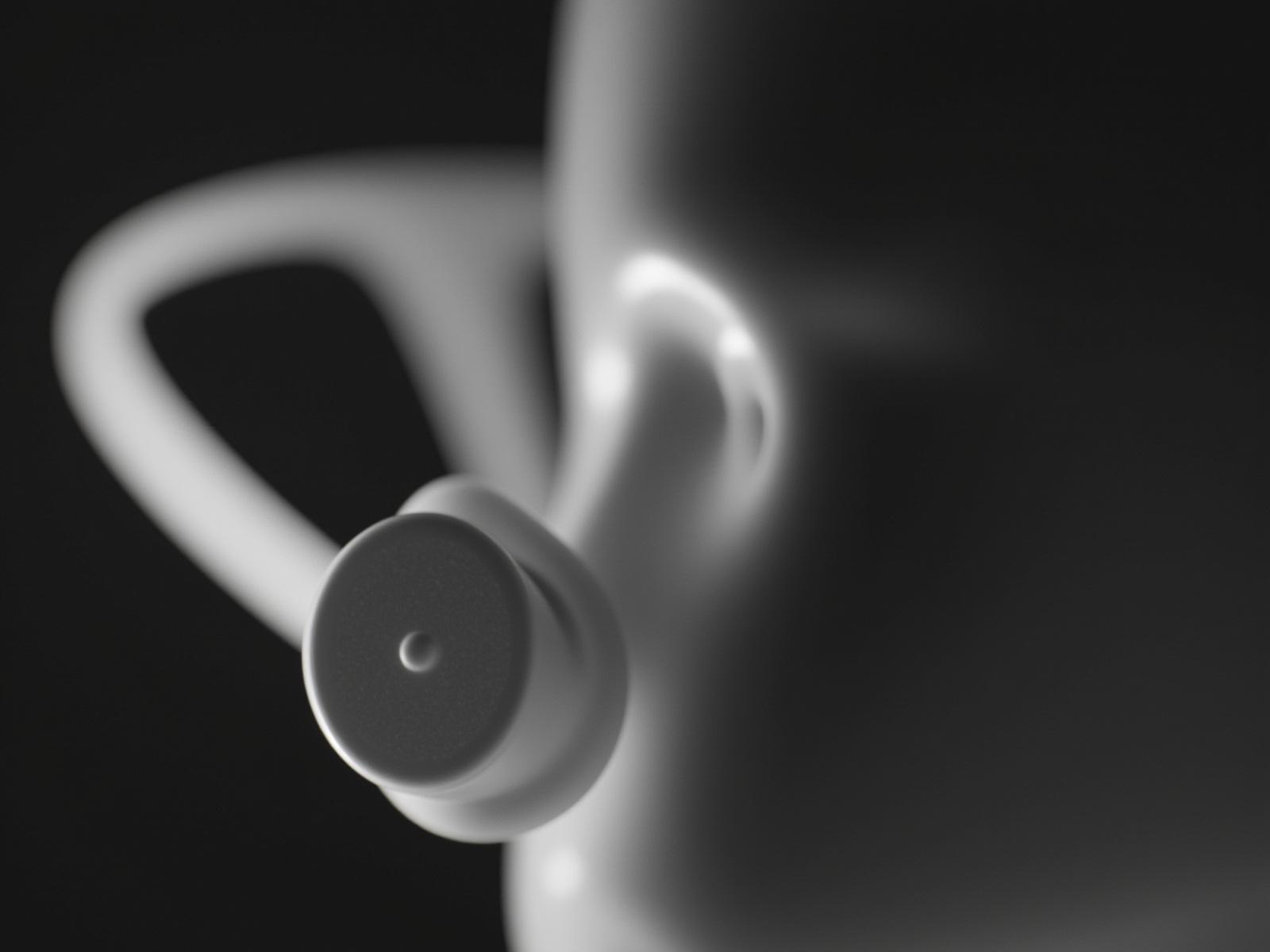
The comparison-table error with a regulatory tail
Mistake seven: merging open-ear audio with bone conduction
These are separate categories with separate rules, and merging them is the mistake that does not stay a purchasing error.
Our bone conduction entry publishes an amplification gain of 35 dB, with a 200 mAh cell, a charge time of two hours or less and a rated use of roughly seven hours. That 35 dB figure is a hearing-assistance figure, not an audio figure. A product marketed on that basis can be treated as a regulated device depending on the jurisdiction and the claims made, and the burden of classification sits with the party placing it on the market.
If you are buying open-ear audio for a music-and-calls proposition, do not let a 35 dB number enter your comparison table at all. It is not a comparable metric, it is a metric from a different regulatory world, and a spreadsheet that contains both will eventually produce a shortlist decision that nobody realised was a medical question. The FDA framework that governs device classification is the reference that matters here, and the bone conduction procurement checklist treats it on its own terms in bone conduction glasses checklist for procurement.
The trade-offs a buyer can make deliberately once the seven errors are out of the way
The point of clearing the errors is that the decisions become real rather than accidental. Four trade-offs in this family are worth deciding explicitly, because each of them is decided by a spreadsheet default otherwise.
Single cell or two cells. The single-cell arrangement, as on the D11, the D12, the D17 and the ZH12, concentrates the mass and gives the frame one interface to seal. The two-cell arrangement, as on the LC-105-1 and the K02, the LC-105-2 and the G07, the K01 and the YKC02, and the YK12, spreads the mass towards the ends of the temples and publishes the longer runtimes. If your channel's customers wear the product through a long working day, the second arrangement usually wins; if they take it off and put it in a pocket between meetings, the first usually does. The published runtimes are not the deciding number here, because they are quoted without a workload.
Type C or magnetic. The Type C models in this family are the D11, the D12, the D17 and the ZH12, and the magnetic ones are the rest. Type C means the customer owns something they already have, which removes a support reason and a return reason. Magnetic means the contact geometry is defined for the supplier, which usually means a more reliable charge indication and a more reliable docked case if one exists. Neither dominates, and the tiebreaker is usually the channel rather than the product: a channel serving customers who will not research a cable favours Type C, and a channel selling a bundle with a charging dock favours magnetic.
V5.3 or V5.4. The K01 and the K02 publish V5.3; the rest of the family publishes V5.4. This is a lifecycle decision rather than a performance one, and it should be made against the phone generations your customers will hold for the next three years rather than against the current flagship.
Surround or plain. Five models publish a surround or stereo configuration and the rest do not. Because no output level is published for any of them, the configuration cannot be ranked on loudness, and the only honest way to use it is as a positioning fact — provided the copy does not imply a level that the product cannot deliver.
Once those four are decided deliberately, the remaining questions are the ones in the buying checklist, and the sample session becomes the place where the decisions get tested rather than the place where they get made.
A pre-shortlist pass that catches all seven
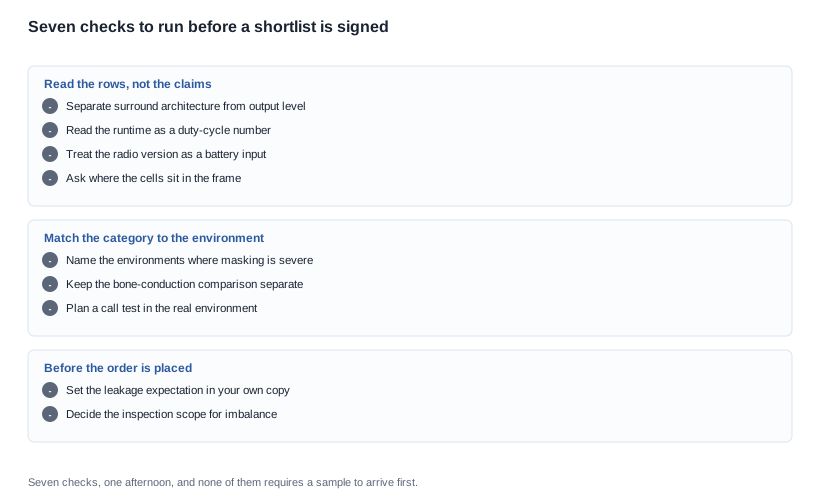
Seven checks, one afternoon, and none of them requires a sample to have arrived. Run them against the spreadsheet rather than against the supplier, because every one of the seven errors is a spreadsheet error before it is a supplier error.
- Separate the architecture from the level. Wherever a row says surround or stereo, mark the row as architecture only and find out what the playback level is separately. If the level is unavailable, treat the model as unranked on loudness.
- Name the environments where masking is severe for your channel, and check that the shortlist is intended for those environments. If the shortlist contains a model chosen because it was the fashionable category, replace it.
- Move the call test out of the quiet room. Add a street-and-wind case to the sample protocol before the sample is booked, so that the booking itself carries the requirement.
- Compare mass distribution, not mAh totals. Where two models publish different cell arrangements, treat the comparison as requiring physical units and multiple wearers.
- Move the Bluetooth version out of the call-quality column. Leave it in the power and lifecycle column where it belongs, and leave the call column to the microphone test.
- Add the public-leakage observation to the sample session protocol as a named step with a recorded result, rather than as something the tester may notice.
- Split the comparison table. If a bone conduction row has entered it, pull it into a separate sheet with a separate review, and check the claims language of anything that was shortlisted while it was there.
These are red flags rather than scoring criteria. Each one has a binary answer, and the point of running them before the sample is that a failure at this stage costs a spreadsheet edit while a failure later costs a re-order.
What the published rows will and will not settle for you
We publish the rows our catalogue holds, which for this family means the charge time, the Bluetooth version, the cell configuration, the runtime, the charging mode and the surround configuration where it is stated, along with the additional features on the models that have them. We do not publish output level, driver size, frequency response, leakage, microphone specification, codec, control latency, multipoint behaviour, application detail or frame weight for any audio model.
We would rather your listing copy describe an open-ear product accurately than describe a product nobody measured, and we would rather your shortlist be short than be long and wrong. Where a figure is not published for us, the honest answer is that you will need to measure it, and we will help you write the protocol.
The background on how the format actually behaves is under open-ear audio. Send us the two models you are comparing and the environments your customers use them in, and we will tell you which of the seven mistakes is most likely to reach your customers first.
Related reading
- The comparison buyers actually need: is it loud enough for calls.
- Bone conduction handled on its own terms: bone conduction glasses checklist for procurement.
Send us the two products you are comparing and the environments your customers use them in, and we will tell you which of the seven mistakes is likely to reach your customers first.


