
A hiking product is judged against a day rather than against an hour, and that single difference changes what the buyer should be looking for. A hiker is on the trail from first light until the last camp, the product is carried through a temperature range that a city retail floor never sees, the hands are occupied with poles or gloves, and there is rarely a charging opportunity between the trailhead and the summit. The published rows in our catalogue answer part of that and are silent about the rest, and the split between those two categories is what this page sets out.
The published material for the models that come up in hiking conversations is specific about power and about interfaces and silent about three things that matter more in this use case than in any other: the frame weight, the ingress test basis and the acoustic behaviour in wind. The V06 and the S7 carry the only ingress markings in the range, at IP54, with no third-party test report number published for either. Two models publish a charge figure shorter than the two-hour ceiling that applies to the rest of the catalogue, and they are the D17 and the ZH12 at roughly one hour. And no model in the range publishes a weight.
Who makes this decision, and what they are defending
A product developer is deciding whether a hiking line is technically defensible, and the three unpublished rows are the ones that determine whether it is.
A brand owner is deciding what the range says about water, and the wording on the box is the first place a buyer finds out what the catalogue actually supports.
A procurement manager is deciding which samples to order, and a sample list that tests the wrong conditions produces a result that cannot be used later.
Smart glasses for hiking: what a full day on the trail asks for
Four conditions separate a hiking product from an outdoor product generally, and each one attacks a different part of the device.
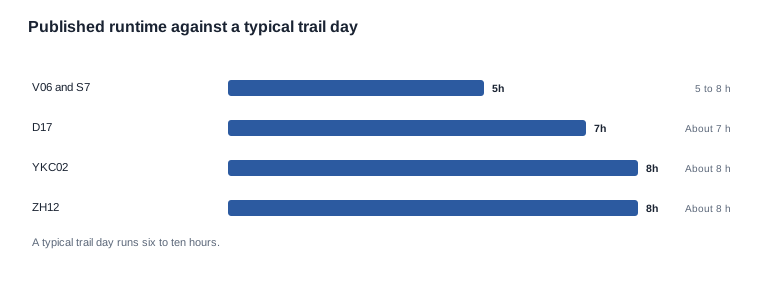
Duration without a charging opportunity. A trail day is six to ten hours for most walkers, and the published runtime bands for the candidate models place the V06 and the S7 in the five-to-eight-hour band, the YKC02 and the ZH12 near eight hours, and the D17 near seven. Only the ZH12 and the YKC02 publish a figure that reaches the far end of a typical day, and both of them are audio models rather than camera models.
Cold and altitude. A cell in cold conditions gives up available capacity and its seal stiffens, so a winter hiking range is operating on a row that has to be requested before it can be planned.
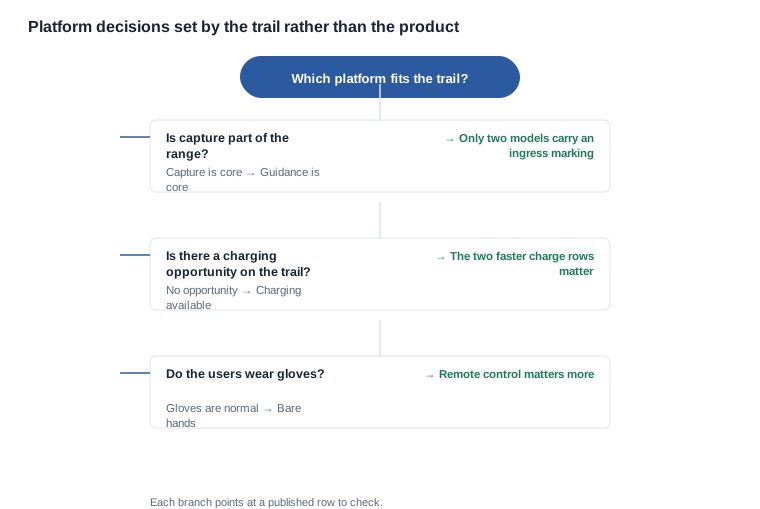
Hands that are not hands. Gloves are the default in a cold mountain environment and they are the condition that breaks a control designed for bare fingers. The remote shutter on the D17 and the ZH12 is the answer that does not depend on a fingertip, and the behaviour of that remote under a glove is published nowhere.
Water in a form that is not a splash. A walker crosses a stream, steps in a puddle and stands under rain that is not falling hard. The second digit of a 4 in an IP rating refers to water arriving from any direction, which does not cover standing water or a pressure jet, and the only models carrying that marking are the V06 and the S7.
The criteria a hiking decision is judged against
This category turns on five questions, and the order in which they bite is not the order in which they are usually discussed. Does the product last the session? This is the first criterion and the most restrictive, because a hiking day routinely exceeds every published runtime band in the range. Can it be captured without bare hands? Only the two models with a published remote answer this. Does it survive the water it will actually meet? Only the two models with an ingress marking can even be discussed here, and the marking is a catalogue annotation rather than a test report. Does it stay on the head for ten hours? No model publishes the frame weight, and the one weight figure in the catalogue belongs to a camera model with a foldable case rather than to any hiking candidate. Does it remain usable in cold? No model publishes an operating temperature range.
What comes out of that assessment is a shortlist, every entry carrying the reason it earned its place, plus an explicit list of the claims the range will not make. A hiking range that promises more than the documentation supports generates the returns that are hardest to defend, because the customer will have followed the instructions exactly.
The published rows for the models a hiking range would use
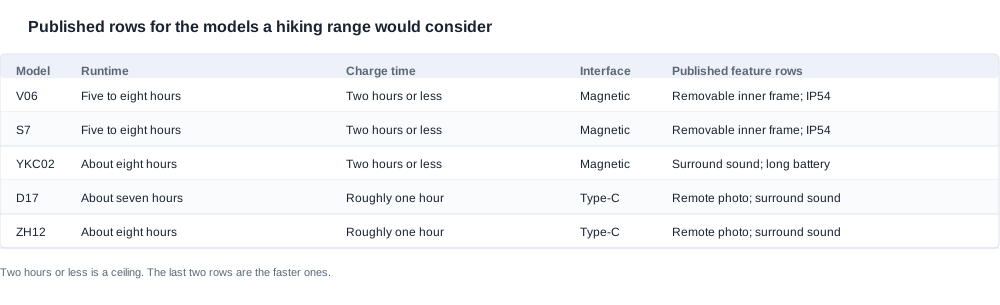
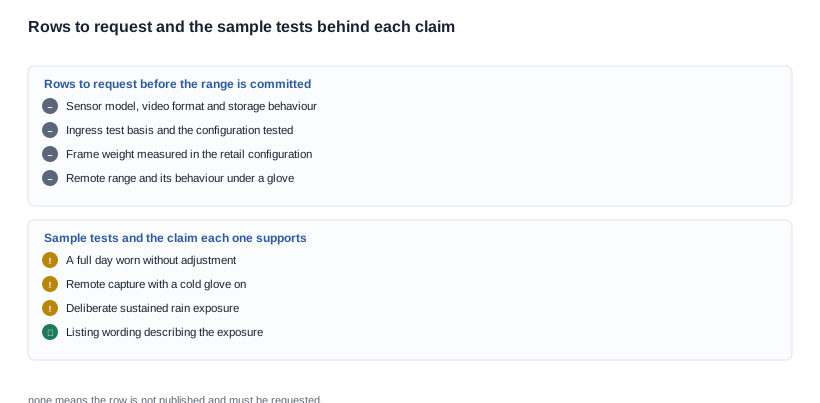
The table below is the published position for the candidates. The right-hand column is the working list of rows to request before the range is committed.
| Model | Feature rows | Runtime | Interface | Charge time |
|---|---|---|---|---|
| V06 | Removable inner frame; IP54; four colourways | Five to eight hours | Magnetic | Two hours or less |
| S7 | Removable inner frame; IP54 | Five to eight hours | Magnetic | Two hours or less |
| YKC02 | Surround sound; long battery life | About eight hours | Magnetic | Two hours or less |
| D17 | Remote control photo; surround sound | About seven hours | Type-C | Roughly one hour |
| ZH12 | Remote photo; surround sound in Chinese line | About eight hours | Type-C | Roughly one hour |
What the camera models contribute and what they cost
The V06 and the S7 are the only models in the range that combine a camera with an ingress marking, which makes them the only camera candidates whose water exposure can even be discussed in a product conversation. Both publish the ergonomic design line and the removable inner frame, while the V06 lists four colourways of its own.
The cost of that combination is weight, heat and a pipeline commitment, and all three are unresolved in the published rows. The frame weight is not published, the sensor model and the field of view and the frame rate and the video format and the storage capacity are not published, and a hiking channel that publishes video therefore depends on an editing pipeline it has not yet specified. The smart glasses camera technology article covers what a resolution class does and does not settle.
What the audio models contribute
The YKC02 publishes about eight hours on two 70 mAh cells with a surround-sound line, and the D17 and the ZH12 are the two models whose charge figure beats the two-hour ceiling, at roughly one hour each. For a long day with no charging opportunity, the ZH12's published figure is the longest runtime on the sport models and its charge time is the shortest, and that combination is what a buyer is really comparing.
The remote is the feature a hiking brief asks about first. Its range, its behaviour under a glove, its response in rain and how it interacts with the camera are all unpublished, so the remote belongs in the sample plan rather than in the specification.
Choosing between the camera platforms and the audio platforms
When capture is the proposition
If the hiking range is a content range, the camera models are the only candidates with a published ingress marking, and the decision inside them is a pipeline decision rather than a hardware one. The V06 and the S7 sit at eight and thirteen megapixels on the same electrical platform, at 260 mAh and a five-to-eight-hour published runtime, and nothing else about them is published. Ask for the sensor model, because a resolution class on its own is not an image quality statement, and ask for the storage behaviour, because a day of capture has to land somewhere.
When guidance is the proposition
If the hiking range is a navigation and communication range, the audio models are the stronger candidates, and the published charge times of roughly one hour on the D17 and the ZH12 matter more than the runtime difference between them. Both are Type-C, so a range built on both can carry one cable type, which is a real reduction in the gear a walker has to manage.
When the two are combined
A range that offers both usually ends up with two products rather than one, and the commercial consequence is a second packaging configuration, a second accessory set and a second set of support questions. The cases make that concrete: the published capacities in the range are 900 mAh, 1200 mAh and 1400 mAh, the KY06 and the MT5 carry a case of unstated capacity, three camera models publish no case row whatsoever, and the V03 Pro has no charging-case row. A hiking line built around the camera models inherits the absence of a case row, and a hiking line built around the audio models inherits a case that has to be sourced with the unit.
How to choose when the range has to cover both
A hiking brand that wants capture and guidance in one line ends up comparing a camera platform against an audio platform, and the comparison is not like-for-like, because the two answer different questions about the session. The honest way to handle it is to treat them as two products with two duty patterns rather than as two configurations of one product.
The first thing to compare is what happens at hour seven. The camera models publish five to eight hours, and the sport models publish about seven hours on the D17 and about eight hours on the YKC02 and the ZH12, while the audio models publish about eight hours on the K-series and the LC-105 pair. On paper the audio models reach further. In practice a camera product that stops at hour six has still produced six hours of footage, while a navigation product that stops at hour eight has produced nothing for the last two, which is why the pattern of use changes the comparison rather than the figure changing it.
The second is the charging opportunity. The D17 and the ZH12 publish roughly one hour, and the camera models publish two hours or less. On a trail where a vehicle is within reach at midday that difference is visible; on a trail with no power at all it is invisible, because neither product will be charged.
The third is what the range can defend. The camera models carry the only ingress markings, and the audio models carry the only remote shutter, so a range with both has one product that can discuss water and one that can discuss capture without touching the frame. Whether that combination justifies two packaging configurations is a commercial question for the brand rather than a technical one, and it is the kind of trade-off that is better settled before the artwork than after the first production run.


Testing a hiking sample before the range is committed
Three checks on real samples do most of the work in this category, and each one is designed to break a specific assumption rather than to confirm a specification.
A full day worn. Not an hour. A unit that passes a shop-floor demonstration can fail in hour five because of temple pressure and accumulated sweat. Re-check the adjustment at the end of the day, because a temple that rides up changes both the camera's framing and the microphone's position relative to the mouth. This is the cheapest test in the set and the one most often skipped.
Capture with gloves on. Remote capture controls are specified for bare fingers, and a hiking glove is the condition that breaks the assumption. Test it on a cold sample rather than a warm one, because glove thickness and condensation both matter.
Sustained rain, deliberately. If the range intends to claim water resistance, test it rather than relying on the marking, and describe the exposure in the listing rather than claiming a rating the documentation does not carry. The ip rating myths article and the ip ratings reference set out what a marking establishes and what it leaves open, and the sample evaluation page covers the sampling discipline itself.
What the sample has to settle before it is ordered
Three things are worth settling before the samples are ordered rather than after they arrive, because each of them changes the sample list itself.
Which environment the sample is exercised in. A sample tested in a showroom answers a question nobody asked. If the range is for hikers, the sample has to be worn on a trail for a full day, at the temperature the range will be sold into, and it has to be taken out in deliberate rain rather than under a tap.
Which configuration is sampled. The V06 and the S7 differ in resolution class and in colour availability, and the D17 and the ZH12 differ in cell capacity and in runtime. A sample of one configuration cannot answer a question about the other, so the shortlist has to name the configurations and the sample order has to match it.
Which questions the sample is allowed to answer. A sample run is cheap and a sample programme is not, so the questions the sample is allowed to answer have to be written down before the unit is shipped. The three tests above are the standard set, and adding questions afterwards is how a sample programme turns into an open-ended exercise that never reaches a decision.
What a hiking range costs to source and support
A hiking range carries two cost items that a shorter outdoor programme does not: the volume of returns it generates and the range of conditions it has to cover.
Where the support cost comes from
The dominant support cost in this category is the return that arrives without a fault. A unit that stopped charging after four hours on the trail is returned as a defective product, and if the published runtime was presented without a condition then the supplier is the one carrying the argument. The remedy is in the wording rather than in the engineering: publish the runtime with its condition, publish the charge time as the ceiling it is, and state the exposure rather than the rating.
What the accessory and packaging rows decide
Where the range ships with a case, a second cell travels in every consignment, and that is where the parcel cost, the declared contents and the transport classification come from. A range without a published case row carries a lighter parcel and a different service kit, and the decision belongs to the buyer rather than to the catalogue.
What the range costs beyond the unit
Two costs sit outside the product and are usually larger than expected. The first is the second lithium cell, because a case in every unit changes what the carton contains, how the consignment is classified and what the shipping paperwork has to say, and the published case capacities of 900, 1200 and 1400 mAh make the scale of that visible to anyone doing the freight arithmetic. The second is the return profile, because a range that publishes a runtime without its condition generates returns that are argued rather than processed, and each argued return costs more desk time than a processed one.
Neither cost appears in a unit price, and both are settled by decisions that sit in this document: which case position the range uses, whether the runtime is published with its condition, and whether the ingress marking is printed at all. Before you order, the total cost of a unit in the field is the unit price plus the accessory set plus the expected handling cost of the returns, and the third term is the one that a per-model price comparison never shows.
Where a hiking programme can hold a term firm
A hiking programme has one commercial term that follows from the trail rather than from the product, and it is the returns policy. A channel whose customer has been out for eight hours in the rain and comes back with a unit that stopped charging is a channel whose returns are argued, and an argued return costs more desk time than a processed one.
- Price and the volume breaks — negotiable.
- Accessories and mounting hardware — order quantities of their own.
- How the unit is packed and how a delivery is split — the packaging specification and the delivery pattern.
- Payment terms — released once the inspection is passed.
- Cover — the period and the response time it carries.
- Returns for a hiking channel — the policy that applies.
- Conditions of a trial order.
- What certification and tooling cost — outside negotiation. The testing body sets the amount and the schedule, tooling is normally recovered over a third order, and certification is invoiced once for every family the factory holds. Check which of those two a quoted line actually points at.
A hiking order should be documented with: the published rows for the configuration ordered, the runtime condition for the intermittent duty pattern, the sensor and video specification where a camera is in scope, the ingress report with the tested configuration, the function and range of the remote and its behaviour with a glove, the frame weight and dimensions as measured, and the warranty period with a stated response.
What must stay out: a waterproof, immersion or rain-capable claim, a weight nobody measured, a runtime guarantee with no condition attached, and an image quality claim that never went onto a sample.
We publish the hiking rows exactly as the catalogue records them, and we do not restate an ingress marking as a rain claim or a runtime figure as a guarantee of a full day. Smart glasses for sports and outdoor hiking use case is a category where the sample does the work the datasheet cannot, and where the listing should describe the exposure rather than promise a rating.
The first three steps for a hiking programme
- Write the trail profile down — the typical day length, the temperature range, the water exposure, and whether capture is part of the proposition.
- Bundle every open row into a single request: sensor and video specification, ingress test basis, frame weight, remote behaviour under a glove, and the runtime for an intermittent duty pattern.
- Run the three sample tests — a full day worn, capture with gloves, sustained rain — and put the pass lines and the exposure wording into the agreement and onto the packaging.
The sports and outdoor solutions page sets out where the range sits in the wider catalogue, and the two platforms carrying an ingress marking in our range are the V06 and the S7.


