

The most expensive ingress myths are not the naive ones. Nobody believes that IP54 means a scuba mask. The costly misunderstandings are the plausible ones — the half-true statements that survive a conversation with a supplier, get written into a purchase order, and end up printed on a retail listing, where a customer who trusted them comes back with a complaint. IP rating smart glasses myths is a list of five of them, and in each case the cost is specific, bounded and avoidable.
Our range carries IP54 on exactly two models, the V06 and the S7. Both are the products where these myths do the most damage, because both are sold into outdoor channels where a customer will leave them on a wet car seat in summer heat and expect them to survive. They may well survive it. That is not what the marking says, and the difference between "probably fine" and "specified" is the whole of the commercial question.
IP rating myths: the half-true ones cost most
The short answer, and the one habit that prevents all five
Every myth on this list is cured by the same substitution: write the exposure rather than the number. "Resists sweat and light rain during a two-hour ride" is defensible against an IP54 marking, because it names what happens and how long. "Waterproof" is not defensible against anything at all, and "IP54 waterproof" is worse than either, because it borrows a standard's credibility to support a claim the standard does not make.
That habit sounds simple and is operationally awkward, because procurement specifications are written in codes and marketing copy is written in adjectives, and the exposure description sits in neither document. It has to be put there deliberately: as a line in the requirement, as a sentence in the copy, and as a row in the acceptance criteria. Three documents, one description, written once and copied.
The reason the half-true myths survive is structural rather than intellectual. "IP54 means splash resistant" is not obviously wrong in a meeting — the product will survive a splash. It is wrong in the sense that it drops the exclusions, and the exclusions are the part the customer needs. A buyer who only checks whether a claim is defensible will pass it. A buyer who checks whether it is complete will not.
The buyer at the point the myth does its damage
The buyer who meets these myths is usually holding a copy draft, a competitor's listing, a datasheet and a channel plan, and is at the moment where the copy has to be approved. What they will not be holding is the discipline to test the copy against the code rather than against the impression — and the copy is almost always the artefact that produces the complaint.
The myths also travel upstream into procurement documents, which is the more expensive route. A purchase order that says "IP65 or better" is not a typo; it is a decision made without asking which digit was meant, and it will be inherited by every subsequent order on the programme.
What a buyer is trying to avoid
A listing that is wider than the evidence. The reader fills the gap with the strongest reading rather than the accurate one, and then acts on it, and the action is what creates the return.
A product rejected on the assumption that an unmarked model is a cheap one. The absence of a marking means the source documentation does not state one. For 26 of our 28 models that is the position, and it says nothing about how the product performs — it says the question has not been answered in writing.
A specification written as "IP65 or better" without defining which digit. The phrase appears on purchase orders and it is ambiguous, because the two positions are independent.
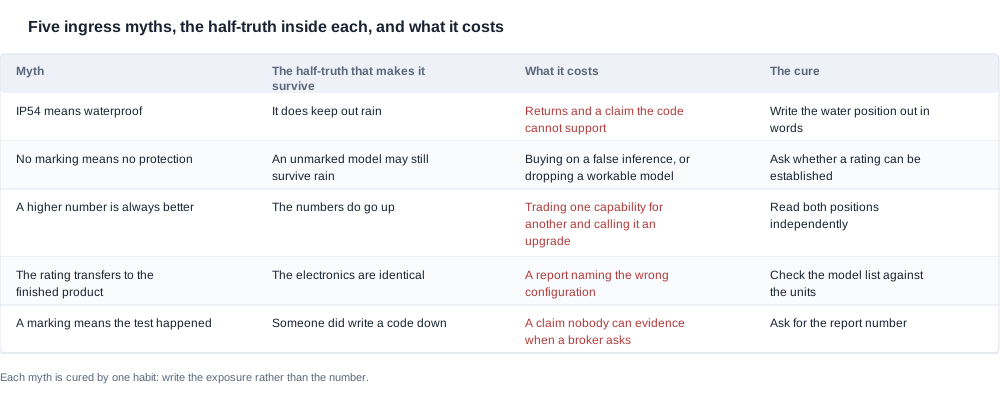
Five myths, each with a specific price
The myth set, the half-truth inside each, and the cure
| Myth | The half-truth that lets it survive | What it costs | The cure |
|---|---|---|---|
| IP54 means waterproof | It does keep out rain | Returns, and a claim the code cannot support | Write the water position out in words |
| No marking means no protection | An unmarked model may still survive rain | Buying on a false inference, or dropping a workable model | Ask whether a rating can be established |
| A higher number is always better | The numbers do go up | Trading one capability for another and calling it an upgrade | Read both positions independently |
| The rating transfers to the finished product | The electronics are identical | A report naming the wrong configuration | Check the model list against the units |
| A marking means the test happened | Someone did write a code down | A claim nobody can evidence when a broker asks | Ask for the report number |
Myth one: a splash code read as a waterproof code
The second position is where this myth lives. A 4 is a splash rating: water hitting a surface from a direction other than immersion — raindrops, spray, sweat, a knocked drink. It is not a rain rating, not a shower rating and not a hose rating, and the phrase "protected against splashing water from any direction" is doing considerably more work than "waterproof" ever does.
The price is paid in two currencies. The direct one is a return rate, in a channel where the customer tests the product personally. The indirect one is worse: the listing has to be corrected, and the correction reaches the packaging, the documentation and the support script as well, so the cost of one bad sentence multiplies across every surface it touched.
Myth two: no marking read as no protection
This myth has a strange property: it makes buyers worse at procurement. A buyer who believes an unmarked model is an unprotected one will either reject a perfectly good product or spend money buying a rating they do not need. Both are errors, and the second is the more expensive because a rating costs a laboratory queue and a seal design exercise.
The correct reading is the other half of the truth. The absence of a marking means the source documentation does not state one. Our own documentation is in exactly that position for every model except the V06 and the S7, and we publish it that way. A buyer who assumes an unmarked product is a cheap product has it backwards.
Myth three: the numbers read as a ladder
This is the myth that costs engineering budget. The two positions do different work and are independent. The first describes solid particle protection, where 6 is dust-tight. The second describes water ingress, where 4 is splash, 5 is jets, 6 is powerful jets and 7 is temporary immersion. An IP54 and an IP65 are not ordered against each other at all — the first is stronger on water, the second on solids. Moving from one to the other is a lateral trade, and calling it an upgrade is how a programme ends up paying for a seal change that does not buy the protection it was aimed at.
The criteria to apply when a better number is requested are simple: name which position has to improve, and what exposure in the channel is currently unaddressed. If the answer is that neither position is the problem, the request is a preference rather than a requirement.
Myth four: the rating treated as a family property
A rating attaches to a configuration, not to a product family. If the marking was established on a frame with a different temple profile, a different seal geometry or a different hinge, a sibling model with the same electronics is not automatically covered. This myth is the most expensive in the set, because it usually surfaces at a customs inspection or a marketplace review rather than at the factory.
It is also the myth most often caught by accident rather than by design. The check that catches it is cheap: read the model list on the report and compare it against the model designation on the unit in your hand, character by character. Where the names are similar, this is the check that catches a substitution, and a mismatch is a stop condition rather than a query.
Myth five: the marking treated as evidence of a test
Our own documentation is a live example of why this is dangerous. We publish that the V06 and the S7 carry IP54. We do not publish a test standard, a laboratory, a sample batch or a date. So we can tell you the marking exists in our source material, and we cannot tell you it was tested, where, or on which units.
That gap is the honest position, and it is also the position a buyer should insist on from every supplier. A code is a claim about a document. A document is a claim about a test. A test is a claim about a configuration. Each step down is a step closer to something that can be verified, and a buyer who stops at the code has stopped one step short of anything they can file.
The purchase-order wording each myth has already corrupted
The three requirements that carry the damage
Three lines in a procurement document carry most of the damage from these myths, and each one can be rewritten without any new information.
The first is a floor expressed as a number. "IP65 or better" is ambiguous in a way that matters, because the two positions are independent and a supplier satisfying one of them has met the written requirement. The rewrite names the position, the level, the configuration and the document: "protected against splashing water from any direction, on the shipped configuration, report number attached."
The second is a requirement written as a brand name rather than a condition. "IP54 rated" is shorthand that gets expanded by the person writing the artwork, and they expand it towards the benefit. The rewrite is the marking with both positions written out, plus the exclusion list, and the exclusion list is what stops the expansion.
The third is the requirement that assumes coverage. "Ingress protection to be inherited from the platform model" is the myth-four line, and it is the one that ends in a customs query. The rewrite names the model designations the document covers and requires confirmation for any derived configuration.
The thresholds a supplier has to clear
The criteria for accepting an ingress requirement are worth writing down once, because they are the same for every myth and they are checkable. The standard and its edition, named. The code with both positions written out in plain language. The report number with the issuer and the validity dates. The model designations the document names, matching the designation that will appear on the goods. The tested variant, with the port arrangement, the contact points and the interfaces it was fitted with. The exclusion list, in writing. The production control, with a reference unit and a test frequency. The seal material and its expected service life.
A soft answer to any row of that list is not a gap in the supplier's documentation; it is a fact about the supplier's documentation, and the buyer's next action depends on which fact it is. "Not published" on the seal service life is a complete answer that can be priced. "High quality seals" on the same row is not an answer at all.
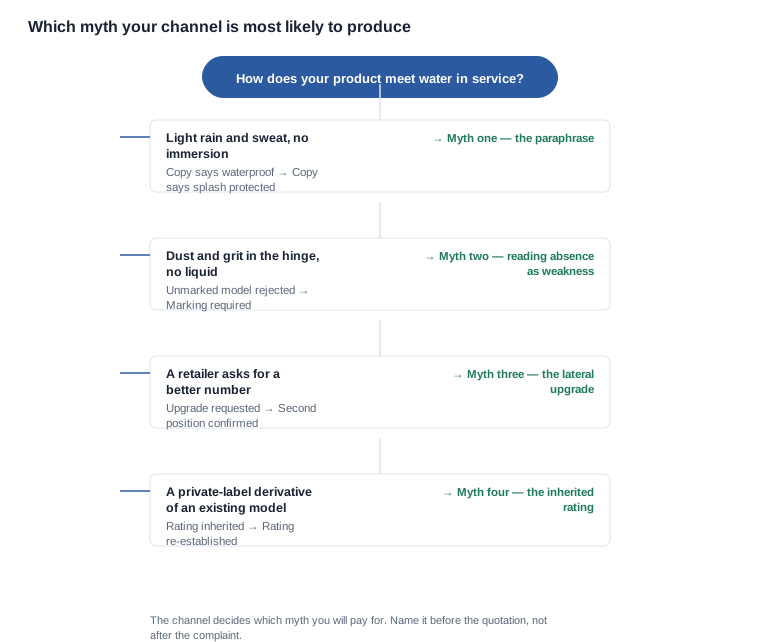
Which myth your channel is most likely to produce
The channel decides which myth a programme will pay for, and the mapping is fairly tight. A sport or cycling channel produces myth one, because the copy has to survive a customer who is outdoors in the rain. A channel that serves dusty industrial environments produces myth two, because unmarked models keep getting discounted on the assumption that they are unprotected. A retailer negotiating a specification sheet produces myth three, because a higher number reads as better to everyone in the room. A private-label programme produces myth four, because the branded unit differs from the platform model in ways that are easy to overlook. And a compliance or procurement review produces myth five, because that is the point at which somebody finally asks for the document.
Naming the myth in advance is worth doing, because each one has a different remedy and a different owner. Myth one belongs to the copywriter. Myth two belongs to the buyer. Myth three belongs to the product manager. Myth four belongs to the engineer. Myth five belongs to the compliance reviewer. Assigning them early is cheaper than diagnosing them after a return.

Separating the myth from the document
Five steps, in the order that makes them cheap
How to separate a myth from a fact in this category takes five steps, and the order is chosen so that the cheapest disqualifying check comes first.
The first step is to check the report number in the issuing body's register, confirming the model designation, the covered functions and the validity date. It takes minutes and it is the highest-yield check in the category. The second is to read the exclusion list before approving any copy, because it is the list of things a customer might reasonably believe the product can do, and the copy has to be narrower than the reader's imagination. The third is to compare the three documents — device, documentation, packaging — against each other, because where they disagree the packaging is usually the outlier.
The fourth step is to test the copy against the code yourself. Take every adjective on the page and ask which position covers it. "Waterproof" has no position at all. "Splash resistant" has the second position of a 4. "Dust proof" has the first position of a 5 or a 6, and you should be able to say which one. The fifth step is to run a buyer-side test on a sample for the exposure the channel actually produces, with the protocol written before the first reading.
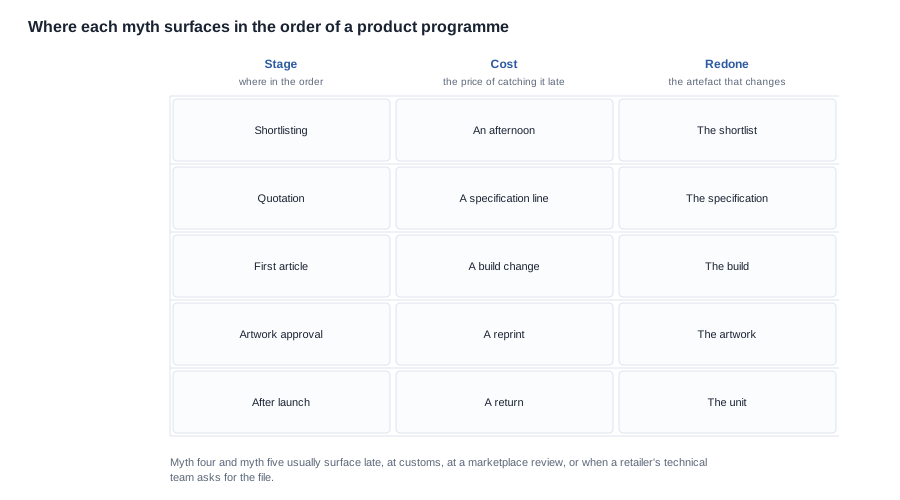
The order of a programme, and where each myth shows up
Timing matters because the cost of a myth rises with the stage at which it is caught. In the shortlisting stage, a myth is a filter that costs an afternoon. At the quotation stage it is a line in a specification that has to be renegotiated. At first-article it is a build change. At artwork approval it is a reprint. After launch it is a return.
The pattern worth noting is that myth four and myth five usually surface late — at customs, at a marketplace review, or when a retailer's technical team asks for the file. The reason is that both are document questions, and document questions are asked by people who are outside the buying process and therefore outside the timeline the buying process set.
Writing the exposure into the specification
The replacement text for every myth is the exposure description, and it has a specific shape: the environment, the duration, and what happens afterwards. "Rain during a two-hour ride, sweat at the temple, wiped with a cloth afterwards" is a complete requirement. "Water resistant" is not a requirement at all, because it does not constrain anything.
The criteria for a usable exposure description are that a supplier can price it, a laboratory can test it, and a customer can act on it. Those three tests will usually reject the sentence you first wrote, and what remains is the requirement.
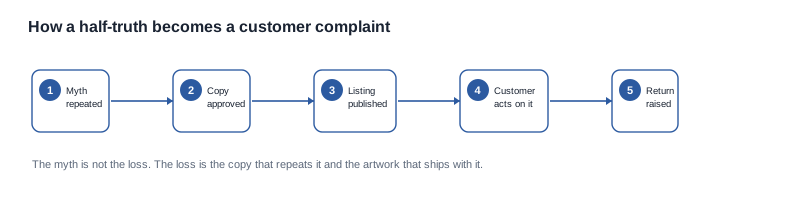

Where each myth surfaces in a product programme
A customer returns the product after rain and the supplier says the rating was misread. The symptom is a return whose description is about the weather. The root cause is that the copy said waterproof while the marking said splash protection, and the copy was the version the customer acted on. The prevention is to fix the copy in the same words on the product page, in the packaging and in the listing, and to add the exclusions.
A product is rejected by a retailer's technical team because the specification says "IP65 or better". The symptom is a technical query escalating to a purchasing block. The root cause is that the two positions are independent and the phrase does not say which was meant. The prevention is to write the position, the level, the report number and the configuration.
A variant is rejected at customs because the report names a different model. The symptom is a held shipment and an expedited documentation request. The root cause is that the rating was quoted for a sibling. The prevention is to check the model list on the report against the units that actually arrive, and to make the exact designation a condition of the purchase order.
A decision is taken to drop the ingress feature because the model has no marking. The symptom is a product line that loses a differentiator it never actually had. The root cause is that the absence of a marking was read as a weakness rather than as an unanswered question. The prevention is to ask the supplier whether a rating can be established on the configuration you need, and to price that against the cost of the claim you would be dropping.
A marketing team reinstates the "waterproof" wording after a compliance review. The symptom is a dispute inside the buyer's own organisation, two months after the copy was approved. The root cause is that the exclusion list was never attached to the copy, so the reviewer had nothing to test it against. The prevention is to put the exclusion list inside the copy workflow rather than in a separate file that nobody opens.
The one habit that prevents all five, and the gap in our own documentation
The commercial terms that apply once the claim is correct
Once the claim is written at the width of the evidence, the commercial negotiation becomes ordinary, and the interesting term is the one that protects the buyer on the failure that costs most here. A deposit, a balance on inspection before shipment, and a retention held against the documentation package protect the buyer on the failure that costs most in this category, which is a product that arrives with a marking nobody can evidence.
The per-variant cost of a documentation-only change is usually negotiable, because no hardware is touched. The number of units per variant is negotiable, and more so on a repeat order. Delivery splitting against a documentation-review milestone is often granted more easily than a price concession, because it moves the risk onto the review rather than onto the shipment.
What cannot be negotiated is the certification cost and the certification time, which are a per-configuration cost and a laboratory queue respectively. Two questions sit underneath the tooling line: the volume the one-off cost is spread over, which is normally the first order, and what the position is on the tooling and the sealing tooling once the programme is discontinued. And the seal is not negotiable: a supplier who will not change the seal material, the seal geometry or the port design is telling you that the ingress performance is fixed, and with it the exclusion list.
One term is specific to a claim-led programme and worth writing explicitly. If the copy is the differentiator, then the artwork approval is a commercial milestone, the artwork round count should be negotiated rather than assumed, and the contract should give the buyer the right to require that the wording be amended to match the marking.
A worked scenario: a sports launch with a Friday copywriter and a printer deadline
This is a hypothetical case rather than a client project, and it is included to show how naming the myth changes the decision.
Assume a brand launching a smart-glasses line into a sports channel, with a supplier whose catalogue states an ingress marking on the model the brand wants. The brand's copywriter has drafted "IP54 waterproof" and the packaging is due at the printer the following week.
The first step is naming the myth: this is myth one, and its owner is the copywriter, so the conversation is short. The second step is testing the copy against the code, which reduces "IP54 waterproof" to "IP54", and then reduces IP54 to "dust protected, protected against splashing water from any direction, not for immersion". The third step is checking myth three, because the brand had also asked the supplier to quote an "IP65 or better" option as an upgrade. The supplier's answer is that the improvement is on the solids position, which the brand's channel does not need, so the upgrade is dropped and the money is kept. The fourth step is myth four: the brand's own unit differs from the platform model in its charging interface, so the marking does not travel automatically, and the exact model designation becomes a condition of the purchase order.
The fifth step is the correction. The artwork changes from "IP54 waterproof" to the plain-language sentence, the exclusions go next to it, and the quick start guide gains the wet-unit handling instruction. The printer slot moves by four days and costs a plate charge. The same correction discovered after launch would have cost a reprint of the whole packaging run, a listing correction across every marketplace, and a support script rewrite — and it would have arrived as a cluster of returns rather than as a single conversation with a copywriter.
What our own documentation does and does not settle
The working rule we apply: an ingress rating should be written as a code with its conditions and never as an adjective, and the mechanism, the ageing and the tested configuration matter as much as the code. We publish the IP54 marking on the V06 and the S7 because that is what the catalogue states, we publish no rating for the other models, and we will not describe a splash-protected product as waterproof.
We will also be candid that our own claim has the same shape of limitation these myths describe: the marking is there, the report is not, and the gap is the gap. A buyer checking claims should be able to check ours too.
Three actions that cost nothing this week
Write the exposure down, one line per channel, with the environment, the duration and what happens afterwards. Test every adjective on the listing against the code, and delete the ones that do not resolve to a position — delete rather than soften, because a softened adjective is exactly as unanchored as the strong one.
Send us the draft listing and the target channel, and we will tell you which of the five myths the copy is currently carrying and what each one would cost in your market. The background is under IP ratings and durability, the cost side is in IP rating cost factors, the upgrade side is in IP rating upgrade considerations, the frame question is in smart glasses frame materials, and the sample route is sample evaluation.
Where the myth list comes from
Send us a draft listing and we will tell you where the claim is wider than the evidence.


